You were just acquired. What happens to your IT contract?
When your company is acquired, your managed IT contract does not automatically move. Deal structure sets the default, and the assignment and change of control clauses override it. The harder problem is licensing, because Microsoft states that a customer cannot initiate a transfer of resold subscriptions between partners.
- Deal structure sets the default. Federal procurement rules treat a novation agreement as unnecessary after a stock purchase, but only on three stated conditions.
- Two clauses override the default. An assignment clause governs who may hand the agreement on, and a change of control clause fires when your ownership moves.
- You cannot move your own Microsoft licenses. Microsoft states that customers do not initiate a partner transfer, that it will not override one without the outgoing partner's approval, and that the request expires after 30 days.
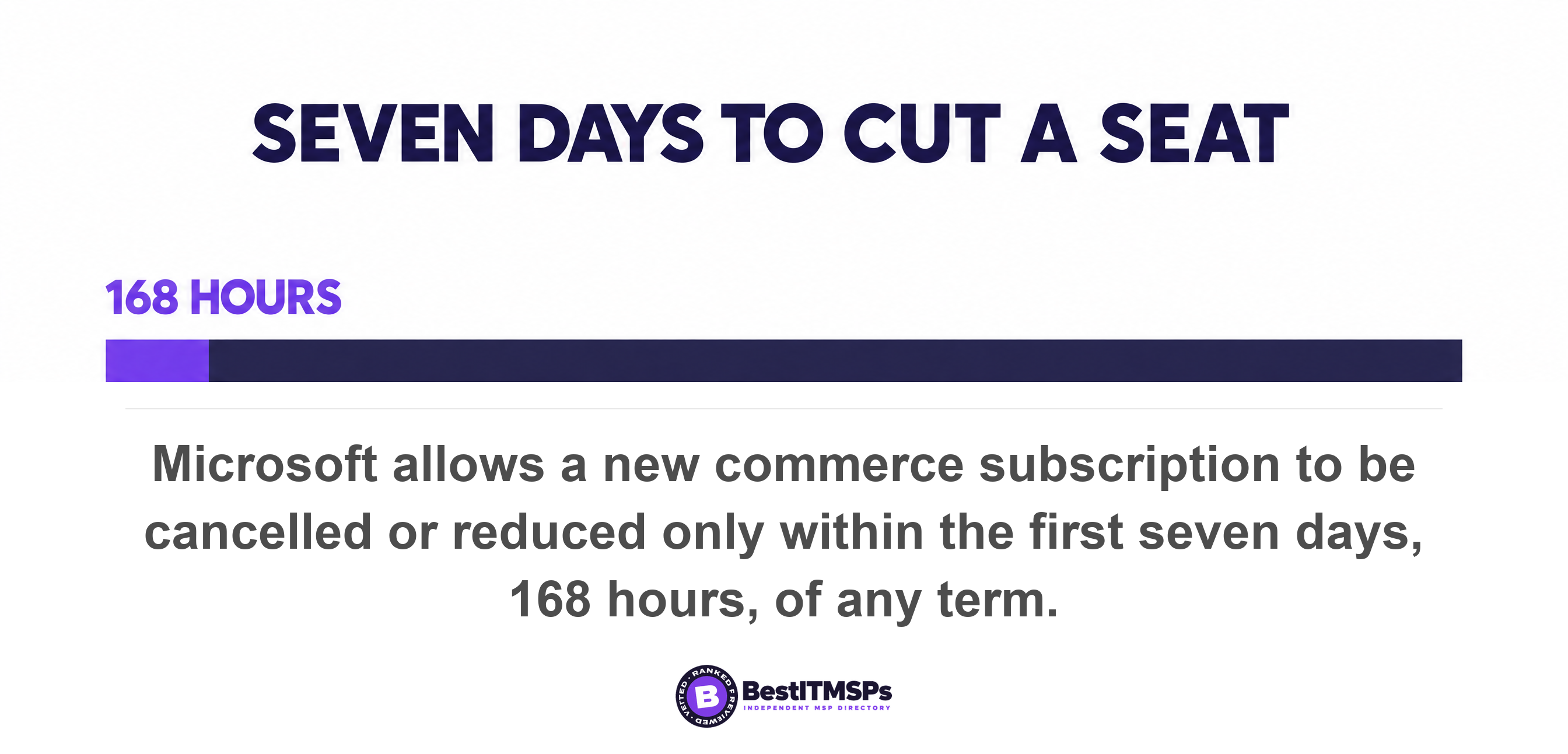
- Seat counts are frozen for the term. A new commerce subscription can only be cancelled or reduced within the first seven days, 168 hours, of any term.
- Cutting admin access does not cut the billing. Removing a partner's delegated admin privileges leaves the reseller relationship, and the invoices, in place.
What happens to your IT contract when your company is acquired?
Your managed IT contract does not move by itself when your company is acquired. Three things decide what happens to it. The structure of the deal, the assignment and change of control clauses already sitting in the agreement, and who holds the licensing relationship with Microsoft or your other software vendors. Two of those three were settled before anyone told you the deal was happening.
This post is written for the company that was bought. If you are the one buying, the checks to run on the other company's estate sit in IT due diligence before you buy another company. This is the other end of the same transaction, and the two ends have different problems. An acquirer worries about what it is inheriting. You worry about an agreement you signed, a provider who now answers to somebody else, and an invoice that may not stop.
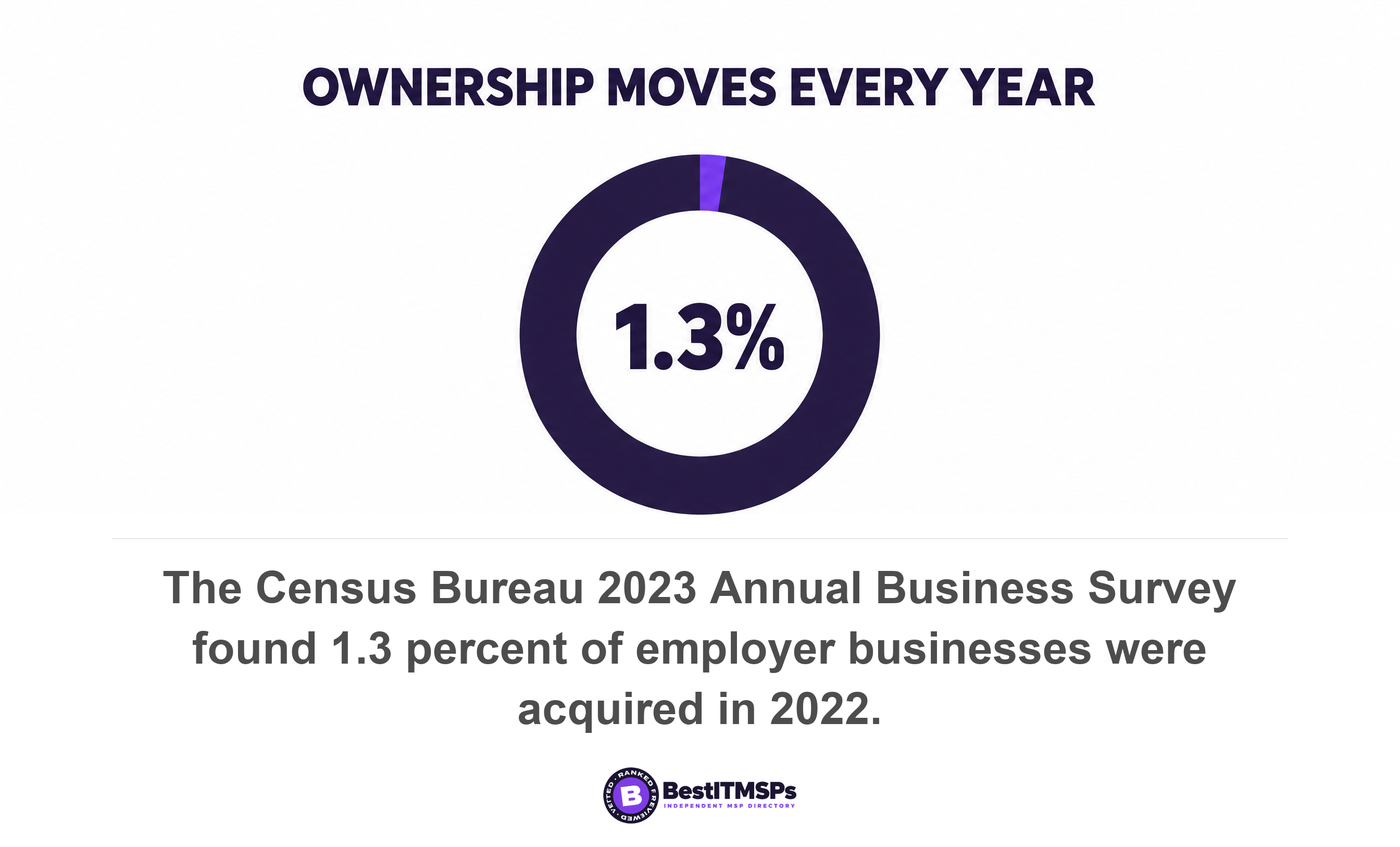
Nobody publishes a count of deals this size. A merger only requires a premerger notification filing once it crosses a jurisdictional threshold, and the Federal Trade Commission raised the size of transaction threshold from $126.4 million to $133.9 million for 2026, adjusted on the change in gross national product. Your deal almost certainly sits far below that, so it never appears in the federal merger filing statistics. The cleaner measure comes from the Small Business Administration's Office of Advocacy, which reports that in 2017, 67 percent of business owners that employed workers founded their business, while another 22 percent purchased their business. Roughly one employer business in five is running on a contract somebody else signed. The Census Bureau measures the same thing a different way: its 2023 Annual Business Survey reports 57.2 percent of employer businesses were acquired after 1999 and only 1.3 percent in 2022, though that figure records the year the current owner took ownership, so founding counts as acquiring. Ownership moves constantly. What it does to your IT contract is rarely written about from your seat.
One caution before the detail. Best IT MSP is an independent directory and not a law firm, so nothing here is legal advice. Contract law varies by state and by agreement, and the only reliable reading of your position is your own document reviewed by your own lawyer.
Does an asset purchase or a share purchase decide whether your contract survives?
Deal structure sets the starting position. In an asset purchase the buyer takes named assets, so every contract it wants has to be re-papered with the other side's permission. In a stock purchase the buyer takes the company that already holds those contracts, the contracting party never changes, and most agreements carry on untouched.
The clearest free public statement of that distinction is the rule the federal government writes for its own purchasing, and the framing matters. This is federal contracting procedure, cited because it handles both structures in one short paragraph that anyone can read. It is not a law that governs your private managed IT contract. The regulation recognizes a successor only where the third party's interest arises out of the transfer of all the contractor's assets, or the entire portion of the assets involved in performing the contract.
Then comes the sentence worth copying into your deal file, with its qualifiers intact. A novation agreement is unnecessary when there is a change in the ownership of a contractor as a result of a stock purchase, and that exemption carries three further conditions. There must be no legal change in the contracting party, that contracting party must remain in control of the assets, and it must still be the party performing the contract. Three conditions, not one. "Buy the shares and the contracts stay" is a summary, and summaries are what strand people in the weeks after a close.
The same paragraph then removes the comfortable reading. Even the federal buyer, having just said no novation agreement is needed, adds that whether there is a purchase of assets or a stock purchase, there may be issues related to the change in ownership that appropriately should be addressed in a formal agreement. The most demanding customer in the country does not treat a share sale as a non-event. So put one question to your lawyer in writing, early. Was this an asset purchase or an equity purchase, and which legal entity is the named customer on the managed IT contract today. Everything below depends on that answer.
Assignment and change of control are two different clauses
An assignment clause governs who may hand the agreement to somebody else. A change of control clause fires when the ownership of a party moves, even though the agreement itself has not been handed anywhere. They are separate mechanics, and an agreement can be silent on one and strict on the other.
We could not find a government body or standards organization that publishes model assignment or change of control wording for a commercial managed IT agreement, so there is no authoritative standard text to quote. What follows is the general commercial pattern, not a rule, which is exactly why you have to read your own document. The federal procedure shows the shape of the question. Your signature decided the answer.
An assignment clause usually does one of four things. It bars assignment outright, it permits assignment with the other party's prior written consent, it permits assignment to an affiliate or a successor in interest without consent, or it says nothing at all. The third version catches acquired companies most often, because successor language can let your provider follow you into the acquirer's group, or let the provider assign your agreement to whoever buys the provider. That second case runs the opposite way and is covered in termination for convenience and why your contract may not have it.
A change of control clause works on the fact of the ownership change rather than on any paperwork. Where one exists it gives somebody a contractual right, and whose right it is matters more than the wording. Some versions require notice inside a stated number of days. Some require consent, and a counterparty who declines to consent holds a veto over your timetable. Some hand a termination right to your provider, which is the version nobody expects, and some hand it to you. A clause that defines the trigger by a percentage of voting shares behaves differently in a full sale than in a minority investment, so read the definition of control as carefully as the right it creates.
The five things to pull out of your own agreement are listed below, in this order.
- Quote the assignment clause verbatim into one column, so your lawyer reads the text and not your summary of it.
- Quote the change of control clause into the next column, including any definition of control.
- Mark which party holds the right each clause creates, because a termination right pointing at you is a different problem from one pointing at your provider.
- Note every deadline in days, since a notice obligation you miss is the cheapest way to lose a right you already had.
- Check whether each clause survives a change in the legal entity name, which is common after an equity deal.
Your own documents often disagree. The master services agreement, the service schedules and the order forms can each carry their own assignment language, and the later document usually wins. Read all three. An agreement that looks assignable on page two can be locked on page nineteen, and the service level agreement attached to it can carry a third answer again.
Your resold Microsoft licenses cannot move on closing day
If your Microsoft 365 subscriptions were bought through your IT provider, they cannot move to the acquirer's provider on the day of the close. Microsoft documents the mechanism plainly. You do not control it, and neither does the acquirer.
Microsoft states that partner transfers can only occur if both the source and target partner approve it, that customers don't initiate the transfer process; instead, their target partner does, and that partners are under no obligation to approve or send transfer requests. It then goes further. Microsoft will not override a CSP subscription transfer without the source partner's approval, disputes between partners are not mediated, and the outgoing partner is not required to accept the request. Where that partner declines or does not answer, the request expires after 30 days.
Read that as a buyer. The provider you are leaving holds a veto over licenses you pay for, Microsoft support cannot overrule it, and an unanswered request runs a month. Microsoft even names your case among the reasons transfers happen, listing where a partner may merge with or be acquired by another partner. It is a documented process your signature never touched, and nothing in your estate is transferable because an integration plan assumes it is.
The same lock shows up in your own admin center. Microsoft tells customers directly that you can't remove a reseller relationship yourself, that the delete option is grayed out, and that you must ask the reseller to do it. On their side, removing it removes their delegated admin privileges for the customer and prevents them from making future purchases for the customer, but only after every subscription is dealt with, because if any subscriptions are still active, the Remove reseller relationship link will be inactive. Indirect resellers cannot even do that alone, since they must work through the Indirect Provider to do so.
Which brings in the window that decides the money. For new commerce offers, Microsoft says a partner can cancel their subscription with a prorated refund within the first seven days (168 hours) of any term, and that after the seven day window ends, cancellation is no longer available. The next sentence is the one to read twice. The partner is billed for the full term even if the customer stops paying for or using the subscription. Seat counts follow the same rule. License numbers can be decreased only within the first seven days of when the licenses were added, and that applies whether the licenses were added at the initial purchase, on renewal, or at midterm.
Put the three mechanics together and you get the outcome nobody plans for. Half your staff migrate to the acquirer's tenant in month four of a twelve month term. The vacated seats cannot be reduced, the subscription cannot be cancelled mid-term, the transfer needs your outgoing provider to submit it, and the acquirer starts paying for the same people again in its own tenant. You are paying twice for one head count, on a term nobody can shorten.
The provider you are leaving holds a veto over the licenses you pay for. Microsoft says so in writing, and says it will not overrule them.
So the first email after the close goes to your provider, not to the acquirer. Ask in writing for the term end date and renewal date of every subscription, and ask whether they will submit a partner transfer request. A provider who answers yes has cost you one email. A provider who will not answer has told you to plan around the renewal date. If you have never tested what you could take with you, start with could you leave your IT provider if you had to.
What else fires when the ownership moves
Several things reprice or restart around a change of control, and none of them lives in the clause you just read. The renewal calendar, the uplift clause, the minimum commitment, the subscription lifecycle and your own domain name each behave differently in the weeks around a close.
Start with the calendar, because it is the cheapest item to get wrong. An auto-renewal clause with a notice window you miss commits you to another full term, and the arithmetic sits in auto-renewal and the notice window you already missed. An acquisition is exactly when nobody watches that date, because whoever used to watch it is busy or gone. Price runs on its own clause, covered in annual uplift clauses and CPI escalators. Read both before you agree an integration timetable.
Then count the commitments. A per-user price looks flexible and usually is not, because the floor sits in a minimum commitment or a stated minimum user count. Where staff leave after a close, a minimum commitment keeps the invoice where it was. A subscription on the older billing agreement with more than 25 licenses must be reduced to 25 or fewer before you can cancel it online, and you can't reduce the number of licenses for your subscription if all licenses are currently assigned to users. Unassign first, then renegotiate, and expect a late reduction to land on the first invoice you receive after the subscription renewal date.
One billing detail catches almost everybody. Microsoft states that if you have an annual subscription and are paying monthly, you're charged each month for the remainder of your subscription term. Paying monthly is not the same as being committed monthly. Confirm which you hold before the acquirer's finance team budgets a saving that does not exist.
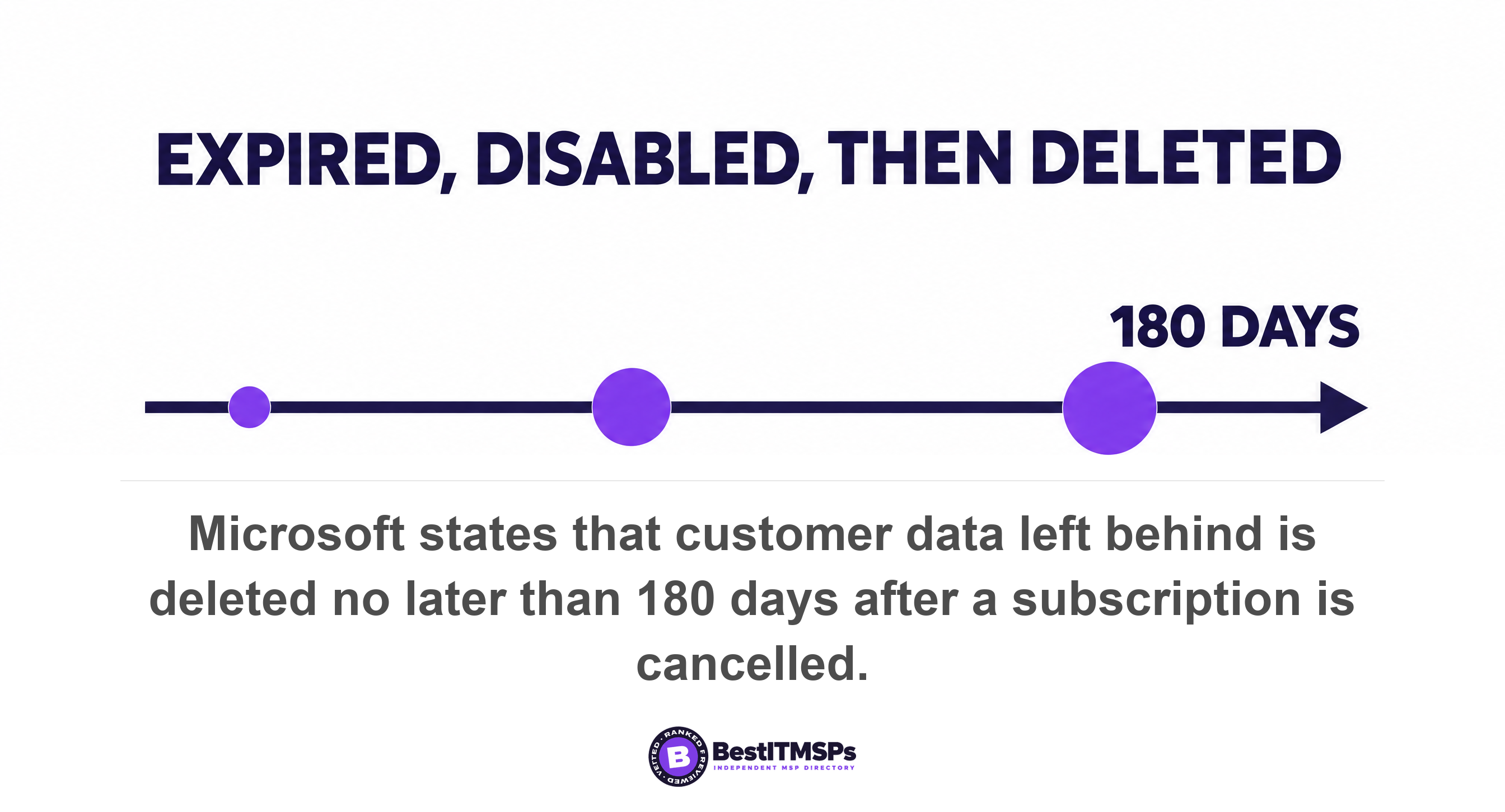
If a subscription does end, the data does not vanish the same day, and that window is useful. Microsoft's lifecycle runs Active, then Expired, then Disabled, then Deleted, with 30 days in Expired and 90 days in Disabled for most terms. In the Disabled state data is accessible to admins only, so users lose the apps while an administrator can still export. Anything left behind is deleted no later than 180 days after cancellation. One action skips all of that. If you explicitly delete a subscription, it skips the Expired and Disabled statuses and SharePoint Online data and content, including OneDrive, is immediately deleted. Nobody should be near that button in week one.
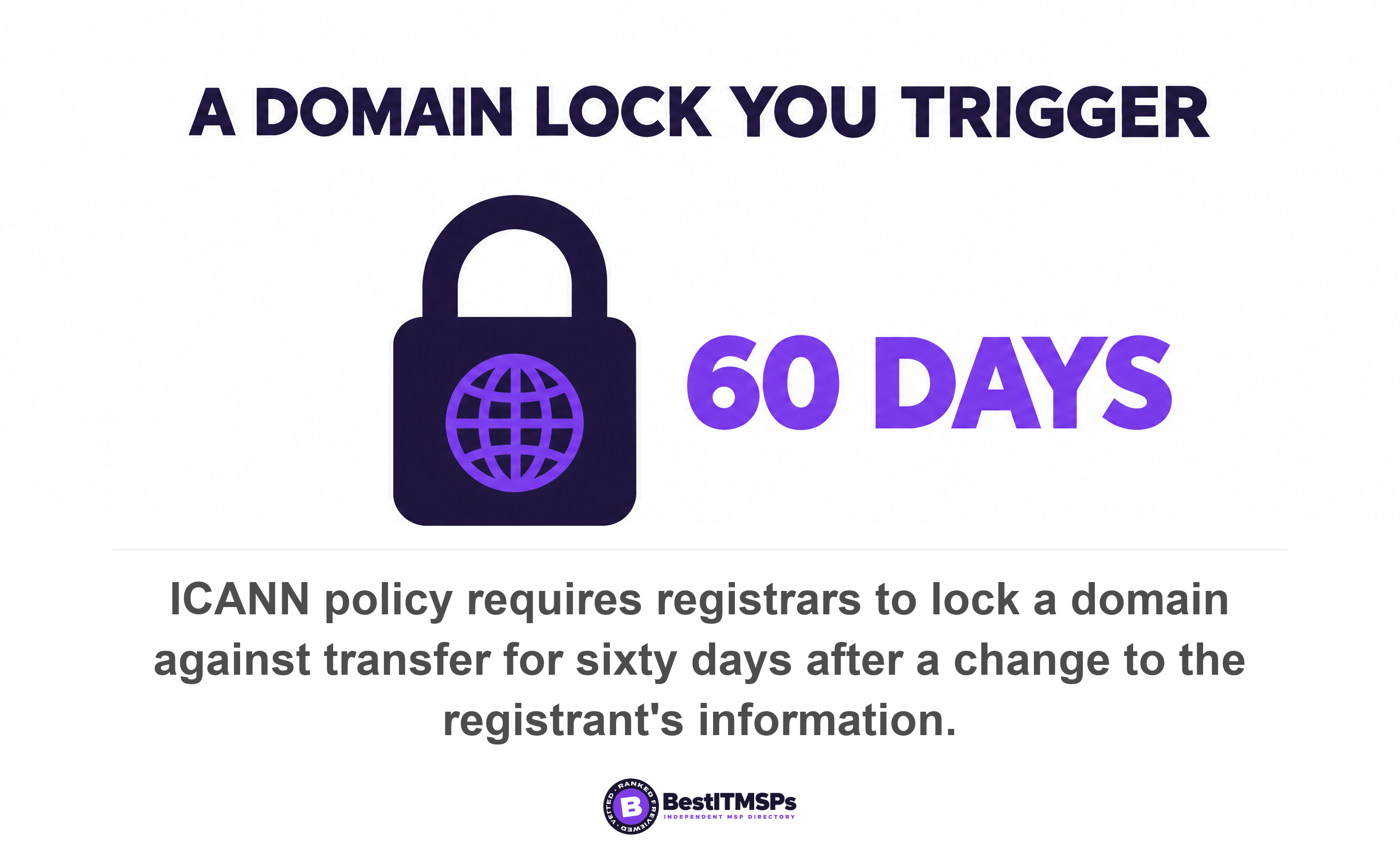
Your domain name carries its own trap, and you can spring it yourself. Where the acquirer updates the registrant details on your domain, ICANN policy requires that registrars must impose a lock that will prevent any transfer to another registrar for sixty (60) days following a change to a registrant's information, though registrars may (but are not required to) allow registrants to opt out of the 60-day lock. Change the registrant in the wrong order and you have frozen your own ability to transfer the domain for two months, in the exact period you planned to migrate mail.
Who holds Global Administrator while two companies merge
Decide who holds Global Administrator on your tenant before anybody starts a tenant migration, because during an integration that role spreads quietly and nobody owns the list. Your old provider, the acquirer's provider and the acquirer's internal IT team can all hold it at once, each for a reason that sounded fine when it was granted. How to list every holder, and what one of them can do, is covered in who is the Global Administrator on your Microsoft 365 tenant.
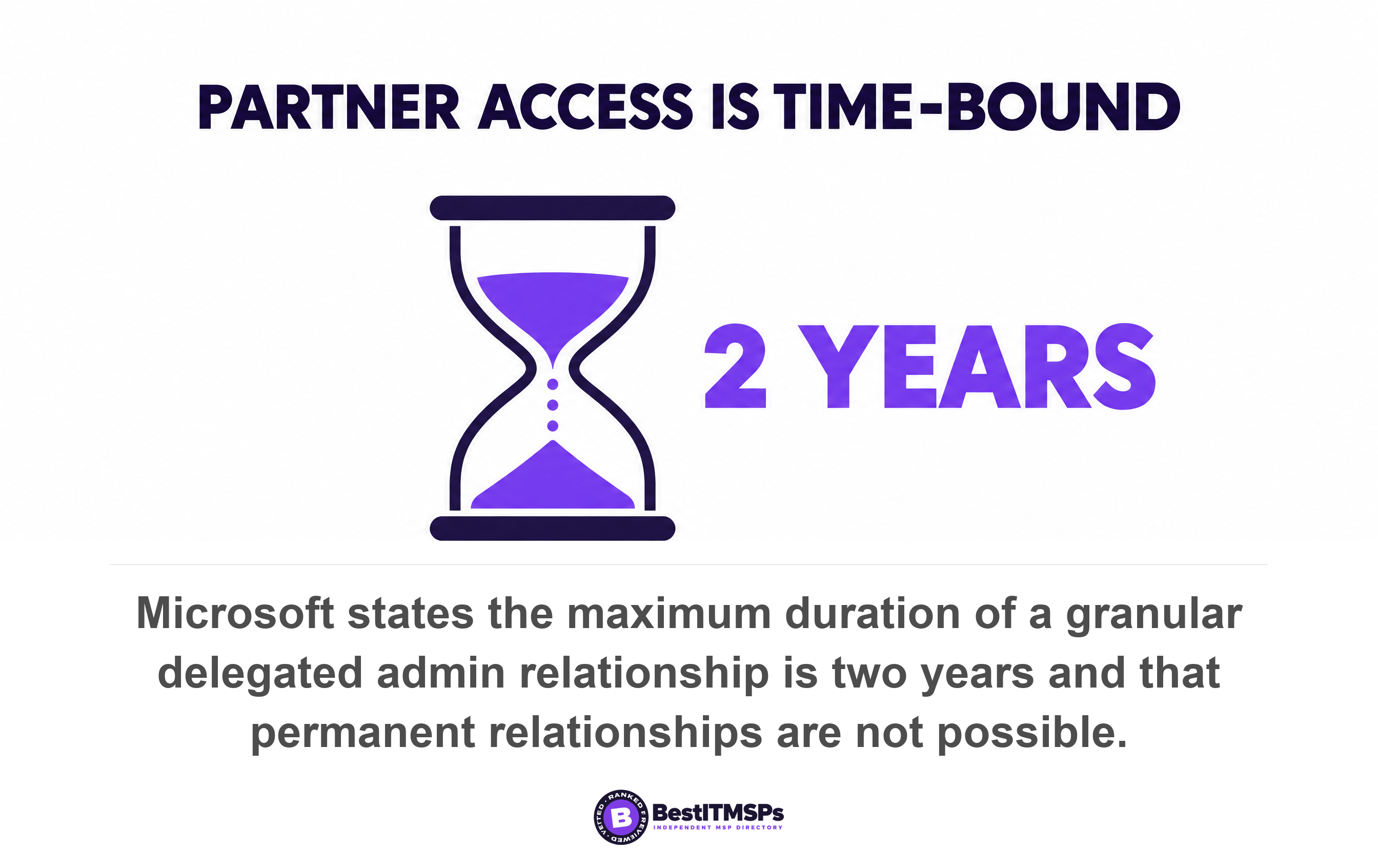
Microsoft's partner access model is time-bound by design. Microsoft states that permanent GDAP relationships with customers aren't possible for security reasons and that the maximum duration of a GDAP relationship is two years, with an auto extend setting that can extend an admin relationship by six months, until terminated. A pending request expires after 90 days if the customer never acts. Where a relationship ends, the security groups assigned to the relationship lose access to that customer, and in your organization it is people with the Global admin role who receive the termination notification.
Now the part that inverts the usual advice. Cutting your old provider's delegated admin access does not touch their commercial position. Microsoft states that removing the GDAP relationships with a customer doesn't terminate the partners' reseller relationship with the customer and that they can still purchase products for the customer. It also confirms there is no change to a customer's existing subscriptions when a GDAP relationship expires. Access and billing are two separate levers held by two different people, and most integration plans pull only one. Revoke the access on day one if you want to. Do not then assume the invoices stopped.
The reason to be strict about the access list is in the incident data. Verizon reported breaches involving a third party now accounting for 48 percent of all breaches, and Sophos found four in five (79%) of ransomware attacks starting with compromised identities. An acquisition manufactures exactly those conditions. More third parties holding privileged access, more administrator accounts, and nobody certain which are still needed.
Two retention rules decide the order you run the offboarding in, and both argue for patience. A deleted account in Microsoft Entra ID remains in a suspended state for 30 days, after which the permanent deletion process automatically starts and can't be stopped. A departing user's OneDrive has a default retention period of 30 days, and after seven days, the OneDrive for the deleted user is moved to the site collection recycle bin, where it's kept for 93 days. Disable first, document who owned what, then delete. That is the sequence set out in the employee offboarding IT checklist.
One correction belongs in the handover notes. Resetting a password does not reliably revoke an application's existing access. Microsoft's own table shows a confidential client refresh token survives when an admin resets password from Azure portal, but is revoked when an admin resets password from Microsoft Entra admin center or from the Microsoft 365 admin center. Pick the right console, and say which one you mean.
Finally, export the sign-in logs before the two tenants merge. Microsoft Entra ID Free retains audit logs and sign-ins for seven days, against 30 days on P1 and P2, and log retention changes aren't retroactive, so upgrading the license later recovers nothing. The record of who did what in the week of your close is the shortest-lived document in the transaction.
The questions to ask your provider, and the acquirer's IT people
Two conversations decide how this goes, and each needs its own questions. Your provider knows what the agreement and the licensing permit. The acquirer's IT people know what they intend to do, and by when. Neither will volunteer it.
Six questions for your current provider
- Ask which legal entity is named as the customer on the agreement, and on each service schedule.
- Ask what the assignment clause and the change of control clause say, and request both quoted back to you in an email.
- Ask for the term end date, the renewal date and the notice deadline on every subscription and every service line.
- Ask whether they will submit a partner transfer request for the resold licenses, and how much notice they need.
- Ask what an exit would cost today, including any early termination fee and any offboarding charge.
- Ask which of their staff accounts hold delegated admin access to your tenant right now, named individually.
Five questions for the acquirer's IT people
- Ask whether they intend to migrate your tenant, run it alongside theirs, or leave it alone, and in which month.
- Ask who holds Global Administrator on your tenant during the transition, by name, and who removes that access afterwards.
- Ask which provider supports your staff from day one, and what number a user calls at 7am.
- Ask whether they expect your license count to fall, then tell them the renewal date before anyone budgets a saving.
- Ask who is accountable for a security incident inside your business during the overlap, and get that answer in writing.
Write the answers down and date them. People change roles faster than documents get updated, so an email from the week of the deal is often the only verifiable record of what was agreed. If the decision is a full move to a different provider, the mechanics sit in the switching MSPs transition playbook, and the clauses to watch in whatever you sign next are in MSP contract red flags.
What to do in the four weeks around a close
To protect your position around a close, work four weeks in a fixed order, because two of these items expire and the rest do not.
- Week minus one. Pull the assignment clause, the change of control clause and every renewal date onto one page, and export the sign-in logs while the history still exists.
- Week of the close. Confirm with your lawyer which legal entity is the customer now, then send your provider one written request for term end dates and a yes or no on a partner transfer.
- First 30 days. List every account holding administrative access, including your provider's, then disable what is not needed and document who owned each one before anything gets deleted.
- First 90 days. Agree in writing who supports the business, who holds Global Administrator and when that access ends, and diary every notice deadline you found in week minus one.
Most of that costs an afternoon and one email. The expensive version is the default one, in which both companies keep both providers for a year and pay twice, because deciding felt harder than waiting. Audit the licensing separately from the contract review, because the two fail in different ways and on different dates.
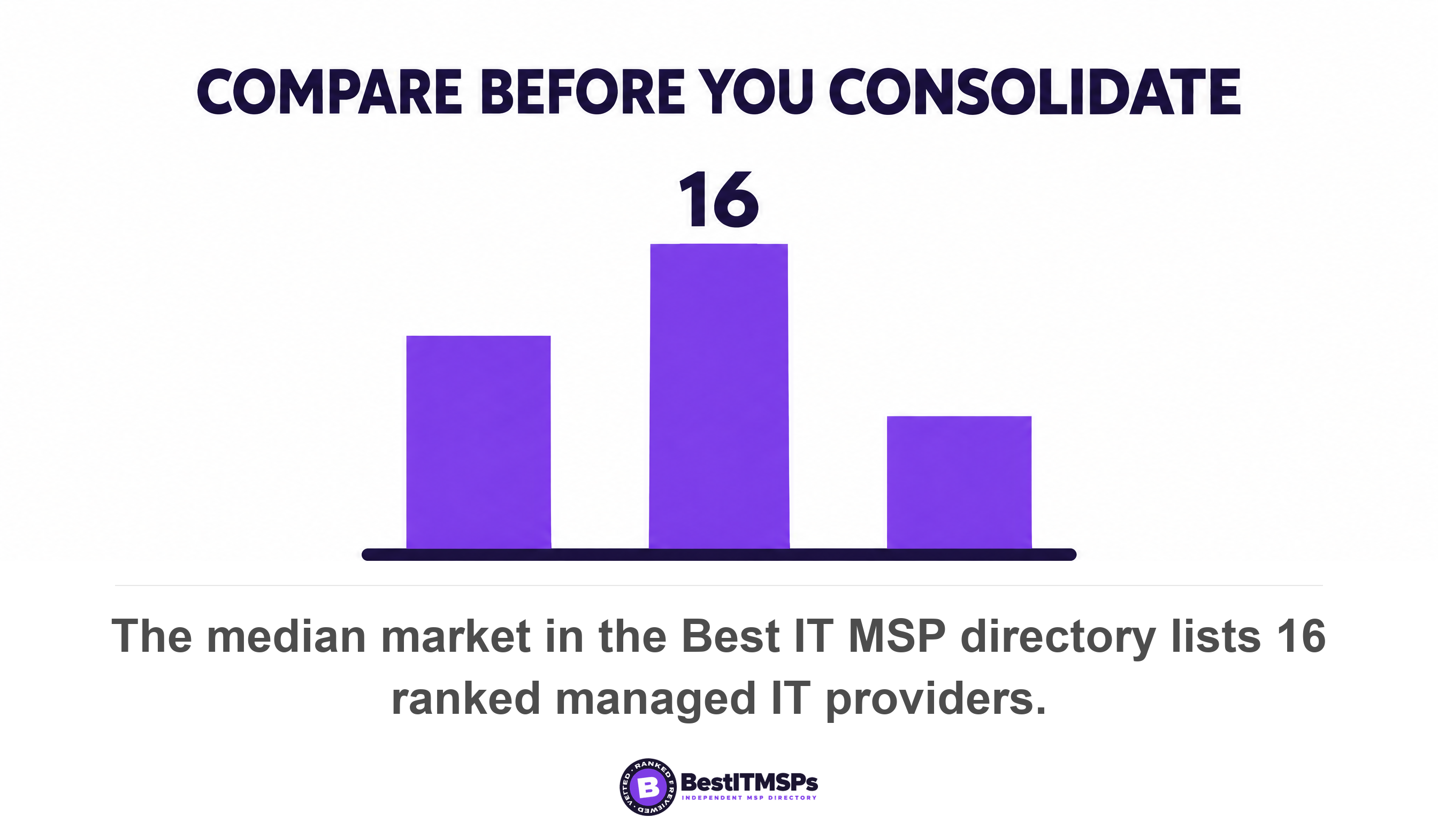
If the combined business is going to settle on one provider, pick from a ranked list rather than from whoever shouts first. Our directory lists 16 ranked managed IT providers in the median market, with 11 at the 25th percentile and 22 at the 75th, measured across 24,491 roster rows in 730 city datasets. We rank on verified rating and firmographic data, we label paid placement, and we do not sell IT services, so that count is a measurement rather than a pitch.
An acquisition does not void your managed IT contract, and it does not automatically move it either. It hands the question to whichever clause was written first, and to whoever holds the licensing relationship. Read the two clauses, find the renewal dates, ask the two sets of questions above, and get one lawyer's view on the entity. None of that needs a specialist firm, and all of it is cheaper this month than next quarter.
FAQ
Does a managed IT contract transfer automatically when a company is acquired?
Not automatically. Deal structure sets the default and your own clauses override it. Federal procurement rules treat a novation agreement as unnecessary when there is a change in the ownership of a contractor as a result of a stock purchase, on three stated conditions. Read your assignment and change of control clauses, and have a lawyer confirm your position.
Can the company that bought us move our Microsoft 365 licenses to its own IT provider?
Only if your current provider agrees. Microsoft states that customers don't initiate the transfer process, that Microsoft will not override a CSP subscription transfer without the source partner's approval, and that an unanswered request expires after 30 days. Ask your provider for a written yes or no early, before the integration plan assumes it.
Can we reduce our license count after staff move to the acquirer?
Usually not mid-term. Microsoft states that license numbers can be decreased only within the first seven days of when the licenses were added, and that after the seven day window ends, cancellation is no longer available. The partner is billed for the full term regardless of use. Plan any reduction for the renewal date instead.
Should we remove our old IT provider's admin access on the day of the close?
You can, and it does not stop the billing. Microsoft confirms that removing the GDAP relationships with a customer doesn't terminate the partners' reseller relationship with the customer, and that there is no change to a customer's existing subscriptions when a GDAP relationship expires. Treat access and billing as two separate jobs with two separate owners.
What should we do first if our company has just been acquired?
Pull three documents in week one. The assignment clause, the change of control clause, and every renewal date. Export the sign-in logs as well, because Microsoft Entra ID Free retains audit logs and sign-ins for seven days and log retention changes aren't retroactive. Then ask your lawyer which legal entity is the customer now.
Best IT MSP is the independent directory of vetted managed IT providers across the US and Canada. Organic ranking is earned on verified rating and firmographic data, paid placement is always labeled, and we do not sell IT services. Open the ranked list for your city, then ask three firms how they would run day one of the combined business.