Annual Uplift Clauses and CPI Escalators in MSP Contracts
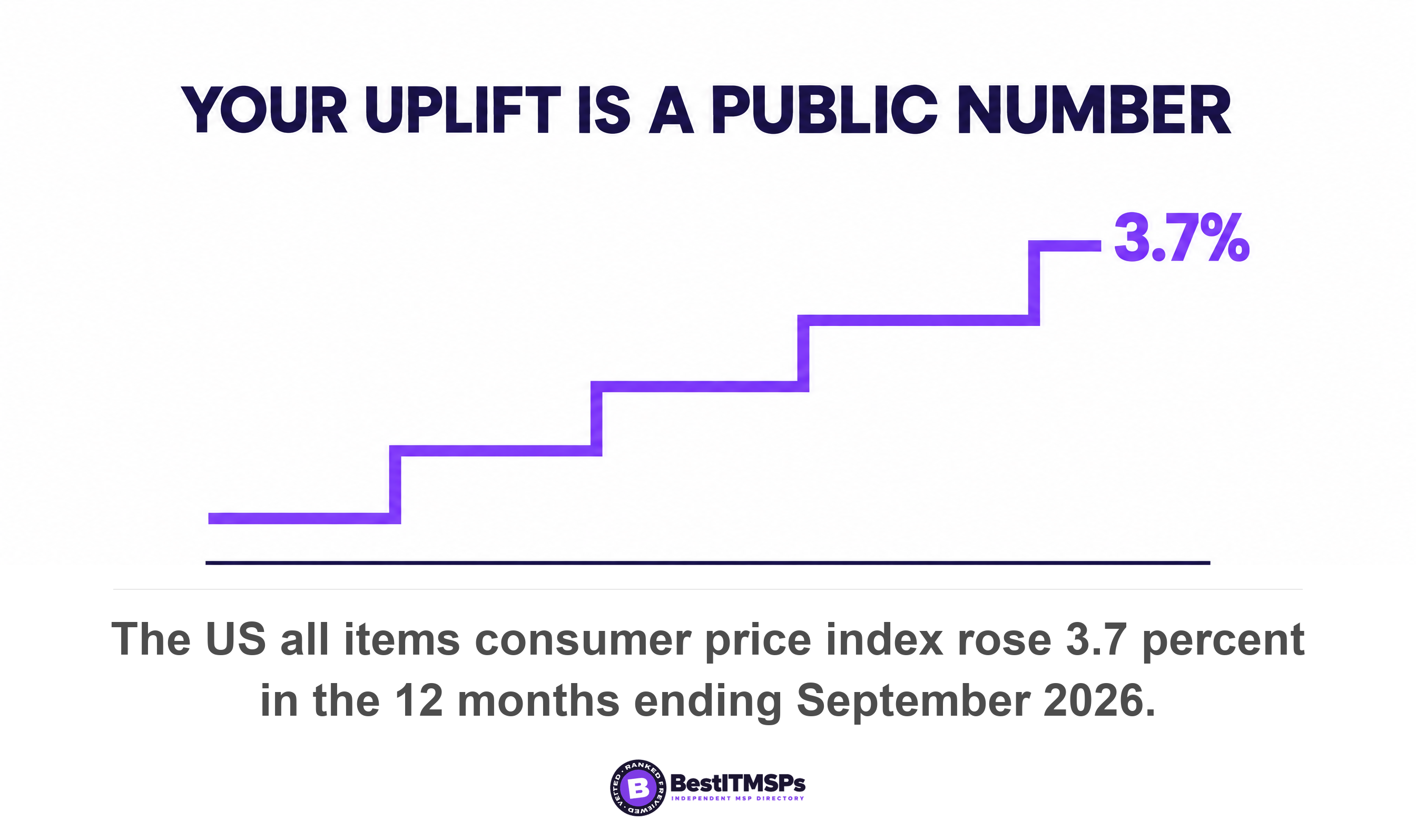
An annual uplift clause lets your provider raise your rate yearly against a named index. US consumer prices rose 3.7 percent in the year to September 2026, while private wages rose 3.1 percent. Check which series the clause names, whether it has a ceiling as well as a floor, and who computed the figure.
- An annual uplift clause tracks a published index, tracks that index plus a margin, or sets a floor the increase cannot fall below. Only the first is forecastable.
- BLS says an escalation clause should identify four things: the population coverage, the area coverage, the series title and the index base period. A clause that says only CPI identifies none of them.
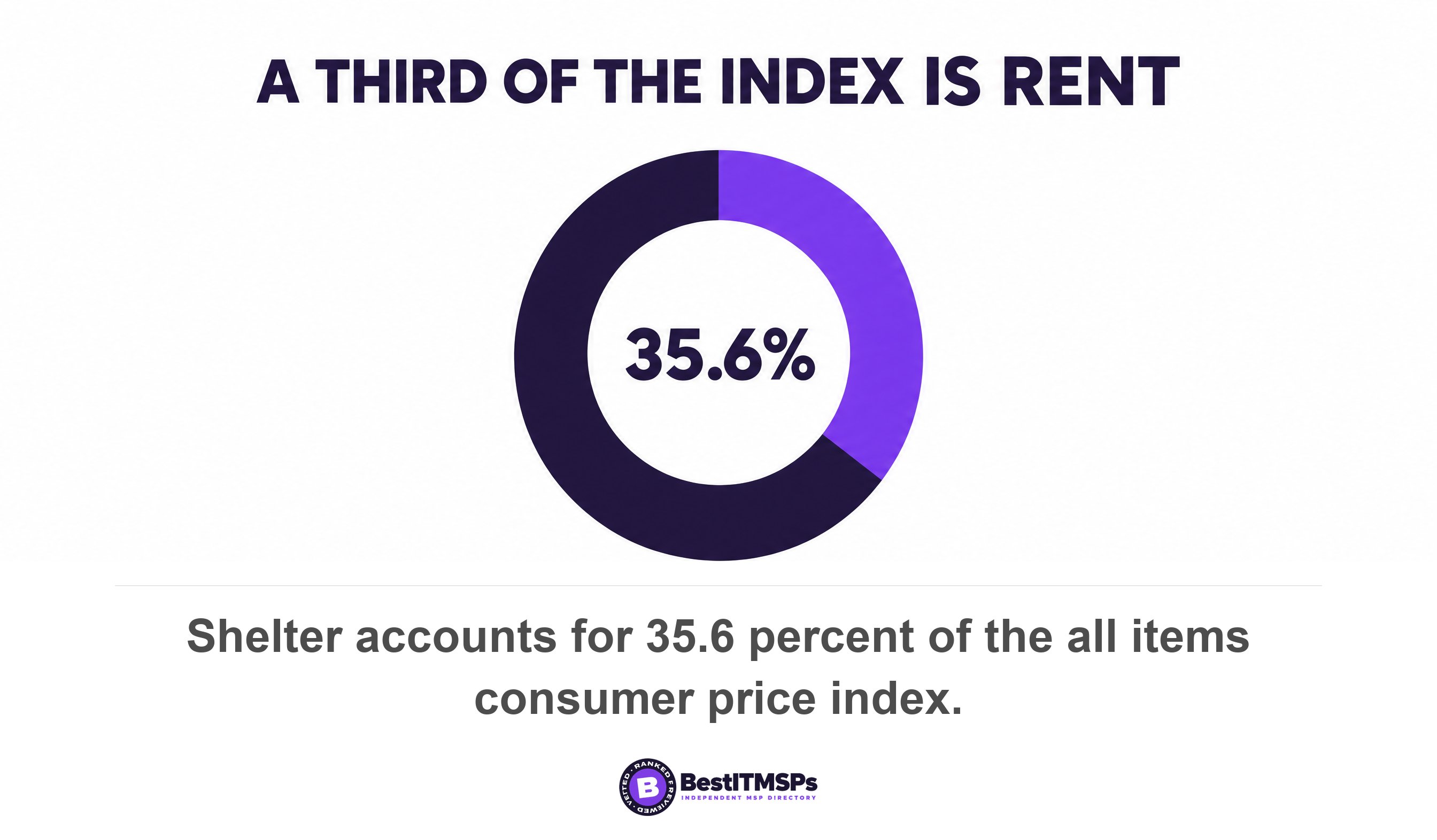
- Shelter is 35.6 percent of the consumer price index. Your provider's costs are salaries and software, so the wage index and the producer price index for data processing fit the cost base better.
- The federal government caps aggregate increases in its own standard price adjustment clause at 10 percent and leaves decreases uncapped. A floor with no ceiling is the mirror image.
- BLS never published an October 2025 CPI and says the data cannot be collected retroactively. A clause naming a single month needs a named fallback.
What does an annual uplift clause in a managed IT contract do?
An annual uplift clause lets your provider raise your monthly rate once a year without reopening the agreement. Most versions take one of three shapes. They track a published index, they track that index plus a fixed margin, or they set a floor the increase cannot fall below. Only the first is forecastable. The clause is often called a CPI escalator clause, because the index it names is almost always a consumer price index.
The third shape empties a budget quietly. A clause reading "not less than 4 percent, or the increase in the Consumer Price Index, whichever is greater" has a floor and no ceiling. It cannot produce a small increase in a flat year, and nothing in it stops a large one. The US Bureau of Labor Statistics put the all items index for all urban consumers 3.7 percent higher over the 12 months ending September 2026. A 4 percent floor beats that. That makes the clause asymmetric by design, and nobody points the asymmetry out at signing.
Compounding is why the invoice stops matching the quote. Three annual uplifts of 5 percent raise a rate by 15.76 percent rather than 15 percent, because each uplift is applied to the raised base rate instead of the original. That figure is our arithmetic, not a published statistic, and it is the whole reason a buyer cannot reconstruct a third-year invoice from memory. To forecast the fourth-year number you need four things: the clause, the index, the reference month and a calculator. Most buyers have the first and none of the rest.
This post covers the price escalation specifically. An uplift normally fires at the same moment as an automatic renewal, so read MSP Contract Auto-Renewal for the notice mechanics and MSP Contract Red Flags for the other nine clauses that cost money. For the base rate an uplift is applied to, see How Much Do Managed IT Services Cost? and Per-User vs Per-Device Pricing.
Best IT MSP is an independent directory of vetted managed IT providers across the US and Canada, and we do not sell IT services. That is why this page explains the clause rather than defending it. None of it is legal advice, so check your agreement with a lawyer in your state.
Which index does your uplift clause name?
Read the clause and look for four specific identifiers, because the agency that publishes the index says an escalation clause should identify the population coverage, the area coverage, the series title and the index base period. A clause that says only "CPI" identifies none of the four.
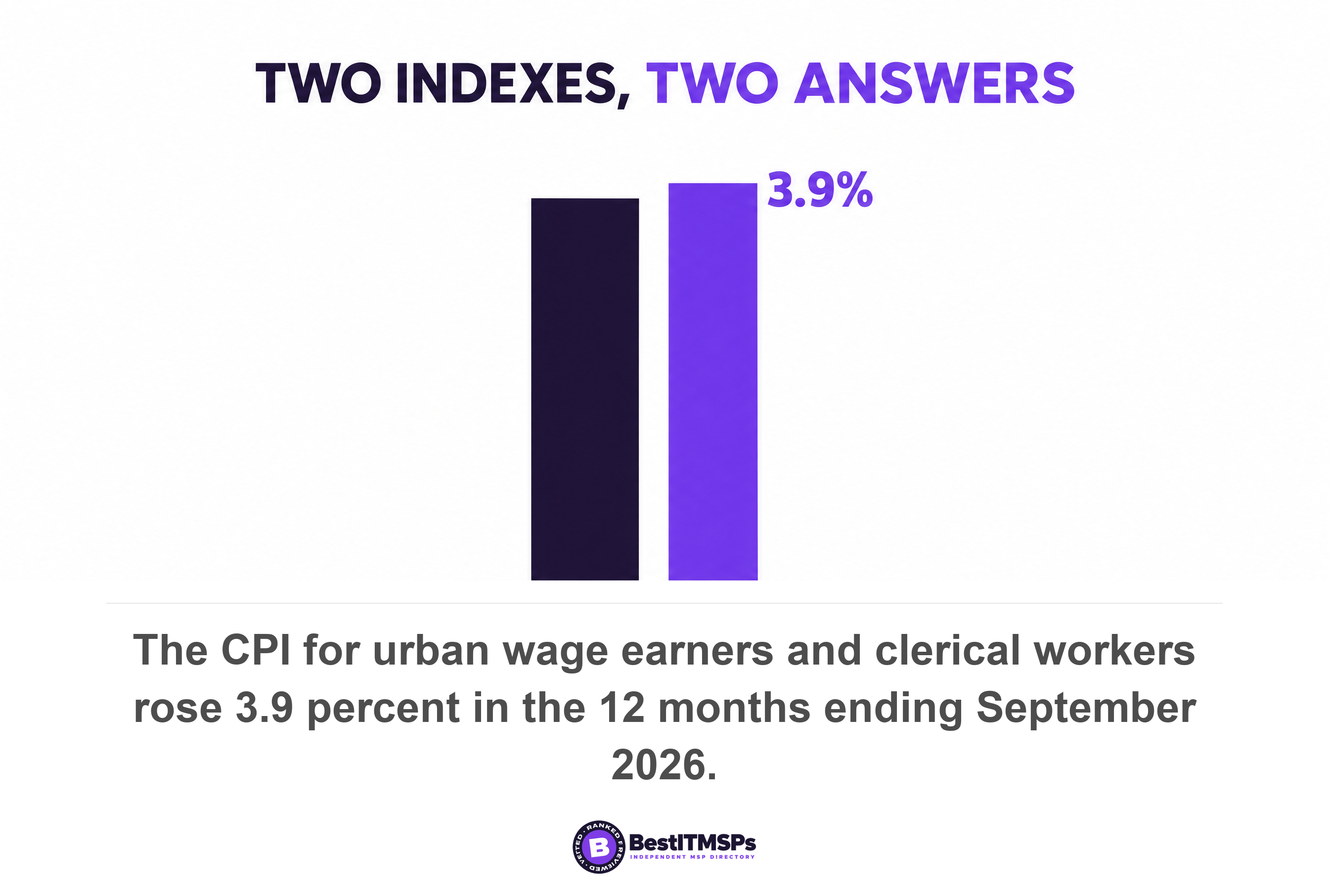
Those identifiers are not pedantry. BLS publishes several consumer price indexes and they disagree with each other in any given month. The all items index for all urban consumers rose 3.7 percent in the 12 months ending September 2026, while the index for urban wage earners and clerical workers rose 3.9 percent over the same 12 months. Two tenths of a point sounds like nothing. Compounded through three annual uplifts on a 4,000 dollar monthly agreement, it is about 26 dollars a month by the fourth year, by our calculation. The clause decides which number you pay, and most clauses do not say.
CPI-U, CPI-W and the chained CPI
Three national indexes could sit in your clause, and they cover different people. The CPI-U covers urban households, which BLS puts at over 90 percent of the US population. The CPI-W is a subset covering wage earners in eligible occupations, approximately 30 percent of the total US population. The chained CPI uses the CPI-U population but allows substitution between item categories. What matters to whoever pays is finality. BLS states that the CPI-U and CPI-W are final when issued, while the chained CPI is revised three times quarterly and becomes final only 10 to 12 months after publication. A clause pegged to the chained CPI bills you on a number that can still be revised after you have paid it.
Seasonally adjusted or not seasonally adjusted
Use the unadjusted series, because BLS says plainly that the use of seasonally adjusted data in escalation agreements is inappropriate. The reason is revision again. Seasonal factors are recalculated every year, and seasonally adjusted data are subject to revision for up to five years after their original release. A seasonally adjusted figure can be restated long after it set your rate, and the restated number does not give you a refund. If your clause does not contain the words "not seasonally adjusted", it has not closed that door.
The national series or your own metro area
Name the national series rather than your city. BLS recommends that users adopt the US city average CPI for use in escalator clauses and warns that metropolitan indexes carry substantially larger sampling errors because their samples are small. There is a practical trap too. Of the metro areas BLS publishes, only three publish monthly and the other 20 publish bimonthly, so a clause naming your metro index can name a reference month for which no index exists.
What has the consumer price index actually done, year by year?
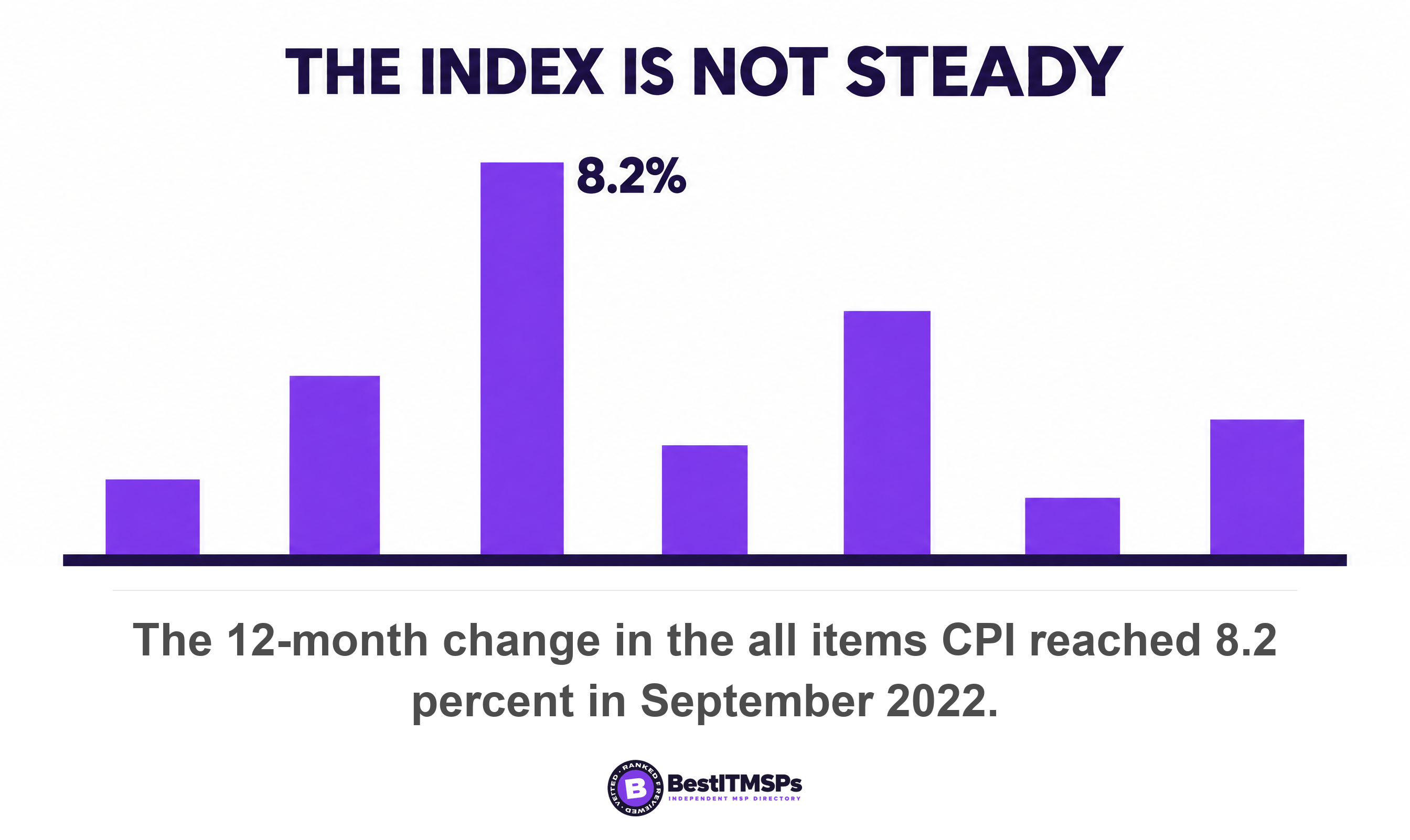
The 12-month change in the all items index has ranged from 1.4 percent to 8.2 percent across the seven Septembers to 2026. Read straight off the BLS series, the September figures are 1.4 percent in 2020, 5.4 percent in 2021, 8.2 percent in 2022, 3.7 percent in 2023, 2.4 percent in 2024, 3.0 percent in 2025 and 3.7 percent in 2026.
That spread is the argument for a ceiling, and it beats any forecast. A buyer who signed "CPI plus 2 percent" in early 2021 was quoted against a 1.4 percent index and billed 10.2 percent in 2022, because the index had moved to 8.2 percent. Nothing misfired. The clause did what it said, the provider justified nothing, and the buyer had no mechanism to object. An uncapped clause transfers that whole risk to you in one sentence.
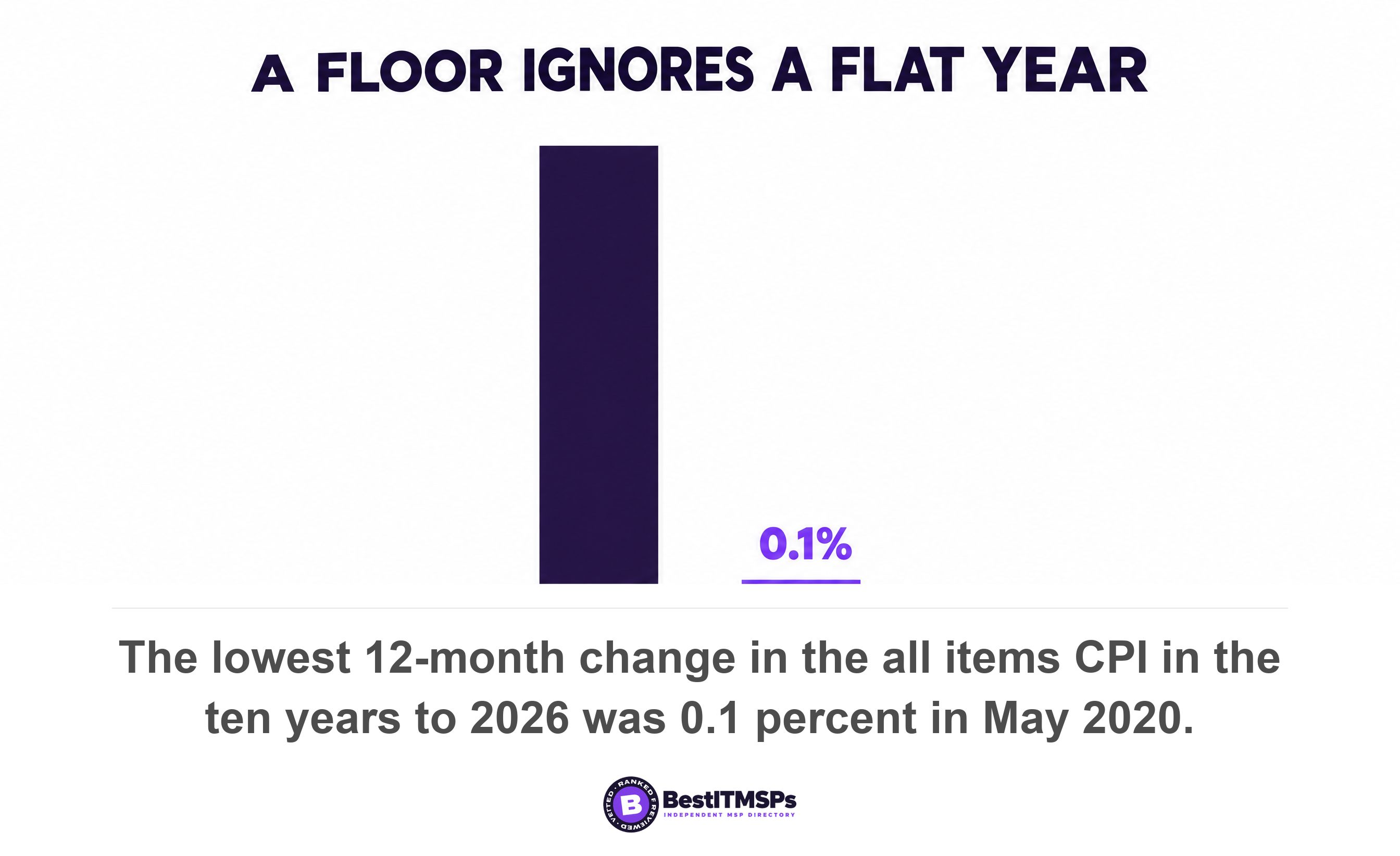
The floor has the opposite problem, and it shows up in quiet years. The lowest 12-month change in the ten years to 2026 was 0.1 percent, in May 2020. A 4 percent floor that year would have delivered 40 times the published change in the index it claimed to track. A clause producing 4 percent when prices are flat is not an inflation adjustment. It is a scheduled annual price rise with an index in the footnotes, and it should be negotiated as one.
Why the consumer price index is not your provider's cost base
The consumer price index measures what households pay, not what it costs to employ an engineer. BLS describes it as representing changes in prices of all goods and services purchased for consumption by urban households, across eight major groups of consumer expenditure including food and beverages, housing, apparel, transportation and medical care.
Look at the weights and the mismatch becomes obvious. In the December 2025 relative importance table, shelter alone accounts for 35.625 percent of the all items index. Food is 13.698 percent, transportation 16.316 percent, medical care 8.423 percent and energy 6.383 percent. Your provider's costs are mostly salaries, software licences, tooling and insurance. None of those five groups measures any of that, and the index also excludes income taxes and investment items. You are escalating an IT support fee against the cost of renting a home and filling a car.
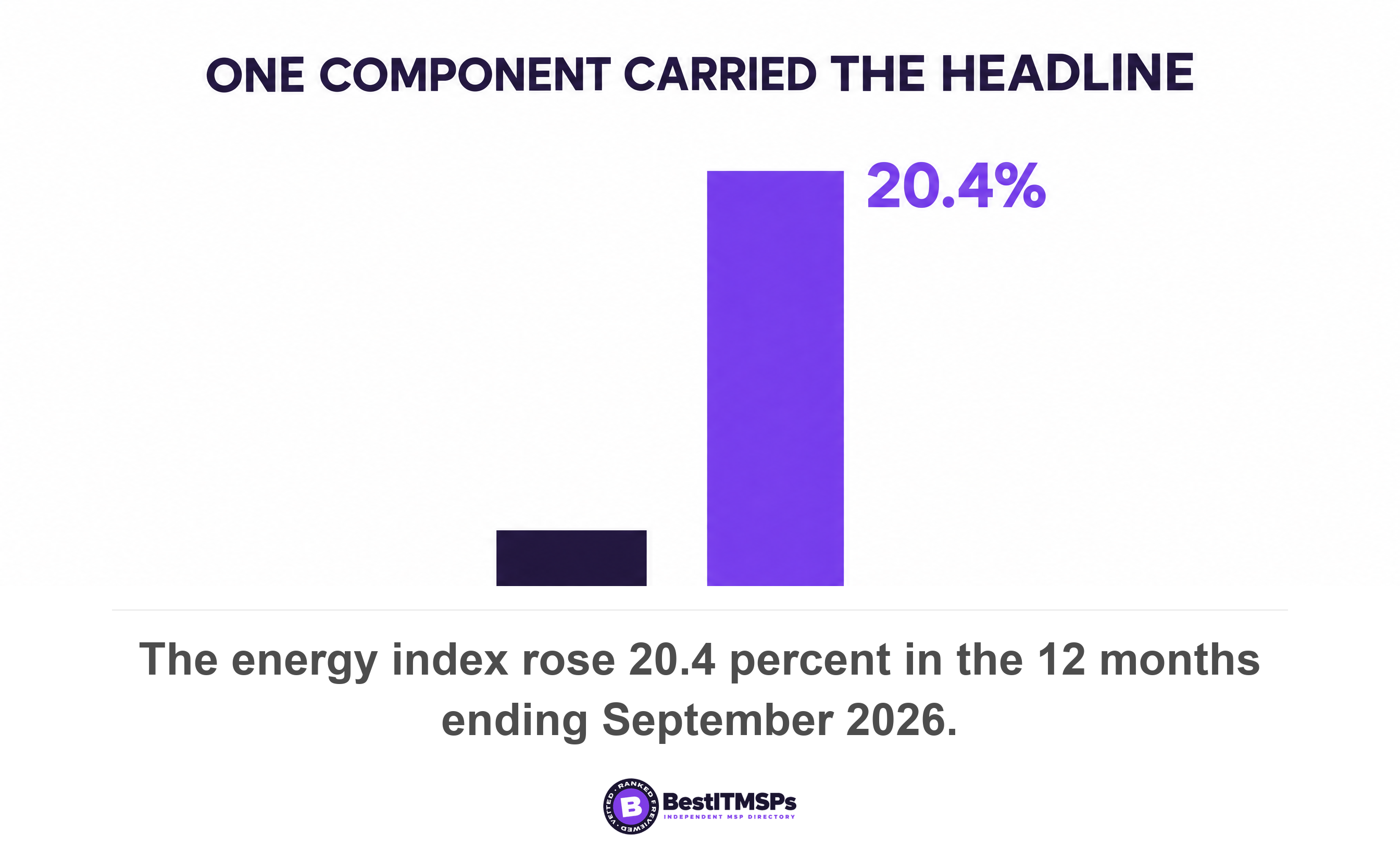
September 2026 shows how one component carries the headline. The all items index rose 3.7 percent over the year, but the energy index rose 20.4 percent while all items less food and energy rose 2.6 percent and shelter rose 3.2 percent. A clause pegged to headline CPI handed your provider a 3.7 percent uplift in a year when the trend outside food and energy was 2.6 percent. Your provider does not buy gasoline at the scale that moved that number.
Two published indexes that fit the cost base better
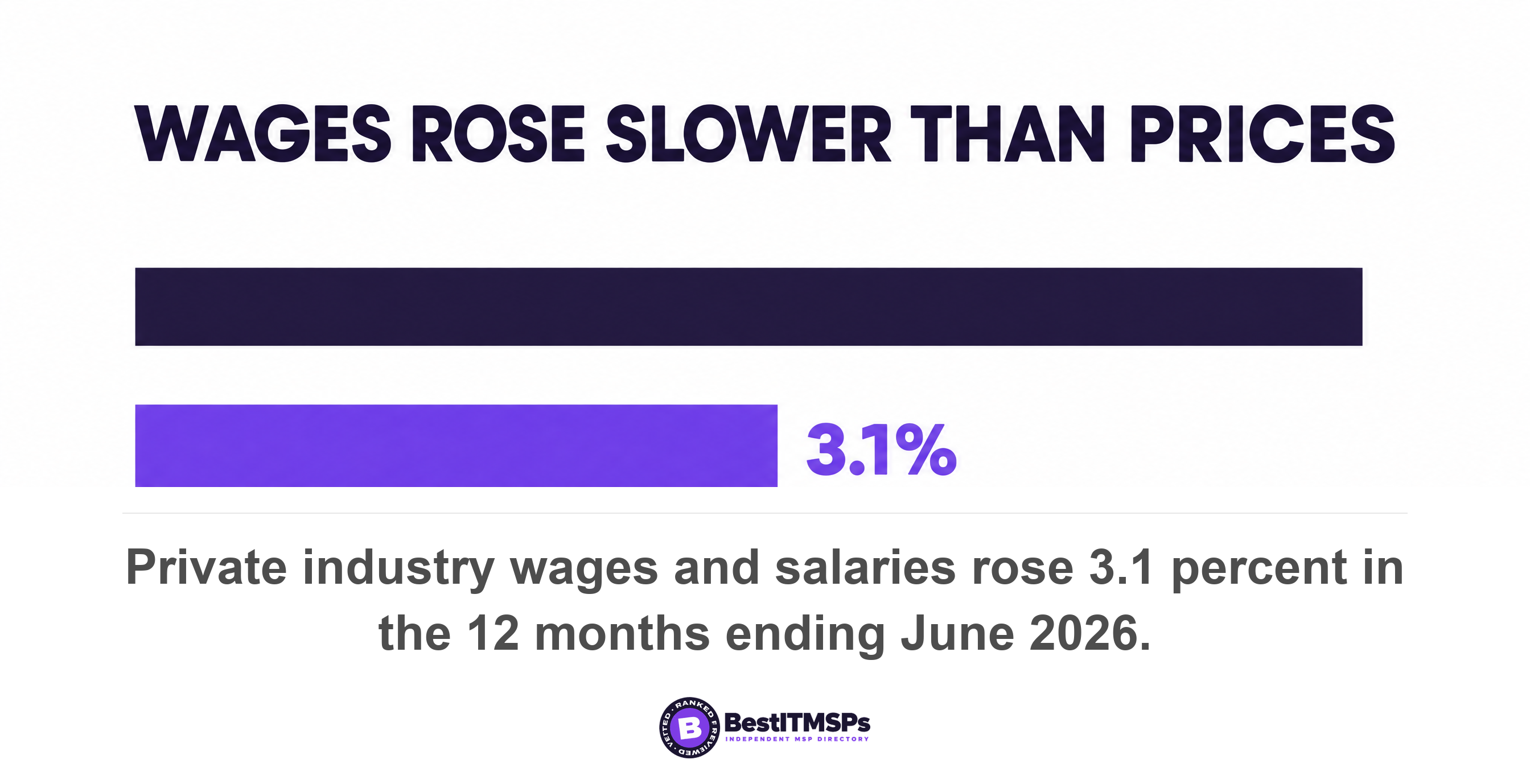
Two BLS series track a provider's real cost base more closely than headline CPI, and both are free to read. The employment cost index measures the price of labour, which is most of a provider's bill. For the 12 months ending June 2026, compensation costs for private industry workers rose 3.3 percent, with wages and salaries up 3.1 percent and benefit costs up 3.8 percent, while civilian workers' total compensation rose 3.4 percent. The producer price index for the provider's own industry measures what firms selling this service charge. The BLS index for data processing, hosting and related services stood at 127.436 in September 2026, preliminary, against 123.943 a year earlier, about 2.8 percent higher by our calculation.
Hold the three numbers side by side. Consumer prices rose 3.7 percent, the private wage bill rose 3.1 percent, and the price of the service your provider sells rose about 2.8 percent. The index with the largest increase is the one almost every managed services agreement names. Ask your provider to index the uplift to the employment cost index, or to the producer price index for data processing and hosting, rather than to a basket that is a third shelter.
What does a floor with no ceiling cost over a three-year term?
A floor sets the smallest uplift you can receive and a ceiling sets the largest, so a clause with a floor and no ceiling moves in one direction only. Price the paths before you sign rather than after. Take a 4,000 dollar monthly agreement and three annual uplifts inside a rolling renewal term.
- Track the published index. Three uplifts at the 3.7 percent recorded for the 12 months ending September 2026 reach about 4,461 dollars a month in the fourth year.
- Add a three-point margin. The same clause written as the index plus 3 percent reaches about 4,859 dollars a month, which is 398 dollars more every single month.
- Total the gap. Across four years the margin version costs about 9,250 dollars more, on an agreement nobody reopened and nobody renegotiated.
Those three figures are our arithmetic from the published index change, not published figures. Run them on your own base rate, because the gap scales with the base and with the length of the term.
The federal government caps its own version of this clause
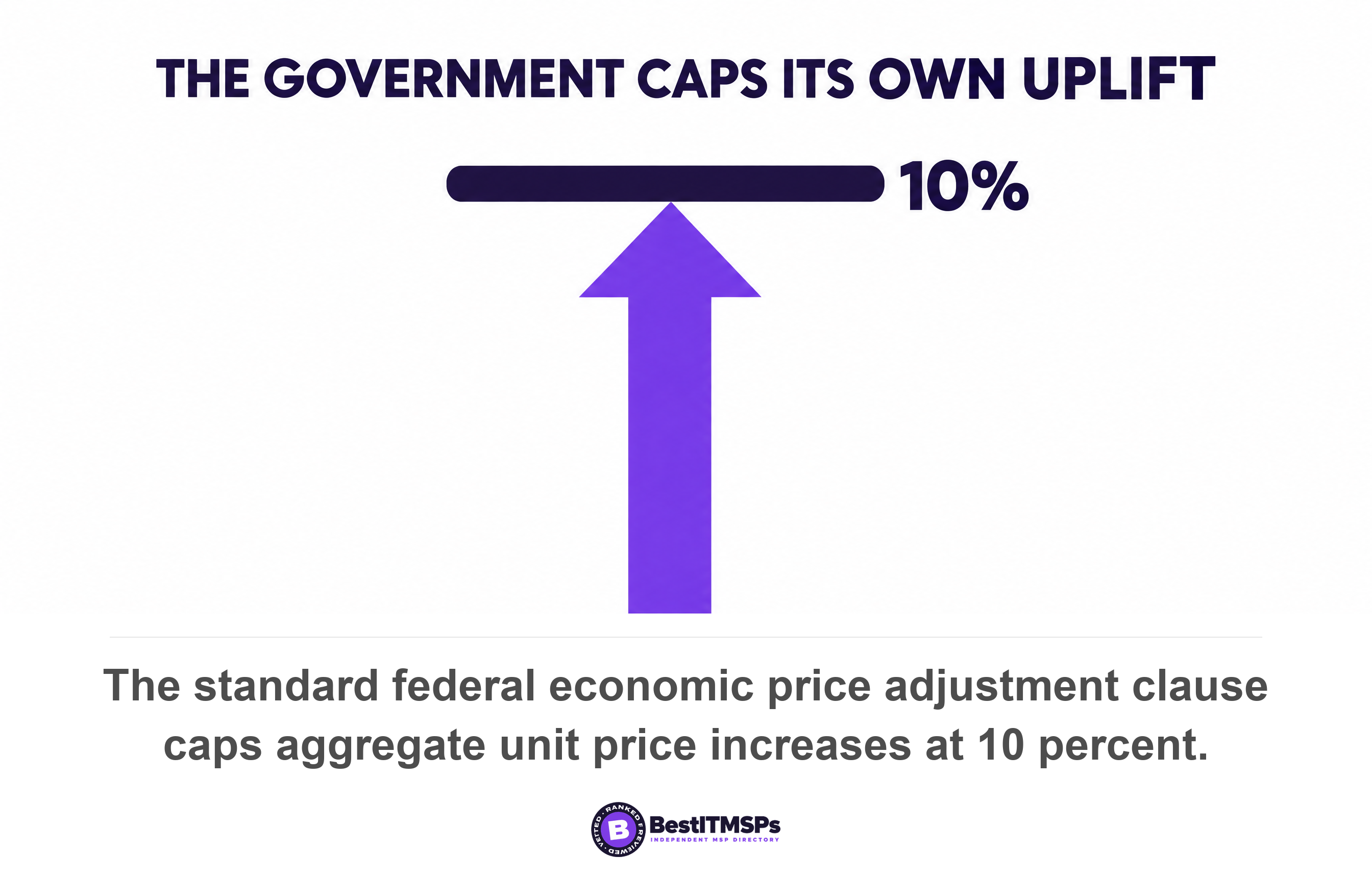
The US government uses index-based price adjustment too, and it bounds it carefully. The Federal Acquisition Regulation describes one permitted method as adjustment based on increases or decreases in labor or material cost standards or indexes that are specifically identified in the contract. Its standard economic price adjustment clause then states that the aggregate of the increases in any contract unit price made under this clause shall not exceed 10 percent of the original unit price, and places no percentage limit on decreases at all. A contracting officer may raise that 10 percent limit only with the approval of the chief of the contracting office, which tells you how seriously the ceiling is treated.
Read that asymmetry against your own clause, because it runs the other way. The federal clause caps what the seller can add and leaves what the buyer can claw back open. A floor with no ceiling does the reverse. The regulation is explicit that a price adjustment clause exists to protect the contractor and the Government against significant fluctuations in labor or material costs, a two-sided purpose in its own wording. Two further details are worth copying. The federal clause applies no adjustment to a change that would not produce a net change of at least 3 percent of the current total contract price, and requires notice within 60 days after the increase or decrease.
The regulation also treats index-based adjustment as the unusual option. It names three circumstances in which such a clause may be appropriate: a contract with an extended period of performance and significant costs to be incurred beyond one year after performance begins, a contract amount subject to adjustment that is substantial, and economic variables for labor and materials too unstable to permit a reasonable division of risk without it. For that method the regulation prescribes no standard clause at all, and requires any such clause to be prepared and approved under agency procedures. Your managed IT agreement uses the method the federal rules associate with long, volatile, high-value contracts, applied to a routine 12-month support arrangement, and with none of the drafting scrutiny that method is supposed to attract.
How do you compute your own uplift from the published index?
To compute the uplift yourself, take the index value for the month your clause names, subtract the value from 12 months earlier, divide by the earlier value and multiply by 100. BLS publishes that formula with a worked example, giving 232.945 less 229.815, divided by 229.815 and multiplied by 100, as a 1.4 percent change. Four steps verify a figure your provider spent one sentence on.
- Find the reference month named in the clause. A clause that names no month is not computable, and that is the most common defect in these clauses.
- Read the index level for that month and the same month a year earlier. September 2026 published the all items CPI-U at 336.940 and the CPI-W at 330.654, on the 1982-84 equals 100 index base period.
- Divide the difference by the earlier value, or skip the arithmetic, because BLS publishes the 12-month change directly at 3.7 percent for September 2026.
- Compare the result with the increase on your invoice. A gap means a different series, a different reference month, or a margin nobody mentioned.
Allow for the publication lag, because it decides which month a clause can honestly use. BLS releases each month's index about two weeks after the reference month, so May's CPI is published in mid-June, and the September 2026 figures came out on Wednesday, October 14, 2026. A clause naming the December index cannot be computed until mid-January, so an uplift invoiced on 1 January was computed from some other month. Ask which month it used, and ask in writing.
What happens when the index your clause names is never published?
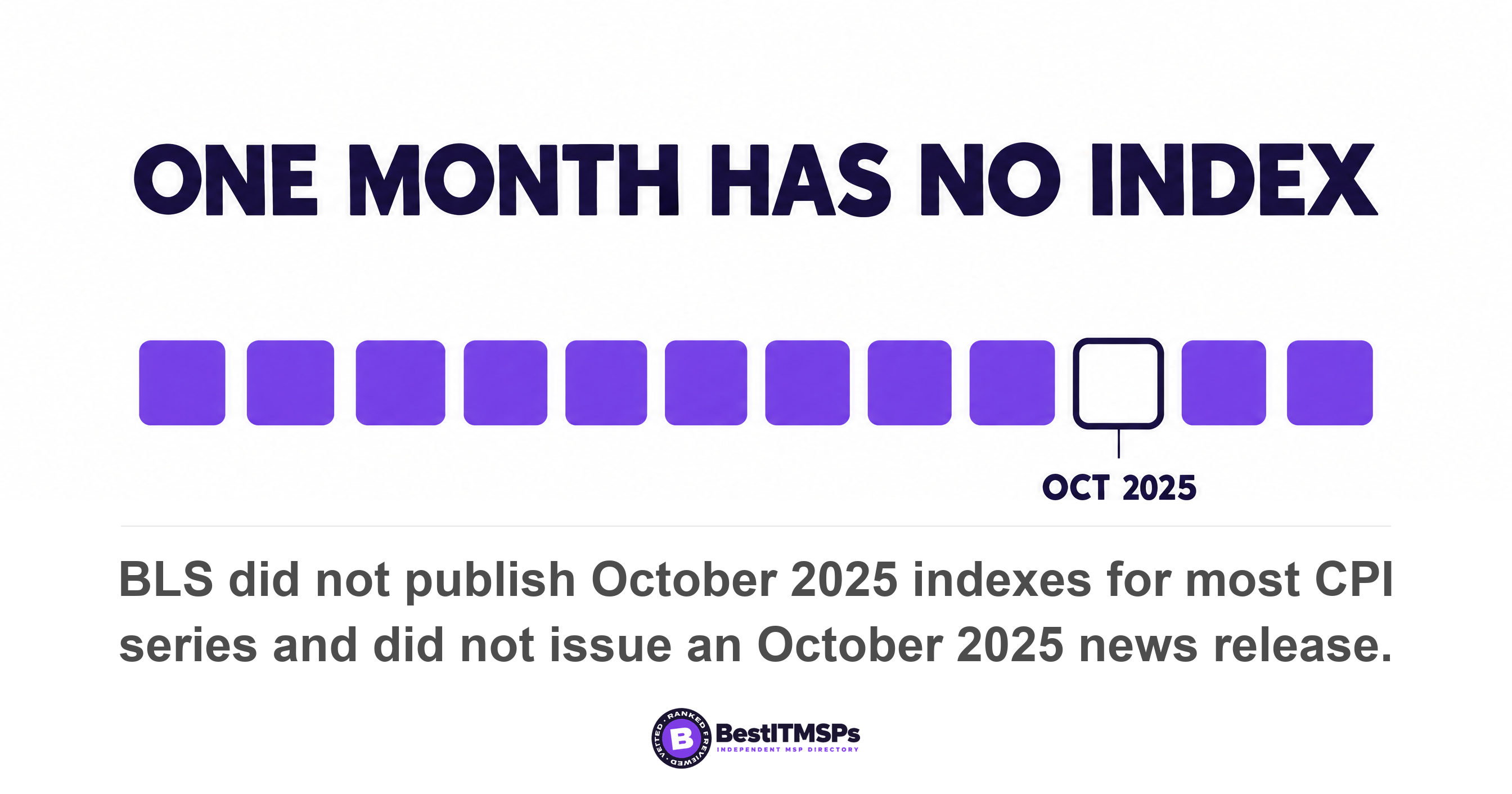
Your clause stops being computable, and this is not a hypothetical. BLS did not collect CPI data from October 1, 2025 through November 12, 2025 during the lapse in appropriations, and states that for most CPI series, October 2025 indexes were not published.
The gap is permanent. BLS did not issue an October 2025 CPI news release and viewed retroactively collecting data for October as both costly and potentially inaccurate. Its own database records no 12-month change for October 2025 in the all items series. The November release worked around the hole, with the one-month change estimated by comparing November 2025 prices with imputed October 2025 prices.
Now read your clause again. An uplift pegged to the October index had no October index to read in 2025, and never will, and the missing data also affected the April 2026 rent and owners' equivalent rent indexes months later. Almost no managed services agreement says what happens next, which leaves the provider to pick a substitute and tell you afterwards. BLS advises that an escalation clause include a built-in method for handling major revisions or base-period changes, and neither encourages nor discourages price adjustment clauses, will not write contract wording, and will not mediate legal or interpretive disputes.
So the fallback is yours to negotiate. Ask for one sentence naming a substitute series and a substitute reference month, and ask for the uplift to be waived in any year where neither is published.
The four amendments worth asking for
Ask for four amendments, in this order, because the first two are worth more than the other two combined.
- Name the series in full. Write the population coverage, the area coverage, the series title and the index base period into the clause, which is what the publishing agency says an escalation clause should identify, and add the words "not seasonally adjusted".
- Cap the uplift. Ask for a ceiling expressed as the lower of the index change or a fixed percentage, applied at every uplift rather than once. The federal standard clause caps aggregate increases at 10 percent of the original unit price, so a ceiling is hardly a radical request.
- Delete the floor, or make it two-sided. A floor with no matching ceiling is one-way, and the federal clause does the reverse by capping increases and placing no percentage limit on decreases. The regulation's purpose is to protect the contractor and the Government against significant fluctuations in labor or material costs, which cuts both ways.
- Add a fallback and a notice period. Name a substitute index for any month that is not published, require written notice showing the calculation, and borrow the federal 60 day notice requirement. BLS itself tells users to consider whether to include a cap on increases or a floor on the minimum adjustment.
Ask for one amendment at a time and get each answer into the signed document rather than into an email from a salesperson. A provider who will swap headline CPI for the employment cost index has told you the clause was about cost. A provider who will not cap anything has told you it was about margin.
Is there a normal annual uplift in a managed IT contract?
No independent, published measurement of the typical annual uplift in managed IT agreements exists. The percentages circulating in the channel come from vendor pricing surveys that report the share of providers raising prices rather than the size of the increase, and the ones we found are years out of date. Treat any "industry standard" uplift figure as a sales number until somebody shows you the study.
Four published benchmarks are available instead, and every one of them is free to check in a browser. US consumer prices rose 3.7 percent in the 12 months to September 2026. Private industry wages and salaries rose 3.1 percent in the 12 months to June 2026. The producer price index for data processing, hosting and related services moved from 123.943 to 127.436 between September 2025 and September 2026. Canadian readers have the same check: Canadian agreements name the national all-items CPI, and the Bank of Canada publishes total CPI inflation of 3.1 percent for September 2026, at an index level of 170.0.
Judge your clause against those four numbers rather than against a figure someone quoted at you. An uplift inside that range tracks the economy. An uplift at double the range is a margin decision, and you are entitled to ask what it buys. A provider who can show you which series, which reference month and which calculation produced the figure is operating a contractual mechanism properly.
The index is public, the reference month is public, and the arithmetic takes two minutes. If your provider cannot show you all three, the increase was not an index adjustment.
Read this beside the clauses that decide whether you can act on it. Termination for Convenience sets out the exit right that makes an uplift negotiable, Out of Scope IT Support covers the other way a bill grows without a rate change, and Could You Leave Your IT Provider If You Had To? tests whether your side of the negotiation is real.
FAQ
What does "CPI plus 2 percent" mean in a contract?
It means your rate rises each year by the published 12-month change in the named consumer price index, plus two percentage points. With the all items index up 3.7 percent in the 12 months to September 2026, that clause produces 5.7 percent. The margin compounds alongside the index, because each uplift applies to the raised base rate.
Which CPI should a managed IT contract use?
BLS recommends the US city average CPI for escalator clauses and says seasonally adjusted data are inappropriate in them. Name the population coverage, the area coverage, the series title and the index base period. The CPI-U covers over 90 percent of the US population, which is why most escalation agreements use it rather than the narrower CPI-W.
Can my MSP raise prices by more than CPI?
Yes, if the clause allows it, and most do. A floor reading "not less than" a percentage pays that percentage even when the index is flat. The lowest 12-month change in the ten years to 2026 was 0.1 percent in May 2020, so a 4 percent floor that year would have paid 40 times the index it named.
How do I check whether my MSP's annual increase was correct?
Find the reference month in the clause, then read the published 12-month change for that month. BLS gives the formula as the index point difference divided by the earlier index, multiplied by 100, and publishes the answer directly. September 2026 was 3.7 percent. Any gap means a different series, a different month, or an undisclosed margin.
What if the index for the month in my clause was not published?
Ask which substitute your provider used, and get the answer in writing. BLS did not issue an October 2025 CPI news release and did not publish October 2025 indexes for most CPI series after the lapse in appropriations, and that data cannot be collected retroactively. Negotiate a named fallback index and month into the clause now.
Best IT MSP is the independent directory of vetted managed IT and cybersecurity providers across the US and Canada. Organic ranking is earned on rating and verified data, and paid placement is always labelled. Take the four amendments above to three merit-ranked firms in your city and compare who says yes.