MSP Contract Red Flags: 10 Clauses to Read Twice and How to Negotiate Them
Read the limitation of liability first. Most managed IT contracts cap your recovery at one month of fees, near 6,000 dollars, against an average breach cost of 4.99 million dollars. Nine other clauses follow the same pattern, covering auto-renewal, term length, data exit, service levels, scope, pricing, subcontracting, insurance and assignment.
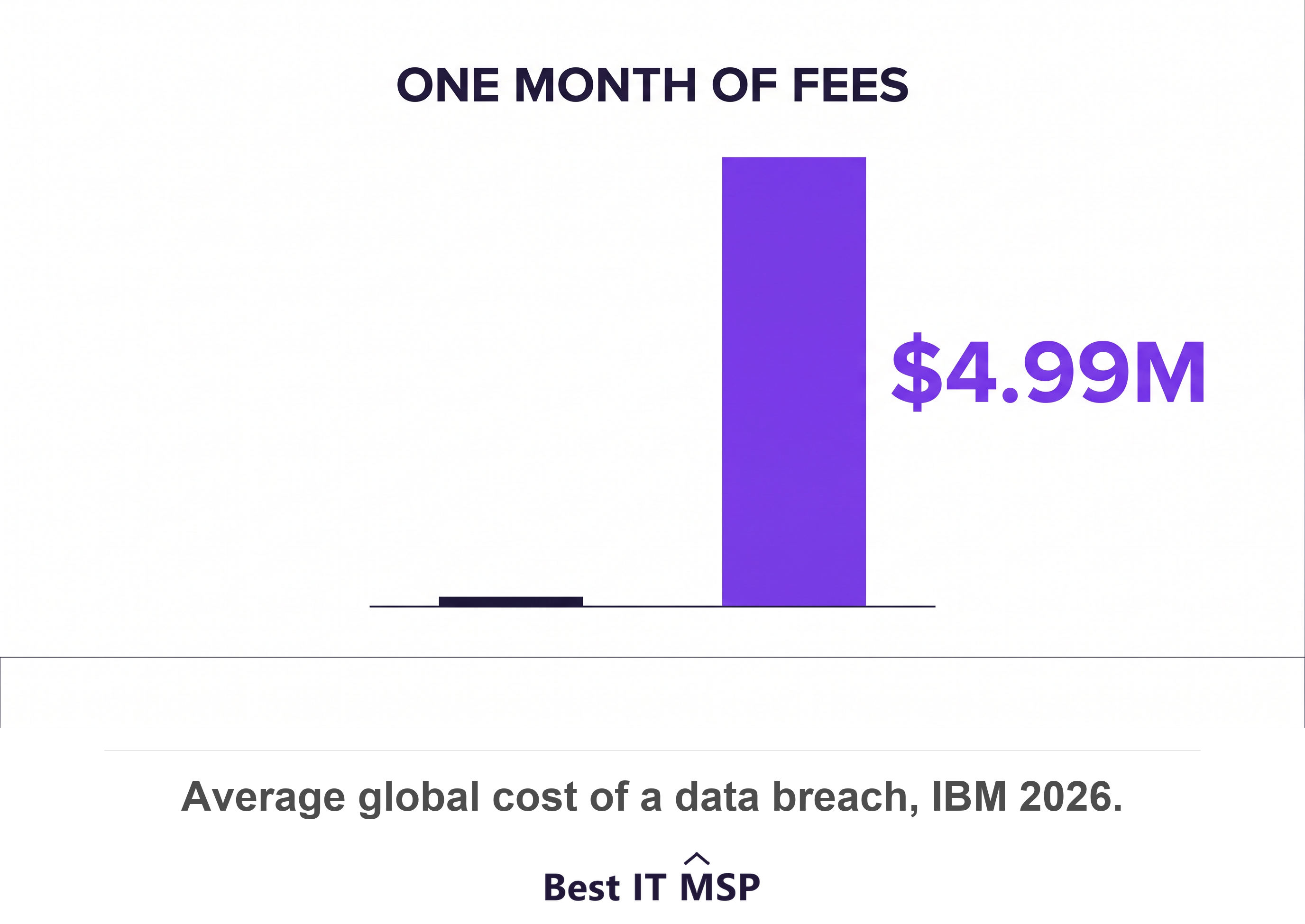
- The liability cap is the whole negotiation. One month of fees on a 6,000 dollar contract caps your recovery near 6,000 dollars against an average breach cost of 4.99 million.
- Consumer auto-renewal laws do not protect your business. California's statute covers individuals buying for personal use, so your notice period is whatever you signed.
- New York is the exception. Its service-contract statute makes an auto-renewal unenforceable unless the provider serves written notice 15 to 30 days before your deadline.
- Ask for what the law already requires. HIPAA forces a business associate to return or destroy your data at termination, so that exit clause costs your provider nothing.
- A general no-assignment clause is not change of control protection. It bars only delegation of performance, so ownership can change while the paperwork stays identical.
Which MSP contract clauses cost you the most money?
Ten clauses decide what a managed service provider contract is worth to you, and the limitation of liability decides the most. Your provider prices the monthly fee in public. It prices its own risk in the master services agreement, on the pages most buyers skim. This guide walks those ten red flags in order. Each one gets the flag, the cost to you, and the exact wording to redline.
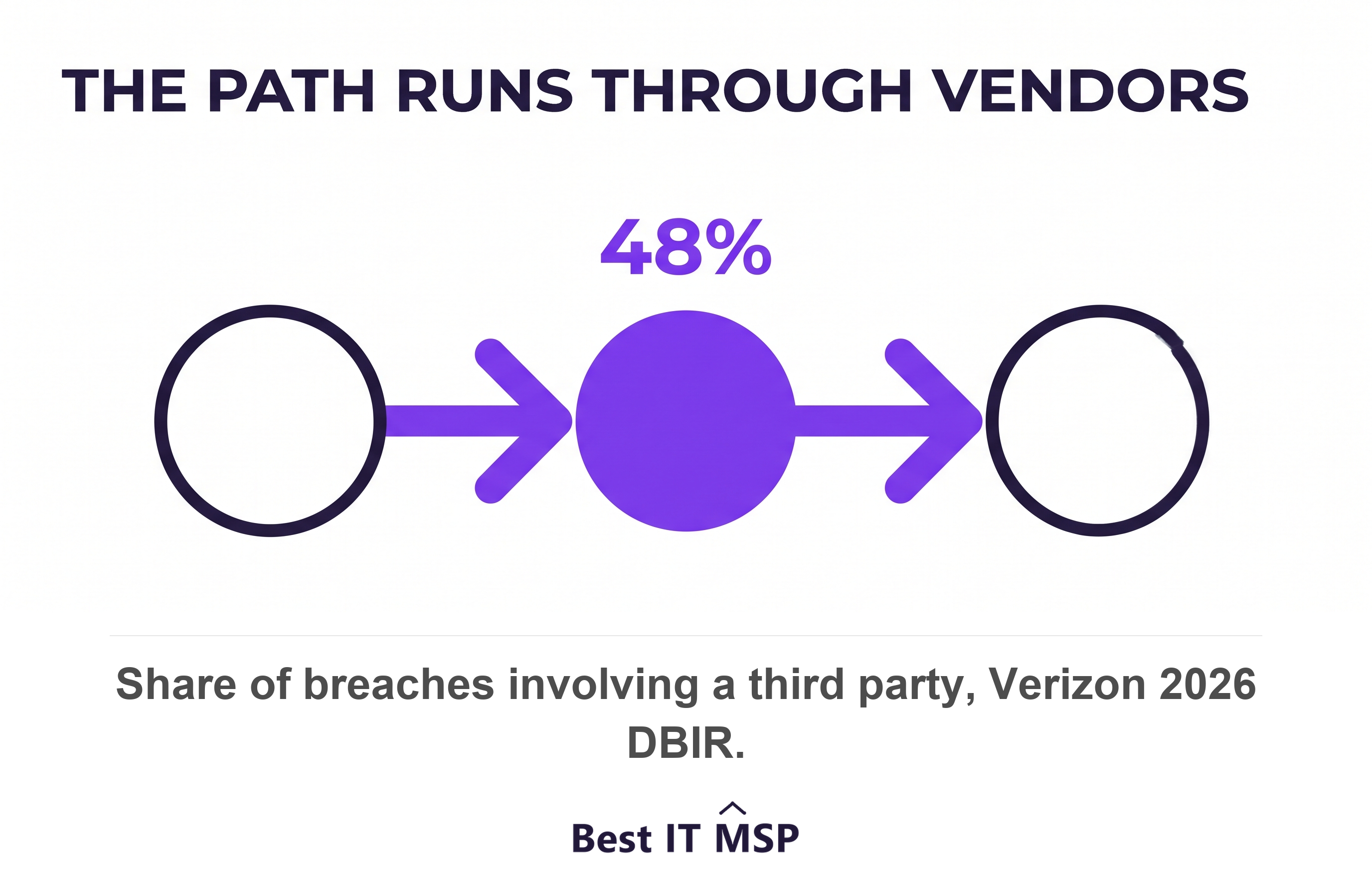
Read the contract as a budget, not as paperwork. Every cap, exclusion and notice period tells you how much your provider is willing to spend to protect you. A cap of one month of fees sets that number at one month of fees. Verizon found 48 percent of breaches now involve a third party, a 60 percent rise in a single year, so the clause that limits your provider's exposure quietly sets your own.
- <strong>Auto-renewal.</strong> A 90-day notice window on a 12-month term.
- <strong>Term and exit fees.</strong> Three-year lock-ins with 100 percent of remaining fees due on exit.
- <strong>Limitation of liability.</strong> Recovery capped at one month of fees.
- <strong>Data ownership.</strong> No named exit deliverables and no deadline.
- <strong>Service levels.</strong> Best effort language with no remedy.
- <strong>Scope of services.</strong> An out-of-scope definition you cannot price.
- <strong>Price escalation.</strong> Uncapped annual increases and seat counts that only ratchet up.
- <strong>Subcontracting.</strong> Offshore delivery without notice or consent.
- <strong>Insurance.</strong> No named limits and no additional insured status.
- <strong>Assignment.</strong> A silent transfer of your contract on acquisition.
This guide is not legal advice. Best IT MSP is an independent directory, not a law firm, so have a contract lawyer in your state review anything you sign. What follows is what experienced buyers negotiate, and what reasonable providers agree to without much argument. If you are earlier in the process, start with how to choose a managed service provider and price the deal against how much managed IT services cost.
Red flag 1: auto-renewal with a 90-day notice window
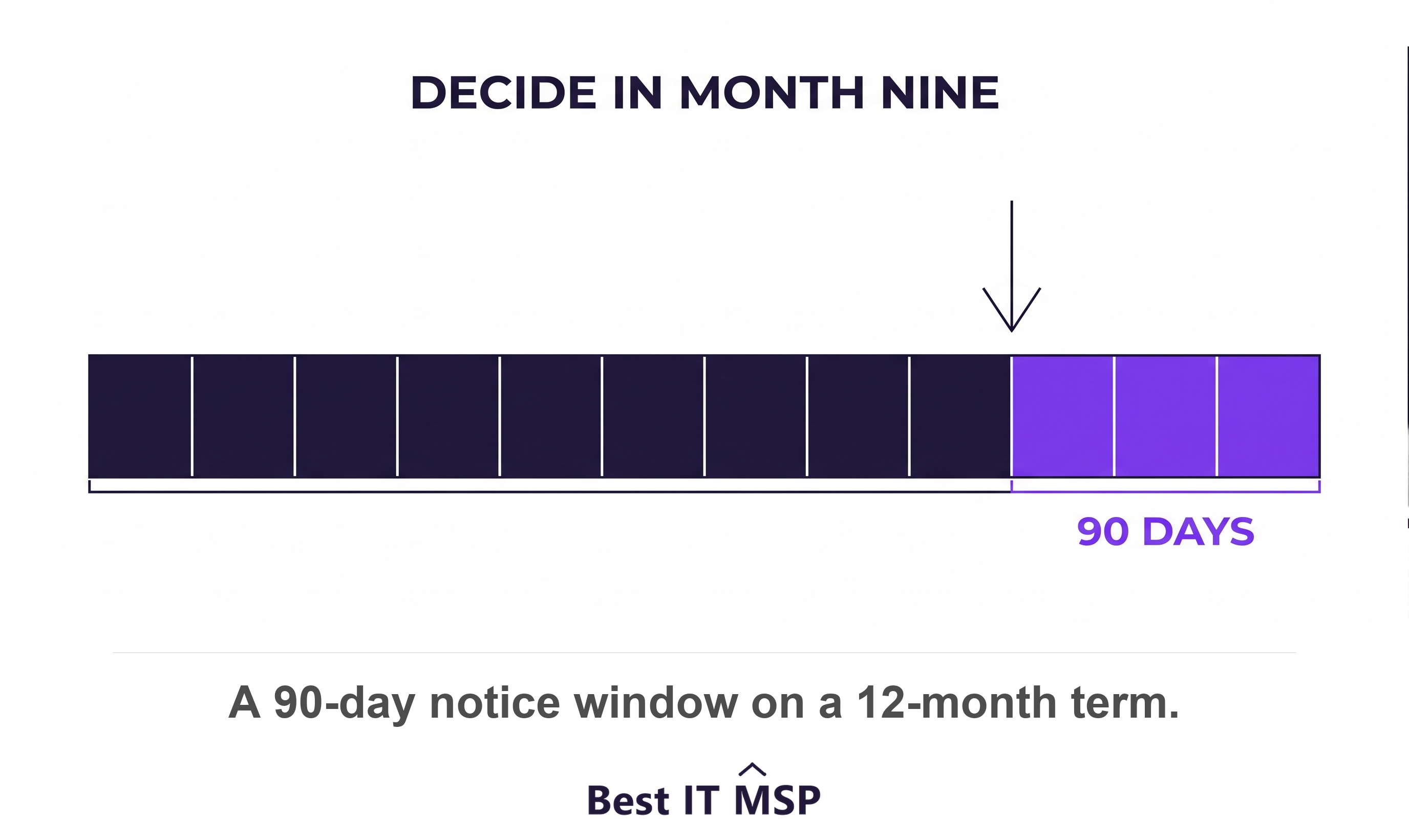
A 90-day notice window on a 12-month term means you decide in month nine. You get three quarters of a year of experience with your provider, not four, and the renewal is silent. Miss the date and you owe another full term. The auto-renewal clause is not the problem by itself. The notice period is.
The consumer protections you have read about do not cover your business. California's automatic renewal law defines a consumer as an individual who acquires goods or services for personal, family, or household purposes. A company buying managed IT is not covered. New York is the exception. Its service-contract statute makes an auto-renewal unenforceable unless the provider serves written notice 15 to 30 days before the cancellation deadline, and it defines a person to include a firm, company, partnership or corporation. Outside New York, your only protection is the sentence you negotiate.
- <strong>Cut the notice period to 30 days.</strong> Sixty days is a fair landing point on a 12-month term.
- <strong>Require a written renewal reminder.</strong> Ask for notice 30 days before your own cancellation deadline.
- <strong>Convert to month-to-month.</strong> Let the agreement continue monthly after the initial term.
- <strong>Delete evergreen renewals.</strong> Replace an indefinite rollover with one 12-month extension you accept in writing.
Red flag 2: long terms and punitive early termination fees
A 36-month term with 100 percent of remaining fees due on exit is punitive, and a 12-month term with a 30-day termination right is normal. The fee is the tell. A provider recovering unamortized onboarding costs asks for a declining amount. A provider protecting revenue asks for all of it.
The largest IT buyer in the world does not accept lock-in. Federal service contracts carry a clause letting the government terminate for convenience, after which it is liable only for payment for services rendered before the effective date of termination. Quote that when a provider tells you a termination right is unusual. It is standard in the contracts they bid on.
Be fair about why the clause exists. Onboarding a new client costs a provider real money in documentation, tooling and unbilled hours, most of it in the first 60 days. A clawback of that specific cost is reasonable. A penalty equal to a year of profit is not.
- <strong>Set the initial term at 12 months.</strong> Reserve 24 or 36 months for a discount you can see on the invoice.
- <strong>Add termination for convenience.</strong> Ask for 60 days written notice, available after month six.
- <strong>Replace the exit fee with a declining onboarding credit.</strong> Amortize it over 12 months so it reaches zero.
- <strong>Add termination for cause with a cure period.</strong> Thirty days to fix a material breach, then you can terminate.
Red flag 3: liability capped at one month of fees
A cap of one month of fees is the most expensive line in the document, and it appears in almost every first draft. On a 6,000 dollar monthly contract, that cap limits your total recovery to 6,000 dollars. IBM puts the global average cost of a data breach at 4.99 million dollars in 2026. The gap is roughly 800 to 1, and you are on the wrong side of it.
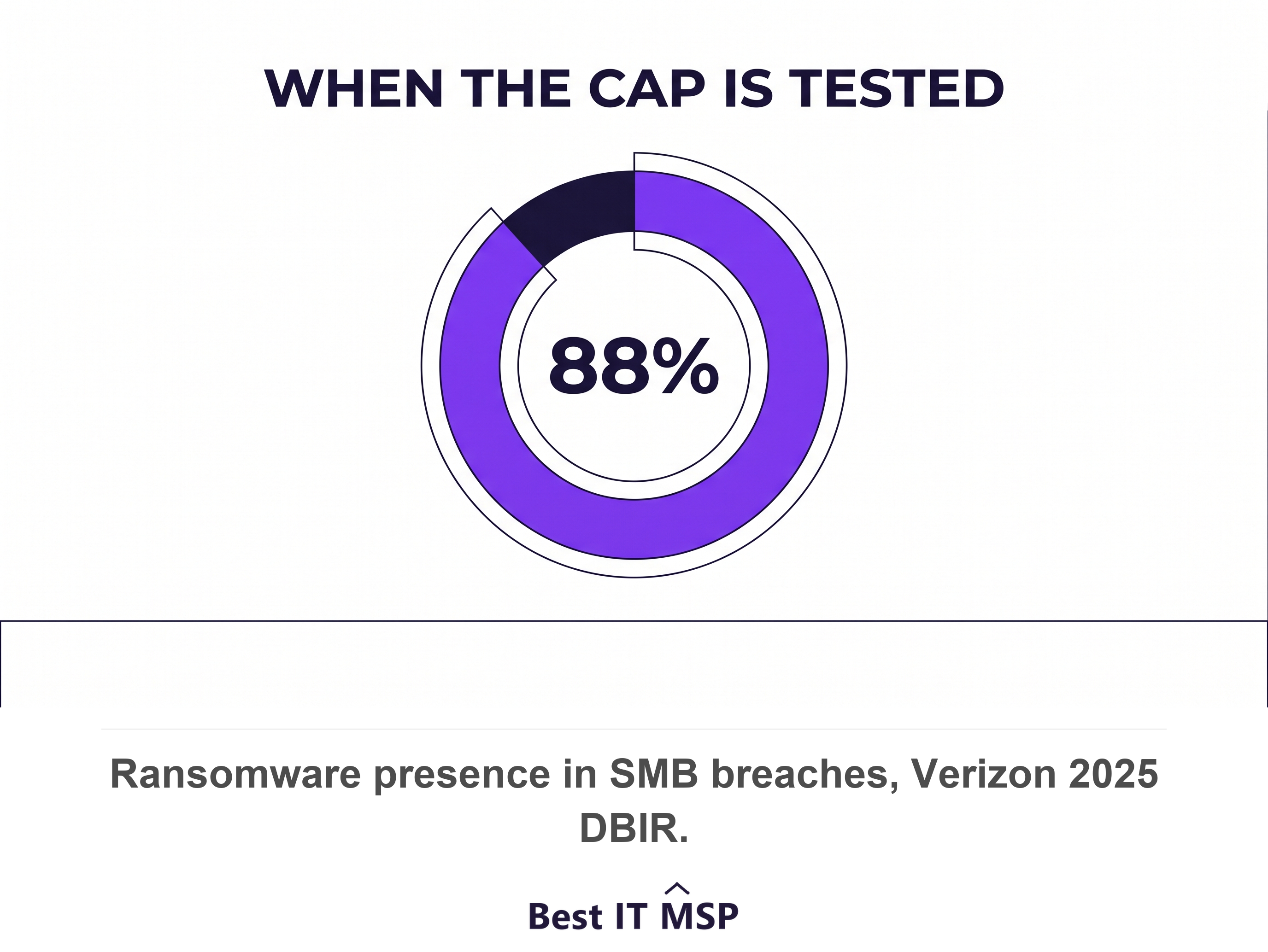
Small firms get no discount on the damage. Verizon found ransomware present in 88 percent of breaches at small and medium businesses, with a median ransom payment of 115,000 dollars. That figure is the ransom alone. It excludes downtime, overtime, forensics, legal fees and the customers who do not come back. Encouragingly, 64 percent of victims refused to pay, up from 50 percent two years earlier, which means most of that money now goes to recovery instead.
These caps are usually enforceable between businesses, so plan around them. Under the Uniform Commercial Code, consequential damages may be limited unless the limitation is unconscionable, and the same section confirms that a limit where the loss is commercial is not prima facie unconscionable. Article 2 covers the hardware you buy through your provider. The services sit under state common law, where courts reason along similar lines. One escape hatch exists. Where an exclusive or limited remedy fails of its essential purpose, other remedies open up. Do not build your plan on that argument. Build the protection into the clause.
You will rarely delete the cap, so buy exceptions instead. Experienced buyers trade a modest general cap for hard carve-outs plus a second, higher cap that applies only to data incidents. That trade is routine, and it costs your provider nothing it has not already insured. A provider that refuses every version of it is telling you its policy will not answer for your loss.
- <strong>Raise the general cap to 12 months of fees.</strong> Six months is a common landing point.
- <strong>Carve out gross negligence and willful misconduct.</strong> No cap applies to either.
- <strong>Carve out confidentiality and data security breaches.</strong> Set a super-cap equal to the provider's cyber liability insurance limit.
- <strong>Keep the consequential damages waiver mutual.</strong> Exclude breach response, forensics and notification costs from the waiver.
- <strong>Make the indemnity two-way.</strong> Ask the provider to indemnify you for third-party claims caused by its own negligence.
The liability cap is not a legal detail. It is your provider's security budget, written down.
Red flag 4: no data ownership or exit clause
You own your data, your documentation, your administrator credentials and your backups, and the contract has to say so in those words. Many drafts reserve the provider's "tools, methodologies and work product," which can be read to cover the network diagram you paid for. The argument is never about data ownership in principle. It is about what you receive, in what format, and how fast.
Ask for what regulation already forces on regulated data. A HIPAA business associate agreement must require the provider to return or destroy all protected health information at termination and retain no copies. California's privacy law requires your contract with a service provider to grant you the right to stop and remediate unauthorized use of personal information. Your provider already signs those terms elsewhere, so they cost it nothing. That makes them the cheapest wins in the document.
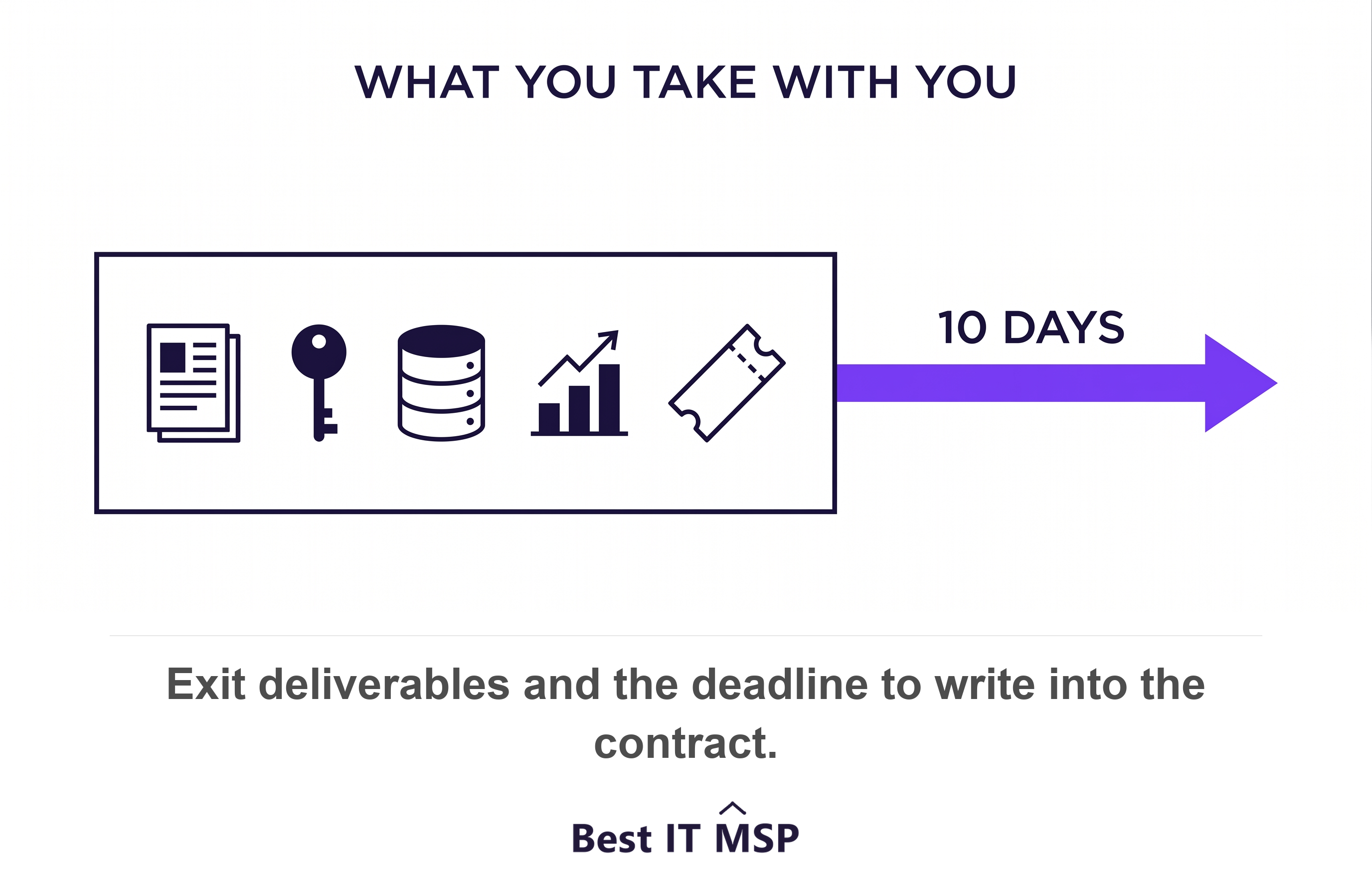
- <strong>Full documentation.</strong> Network diagrams, asset inventory, licence records, vendor contacts and runbooks.
- <strong>Administrator credentials.</strong> An export of the password vault in a standard file format, not a screen share.
- <strong>Backup data.</strong> Your backups in a restorable native format, with one test restore before handover.
- <strong>Monitoring and ticket history.</strong> An export from the RMM and ticketing platforms covering the full term.
- <strong>A deadline and a rate.</strong> Ten business days, at an hourly rate fixed now rather than quoted later.
Those five deliverables are what let you migrate without downtime, so treat the list as one clause and not five favours. Add written confirmation of deletion after handover, and name the role that signs it. If you plan to keep part of the work in-house, co-managed IT changes which credentials you should hold from day one.
Red flag 5: a service level agreement that promises best effort
Best effort is not a service level agreement, it is a mood. A usable SLA defines four things, which are severity levels, response time, resolution target and the remedy when a target is missed. Most first drafts define one. Ask what "response" means and you often learn it means an automated ticket acknowledgement sent by a robot at 2am.
Speed matters more than it did three years ago. Verizon reports vulnerability exploitation as the top initial access vector at 31 percent of breaches, and warns that attackers using AI have shrunk the exploit window from months to hours. A four-hour response target on a critical incident is a real commitment. A next-business-day target is a scheduling policy with a nicer name.
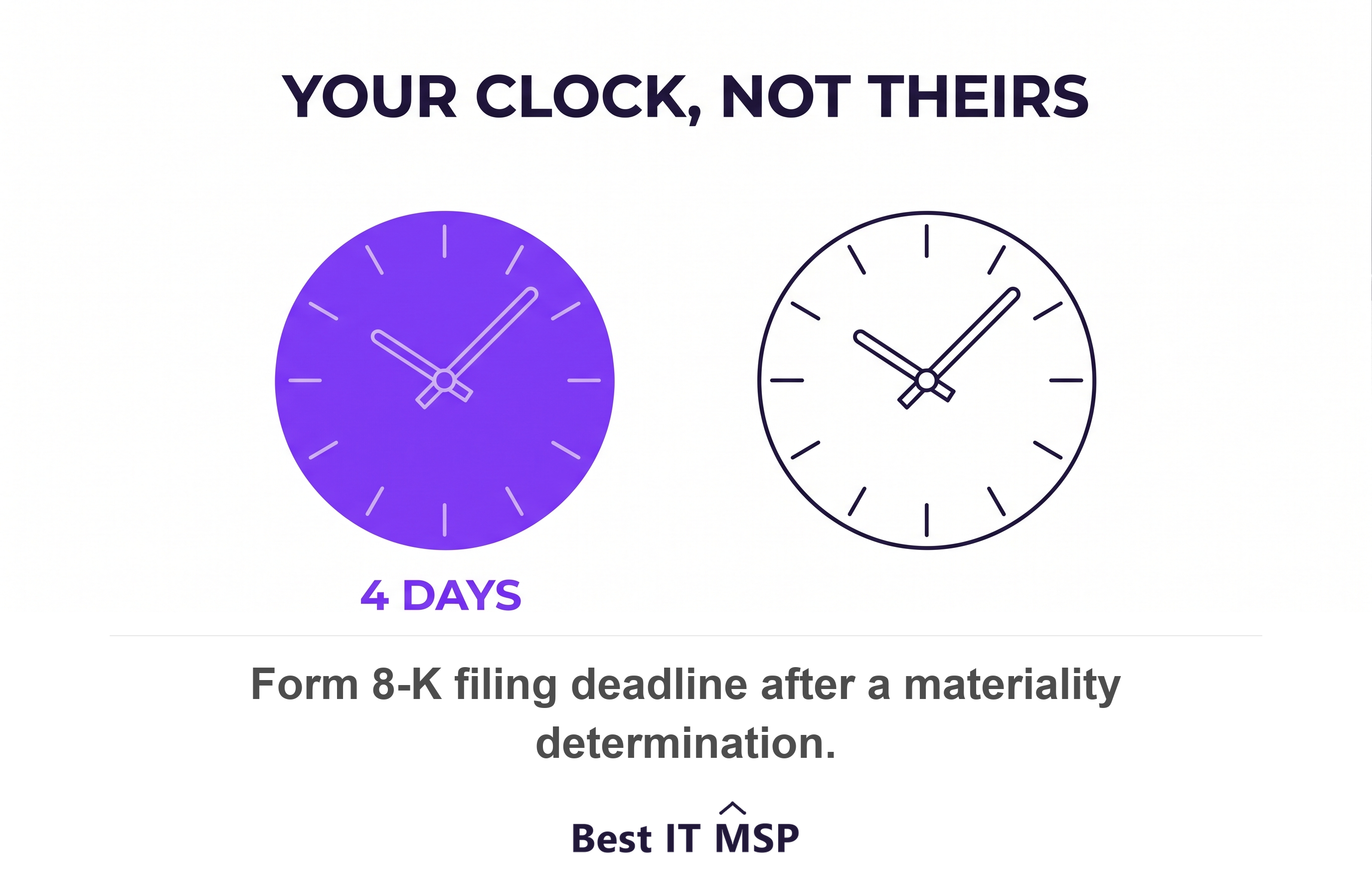
Your provider's notification clock has to be shorter than your own legal clock. A public company must file a material cybersecurity incident on Form 8-K within four business days of determining materiality. A business under the FTC Safeguards Rule must notify the Commission no later than 30 days after discovering an event affecting at least 500 consumers. If your provider promises to tell you "promptly," you cannot plan around either deadline. Write the hours into the contract.
- <strong>Define severity levels in writing.</strong> Name one example incident for each level.
- <strong>Separate acknowledgement from response.</strong> A ticket receipt is not a human being.
- <strong>Apply service credits automatically.</strong> Credits you have to request are credits you will forget.
- <strong>Add a chronic failure termination right.</strong> Three missed targets in a quarter lets you exit without a fee.
- <strong>Require security incident notice in hours.</strong> Four hours from suspicion, in writing, to a named person.
Red flag 6: an out-of-scope definition you cannot price
Out of scope is where the monthly fee stops and the hourly rate starts, so that definition sets your real budget. A one-line scope of services followed by a long exclusions list means your invoice is negotiable every month. Ambiguous scope language is the most common reason a fixed price stops being fixed.
The usual triggers are predictable. Projects, office moves, cloud migrations, new site builds, after-hours work, third-party application support and anything touching hardware you did not buy through the provider. None of those are unreasonable to bill separately. What is unreasonable is learning where the boundary sat after the work is finished.
This clause protects both sides. An unlimited scope invites unlimited requests, and that is how providers end up losing money on an account and quietly cutting the hours they spend on it.
- <strong>Attach a scope exhibit.</strong> List what is included, by system and by task.
- <strong>Fix the hourly rate for the term.</strong> Include after-hours and weekend multipliers.
- <strong>Require written pre-approval.</strong> No out-of-scope work above 500 dollars without an email approval.
- <strong>Report hours quarterly.</strong> Ask for a running total so you can audit the pattern.
- <strong>Add a bank of included hours.</strong> Ten hours a month removes most of the friction.
Red flag 7: price escalation you cannot forecast
An uncapped, unilateral annual increase hands your provider your budget. Costs escalate quietly when the clause is open, and a renewal priced at "then-current list price" is the same clause with better manners. Cap the escalator and the rest of the contract becomes forecastable. Leave it open and every other number you negotiated has a shelf life of 12 months.
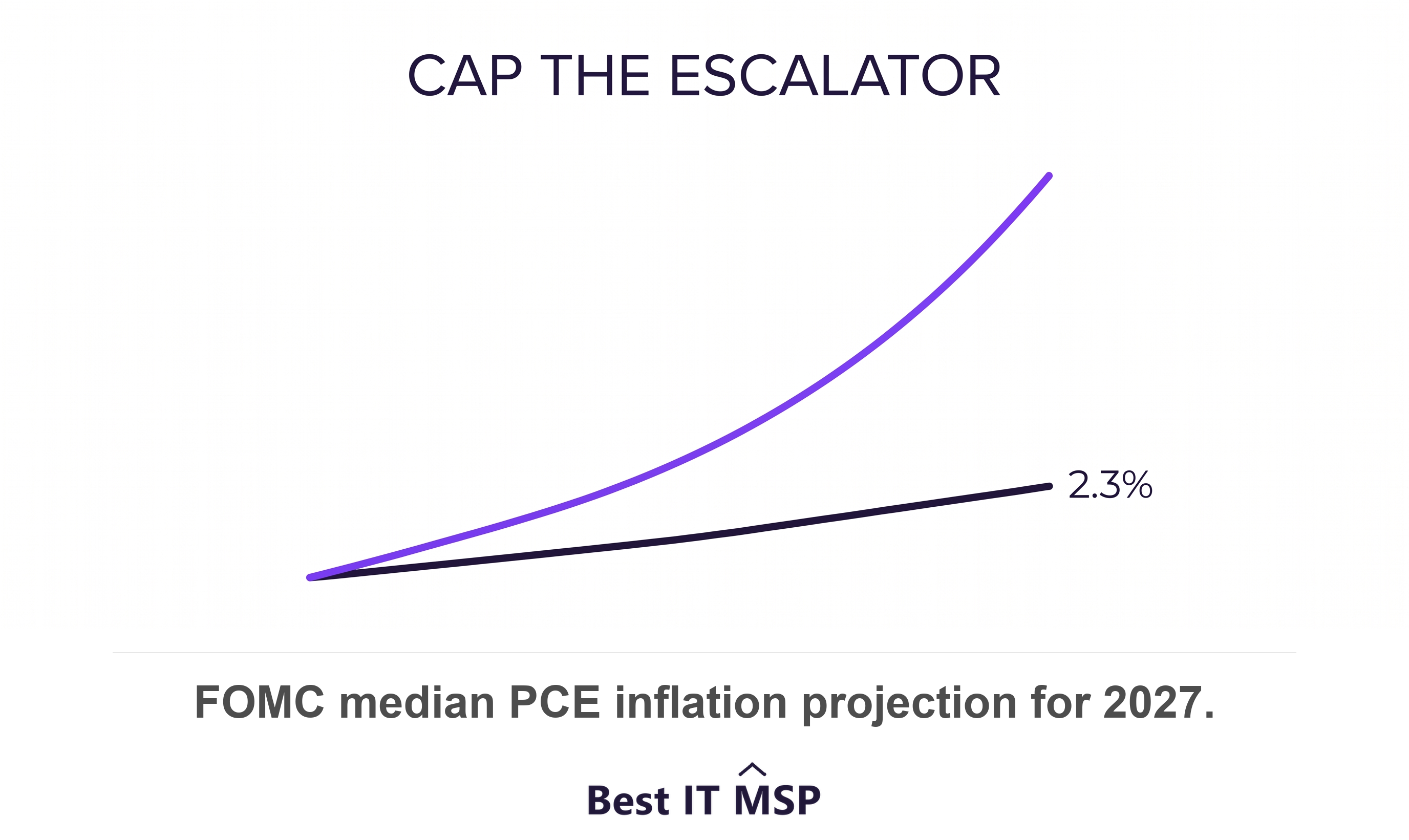
Anchor the cap to a published index. The Federal Open Market Committee's June 2026 projections put median PCE inflation at 3.6 percent for 2026 and 2.3 percent for 2027, against a longer-run projection of 2.0 percent. A 7 percent annual escalator in that environment is a margin decision, not a cost pass-through. Ask which one it is, and ask in writing.
Watch the seat count as closely as the rate. Per-user pricing usually adjusts up automatically when you hire and stays put when you do not. Some agreements add a high-water-mark clause that locks your bill to the largest headcount you reached during the term. If you run seasonal staff, that one sentence can cost more than the escalator does.
- <strong>Cap the annual increase.</strong> CPI or 5 percent, whichever is lower, with 60 days written notice.
- <strong>Fix rates through the initial term.</strong> No increase inside the first 12 months.
- <strong>Allow the seat count to fall.</strong> True down quarterly, with a floor of 90 percent of your starting count.
- <strong>Delete high-water-mark language.</strong> Bill the actual count each month.
Red flag 8: subcontracting and offshoring without your consent
Your provider can subcontract your support unless the contract says otherwise, because the default rule is permissive. Under the Uniform Commercial Code, a party may perform its duty through a delegate unless otherwise agreed. A general no-assignment clause does not fix it either, since a prohibition on assigning the contract bars only the delegation of the assignor's performance.
The regulator holds you responsible for a subcontractor you were never told about. The FTC Safeguards Rule requires you to select service providers capable of maintaining appropriate safeguards, require those safeguards by contract, and periodically assess them. HIPAA imposes the same flow-down, obliging your provider to ensure subcontractors agree to the same restrictions and conditions. You cannot assess a firm whose name you do not know.
Offshore delivery is not automatically a problem. Follow-the-sun staffing is how some providers run a 24/7 help desk at an SMB price, and the engineers are often excellent. The problem is silence. Ask which countries hold or access your data before you sign, because compliance obligations follow the data, not the head office.
- <strong>Require written notice of any subcontractor.</strong> Thirty days before the change takes effect.
- <strong>Flow down the security terms.</strong> Same confidentiality, same insurance, same breach notice window.
- <strong>Name the countries.</strong> List every location where staff can access your systems or data.
- <strong>Keep your provider liable.</strong> It stays responsible for the acts of anyone it hires.
Red flag 9: thin insurance and no additional insured status
Ask for the certificates before you sign, not after an incident. Two policies matter for a managed service provider, which are technology errors and omissions, and cyber liability insurance. A 1 million dollar cyber limit reads generous until you set it beside an average breach cost of 4.99 million dollars.
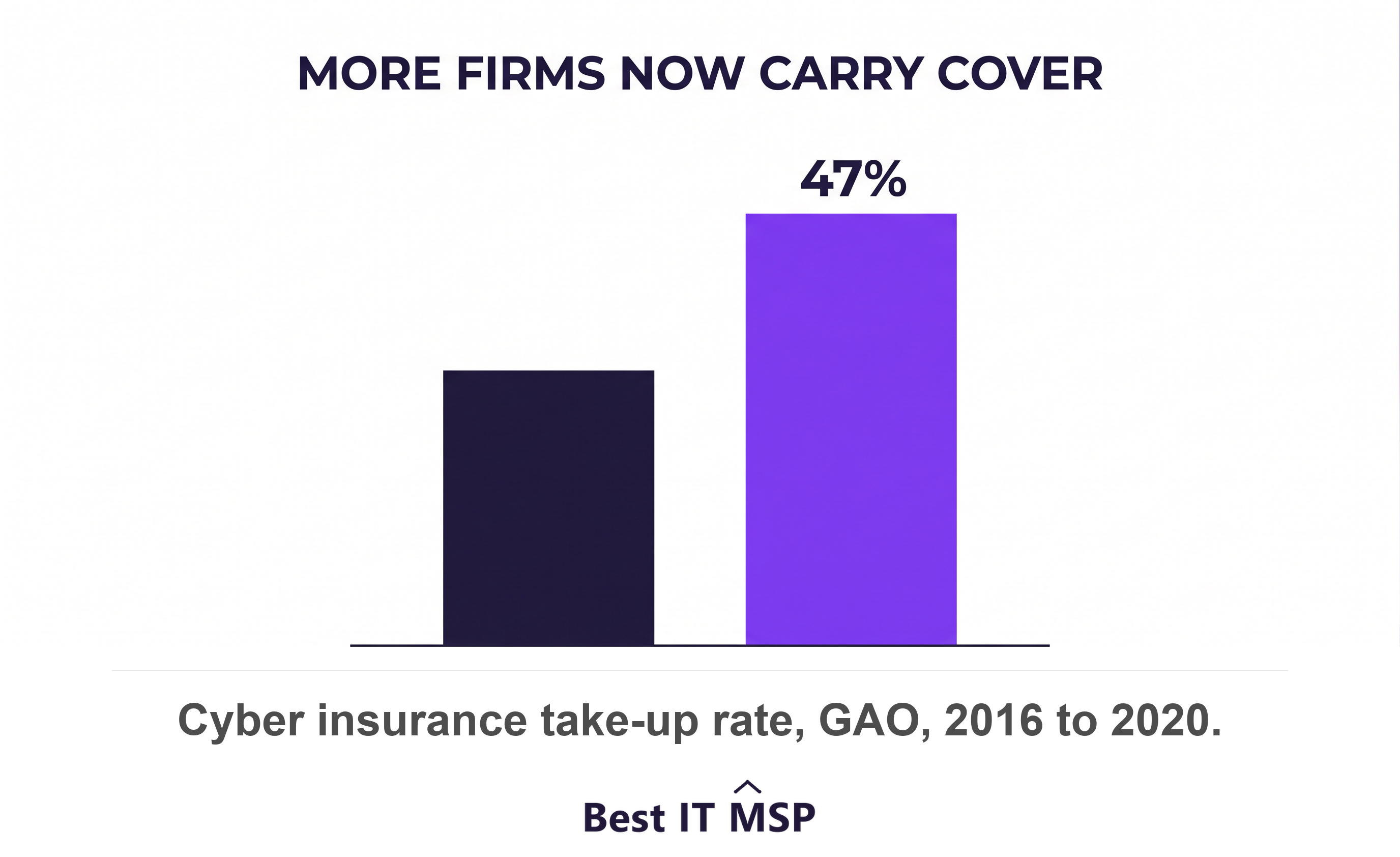
Coverage has been getting harder to buy, not easier. GAO found the take-up rate for cyber insurance among one broker's clients rose from 26 percent in 2016 to 47 percent in 2020, and reported that insurers responded to rising attacks by reducing coverage limits for some sectors, including healthcare and education. A provider that carried a high limit three years ago may not carry it today. Ask for the current certificate, dated this year.
Additional insured status is standard on general liability and often unavailable on professional liability, so ask for it and accept the sensible alternative. A certificate naming you, a waiver of subrogation, and 30 days notice of cancellation delivers most of the protection without a fight.
- <strong>Set named minimum limits.</strong> Write the numbers into the contract, not into an email.
- <strong>Request the certificate annually.</strong> Diary it against the renewal date.
- <strong>Ask to be named as additional insured.</strong> Accept certificate holder plus waiver of subrogation where the policy forbids it.
- <strong>Confirm subcontractors are covered.</strong> Ask whether the policy answers for delegated work.
Red flag 10: assignment on acquisition
Your contract usually survives the sale of your provider, and that is exactly the risk. Consolidation in managed IT is real, so the 12-person firm you picked for its 20-minute response can become a division of a national roll-up inside a year. Same paper, different people, different priorities. The clause you need is not a no-assignment clause. It is a change of control clause.
The distinction matters. A prohibition on assigning the contract is construed as barring only the delegation of performance, so it does not stop the sale of the business that performs it. Ownership can change while every word you signed stays identical. Write the trigger and the remedy yourself, because nothing in the standard draft does it for you.
- <strong>Define the trigger.</strong> A sale of the business, a merger, or a change in majority ownership.
- <strong>Set a termination window.</strong> Sixty days from written notice, with no early termination fee.
- <strong>Require re-certification.</strong> The new owner confirms the SLA, insurance and security terms in writing.
- <strong>Hold your pricing.</strong> No repricing before the end of the current term.
What to get in writing before you sign
Request four documents together and read them as one contract. Providers usually send the friendly one first. The master services agreement, the service level agreement, the scope exhibit and the pricing schedule only make sense side by side, because the exclusions in one quietly undo the promises in another.
- <strong>Request the full document set.</strong> Master services agreement, SLA, scope exhibit and pricing schedule in one file.
- <strong>Request current certificates of insurance.</strong> Dated inside the last 12 months.
- <strong>Request the offboarding process.</strong> In writing, with named deliverables and a deadline.
- <strong>Request two references.</strong> Clients of similar size who have renewed at least once.
- <strong>Request the escalation path.</strong> Names and phone numbers, not a generic inbox.
Be fair to good providers, because several of these clauses exist for sound reasons. Auto-renewal stops security coverage from lapsing by accident. Term length lets a provider amortize onboarding it already paid for. A liability cap keeps a 30-person firm insurable. A tight scope of services spares both sides a monthly argument. The tell is not whether a provider uses these clauses. It is which ones it refuses to discuss, and whether it can explain why.
A provider that agrees to a 30-day notice period, named insurance limits, a written exit process and a carve-out for gross negligence is showing you how it runs. So is one that will not move a comma. Still comparing models? Weigh managed IT vs in-house IT, then check your triggers in HIPAA vs CMMC vs SOC 2 before you sign anything touching regulated data. Take the same redlines to all three finalists and compare the answers, not the brochures.
FAQ
What is the most important clause in an MSP contract?
The limitation of liability. Most drafts cap your recovery at one month of fees, near 6,000 dollars on a typical SMB agreement, against an average data breach cost of 4.99 million dollars. Negotiate carve-outs for gross negligence and for data security breaches rather than fighting the cap itself.
Is a 90-day cancellation notice normal for an MSP contract?
It is common and it is negotiable. Thirty to 60 days is reasonable on a 12-month term. New York's service-contract statute makes auto-renewal unenforceable unless the provider serves written notice 15 to 30 days before your deadline. Most states set no such rule for business buyers.
Who owns the documentation and passwords when you leave an MSP?
You do, if the contract says so. Name the exit deliverables in writing, meaning documentation, an administrator credentials export, backup data and ticket history, inside 10 business days. HIPAA already forces a business associate to return or destroy all protected health information at termination, so the clause is standard.
Can an MSP raise prices mid-contract?
Only if the contract allows it. Cap any annual increase at CPI or 5 percent, whichever is lower, with 60 days written notice. The FOMC projects median PCE inflation of 2.3 percent for 2027, so a 7 percent escalator is a margin decision. Fix rates through the initial term.
What happens to my MSP contract if the provider is acquired?
It usually transfers with the business. A general no-assignment clause is read narrowly, because a prohibition on assigning the contract bars only the delegation of the assignor's performance. Add a change of control clause giving you 60 days to terminate without an early termination fee after written notice.
Best IT MSP is the independent, merit-ranked directory of managed IT and security providers across North America. Compare firms in your city by rating and verified data, shortlist three, and take the same redlines to all of them. Free to browse, and paid placement is always labelled.