Termination for convenience, and why your contract may not have it
Termination for convenience is the right to end an agreement because you want to, with no breach to prove. Termination for cause makes you prove fault first, and the standard federal default clause gives a provider 10 days to cure a stated failure. Your agreement may grant one right, both, or neither, so find the clause before you need it.
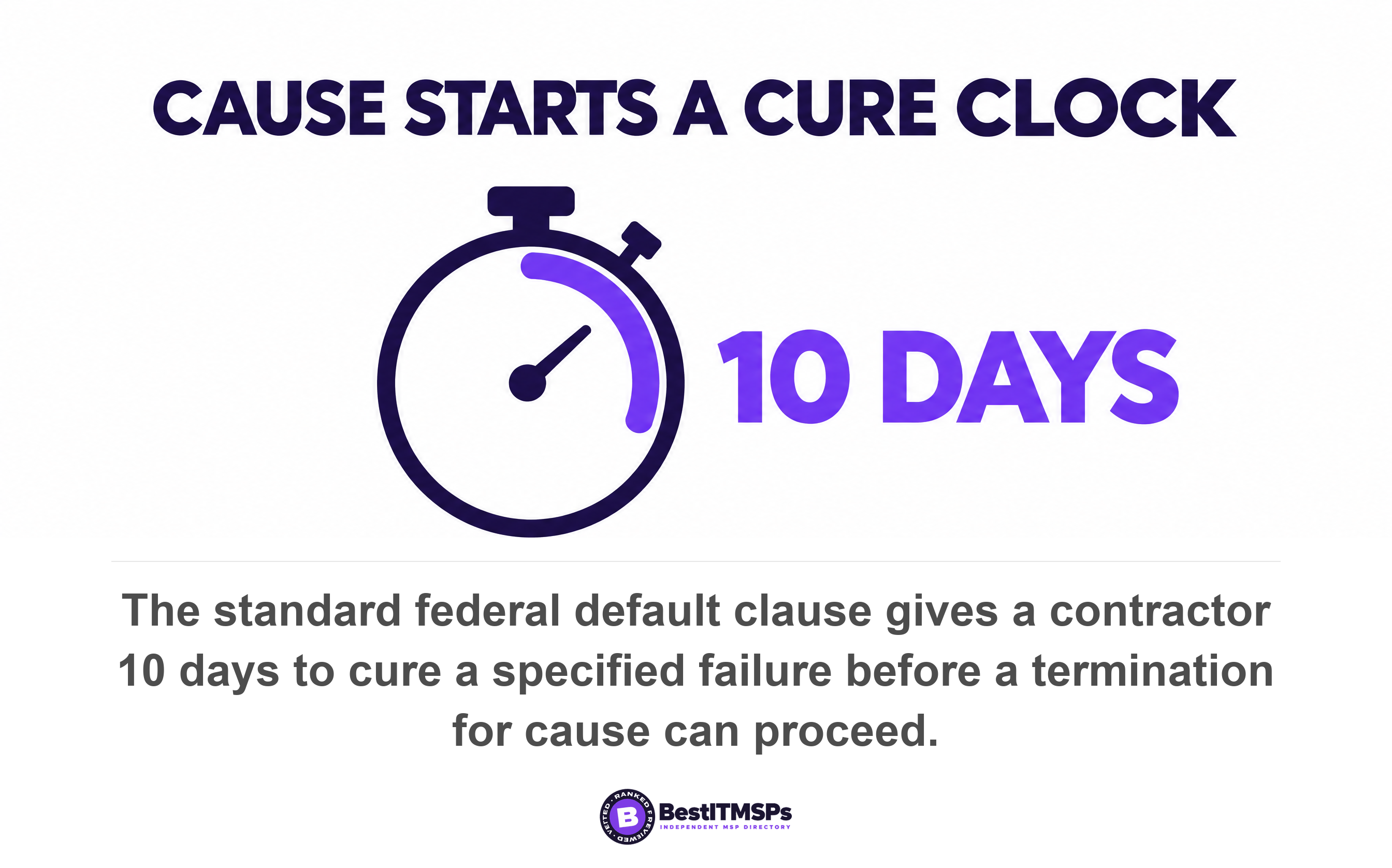
- Termination for cause makes you prove fault and wait out a cure period. The standard federal default clause sets that period at 10 days from the notice specifying the failure.
- A failed cause termination does not vanish. Under federal rules an improper default termination is deemed a termination for convenience, so the buyer pays the convenience settlement anyway.
- Ask for a priced exit, not a free one. An early termination fee set at the full remaining contract value is an anticipatory profit, and federal settlement policy refuses to pay one.
- The clause that strands you is the wind-down clause. The federal continuity of services clause buys up to 90 days of phase-out help and pays the provider a pro rata fee for it.
- Your data runs on its own clock. A cancelled Microsoft 365 business subscription deletes leftover customer data no later than 180 days after cancellation, and only admins can retrieve it once it is disabled.
What is the difference between termination for cause and termination for convenience?
Termination for convenience ends an agreement because you want it ended. Termination for cause ends it because your provider broke something, and you carry the burden of proving that. The two rights cost very different amounts of time, money and argument to use, and only one of them works when nothing is actually broken.
The cleanest public definition of each right sits in the rules the US federal government writes for its own purchasing, because those rules are free to read and both clauses appear in one place. Under the standard commercial contract clause the Government reserves the right to terminate this contract, or any part hereof, for its sole convenience. Under the same clause it may terminate for cause in the event of any default by the Contractor, or if the Contractor fails to comply with any contract terms and conditions. One right needs a reason. The other does not. That single difference is the whole subject.
What it costs to sit on the wrong side of that line is a question of days rather than principles. A cause route starts with a written notice that specifies the failure, then a cure period in which your provider gets to fix it. The standard federal default clause sets that period at 10 days after receipt of the notice specifying the failure, or longer if authorized in writing. Your own clause names its own number. Through all of it you keep paying, your provider keeps the administrative credentials to your systems, and you are the party assembling evidence.
A convenience route starts and ends with a letter. You notify, the notice period runs, and the agreement ends on a date you can write in a calendar. Nothing has to be proved, which is precisely why providers price that right or leave it out.
This is a buyer's guide to reading your own agreement, not legal advice. Best IT MSP is an independent directory and not a law firm, so have a lawyer in your state review the actual document before you act on any clause in it. What follows tells you which clause to find, what the federal benchmark looks like, and the language to ask for at renewal. For the other problem clauses read MSP contract red flags, and for the operational side of leaving read could you leave your IT provider and the switching MSPs transition playbook.
Which clause to find in your own agreement
To find your exit right, open the master services agreement (MSA) and read the section headed Term and Termination from the first word to the last. That section, not the proposal and not the sales email, is where your right to leave either exists or does not. Six passes through the paperwork settle the question.
- Open the master services agreement before the statement of work (SOW). The MSA normally carries the termination terms and the SOW normally carries the services and the dates, so a term buried in one can outlive the other.
- Read the termination clause twice, once for each party. Mark which sentences name you and which name the provider.
- Count the notice period in days, then check whether the same number applies to both sides.
- Look for the words convenience, without cause, for any reason, or at its sole discretion. Any of the four signals a convenience right, so note who holds it.
- Check the survival clause, which lists the obligations that continue after termination. Transition assistance and data egress duties are worth nothing if they do not survive.
- Price the exit by finding the early termination fee, the offboarding fee, and the rate card that covers wind-down services.
The fastest useful test takes five minutes. Count whose name appears beside the word convenience. Where the provider can terminate for convenience on 30 days notice and you can terminate only for cause, the agreement is one-sided on the single clause that decides whether you are a customer or a captive. A unilateral right is a normal commercial position and not proof of bad faith. It does tell you where the leverage sits before you open your mouth.
The federal model is deliberately one-sided in the opposite direction. The buyer holds the convenience right, the seller does not, and the short services clause says so in a single sentence: the contracting officer by written notice, may terminate this contract, in whole or in part, when it is in the Government's interest. Nobody pretends that is mutual. It is the largest buyer of IT services in the world writing the clause it wants, which is exactly the job in front of you.
Why termination for cause is the expensive right to own
Termination for cause is expensive because it runs on evidence and a clock rather than on a decision. You identify a breach, specify it in writing, serve the notice the way the notices clause requires, wait out the cure period, and then defend the call if your provider disputes it. Every one of those five steps happens while the invoices keep arriving.
Federal practice shows what happens when a buyer gets that call wrong, and this is the part worth knowing before you try it. Where a default termination turns out to be improper, the rights and obligations of the parties shall be the same as if the termination had been issued for the convenience of the Government. The commercial clause is blunter still. If it is determined that the Government improperly terminated the contract for default, such termination shall be deemed a termination for convenience.
Read that backwards and it explains the shape of your problem. A failed cause termination does not disappear. It converts into the convenience termination you did not have, and the buyer pays the convenience settlement anyway. The federal system absorbs that outcome because it holds both rights. A business holding only the cause right has no landing place when the argument goes against it, which is why a cause-only exit is a worse deal than it looks on the page.
One phrase in the federal cause clause is worth copying into your own paperwork. It permits termination where the contractor fails to provide the Government, upon request, with adequate assurances of future performance. That is a lower and far more practical bar than proving a breach after the fact, because it turns on a question your provider either answers or does not. Ask for that wording and you gain a documented route that starts with a request rather than a dispute.
What should an exit for convenience actually cost?
An exit for convenience should cost you the work already done, plus your provider's unavoidable costs of stopping, and nothing for revenue they expected to earn. That is the federal settlement principle, and it is the most useful benchmark an SMB buyer has, because it is published, specific and free to quote.
Start with the simplest version of it. Under the short services clause, if the contract is terminated the Government shall be liable only for payment under the payment provisions of this contract for services rendered before the effective date of termination. No fee, no multiple of the remaining term, no penalty. You pay for what you received.
The commercial clause adds the two adjustments that make the principle fair to the seller. The contractor is paid a percentage of the contract price reflecting the percentage of the work performed prior to the notice of termination, plus reasonable charges the Contractor can demonstrate to the satisfaction of the Government using its standard record keeping system, have resulted from the termination. It then caps that second half, because the contractor shall not be paid for any work performed or costs incurred which reasonably could have been avoided.
The governing policy says the same thing in plainer language. A settlement should compensate the contractor fairly for the work done and the preparations made for the terminated portions of the contract, including a reasonable allowance for profit, and the use of business judgment, as distinguished from strict accounting principles, is the heart of a settlement. Then comes the line to carry into your renewal meeting. Anticipatory profits and consequential damages shall not be allowed.
An early termination fee set at the remaining contract value is an anticipatory profit
An early termination fee priced at the full value of the remaining term charges you for months of service nobody will deliver. The federal buyer refuses to pay that, in writing, as published policy. So you are entitled to ask your provider why your fee is priced as though the work will still be done, and to propose the shape the federal rules use instead. Build the figure from costs you can name. Unrecovered onboarding labor, unamortized hardware, and committed third-party licenses that sit on a real invoice, each declining as the term runs down.
Then do the thing most buyers skip. Ask for a priced exit rather than a free one. A provider will fight a no-fee convenience right because it makes their revenue impossible to forecast, and that fight is usually lost. The same provider will often sell you a convenience right at a stated, declining fee, because a number is something they can plan around. A priced exit you can actually use beats a free exit you never win, and it beats a cause-only exit by a wide margin.
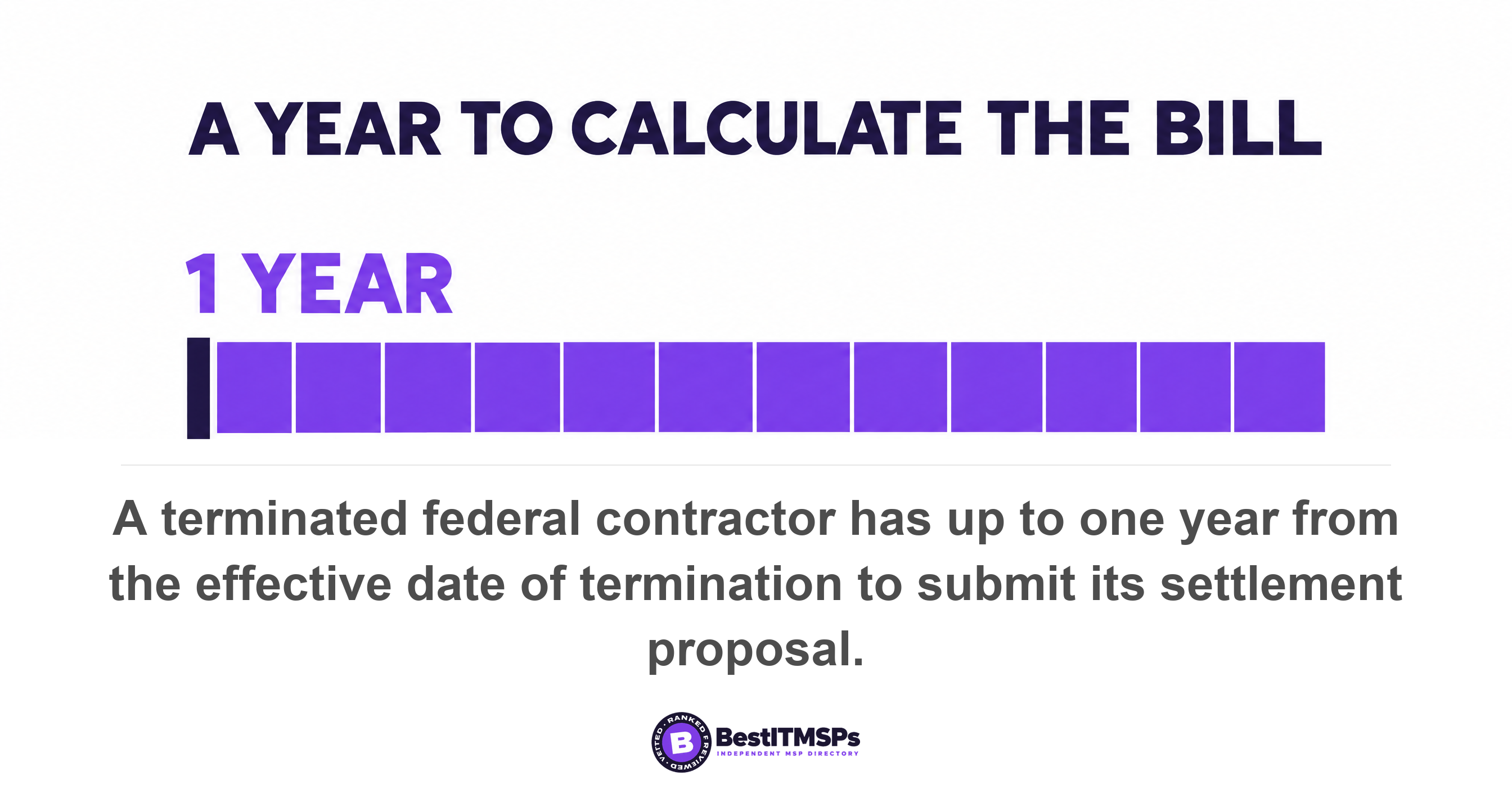
Notice that the federal system does not pre-set the figure at all. A terminated contractor submits its settlement proposal promptly, but no later than 1 year from the effective date of termination, which tells you the amount is meant to be calculated from real costs after the event. A fee written on page nine before anyone knows the costs is a convenience for the drafter, not a measurement.
The clause that strands you is the wind-down clause, not the termination clause
A right to terminate with no matching duty on your provider to help you leave is a right to be stranded, not a right to leave. Buyers discover this late, and it is the most valuable paragraph in this article. Win the exit clause, lose the transition clause, and you have bought a 30-day countdown into a network nobody will explain to you.
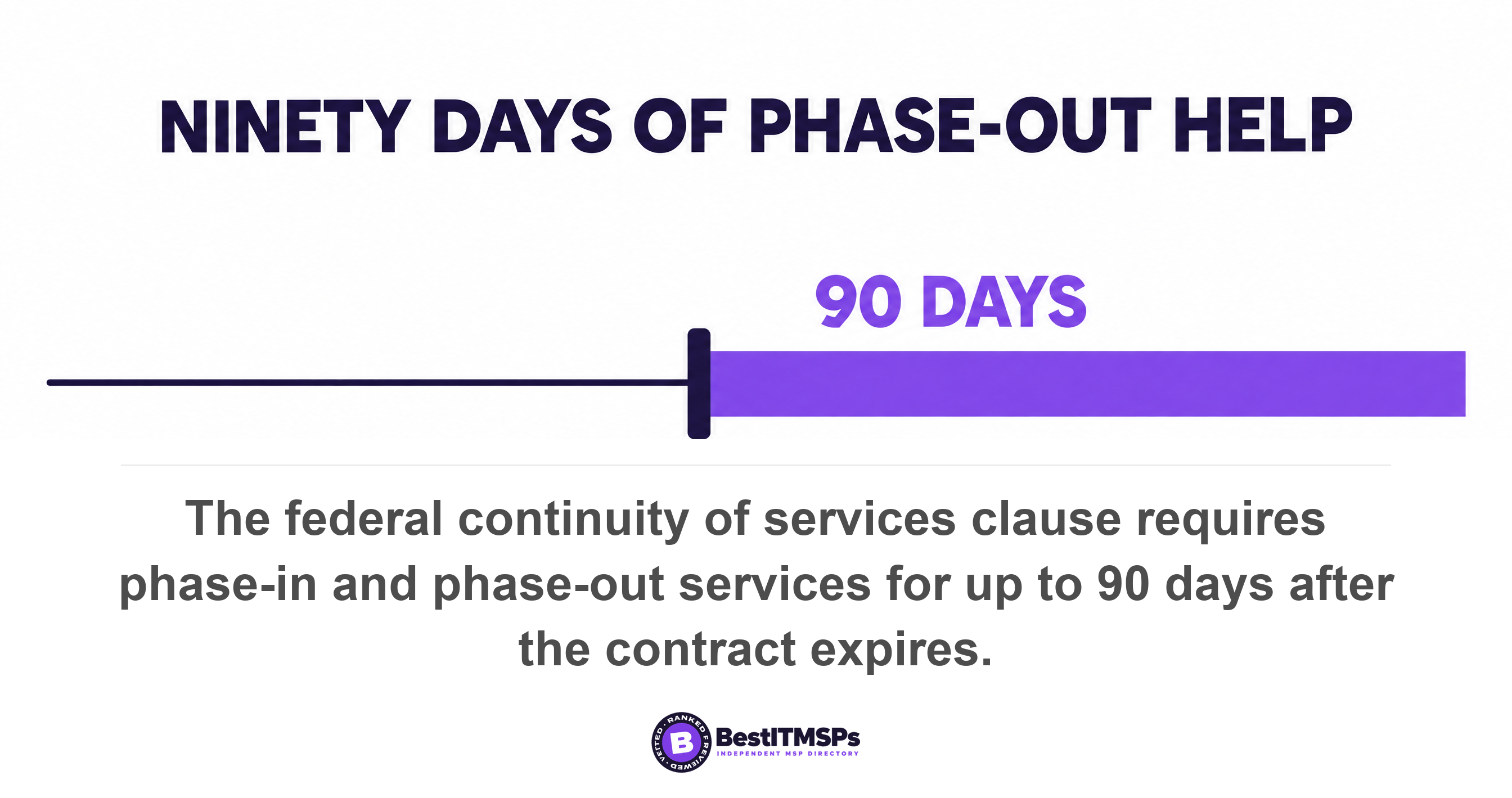
The federal rules treat transition as a separate obligation with its own clause, and the detail is the point. Under the continuity of services clause the contractor must, on written notice, furnish phase-in, phase-out services for up to 90 days after this contract expires, and must exercise its best efforts and cooperation to effect an orderly and efficient transition to a successor. It reaches past goodwill into specifics. The contractor has to negotiate in good faith a plan with a successor that sets a training program and transfer dates, keep enough experienced staff on the work to maintain proficiency, disclose the necessary personnel records, and let the successor interview its employees on site.
Then read the money sentence, because it settles the argument you are about to have. The contractor is reimbursed for reasonable phase-in and phase-out costs plus a fee not to exceed a pro rata portion of the contract fee. The federal buyer pays for transition assistance, at the contract's own margin. Wind-down services are not free, and a provider who prices them is behaving normally. A provider who will not commit to them at any price is the problem you were trying to find.
Data egress runs on a clock you do not control
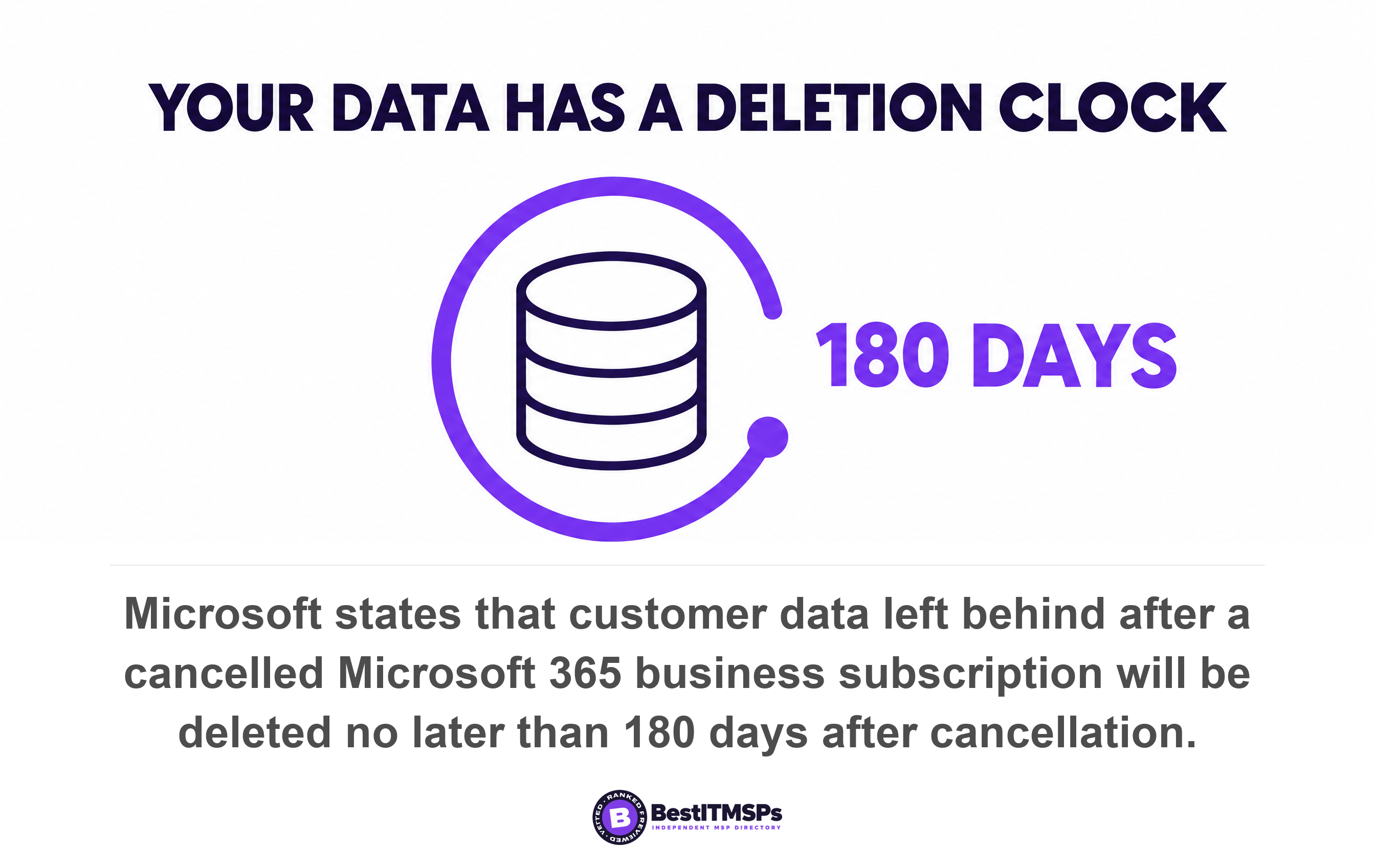
Your data has its own timetable, and it does not pause for a contract dispute. A Microsoft 365 business subscription that ends moves through fixed states. It sits in Expired for 30 days, then Disabled for 90 days, then it is deleted. During the Disabled stage data is accessible to admins only, and users cannot access apps in Microsoft 365. Where a subscription is cancelled rather than left to expire, Microsoft warns that any customer data left behind might be deleted after 90 days and will be deleted no later than 180 days after cancellation.
Line that up against an exit you have just forced. Your staff lose access first, an administrator can still retrieve the data, and the administrative credentials are held by the provider you terminated last week. So the clause that saves you is not the termination clause. It is the one that obliges them to transfer admin credentials, documentation, license keys, backups and exports by a stated date, and that survives termination. Agree the offboarding fee for that work in the rate card while you are still a happy customer. For the specific list to ask for, read documents your MSP should provide.
A termination right without a transition duty is a date, not an exit.
The language to ask for at renewal
To fix a cause-only agreement, ask for six changes at renewal, in this order, because the first two are worth more than the other four together. Put each one in a single sentence and send it in writing before the notice window opens.
- Add a mutual termination for convenience right. Ask for the same right on both sides, with a written notice period of 30 to 60 days, available after a stated minimum term such as month six or month twelve.
- Price the early termination fee as a declining figure tied to the months remaining, built from costs you can name rather than from the value of the remaining term.
- Require wind-down services for a fixed period after the termination date, and put the duty in a clause that survives termination. The federal benchmark is up to 90 days of phase-out support.
- Fix the offboarding fee in the rate card, in dollars, against a named list of deliverables, so nobody prices it during an argument.
- Name the data egress duties and their deadline. Administrative credentials, documentation, license keys, backups and exports, handed over within a stated number of days so you can migrate without asking twice.
- Control the assignment on acquisition clause. Require your written consent before your provider can assign the agreement to whoever buys the firm.
Ask for one item at a time, then make the answer contractual. Get it into the signed document where it is enforceable rather than into an email from a salesperson. A provider who concedes a mutual convenience right in one reply has told you something useful about how they expect to keep your business. A provider who refuses all six has told you more.
Timing decides whether any of it lands. The renewal is the only moment your provider has to compete for work they already hold, so the request goes out before the notice window closes rather than after it. An evergreen clause that renews in silence takes that moment away from you, and the arithmetic behind it sits in auto-renewal and the notice window you already missed.
Does the law give a business a right to leave?
No general US law gives a business a right to leave a managed IT agreement for convenience, so that right exists only where your signature put it. Rules vary by state and by contract type, and the only reliable reading of your position is your own document reviewed by your own lawyer.
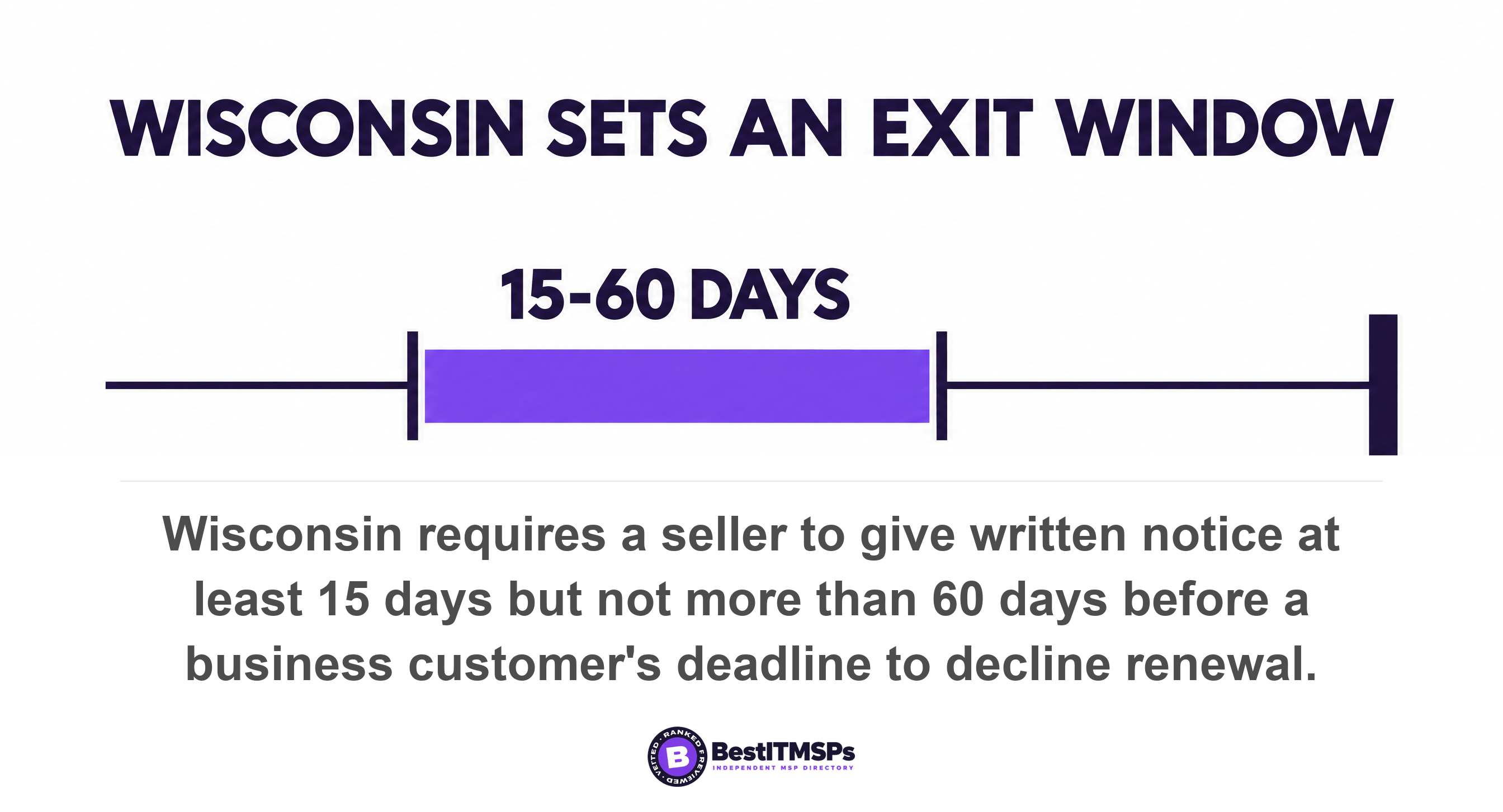
Where legislatures have intervened, they regulate the timing of renewals rather than the right to exit. New York's General Obligations Law section 5-903 requires a provider to warn its customer not less than fifteen days and not more than thirty days before the date set for the customer's termination notice. Wisconsin's section 134.49 requires a seller to give written notice at least 15 days but not more than 60 days before the deadline for the customer to decline renewal. Both statutes aim at the calendar. Neither creates a right to walk away mid-term, and whether either reaches a particular managed IT agreement is a question for a lawyer in that state.
Assignment on acquisition is the clause the federal buyer keeps for itself
On one question the federal rules take the position your own agreement probably reverses. Under the Anti-Assignment Act, the party to whom the Federal Government gives a contract or order may not transfer the contract or order, or any interest in the contract or order, to another party. A sale does not move the contract by itself. The buyer's own regulation then sets out what recognizing a transfer takes. The Government may, when in its interest, recognize a third party as the successor in interest to a Government contract, and only after the contractor supplies the transaction document, a list of every affected contract, evidence that the transferee can perform, a legal opinion that the transfer was properly effected, and audited balance sheets for both parties dated just before and after the transfer.
That is what consent looks like when the buyer holds it. An assignment on acquisition clause that lets your provider assign the agreement to whoever buys the firm hands you a provider you never evaluated, on terms you negotiated with somebody else, with no right to object. Managed IT is a consolidating market. Ask for consent now, while the question is still hypothetical.
What to do if your agreement has no convenience clause
If your agreement has no termination for convenience clause, work three moves in order, and do not open with a threat to terminate. That threat is the weakest card in your hand, because it is the one card you cannot play.
- Document performance from today, in writing, against the service levels in the agreement. Cause is a factual case and the file is the case, so log the tickets, the response times and the missed commitments while they are fresh.
- Price the exit before you want it. Ask, in one email, what the early termination fee would be today, what the offboarding fee covers, and how many days of wind-down services the agreement obliges them to provide. Those three answers are your position, whatever you decide to do with it.
- Trade at the renewal rather than mid-term. Providers routinely accept a mutual convenience right in exchange for a longer notice period, a reference, or a term they can forecast.
Leverage comes from knowing your alternatives, and most buyers hold more of them than they think. The median market in our directory lists 16 ranked managed IT providers, with 11 at the 25th percentile and 22 at the 75th, measured across 24,491 roster rows in 730 city datasets. We rank on verified rating and firmographic data, we label paid placement, and we do not sell IT services, so that count is a measurement rather than a pitch.
None of this needs a dispute to start. It needs one agreement, two clauses and a written question. Owners get trapped by a cause-only exit because nobody reads the termination section until the day they want to use it, and by then the only right they hold is the one that needs a lawyer and a year. Read it this week, price the exit, and ask for the mutual clause at the next renewal. An exit you have already priced is the only kind you can actually use.
FAQ
What is termination for convenience in an MSP contract?
Termination for convenience is the right to end an agreement because you want it ended, with no breach to prove. The federal commercial clause states it directly, reserving the right to terminate this contract, or any part hereof, for its sole convenience. Your own contract sets the notice period and any fee attached to it.
What is the difference between termination for cause and termination for convenience?
Termination for cause needs a reason you can prove, a written notice specifying the failure, and a cure period. Termination for convenience needs only notice. The standard federal default clause gives a contractor 10 days after receipt of the notice specifying the failure to cure it, which is the delay a cause exit costs you before it even begins.
What is a fair early termination fee?
A fair early termination fee covers work already done plus your provider's unavoidable costs of stopping. Federal settlement policy states that anticipatory profits and consequential damages shall not be allowed, so a fee set at the full remaining contract value charges you for service nobody will deliver. Whether a particular fee is enforceable depends on your state and your contract.
How long should wind-down services last after termination?
Up to 90 days is the published federal benchmark. The continuity of services clause requires a contractor to furnish phase-in, phase-out services for up to 90 days after this contract expires and to exercise its best efforts and cooperation to effect an orderly and efficient transition to a successor. The buyer pays for that help, at the contract's own margin.
Can my MSP transfer my contract if it is acquired?
That depends on your assignment on acquisition clause, and many allow a transfer without your consent. Federal practice is the reverse. The Anti-Assignment Act provides that the party to whom the Federal Government gives a contract or order may not transfer the contract or order to another party, and a successor is recognized only when in its interest after a documented novation.
Best IT MSP is the independent directory of vetted managed IT providers across the US and Canada. Organic ranking is earned on verified rating and firmographic data, paid placement is always labelled, and we do not sell IT services. Open the ranked list for your city, then ask three firms the same six questions about termination, transition and data.