What Is an MSSP?
An MSSP (Managed Security Services Provider) is a company that manages a business's cybersecurity as an outsourced service, typically including 24/7 monitoring, threat detection and response, and management of security tools like firewalls and endpoint protection. It differs from a general MSP (which handles all IT) by focusing specifically on security.
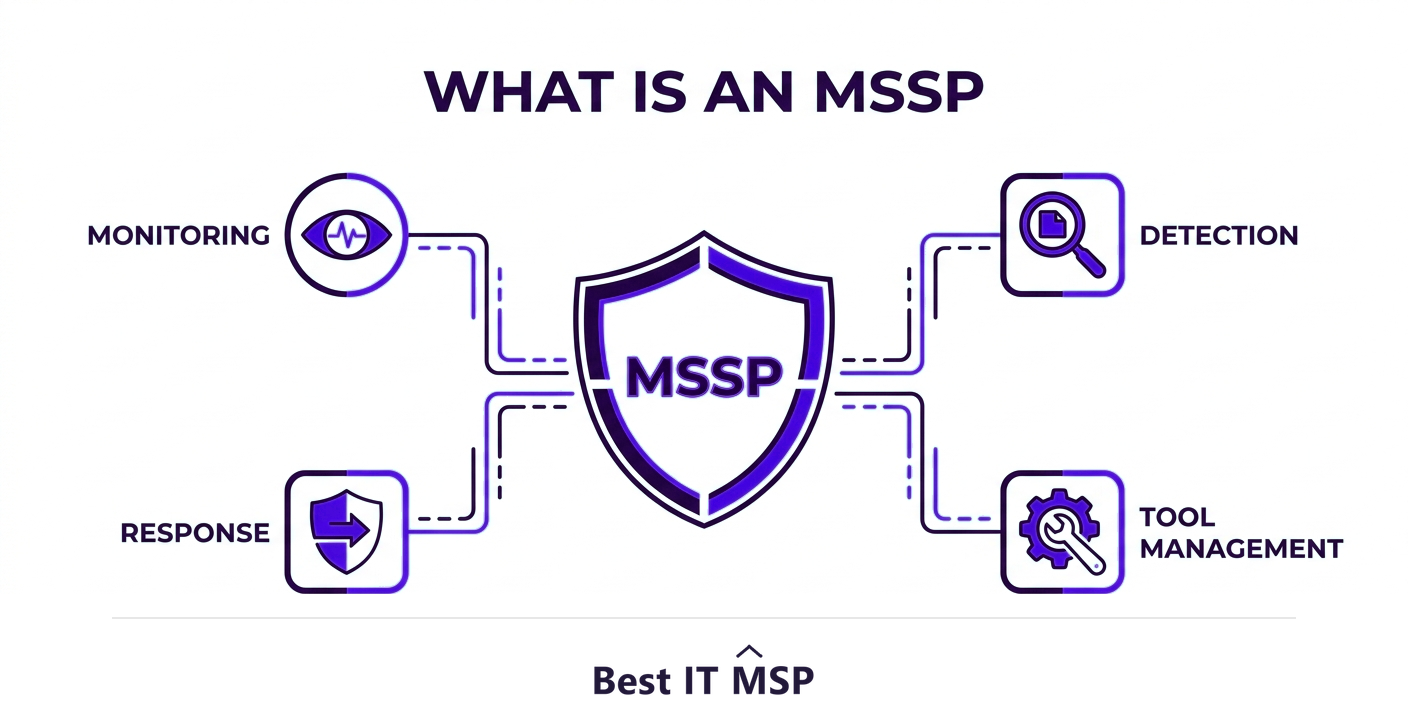
- An MSSP manages a business's cybersecurity as an outsourced, ongoing service.
- Core services include 24/7 monitoring, threat detection and response, and managing security tools.
- An MSSP focuses on security; a general MSP handles all of IT, and many providers do both.
- An MSSP gives a business the security operations center it could not staff in-house.
- Most small and midsize businesses use an MSSP because hiring a security team is hard and costly.
What is an MSSP?
An MSSP, or Managed Security Services Provider, is a company that manages a business's cybersecurity as an outsourced, ongoing service. Rather than building and staffing a security operation in-house, you hand responsibility for monitoring, detecting, and responding to threats, and for running your security tools, to a specialist whose entire focus is protecting clients. Think of an MSSP as your outsourced security department, complete with the around-the-clock monitoring and expertise that few businesses can build alone. As cyber threats have grown relentless and specialized, MSSPs have become a mainstream way for organizations of all sizes to get serious, professional security.
The driver is simple: threats are constant and expensive, with the average data breach reaching $4.88 million, the human element involved in 68 percent of breaches, and reported cybercrime losses topping $12.5 billion in a single year, yet the talent to defend against them is scarce, with a global shortfall of about 4.8 million cybersecurity professionals. An MSSP solves both problems at once. This guide explains what an MSSP does, how it differs from an MSP and from MDR, and who needs one. It pairs with our managed SOC and MDR and cybersecurity services overviews.
What does an MSSP do?
An MSSP delivers a range of security services, typically as a subscription. Core offerings include:
- <strong>24/7 security monitoring.</strong> Watching your systems around the clock from a security operations center (SOC), because attacks do not keep business hours.
- <strong>Threat detection and response.</strong> Identifying threats and acting to contain them, often through managed detection and response (MDR).
- <strong>Security tool management.</strong> Running and tuning your firewalls, endpoint protection, email security, and other defenses so they stay effective.
- <strong>Vulnerability management.</strong> Scanning for weaknesses and helping remediate them before attackers exploit them.
- <strong>Incident response.</strong> Helping you contain, investigate, and recover when an incident occurs.
- <strong>Compliance support.</strong> Helping meet security requirements of frameworks like HIPAA, PCI, or CMMC, with the documentation auditors expect.
MSSP vs MSP: what's the difference?
The terms look almost identical, but the focus differs. An MSP (Managed Service Provider) handles a business's IT broadly, support, infrastructure, cloud, help desk, and keeping everything running, with security as one part of the job. An MSSP (Managed Security Services Provider) specializes specifically in cybersecurity, with deeper security expertise, dedicated monitoring, and a security operations center. An MSP keeps your technology working; an MSSP keeps it secure.
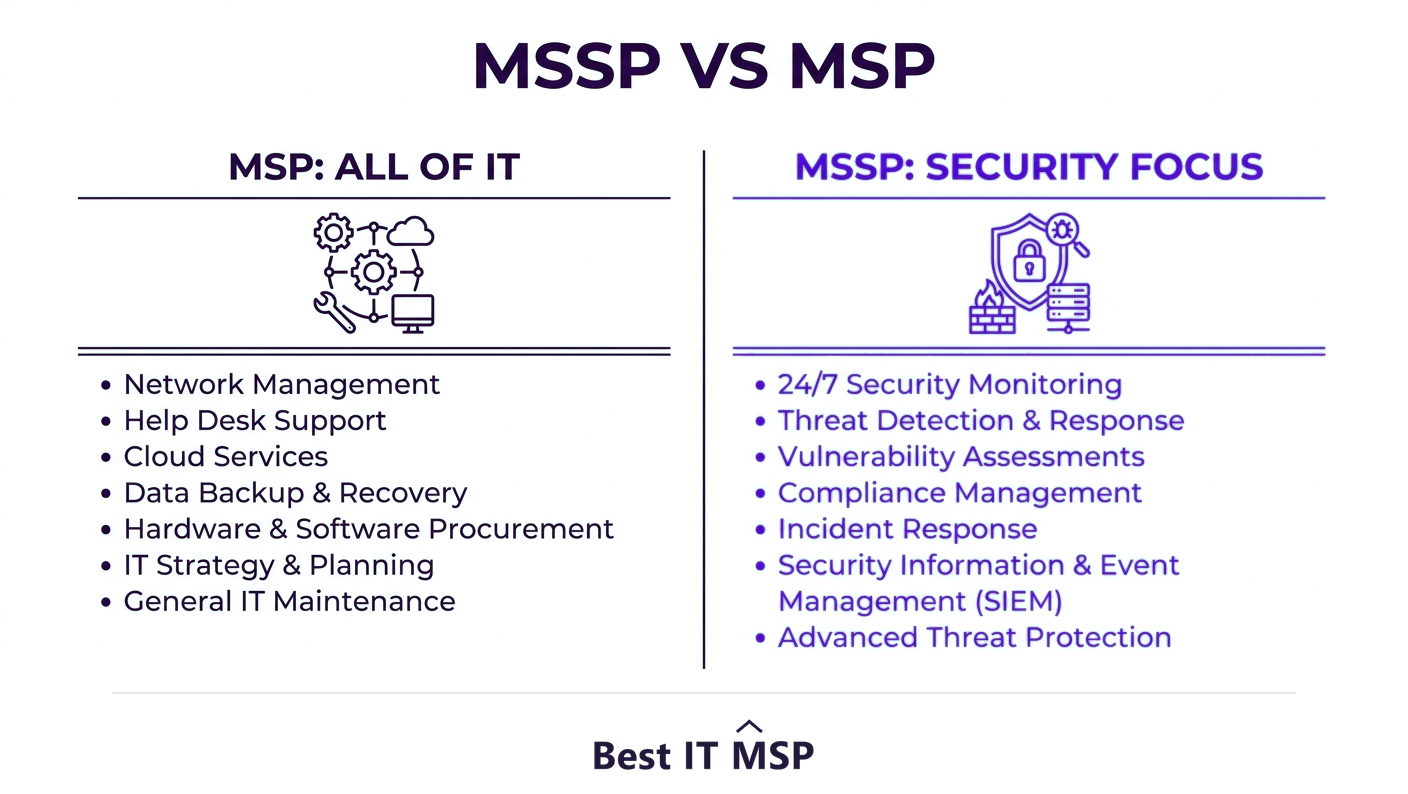
In practice the line blurs, because many modern MSPs include strong security or have grown into offering MSSP-level services, and many businesses prefer a single provider that delivers both their IT and their security under one relationship. The right question is not the label but the capability: make sure whoever you choose has genuine, dedicated security expertise and around-the-clock monitoring, not just security as an afterthought.
MSSP vs MDR: how they relate
MDR (Managed Detection and Response) is often mentioned alongside MSSP, and they overlap. MDR is a specific service focused on detecting and responding to threats, usually built around advanced endpoint and threat-detection technology with a human team that investigates and responds 24/7. An MSSP is broader: it may provide MDR as one of its services, alongside firewall management, vulnerability management, compliance support, and more. So MDR is often a capability within an MSSP's offering. Many businesses start with MDR for its strong detection-and-response value and expand into the wider set of services an MSSP provides as their needs grow.
Who needs an MSSP?
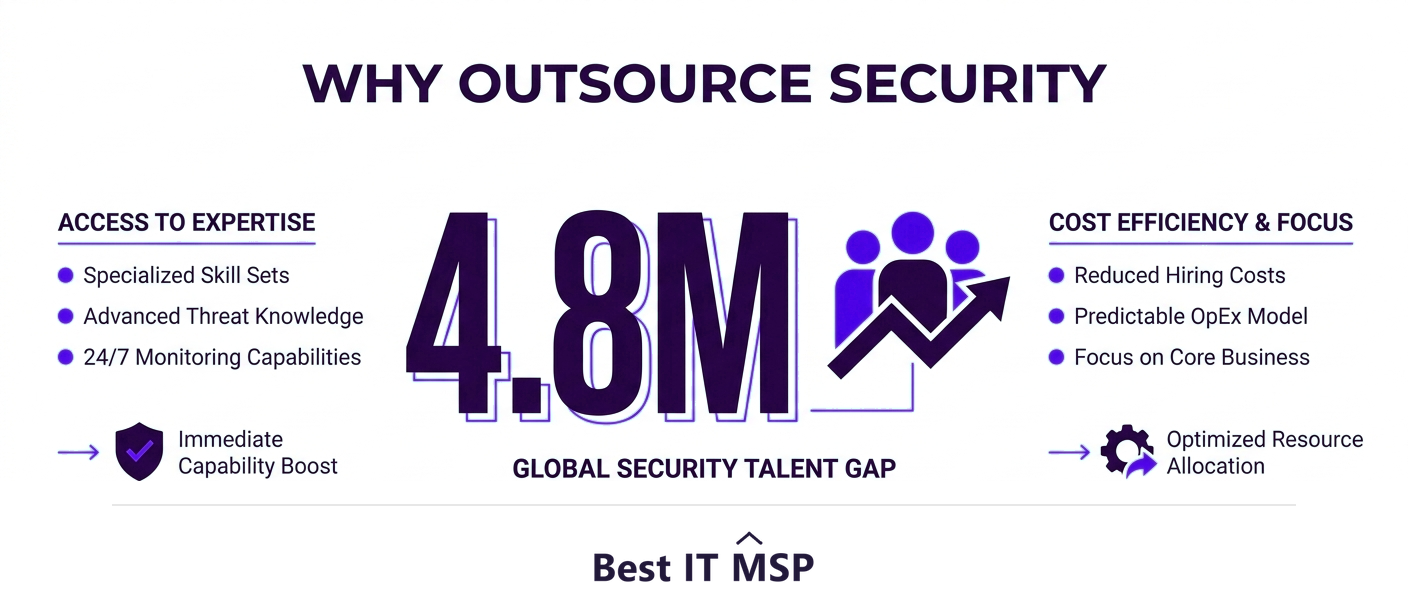
The honest answer is most businesses that take security seriously but cannot build a full security team, which describes the vast majority of small and midsize organizations. Effective security now requires around-the-clock monitoring and specialized skills that are genuinely hard to hire, given the 4.8 million-person talent gap, and prohibitively expensive to staff for 24/7 coverage. An MSSP spreads that expert team and infrastructure across many clients, so a small business gets the kind of security operations center that was once the exclusive preserve of large enterprises, for a predictable fee. If you handle sensitive data, face compliance requirements, or simply cannot afford a serious breach or the downtime it causes, which runs over $100,000 an hour, an MSSP is worth strong consideration.
The benefits of using an MSSP
The advantages mirror why managed services in general are so popular, applied to security:
- <strong>Expertise on demand.</strong> Access to specialized security professionals you could not afford to employ full time.
- <strong>24/7 coverage.</strong> Round-the-clock monitoring and response, including the nights and weekends when many attacks happen.
- <strong>Faster detection and response.</strong> Catching and containing threats quickly, which matters when the average breach takes about 258 days to identify and contain.
- <strong>Predictable cost.</strong> A flat fee instead of the large, unpredictable cost of building and staffing security in-house.
- <strong>Better tools.</strong> Access to enterprise-grade security technology the MSSP operates across its client base.
- <strong>Compliance help.</strong> Support meeting and documenting the security requirements your business faces.
How to choose an MSSP
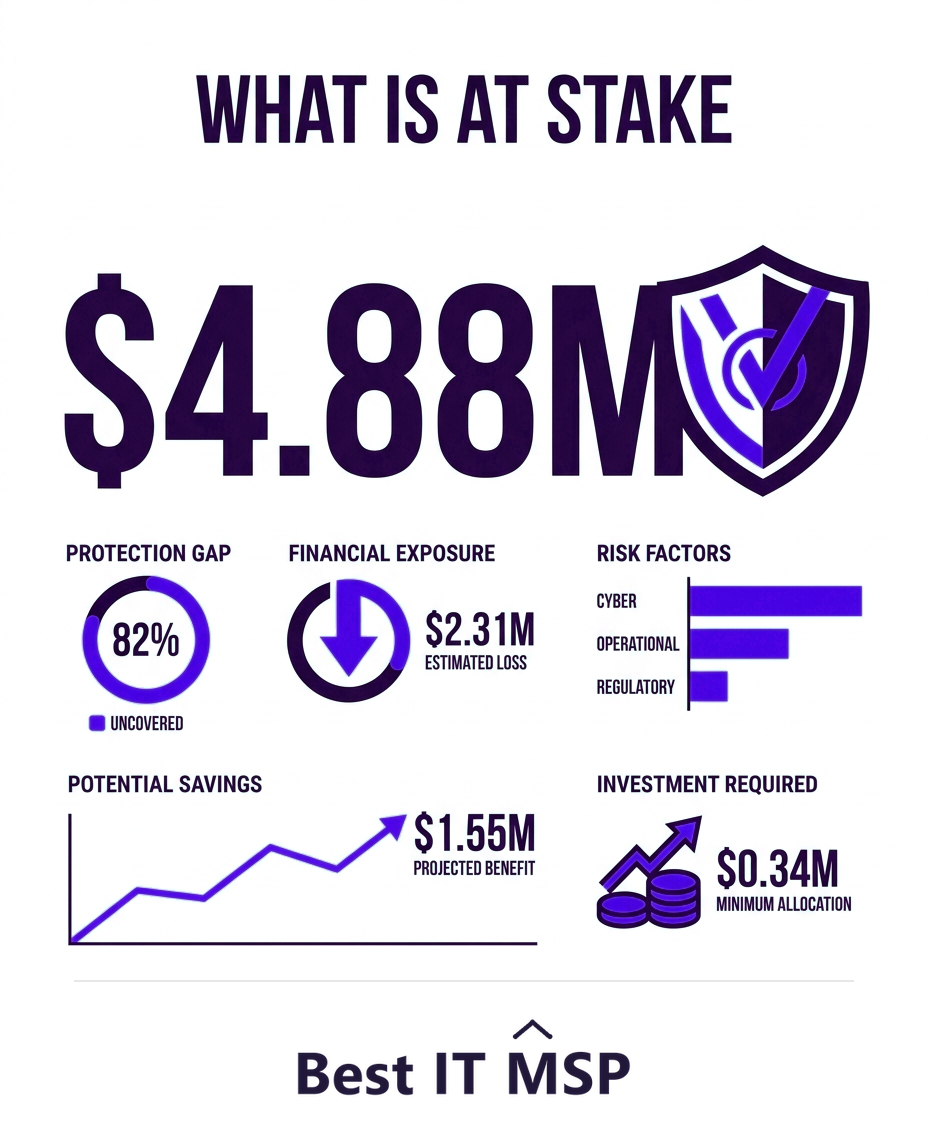
MSSPs vary widely, so choose carefully. Look for genuine 24/7 monitoring from a real security operations center (not just business-hours alerts), clear detection-and-response capabilities (ideally including MDR), experience with businesses your size and in your industry, transparency about what is and is not included, and the ability to support your specific compliance needs. Ask how fast they respond to incidents, who actually does the monitoring, and how they would handle a breach. And because security and IT are intertwined, consider whether you want an MSSP that also provides, or coordinates closely with, your general IT, so security and operations stay aligned. The stakes justify the diligence, with the average breach costing $4.88 million.
Finding the right security partner
An MSSP is how most businesses realistically get enterprise-grade security without building it themselves, which is why managed security has grown so fast, part of the broader managed services market projected to grow from about $330 billion in 2024 to about $879 billion over the next decade, as more of business runs in the cloud, in a market where public cloud spending is forecast to top $723 billion in 2025. The key is finding a provider with real security depth and a track record, rather than one that simply adds security as a label. Many businesses get the best of both worlds with a provider that delivers managed IT and managed security together, so their technology is both running well and properly protected.
If you are considering an MSSP or managed security, comparing vetted providers on merit is the place to start. Browse merit-ranked firms by city in the Best IT MSP directory, where ranking is earned on rating and verified data, not on who pays the most.
FAQ
What is an MSSP?
An MSSP, or Managed Security Services Provider, is a company that manages a business's cybersecurity as an outsourced, ongoing service. It typically provides 24/7 monitoring from a security operations center, threat detection and response, and management of security tools like firewalls and endpoint protection. Think of it as your outsourced security department.
What does an MSSP do?
An MSSP delivers 24/7 security monitoring from a SOC, threat detection and response (often via MDR), management and tuning of security tools like firewalls and endpoint protection, vulnerability management, incident response, and compliance support. The services are usually provided as a subscription, giving a business professional security operations without building them in-house.
What is the difference between an MSSP and an MSP?
An MSP (Managed Service Provider) handles a business's IT broadly, support, infrastructure, cloud, and help desk, with security as one part. An MSSP (Managed Security Services Provider) specializes specifically in cybersecurity, with deeper security expertise, dedicated monitoring, and a security operations center. An MSP keeps technology working; an MSSP keeps it secure. Many providers now do both.
What is the difference between an MSSP and MDR?
MDR (Managed Detection and Response) is a specific service focused on detecting and responding to threats, built around advanced detection technology with a 24/7 human team. An MSSP is broader and may provide MDR as one of its services alongside firewall management, vulnerability management, and compliance support. So MDR is often a capability within an MSSP's offering.
Who needs an MSSP?
Most businesses that take security seriously but cannot build a full in-house security team, which is the vast majority of small and midsize organizations. Effective security needs 24/7 monitoring and specialized skills that are hard to hire amid a 4.8 million-person talent gap and expensive to staff around the clock. An MSSP delivers that affordably.
How do I choose an MSSP?
Look for genuine 24/7 monitoring from a real security operations center, clear detection-and-response capabilities including MDR, experience with businesses your size and industry, transparency about what is included, and support for your compliance needs. Ask how fast they respond to incidents and who does the monitoring, and consider whether you want one provider for both IT and security.
Best IT MSP is the independent directory of vetted managed IT and security providers across North America. Compare merit-ranked firms in your city that deliver managed security and MDR. No pay-to-play.