SMB Cybersecurity: Where to Start
SMB cybersecurity does not require a big budget to start, it requires the right priorities. Small businesses are targeted because their defenses are often thin, but a short list of high-impact basics, multi-factor authentication, tested backups, endpoint protection, email security, prompt patching, and security awareness training, stops the majority of attacks.
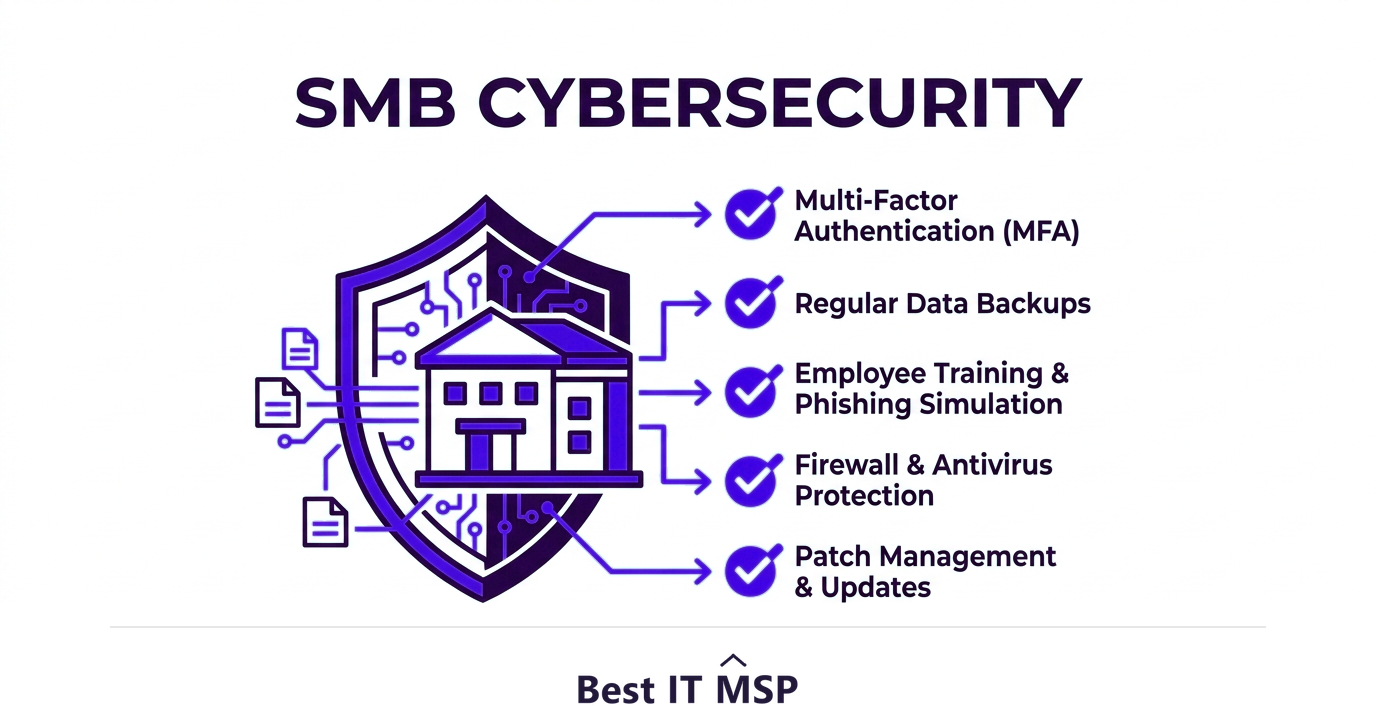
- Small businesses are targeted precisely because their defenses are often thinner than large enterprises.
- A handful of basics, multi-factor authentication, backups, endpoint protection, and email security, stop most attacks.
- The human element drives most breaches, so security awareness training is one of the highest-value steps.
- Follow a prioritized roadmap aligned to a recognized framework like the CIS Controls rather than buying tools at random.
- Most SMBs reach strong security fastest by combining the basics with expert help where skills run out.
Where to start with SMB cybersecurity
For a small or midsize business, cybersecurity can feel overwhelming: endless products, jargon, and threats, with no obvious place to begin. The good news is that strong SMB cybersecurity does not start with a big budget or a wall of tools. It starts with the right priorities. A short list of high-impact basics stops the large majority of real-world attacks, and you can layer on more as you grow. The mistake most small businesses make is either doing nothing because it seems too hard, or buying random tools without a plan. This guide gives you a clear, prioritized starting point: why you are a target, the essential first controls, and the roadmap to follow.
It pairs with our cybersecurity services overview, the email security page, and our guide to email security best practices.
Why small businesses are targeted
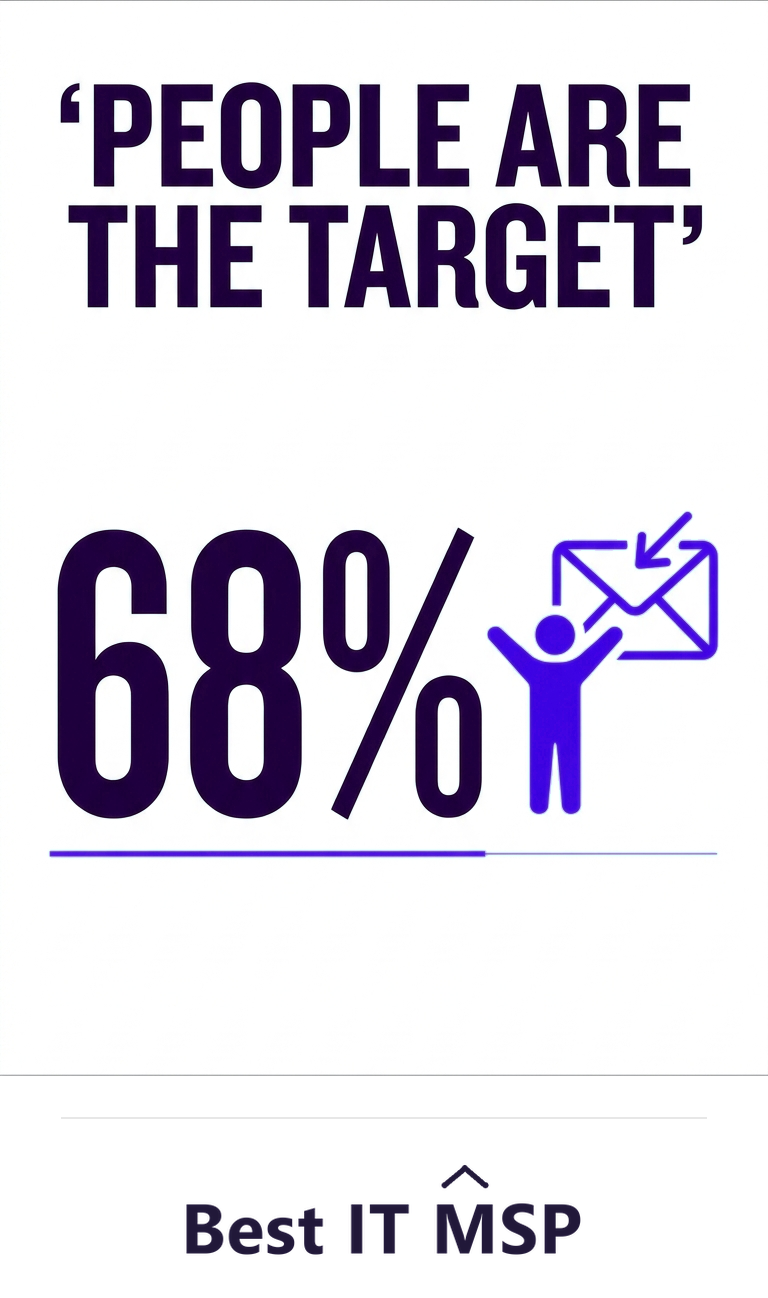
A common and dangerous myth is that attackers only go after big companies. In reality, small businesses are attractive targets precisely because their defenses are often thinner, while the data and money they hold are still worth stealing. Much of this is automated: attackers scan broadly for easy targets, and a small business with weak defenses is exactly that. The cost when an attack lands is not scaled down either, with the average data breach reaching $4.88 million and an hour of downtime costing most organizations more than $100,000. Most attacks start with people, not technology: the human element is involved in 68% of breaches, through phishing, stolen passwords, and simple mistakes. That single fact shapes where a small business should focus first.
The essential first controls
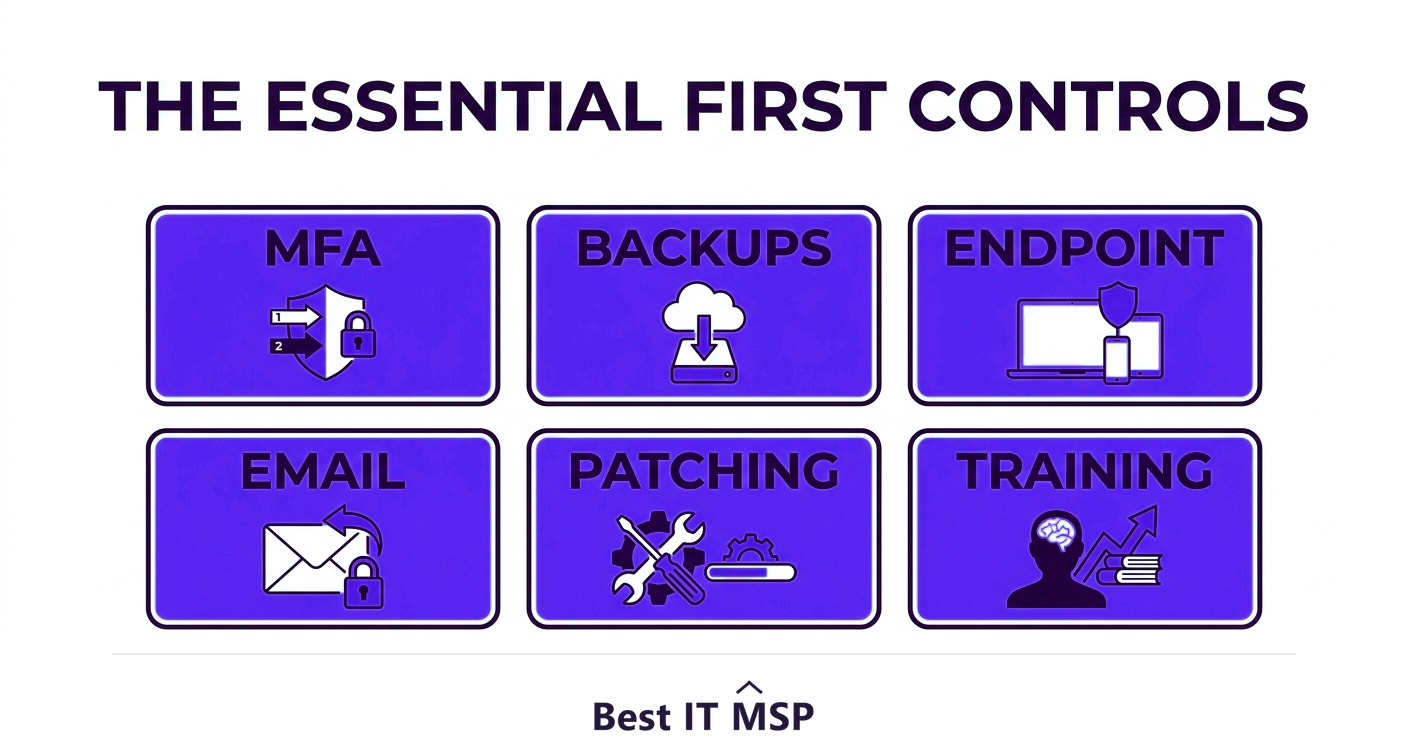
If you do nothing else, do these. They are high-impact, mostly low-cost, and together they block the majority of attacks small businesses face:
- <strong>Multi-factor authentication (MFA).</strong> Turn on MFA everywhere, especially email and any remote access. It is the single most effective step against stolen passwords and account takeover.
- <strong>Tested backups.</strong> Keep regular, isolated, tested backups so ransomware or a mistake never means permanent loss. A backup you have never restored is only a hope.
- <strong>Endpoint protection.</strong> Deploy modern endpoint protection on every device to detect and block malware and ransomware.
- <strong>Email security.</strong> Filter phishing and malicious attachments, since email is the number-one way attackers get in.
- <strong>Prompt patching.</strong> Keep operating systems and software updated so you patch known vulnerabilities before attackers exploit them.
- <strong>Security awareness training.</strong> Teach your team to spot phishing and report it, because people are both the top target and the best early-warning system.
Build a prioritized roadmap
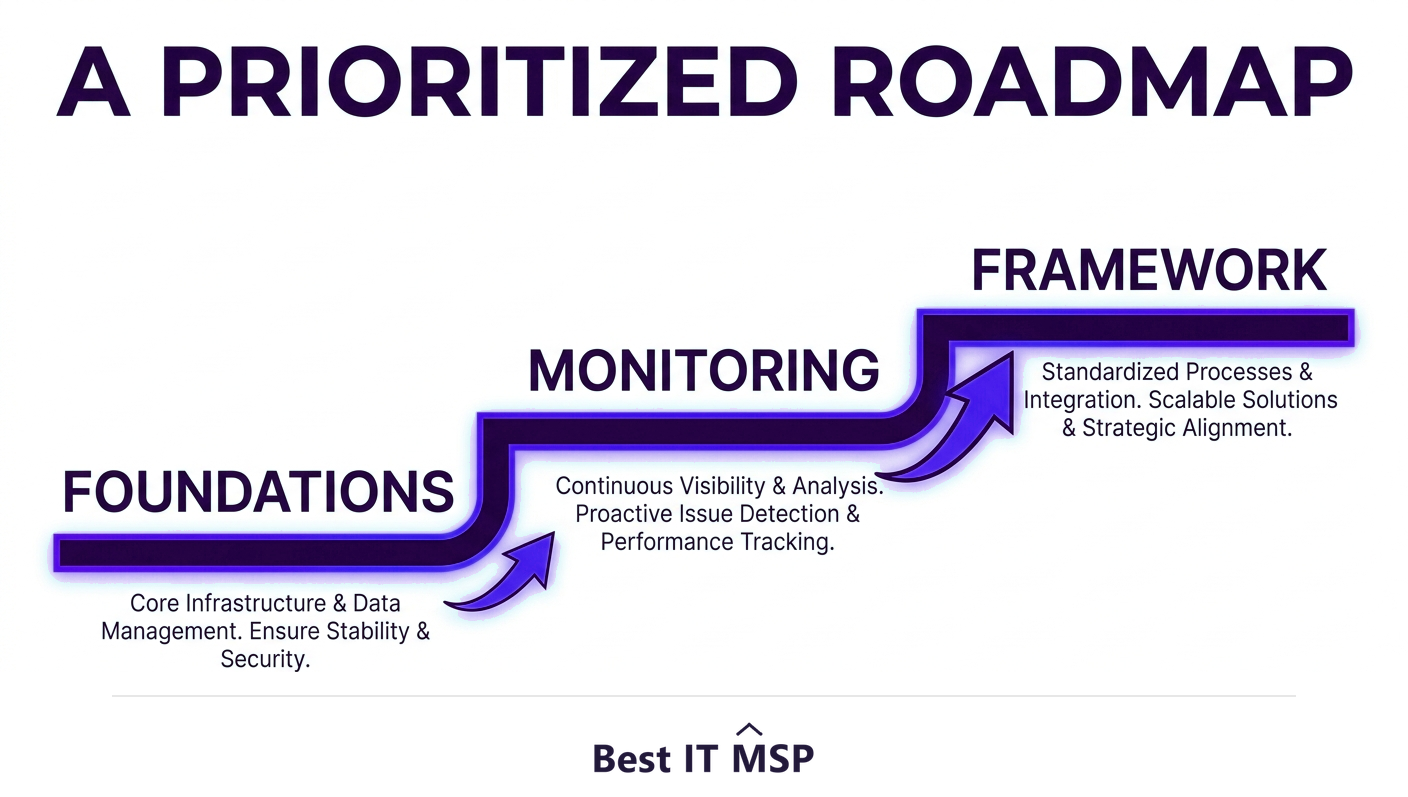
Once the basics are in place, grow deliberately rather than randomly. A sensible roadmap moves through three stages. First, foundations: the essential controls above, plus a password manager and the principle of least privilege so people only have the access they need. Second, visibility and response: monitoring that can detect suspicious activity and someone, internal or external, ready to respond, which matters because breaches take an average of 258 days to identify and contain. Third, maturity: align to a recognized framework so you are not guessing. The CIS Controls and the NIST Cybersecurity Framework both give small businesses a prioritized, sensible checklist, and many compliance requirements map to them. Automation pays off as you mature, with organizations using security automation extensively saving an average of $2.22 million per breach.
When to bring in help
Some of this a capable small business can do itself, turning on MFA, choosing backups, training staff. Other parts, 24/7 monitoring, threat detection and response, and keeping pace with evolving threats, are genuinely hard to do alone, especially given a global shortfall of about 4.8 million cybersecurity professionals that makes hiring security talent difficult and expensive. This is why so many small businesses partner with a managed service provider or managed security provider for the parts that need round-the-clock expertise, and it is a major reason the managed services market is growing from about $330 billion in 2024 toward $879 billion over the next decade. The smart pattern is to own the basics internally and bring in expert help where the skill or coverage gap is real.
The aim is a proactive security posture that protects the business continuously, rather than a reactive scramble after something has already gone wrong. A good provider monitors around the clock, responds quickly when an alert fires, and steadily raises your maturity over time, and modern managed security plans make that level of protection genuinely affordable even on a small business budget. Crucially, outside help does not replace your responsibility; it amplifies it. You still set the priorities, enforce the basics, and decide what matters most, while the provider supplies the tools, monitoring, and specialist skills that would be impractical to build in-house. That combination, internal ownership plus expert support, is what reliably protects a small business at a cost it can sustain.
Getting SMB cybersecurity right
Cybersecurity for a small business is not about doing everything at once; it is about doing the right things in the right order. Start by accepting that you are a target, then put the essential controls in place, multi-factor authentication, tested backups, endpoint protection, email security, patching, and training, because they stop most attacks for little cost. From there, add monitoring and align to a framework like the CIS Controls, and bring in expert help where you need round-the-clock coverage. Done this way, strong security is well within reach for any small business.
If you want help building or strengthening your SMB cybersecurity, comparing vetted providers on merit is the place to start. Browse merit-ranked managed IT and security firms by city in the Best IT MSP directory, where ranking is earned on rating and verified data, not on who pays the most. You can also explore our managed SOC and MDR overview.
FAQ
Where should a small business start with cybersecurity?
Start with a short list of high-impact basics rather than buying tools at random: turn on multi-factor authentication everywhere, set up tested backups, deploy endpoint protection on every device, filter phishing with email security, patch software promptly, and train staff to spot phishing. These foundational controls stop the majority of attacks small businesses face, at relatively low cost.
Why are small businesses targeted by cyberattacks?
Because their defenses are often thinner than large enterprises, while the data and money they hold are still worth stealing. Many attacks are automated, scanning broadly for easy targets, and a small business with weak defenses fits that profile. The cost when an attack succeeds is not scaled down, with the average breach reaching $4.88 million and downtime costing over $100,000 an hour.
What is the most important cybersecurity step for an SMB?
Multi-factor authentication is the single highest-impact step, because it defeats stolen passwords and account takeover, which are behind a large share of breaches. Closely behind it are tested backups, which neutralize ransomware, and security awareness training, since the human element is involved in 68% of breaches. Together these address where small businesses are most exposed.
Does SMB cybersecurity require a big budget?
No. The most effective starting controls, multi-factor authentication, patching, staff training, and email filtering, are low-cost or already included in tools you likely own, such as Microsoft 365. The key is prioritizing high-impact basics first, then adding monitoring and more advanced protection as you grow, and bringing in outside help only where round-the-clock expertise is genuinely needed.
What cybersecurity framework should a small business follow?
The CIS Controls and the NIST Cybersecurity Framework are both well suited to small businesses. They provide a prioritized, sensible checklist so you implement the highest-value controls first rather than guessing, and many compliance requirements map to them. Aligning to a recognized framework also makes it far easier to demonstrate due diligence to customers, insurers, and regulators.
Should a small business outsource cybersecurity?
Often, at least in part. A capable small business can handle the basics like MFA, backups, and training itself, but 24/7 monitoring, threat detection and response, and keeping pace with evolving threats are hard to do alone, especially amid a 4.8 million-person cybersecurity talent gap. Many SMBs own the basics internally and partner with a managed provider for the parts needing round-the-clock expertise.
Best IT MSP is the independent directory of vetted managed IT and security providers across North America. Compare merit-ranked firms in your city that help small businesses get secure. No pay-to-play.