Break-Fix vs Managed IT Services
Break-fix IT means paying a technician by the hour to fix problems after they happen, while managed services means paying a predictable monthly fee for proactive monitoring, maintenance, and support that prevents most problems.
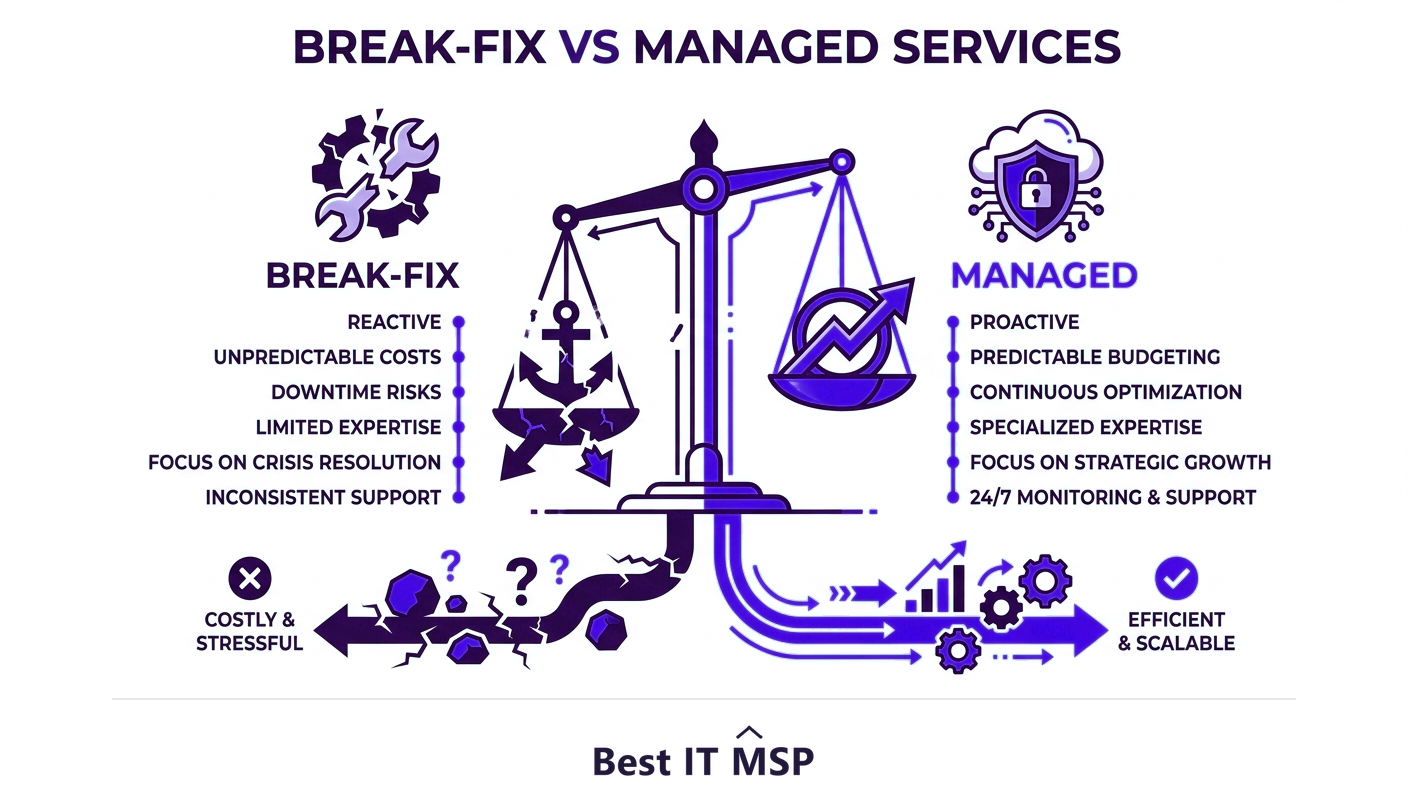
- Break-fix IT is reactive and billed hourly; managed services is proactive and billed at a flat monthly fee.
- Break-fix incentives are misaligned, the provider profits when things break, while managed services rewards prevention.
- Managed services includes 24/7 monitoring, maintenance, and security that break-fix does not.
- Break-fix can still suit very small businesses with minimal, non-critical technology.
- Most businesses that depend on technology have moved to managed services for predictability and uptime.
How did we compare break-fix and managed services?
By following the money, because the sharpest difference between these two is not the work performed but who profits when something breaks.
- The dimensions. When the work happens, how it is billed, who carries the risk of an outage, and which way each arrangement points a provider's incentives.
- The evidence. Downtime cost comes from ITIC, breach cost and disruption from IBM, the security hiring gap from ISC2, and market size from Fortune Business Insights.
- No vendor ranking. This compares approaches, not products. It names no vendors and recommends no supplier.
- Independence. Best IT MSP does not sell IT services or security services, and does not appear in its own rankings.
The incentive row in the table is the one to read twice. It is the only row a provider cannot change without changing its business model.
What is the difference between break-fix and managed services?
When a business needs outside IT help, it faces a basic choice between two models. Break-fix means you call a technician when something breaks and pay them by the hour to fix it, a transaction repeated each time something goes wrong. Managed services means you pay a managed service provider a predictable monthly fee to proactively monitor, maintain, secure, and support your technology on an ongoing basis, so most problems are prevented or caught early. The difference is not just billing; it is a fundamentally different relationship with your technology. This guide compares the two on cost, coverage, and incentives, explains why most businesses have moved to managed services, and notes when break-fix still makes sense.
It pairs with our managed IT services hub and the IT support services page, and builds on our explainer on what a managed service provider is.
What is break-fix IT?
Break-fix is the traditional, on-demand model. Something breaks, a server goes down, a laptop will not boot, the network drops, and you call a provider who comes out, diagnoses the issue, fixes it, and bills you for the time and parts. There is no ongoing relationship or monthly cost; you pay only when you need help. For a long time this was how most small businesses handled IT, and it has a surface appeal: you are not paying for anything when nothing is wrong. The catch is in the word break. Break-fix is purely reactive, which means by definition you are only getting help after a problem has already disrupted your business, and there is no one watching to prevent the next one.
What is managed IT services?
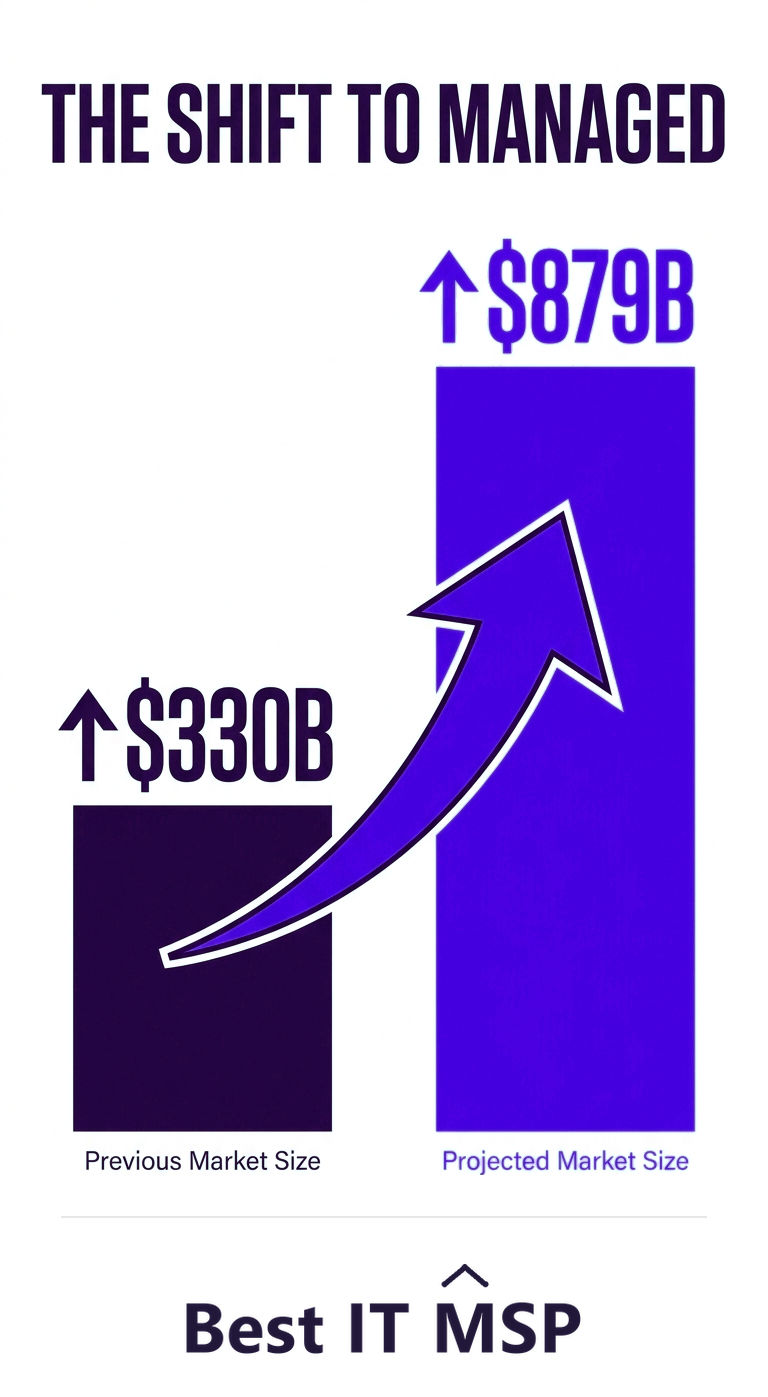
Managed IT services replaces that reactive cycle with a proactive, ongoing partnership. For a flat monthly fee, a managed service provider continuously monitors your systems, applies patches and maintenance, manages your cybersecurity, runs your backups, staffs a help desk, and helps you plan, all designed to keep your technology healthy rather than waiting for it to fail. The relationship is governed by a service-level agreement that defines response and resolution times. In effect, you get an outsourced IT department working in the background every day, not just a repair service you summon in a crisis. Managed services is now the dominant model, and the market reflects it, growing from about $330 billion in 2024 toward $879 billion over the next decade.
How do break-fix and managed services differ on incentives?
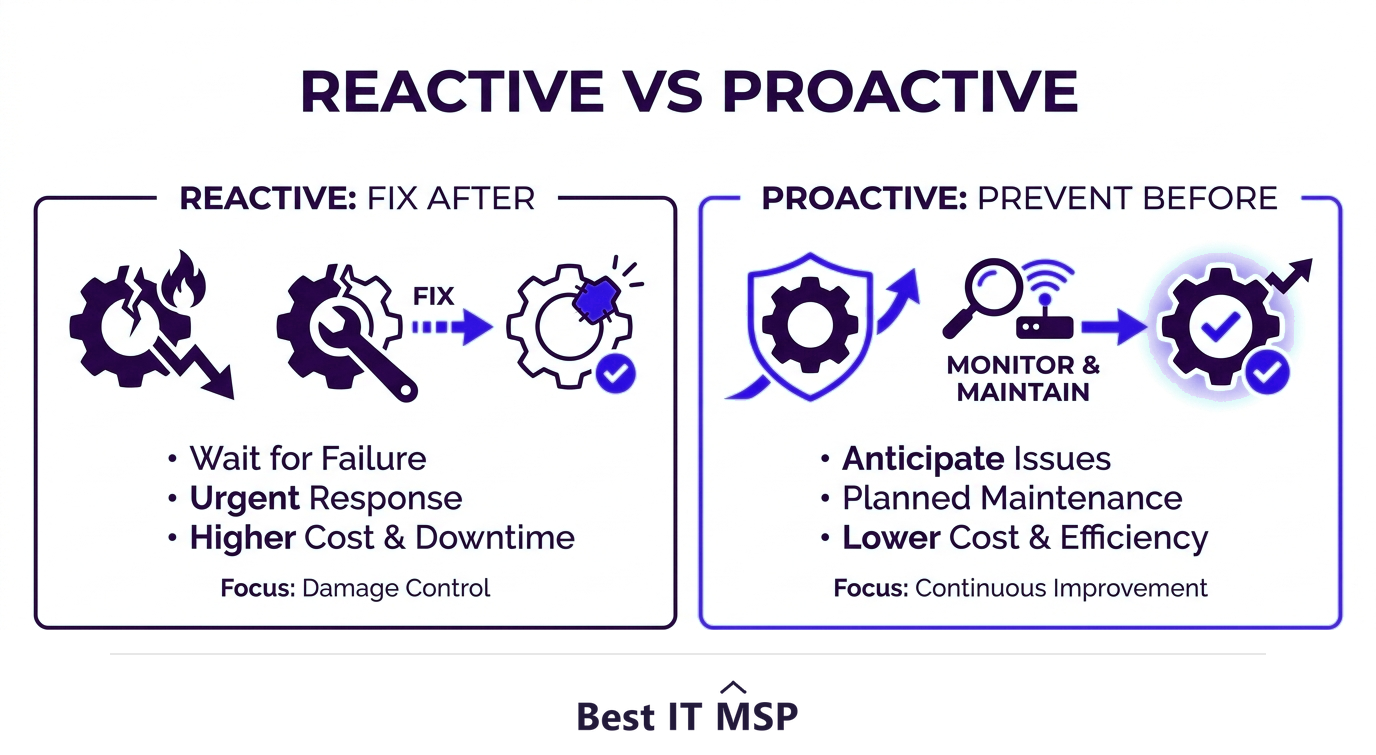
Two differences matter most. The first is reactive versus proactive. Break-fix only acts after something breaks, so you absorb the full disruption of every incident; managed services watches continuously and prevents or catches issues early. The second, and more subtle, is incentives. Under break-fix, the provider makes money when things go wrong, more failures mean more billable hours, which quietly rewards problems rather than uptime. Under managed services, the provider is paid a flat fee to keep everything running, so preventing problems is in their financial interest too. That alignment is the deeper reason managed services tends to produce better outcomes: your goals and your provider's goals point the same direction.
| Dimension | Break-fix | Managed services |
|---|---|---|
| When the work happens | After something breaks | Continuously, mostly before you notice |
| How you are billed | By the hour, per incident | A predictable monthly fee |
| Who carries outage risk | You | Shared, and priced into the fee |
| Budget predictability | None; a bad month is a bad invoice | Fixed, and forecastable |
| Provider incentive | More failures mean more billable hours | Fewer failures protect the provider's margin |
Which one costs less?
On paper, break-fix can look cheaper because you pay nothing when nothing breaks. But that ignores the real cost: downtime. When a break-fix problem strikes, your systems are down while you wait for a technician, and an hour of downtime costs most organizations more than $100,000. One serious incident can erase any savings from skipping a monthly fee. Managed services turns IT into a predictable, flat operating expense and is designed to minimize exactly that downtime. It also strengthens security, which matters because the average breach costs $4.88 million and takes an average of 258 days to identify and contain, with automation saving breached organizations an average of $2.22 million. For any business that genuinely depends on its technology, the predictable model usually costs less over time, not more.
Reactive support means absorbing the disruption rather than avoiding it, and the disruption is the expensive part. IBM found that 70% of the organisations it studied reported operations either significantly or moderately disrupted by a breach, and that the global average breach cost rose 10% year on year, the largest single jump since the pandemic. Those are the years a per-hour arrangement is worst at absorbing.

When does break-fix still make sense?
Break-fix is not always wrong. For a very small business with minimal, non-critical technology, a couple of computers, no servers, little sensitive data, and high tolerance for occasional downtime, paying only when something breaks can be reasonable. The same can apply to one-off projects or hardware that sits outside your core operations. The honest test is dependency: how much does your business lose if a system is down for a day, and how much sensitive data would a breach expose? If the answer is little, break-fix may be fine. If your operations, revenue, or reputation depend on technology, and given a global shortfall of about 4.8 million cybersecurity professionals makes self-managing security hard, the proactive model is almost always the safer choice, especially since organizations facing a security skills shortage saw breach costs about $1.76 million higher.
Why have most businesses moved to managed services?
The market has voted clearly. As businesses grew more dependent on technology and more exposed to cyber threats, the gaps in break-fix, no prevention, no monitoring, no security coverage, and misaligned incentives, became too costly to accept. Managed services answered all of them with proactive monitoring, predictable cost, real security, and a provider whose success depends on keeping you running. That is why the model has become standard and the market continues its rapid climb toward $879 billion. For most organizations, the question is no longer whether to move from break-fix to managed services, but which provider to choose.
How do you get the choice right?
Choosing between break-fix and managed services comes down to how much you depend on your technology. If it is central to your business, managed services delivers the prevention, coverage, security, and predictable cost that break-fix structurally cannot, and it aligns your provider's incentives with your uptime. If your needs are genuinely minimal, break-fix may still serve. Most growing businesses find that the moment technology becomes critical is the moment to switch.
If you are weighing managed services, comparing providers on merit is the place to start. Browse merit-ranked managed service providers by city in the Best IT MSP directory, where ranking is earned on rating and verified data, not on who pays the most. You can also compare staffing models in our guide to managed IT vs in-house IT.
- What does an hour of downtime actually cost you? Until you can answer that, neither model can be priced. Most firms have never worked it out and guess low.
- How much of your estate is business-critical? If one system stops the whole company, reactive support is a gamble with the odds against you.
- Do you need budget certainty more than a low headline rate? Break-fix is often cheaper in a quiet year and far more expensive in a bad one.
- Who is doing the preventative work today? If the answer is nobody, you are already running a break-fix model whatever the contract says.
FAQ
What is the difference between break-fix and managed services?
Break-fix means paying a technician by the hour to fix problems after they happen, with no ongoing relationship. Managed services means paying a managed service provider a predictable monthly fee to proactively monitor, maintain, secure, and support your technology, preventing most problems. Break-fix is reactive; managed services is proactive, and their incentives differ fundamentally.
Is break-fix cheaper than managed services?
It can look cheaper because you pay nothing when nothing breaks, but that ignores downtime. When a problem strikes under break-fix, systems are down while you wait for a technician, and an hour of downtime costs most organizations more than $100,000. One serious incident can erase the savings, so for technology-dependent businesses, managed services usually costs less over time.
Why are managed services incentives better than break-fix?
Under break-fix, the provider earns more when things break, since failures mean billable hours, which quietly rewards problems rather than uptime. Under managed services, the provider is paid a flat fee to keep everything running, so preventing problems is in their financial interest. This alignment means your goals and your provider's goals point in the same direction.
When does break-fix IT still make sense?
Break-fix can be reasonable for a very small business with minimal, non-critical technology, a couple of computers, no servers, little sensitive data, and tolerance for occasional downtime, or for one-off projects and non-core hardware. The test is dependency: if losing a system for a day costs little and a breach would expose little, break-fix may suffice.
What does managed IT services include that break-fix does not?
Managed services includes proactive 24/7 monitoring, regular patching and maintenance, cybersecurity, backups, a staffed help desk, and IT strategy, all delivered continuously for a flat fee under a service-level agreement. Break-fix includes none of this ongoing prevention or coverage; it provides only reactive repairs after something has already broken.
Should my business switch from break-fix to managed services?
If your operations, revenue, or reputation depend on technology, yes. Managed services provides the prevention, monitoring, security, and predictable cost that break-fix structurally cannot, and aligns your provider's incentives with your uptime. Most growing businesses switch at the point technology becomes critical. If your needs are genuinely minimal and non-critical, break-fix may still be adequate.
Best IT MSP is the independent directory of vetted managed service providers across North America. Compare merit-ranked firms in your city that deliver proactive managed services. No pay-to-play.