Common Network Security Vulnerabilities (and How to Fix Them)
The most common network security vulnerabilities are weak or reused passwords, unpatched software, misconfigurations, phishing-prone users, missing multi-factor authentication, unsecured remote access, flat networks with no segmentation, and shadow IT. Almost all are preventable. Fixing them comes down to a few disciplined habits: patch, enforce MFA, configure carefully, segment, train staff, and monitor continuously.
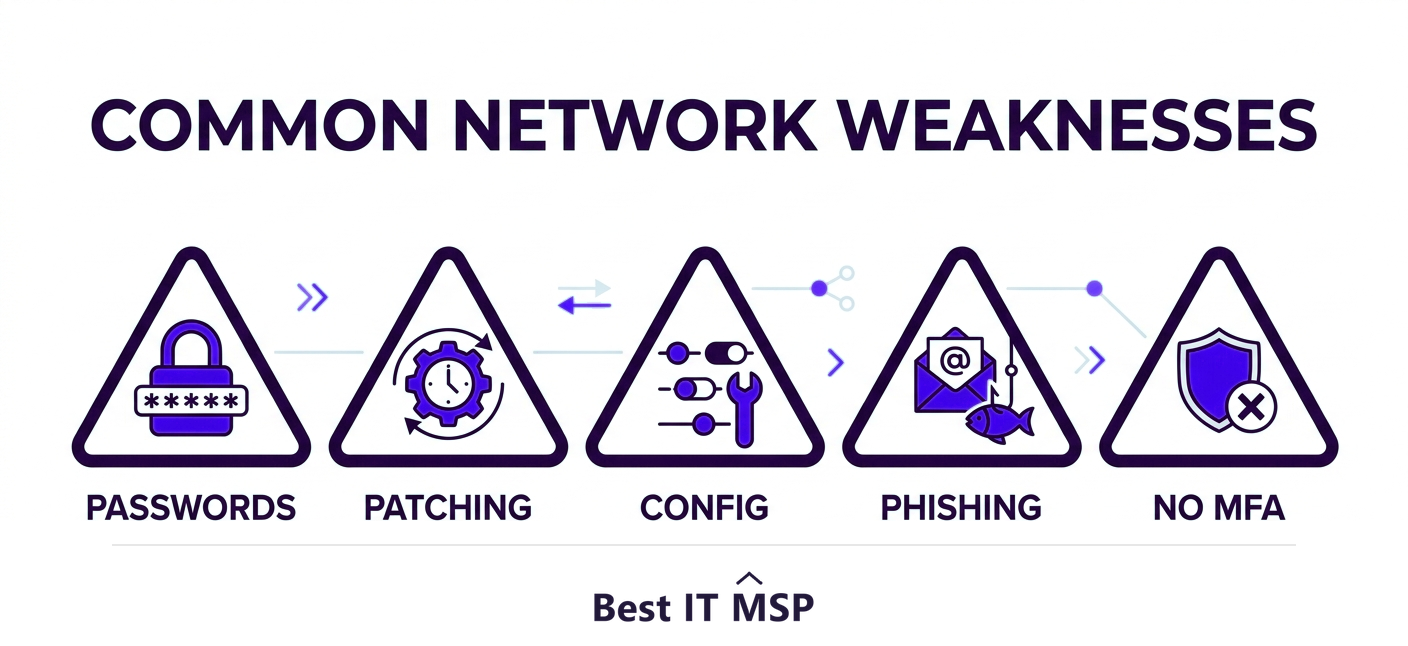
- Most network breaches exploit a handful of common, preventable vulnerabilities, not exotic zero-days.
- Weak passwords, unpatched software, and misconfigurations are the most frequent and most fixable weaknesses.
- The human element is involved in most breaches, so phishing-prone users are a top vulnerability.
- Flat networks, missing MFA, and unsecured remote access let a single foothold become a full compromise.
- A regular vulnerability assessment plus patching, MFA, segmentation, and monitoring closes most gaps.
What is a network security vulnerability?
A network security vulnerability is any weakness in your network, systems, or practices that an attacker can exploit to gain access, steal data, or cause disruption. The uncomfortable truth is that most breaches do not rely on exotic, never-seen-before exploits. They exploit a small set of common, well-understood, and entirely preventable weaknesses that businesses simply never got around to closing. That is good news: if you know the usual suspects, you can find and fix most of your real risk.
The cost of leaving these gaps open is high. The average data breach reached $4.88 million in 2024, reported cybercrime losses topped $12.5 billion in a single year, and an hour of downtime costs most organizations more than $100,000. This guide walks through the most common network security vulnerabilities and how to fix each one. It pairs with our cybersecurity and network support overviews.
The most common network security vulnerabilities
These weaknesses appear again and again in real-world breaches. Most businesses have at least a few of them right now:
- <strong>Weak, reused, or default passwords.</strong> Easy-to-guess or shared credentials are among the simplest ways in, and stolen passwords get replayed across accounts.
- <strong>Unpatched software and firmware.</strong> Known flaws in operating systems, applications, and network gear that vendors have already fixed, but the business never applied.
- <strong>Misconfigurations.</strong> Open ports, default settings, over-broad permissions, and exposed cloud storage, often the single largest source of incidents.
- <strong>Phishing-prone users.</strong> Staff who can be tricked into clicking links or handing over credentials, the entry point for most attacks.
- <strong>Missing multi-factor authentication.</strong> Without MFA, a single stolen password is enough to log in.
- <strong>Unsecured remote access.</strong> Exposed remote desktop, weak VPNs, and home devices that bridge straight into the network.
- <strong>Flat networks with no segmentation.</strong> When everything is connected to everything, one foothold gives an attacker the whole environment.
- <strong>Shadow IT and unmanaged devices.</strong> Unapproved apps and personal devices no one is securing or monitoring.
People are the biggest vulnerability
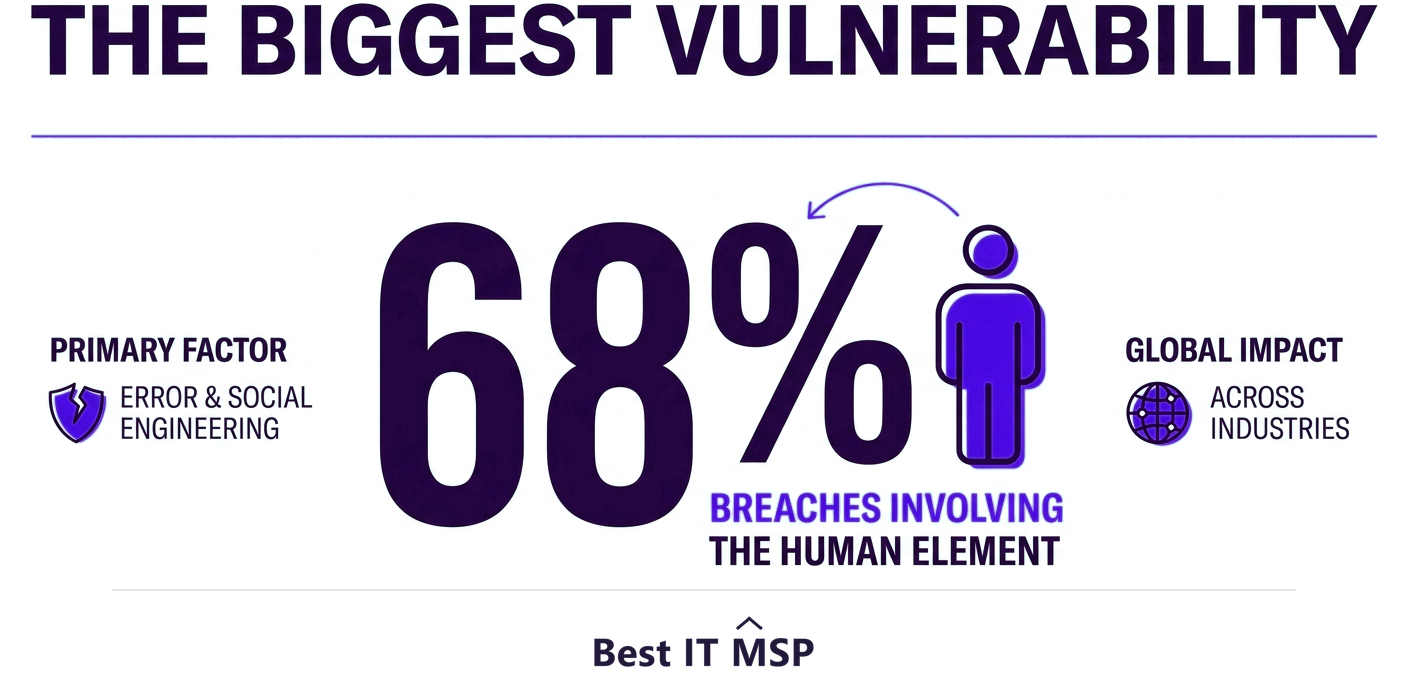
The hardest vulnerability to patch is human. Verizon's research found the human element was involved in 68 percent of breaches, whether through a phishing click, a reused password, or a simple mistake. Attackers know it is far easier to trick a person than to defeat a firewall, so they target inboxes and habits. This is why security awareness training is not a soft extra; it directly closes the most exploited vulnerability in most organizations. A trained, skeptical workforce is one of the highest-return defenses a business can build.
The danger with the human layer is that it cannot be solved once and forgotten. People forget, new staff arrive untrained, and attackers constantly refresh their lures, now using convincing AI-generated emails and cloned login pages. That is why effective programs run short, frequent training and simulated phishing tests rather than a single annual slideshow. The goal is not to blame employees but to build a reflex: pause, check the sender, and verify before clicking. When that reflex spreads across a team, the single biggest network security vulnerability shrinks dramatically.
Why vulnerabilities stay open so long
If these weaknesses are so well known, why do they persist? Usually because no one is responsible for finding them, and because they are invisible until exploited. Many businesses have never run a vulnerability assessment, so they simply do not know what is exposed. The result is that attackers often discover the gaps first, and once inside they linger: the average breach takes about 258 days to identify and contain. Closing the visibility gap, knowing what you have and what is weak, is the first real step to fixing it. You cannot protect what you do not know exists, and most networks quietly accumulate forgotten devices and services over the years.

How to find and fix network security vulnerabilities
The fixes are well established, and most cost far less than a single incident. None of them are exotic; they are the basics, done consistently. The reason they work is that attackers are opportunists who move on to an easier target when the obvious doors are locked. Work through the following in order, starting with the cheapest, highest-impact steps:
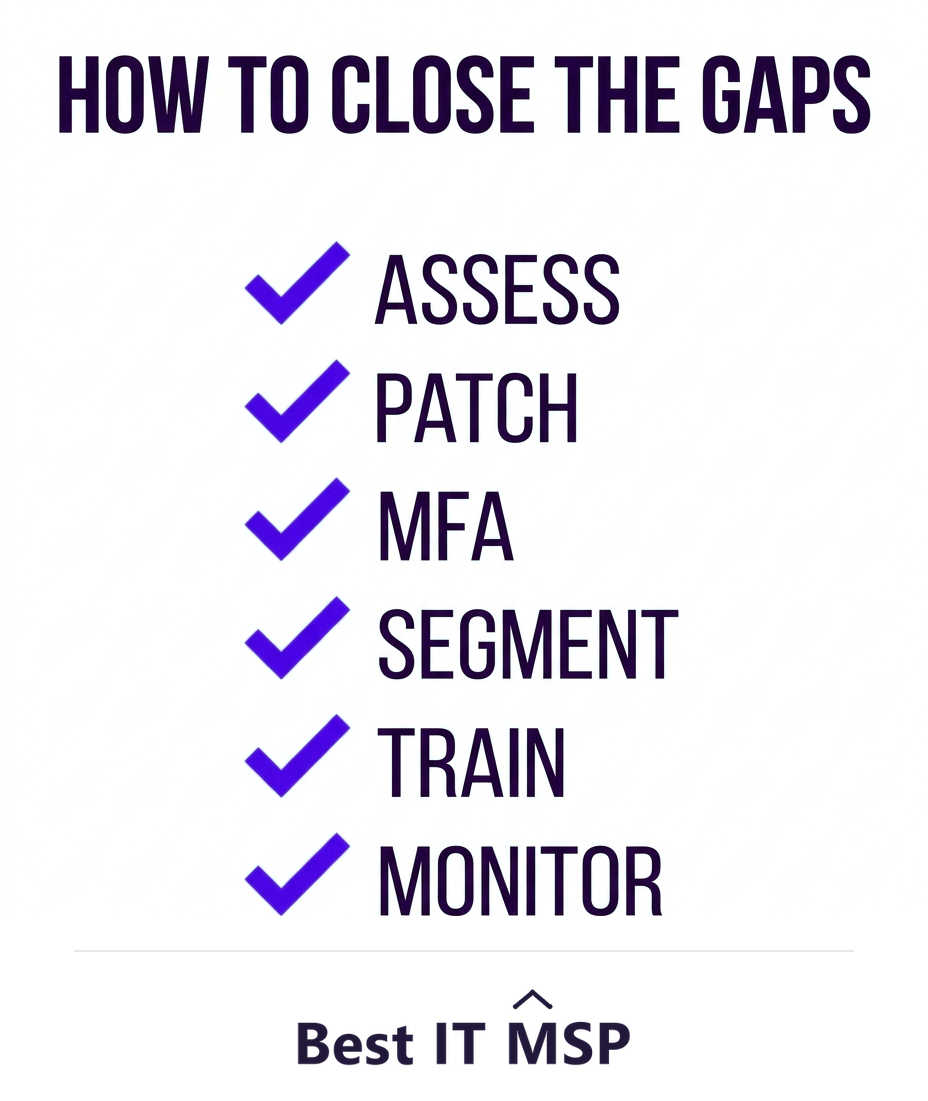
- <strong>Run a vulnerability assessment.</strong> Scan your network and systems regularly to find weaknesses before attackers do, and prioritize by risk.
- <strong>Patch promptly.</strong> Keep operating systems, applications, and firmware up to date on a defined schedule, since most exploits target known, already-fixed flaws.
- <strong>Enforce strong passwords and MFA.</strong> Require long, unique passwords and multi-factor authentication everywhere, especially on email and remote access.
- <strong>Harden configurations.</strong> Close unused ports, change defaults, apply least-privilege access, and check cloud settings against secure baselines.
- <strong>Segment the network.</strong> Separate systems into zones so a breach in one cannot spread to all.
- <strong>Secure remote access.</strong> Use modern, encrypted remote access with MFA, and retire exposed remote desktop.
- <strong>Train your people.</strong> Run ongoing phishing-awareness training to shrink the human attack surface.
- <strong>Monitor continuously.</strong> Watch for suspicious activity so an intrusion is caught in hours, not months.
Make it a continuous process, not a one-time fix
New vulnerabilities appear constantly, as software updates, new devices connect, and the business grows, so security is never finished. The organizations that stay safe treat vulnerability management as an ongoing cycle: assess, fix, monitor, and repeat. This is demanding to sustain in-house, especially given a global shortfall of about 4.8 million cybersecurity professionals, and it keeps growing harder as more systems move to the cloud, in a market where public cloud spending is forecast to top $723 billion in 2025. It is no surprise that the managed services market, worth about $330 billion in 2024, has grown so quickly: businesses increasingly hand this never-ending cycle to specialists. Many small and midsize businesses close the gap by partnering with a provider that runs assessments, patches, and monitoring on their behalf, turning a reactive scramble into a steady, managed routine.
If you want to find and close your network security vulnerabilities, start with a provider who can run a proper assessment. Browse vetted, merit-ranked firms by city in the Best IT MSP directory, where ranking is earned on rating and verified data.
FAQ
What are the most common network security vulnerabilities?
The most common are weak, reused, or default passwords, unpatched software and firmware, misconfigurations such as open ports and exposed cloud storage, phishing-prone users, missing multi-factor authentication, unsecured remote access, flat networks with no segmentation, and shadow IT. Almost all are well known and preventable.
What is the biggest network security vulnerability?
People. Verizon's research found the human element was involved in 68% of breaches, through phishing clicks, reused passwords, and mistakes. Attackers target users because it is easier than defeating technical defenses, which is why security awareness training closes the most exploited vulnerability in most organizations.
How do I find network security vulnerabilities?
Run a vulnerability assessment that scans your network and systems to identify weaknesses, then prioritize them by risk. Because many businesses have never assessed their environment, they do not know what is exposed. Regular assessments, ideally combined with continuous monitoring, reveal the gaps before attackers exploit them.
How do you fix network security vulnerabilities?
Run regular vulnerability assessments, patch promptly, enforce strong passwords and MFA, harden configurations by closing unused ports and applying least privilege, segment the network, secure remote access, train staff against phishing, and monitor continuously. Most of these fixes cost far less than a single breach.
Why do network vulnerabilities go unfixed for so long?
Usually because no one owns finding them and they are invisible until exploited. Many businesses have never run a vulnerability assessment, so they do not know what is exposed. As a result attackers often find the gaps first, and the average breach takes about 258 days to identify and contain once inside.
Is fixing vulnerabilities a one-time task?
No. New vulnerabilities appear constantly as software updates, devices connect, and the business grows, so security is never finished. Effective protection treats vulnerability management as an ongoing cycle of assess, fix, monitor, and repeat. Many small and midsize businesses partner with a provider to sustain that cycle.
Best IT MSP is the independent directory of vetted managed IT and security providers across North America. Compare merit-ranked firms in your city that run vulnerability assessments, patching, and monitoring. No pay-to-play.