Co-Managed IT Explained
Co-managed IT is a partnership where a business keeps its internal IT staff and adds a managed service provider to fill specific gaps, rather than replacing the team. The MSP typically supplies 24/7 monitoring, specialized security expertise, advanced tools, after-hours coverage, and extra capacity, while internal staff focus on the work that needs deep business knowledge and hands-on presence. It suits organizations with capable but stretched IT teams, letting them stop firefighting and get enterprise-grade support without giving up internal control.
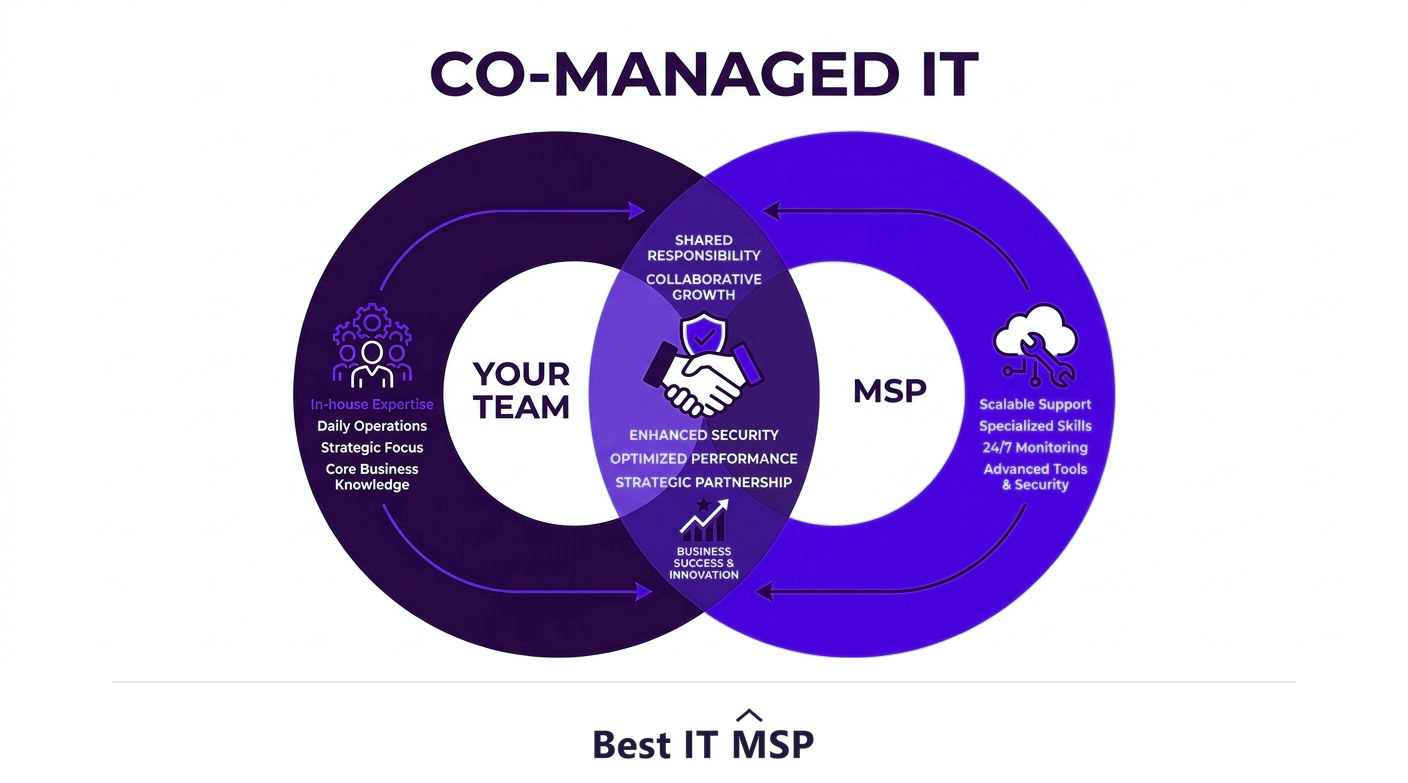
- Co-managed IT keeps your internal IT team and adds an MSP to fill specific gaps, not replace staff.
- The MSP typically supplies 24/7 monitoring, security expertise, advanced tools, and extra capacity.
- It suits organizations with capable but stretched or overloaded internal IT teams.
- It lets internal staff focus on strategic work instead of firefighting day-to-day issues.
- Co-managed IT delivers enterprise-grade coverage and expertise without surrendering internal control.
What is co-managed IT?
Co-managed IT is a partnership model where a business keeps its internal IT team and brings in a managed service provider (MSP) to work alongside it, rather than replacing it. Instead of choosing between doing everything in-house or outsourcing all of it, you split the work: your own staff handle what they do best, and the MSP fills the specific gaps, whether that is round-the-clock monitoring, specialized security skills, advanced tools, after-hours coverage, or extra hands during busy periods. The result is a single, blended IT capability that combines the deep business knowledge of an internal team with the breadth, scale, and tooling of a managed provider. It has become one of the fastest-growing ways midsize organizations run their technology.
This guide explains how co-managed IT works, who it is for, what the MSP typically handles, the benefits, and how it compares to fully managed and in-house IT. It pairs with our co-managed IT overview and the managed IT services hub.
How co-managed IT works
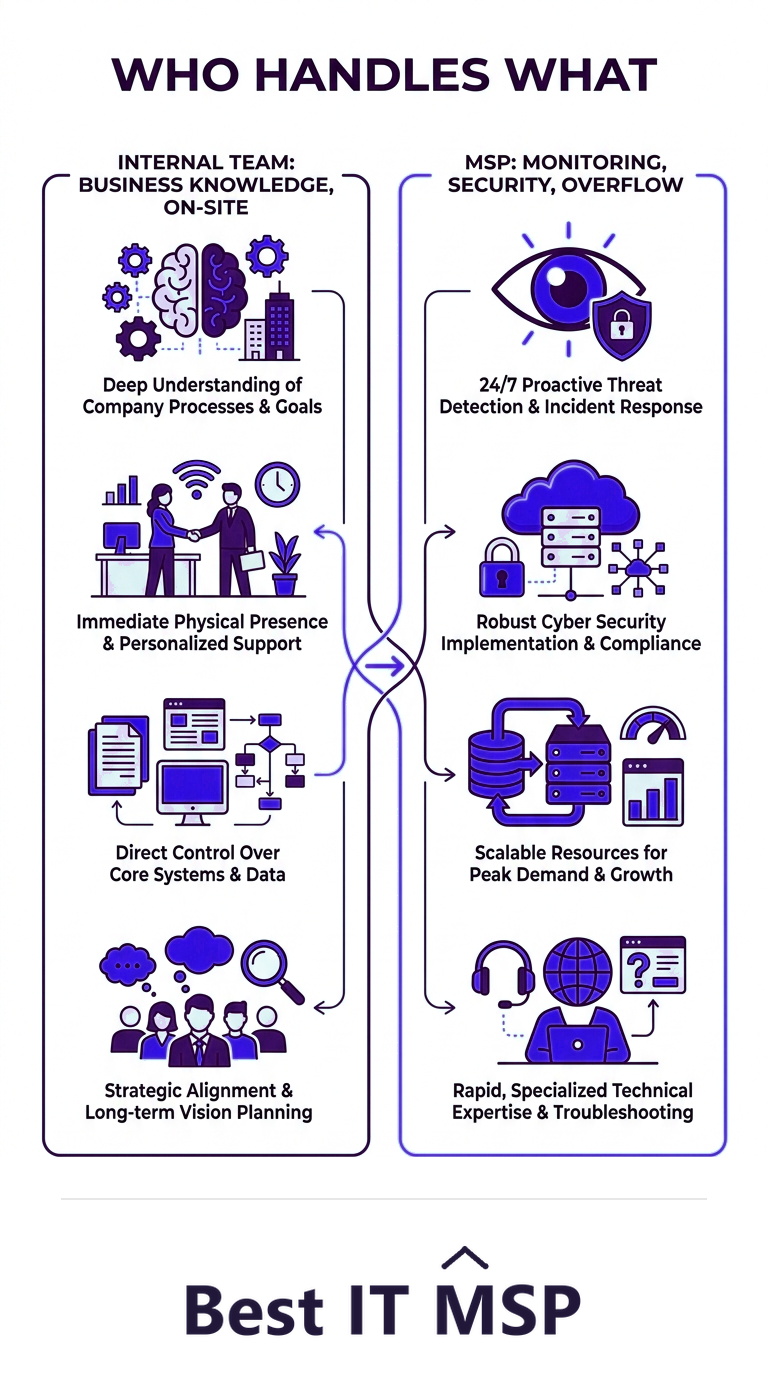
The heart of co-managed IT is a deliberate division of labor. Your internal staff keep the responsibilities where their proximity and business knowledge are most valuable: hands-on support, understanding your specific applications and workflows, and being the familiar face employees turn to. The MSP takes on the work that is hard to staff internally or that benefits from scale, monitoring systems 24/7, providing deep security expertise, supplying enterprise-grade tools, and absorbing overflow during projects or busy seasons. The two collaborate as one team, ideally sharing tools and documentation so nothing falls through the cracks. The exact split is flexible and tailored to each business, which is part of the appeal: you keep control and define which pieces you want the provider to own.
Who co-managed IT is for
Co-managed IT fits a specific and common situation: a business that has capable internal IT but finds the team stretched too thin to do everything well. Maybe you have one or two skilled people who cannot realistically cover nights and weekends, or who are strong generalists but not deep security experts, a real constraint given a global shortfall of about 4.8 million cybersecurity professionals, and one with a price tag, since organizations facing a high-level security skills shortage saw breach costs about $1.76 million higher. Maybe your team is so buried in day-to-day tickets that strategic projects never get done. Maybe a growth phase or a big project has temporarily outstripped your capacity. In all of these, the answer is not to fire your team or hire several more people, it is to augment what you have. That is exactly the gap co-managed IT fills.
What the MSP typically handles
While every arrangement is tailored, an MSP in a co-managed relationship commonly takes on:
- <strong>24/7 monitoring and alerting.</strong> Around-the-clock watch over systems, covering the hours your internal team cannot.
- <strong>Cybersecurity expertise.</strong> Specialized security skills, threat detection, and response that are hard to staff internally.
- <strong>Advanced tools.</strong> Enterprise-grade monitoring, security, and management platforms the MSP already runs across many clients.
- <strong>After-hours and overflow support.</strong> Help desk coverage during nights, weekends, and busy periods.
- <strong>Specialized projects.</strong> Migrations, security initiatives, and other work that needs skills or capacity beyond the internal team.
- <strong>Backup, patching, and maintenance.</strong> Routine but critical work that is easy to let slip when the internal team is overloaded.
The benefits of co-managed IT
The model is popular because it captures advantages from both worlds:
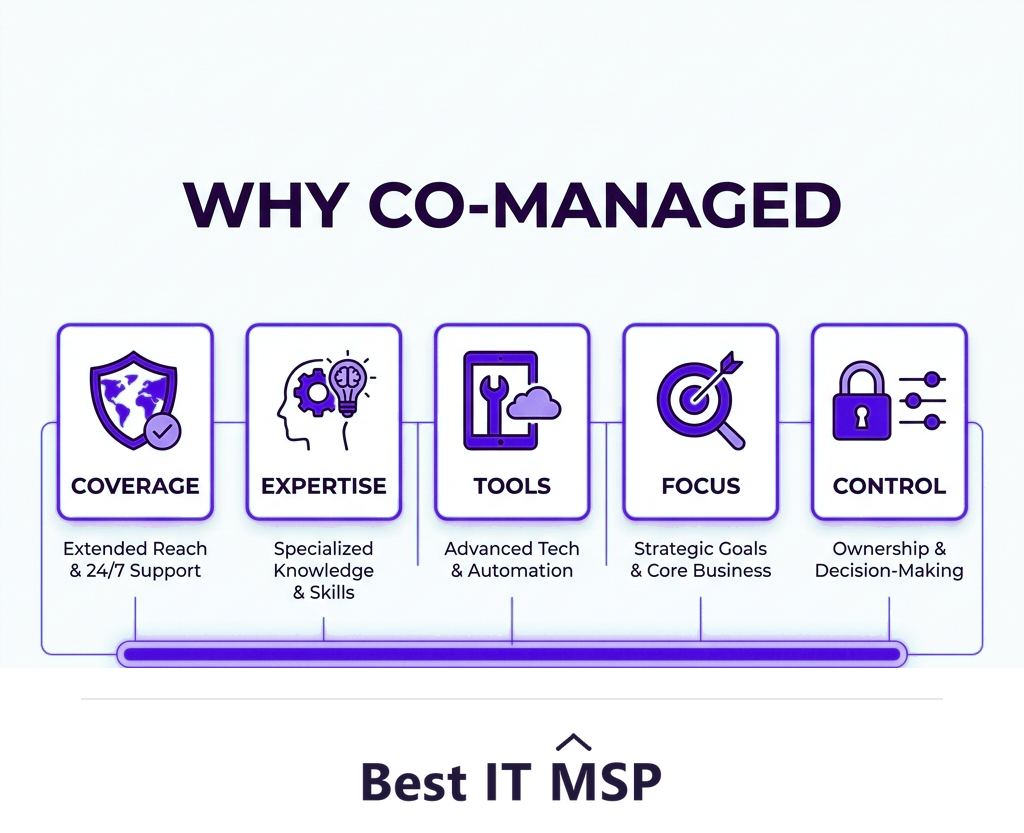
- <strong>Full coverage.</strong> 24/7 monitoring and response without asking a small team to be on call constantly, which matters when downtime costs most organizations more than $100,000 an hour.
- <strong>Specialist expertise on demand.</strong> Access to security and other specialists, important when the average breach costs $4.88 million and takes an average of 258 days to identify and contain.
- <strong>Better tools without the capital cost.</strong> Enterprise platforms, including automation that saves breached organizations an average of $2.22 million, without buying them outright.
- <strong>Internal focus.</strong> Your team stops firefighting and works on strategic projects that move the business forward.
- <strong>Retained control.</strong> You keep your people, your knowledge, and decision-making, while extending capability.
Co-managed vs fully managed vs in-house
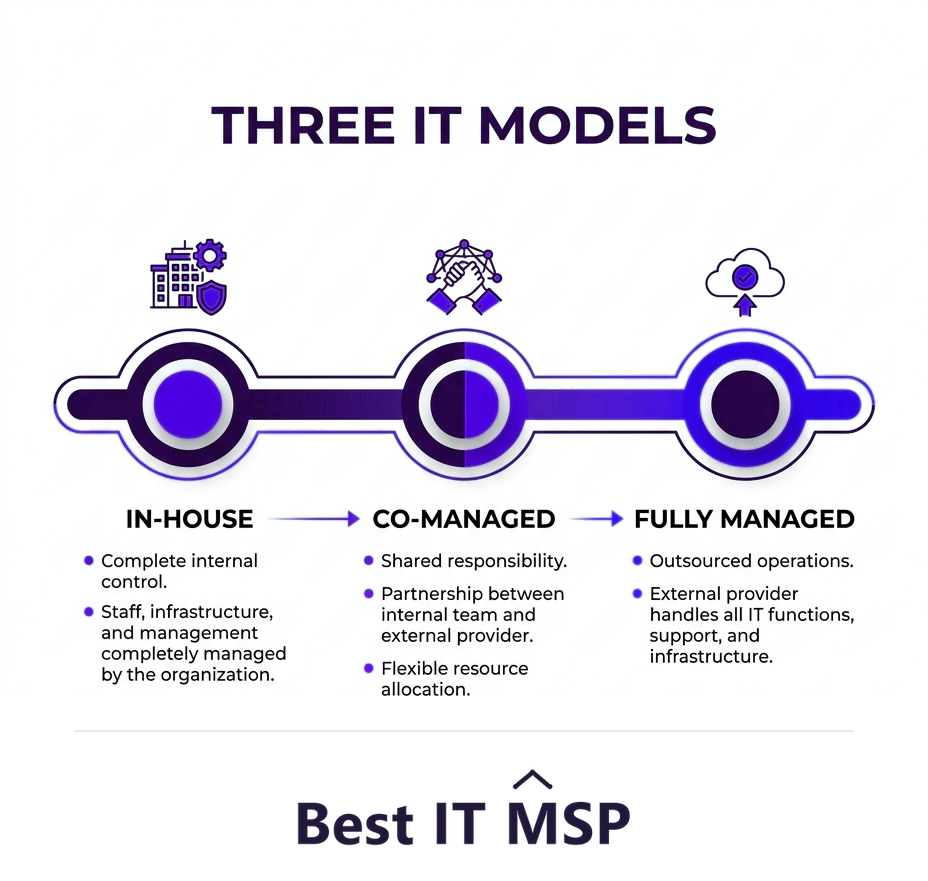
It helps to see co-managed IT as the middle point on a spectrum. Fully in-house IT means your employees do everything, which gives maximum control but is costly to staff for full coverage and broad expertise. Fully managed IT means an MSP runs essentially all of your IT, which is ideal when you have little or no internal team. Co-managed IT sits between them: you keep an internal team and share the load with an MSP. The right choice depends on what you already have. If you have no IT staff, fully managed usually makes sense; if you have a capable team that is simply stretched, co-managed is often the better fit. The collaborative, flexible nature of the model is a major reason the managed services market keeps growing, from about $330 billion in 2024 toward $879 billion over the next decade. For a deeper look at the endpoints, see our guide to managed IT vs in-house IT.
Getting co-managed IT right
Co-managed IT works best when the partnership is clearly defined: agree on who owns what, share tools and documentation so both sides see the same picture, and treat the MSP as an extension of your team rather than an outside vendor. Done well, it lets a stretched internal team breathe, raises your security and coverage to a level you could not reach alone, and keeps the business knowledge and control that make in-house IT valuable. For many midsize organizations, it is the most pragmatic IT model available.
If you are considering co-managed IT, comparing vetted providers on merit is the place to start. Browse merit-ranked MSPs by city in the Best IT MSP directory, where ranking is earned on rating and verified data, not on who pays the most. You can also read our explainer on what a managed service provider is.
FAQ
What is co-managed IT?
Co-managed IT is a partnership where a business keeps its internal IT team and brings in a managed service provider to work alongside it, filling specific gaps rather than replacing staff. The internal team handles work that needs deep business knowledge and hands-on presence, while the MSP provides 24/7 monitoring, security expertise, advanced tools, after-hours coverage, and extra capacity.
How does co-managed IT work?
It works through a deliberate division of labor. Internal staff keep responsibilities where their proximity and business knowledge matter most, while the MSP takes on work that is hard to staff internally or benefits from scale, such as 24/7 monitoring, security, enterprise tools, and overflow support. The two operate as one team, sharing tools and documentation, with the split tailored to each business.
Who should use co-managed IT?
Co-managed IT suits organizations that have capable internal IT but find the team stretched too thin, for example a small team that cannot cover nights and weekends, lacks deep security expertise, is buried in daily tickets, or is temporarily overstretched by growth or a major project. Rather than firing the team or hiring several more people, you augment what you have.
What is the difference between co-managed and fully managed IT?
Fully managed IT means an MSP runs essentially all of your IT, which is ideal when you have little or no internal team. Co-managed IT means you keep your internal team and share the workload with an MSP, which fits when you have capable staff who are simply stretched. The right choice depends on how much internal IT capability you already have.
What are the benefits of co-managed IT?
It provides full 24/7 coverage without overloading a small team, specialist expertise on demand, enterprise-grade tools without the capital cost, and freedom for internal staff to focus on strategic work instead of firefighting, all while you retain your people, knowledge, and control. It effectively delivers enterprise-grade capability while keeping the advantages of an internal team.
Does co-managed IT mean replacing my internal IT staff?
No. The defining feature of co-managed IT is that it keeps your internal team and adds outside support to fill gaps, rather than replacing anyone. The MSP extends your team's reach, hours, and specialties, letting your staff focus on higher-value work. It is designed to make an existing team more effective, not to make it redundant.
Best IT MSP is the independent directory of vetted managed service providers across North America. Compare merit-ranked MSPs in your city that offer co-managed IT. No pay-to-play.