A Cybersecurity Compliance Guide for SMBs
Cybersecurity compliance means meeting the security rules that apply to your business, such as HIPAA, PCI DSS, SOC 2, or CMMC, and proving it. The process runs: identify which frameworks apply, do a gap assessment against their requirements, implement the missing controls, document everything, pass a compliance audit, and maintain it over time.
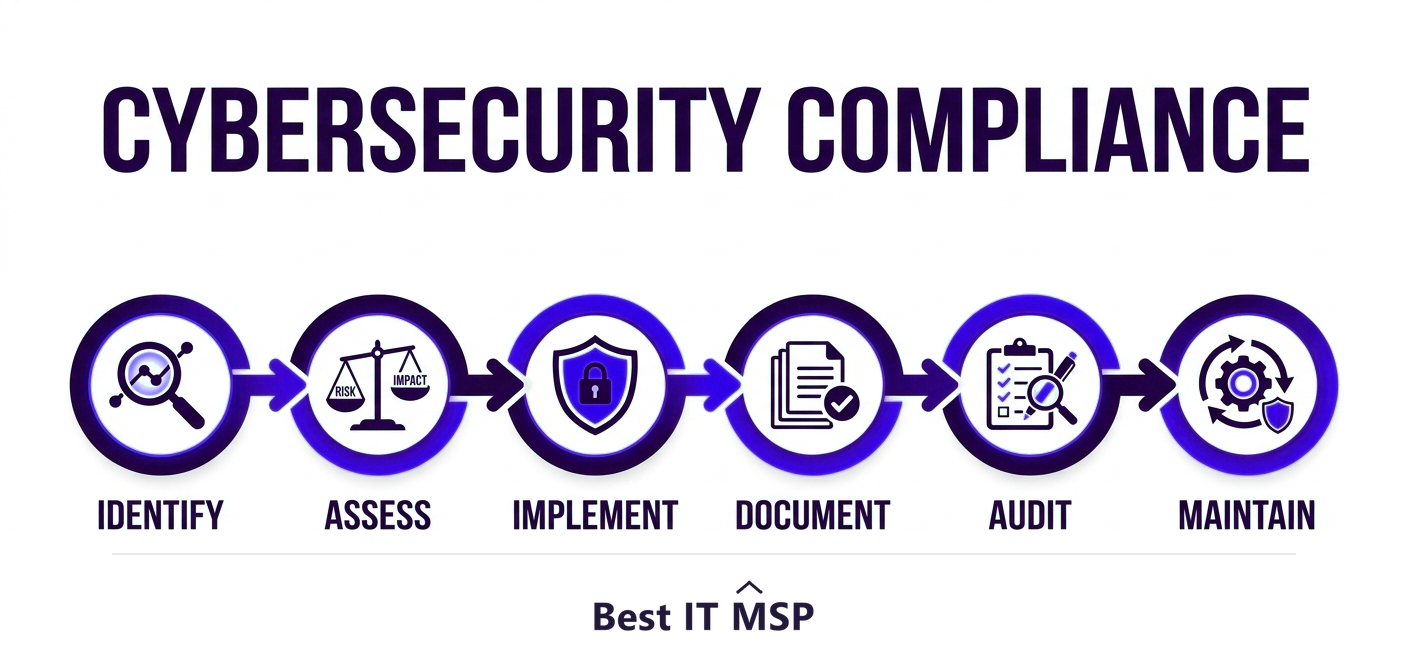
- Cybersecurity compliance is meeting the security rules that apply to you and proving it through a compliance audit.
- Common SMB frameworks include HIPAA, PCI DSS, SOC 2, CMMC, and privacy laws like GDPR and state rules.
- The process: identify obligations, gap assessment, implement controls, document, audit, and maintain.
- Compliance and security overlap but differ: you can be compliant yet insecure, or secure yet non-compliant.
- Documentation and ongoing maintenance, not a one-time push, are what pass audits and keep you compliant.
What is cybersecurity compliance?
Cybersecurity compliance means meeting the specific security rules and standards that apply to your business, and being able to prove it. Those rules might come from laws (like HIPAA for health data), industry standards (like PCI DSS for payment cards), customer requirements (like SOC 2), or government programs (like CMMC for defense contractors). Compliance is not optional where it applies: failing to meet it can mean fines, lost contracts, and legal exposure, on top of the security risk the rules were designed to address. For small and midsize businesses, compliance can feel daunting, but it breaks down into a clear, manageable process.
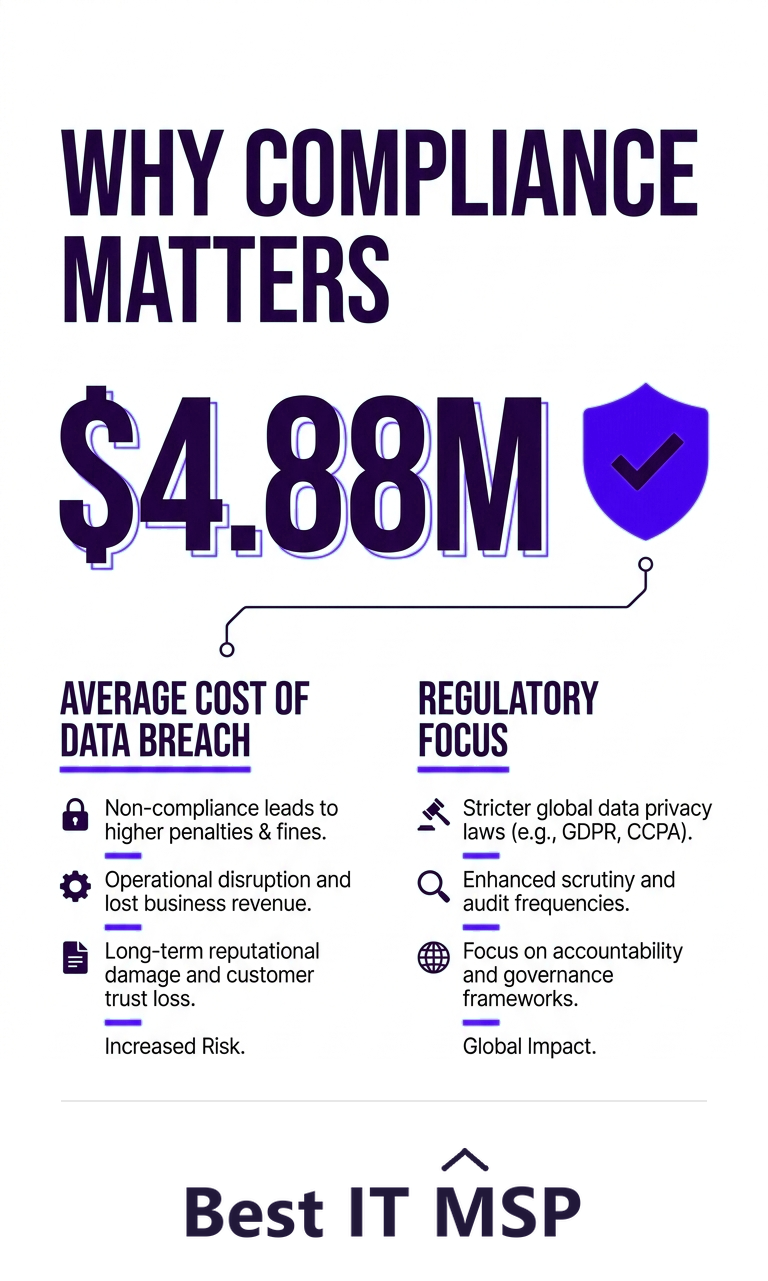
Compliance matters because the underlying risk is real and expensive: the average data breach reached $4.88 million in 2024, far more in regulated sectors like healthcare at $9.77 million, takes about 258 days to identify and contain, and reported cybercrime losses topped $12.5 billion in a single year. Meeting compliance both reduces that risk and, increasingly, unlocks business, since customers now demand proof of security before they sign. This guide walks SMBs through the frameworks, the process, and the role of the compliance audit. It pairs with our IT compliance services and cybersecurity services overviews.
Which compliance frameworks apply to you?
The first task is figuring out which rules you must follow, which depends on your industry, your customers, and the data you handle. The frameworks SMBs most commonly face are:
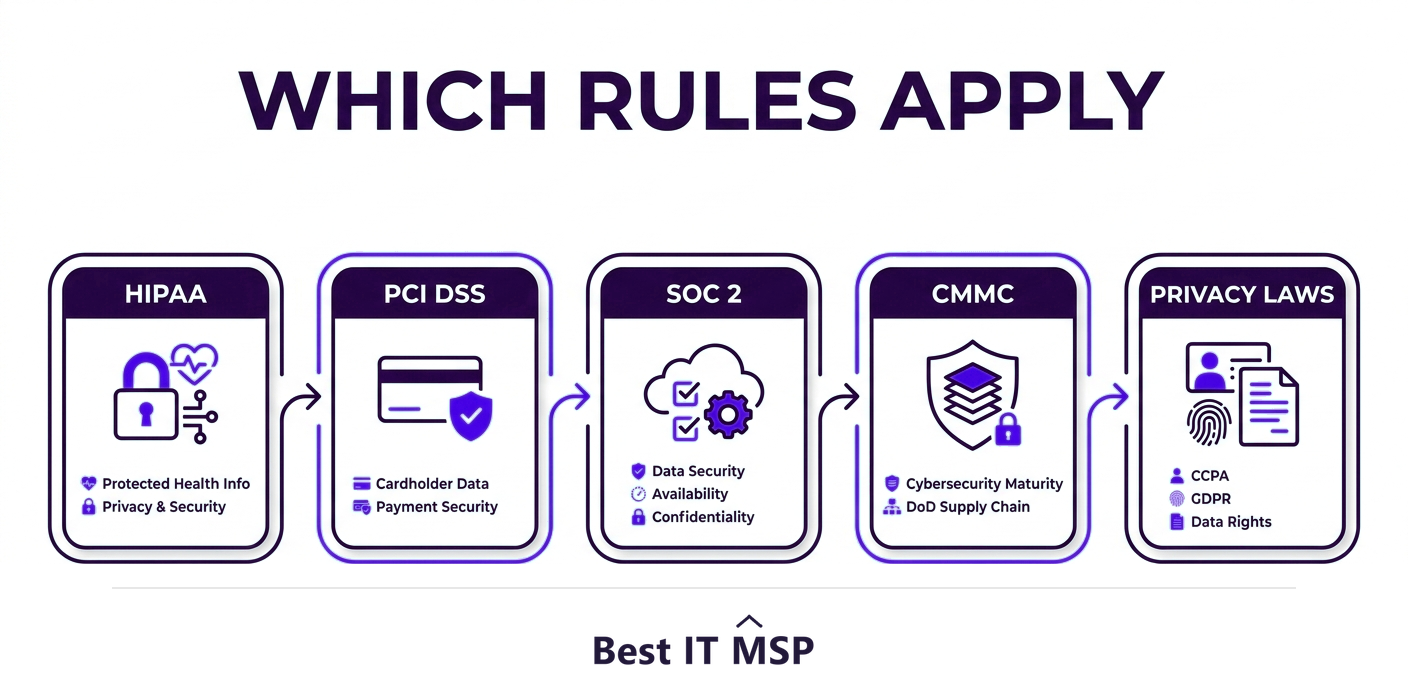
- <strong>HIPAA.</strong> If you handle protected health information, you must meet HIPAA's security and privacy requirements.
- <strong>PCI DSS.</strong> If you accept, process, or store payment cards, the PCI Data Security Standard applies.
- <strong>SOC 2.</strong> Not a law but a widely requested attestation; many B2B customers require a SOC 2 report before trusting you with their data.
- <strong>CMMC.</strong> Required for U.S. Department of Defense contractors handling federal contract or controlled unclassified information.
- <strong>Privacy laws.</strong> Regulations like the EU's GDPR and various U.S. state privacy laws govern how you handle personal data, regardless of industry.
Many businesses are subject to more than one, and the requirements overlap heavily, so identifying all of them up front lets you build one program that satisfies several at once rather than duplicating effort.
Step 1: Identify obligations and scope
Start by mapping exactly which frameworks apply and what data and systems fall under each. This scoping defines the boundary of your compliance effort and prevents two opposite mistakes: missing a requirement you are subject to, and wasting effort securing things to a standard that does not apply to them. Where possible, isolate regulated data (such as payment or health information) into a defined environment so the strictest rules apply only where they must, which keeps the program manageable for a smaller business.
Step 2: Run a gap assessment
Next, measure your current security against each framework's requirements to find the gaps. This gap assessment is the heart of getting compliant: it produces a prioritized list of what you are missing and what you must fix. It is closely related to a broader cybersecurity risk assessment, but here it is anchored to specific, mandated controls. An honest, thorough gap assessment is essential, because underestimating the gaps now leads to failing the formal compliance audit later, which is far more costly and public.
Step 3: Implement controls and document everything
Close the gaps by implementing the required controls, technical measures like encryption, access control, multi-factor authentication, logging, and backups, and organizational measures like policies, training, and incident response. Crucially, compliance is as much about documentation as action. Auditors verify compliance through evidence: written policies, records of training, logs, risk assessments, and proof that controls are operating. If it is not documented, from a compliance standpoint it did not happen. Building good documentation as you implement, rather than scrambling before an audit, is what separates a smooth process from a painful one. People matter here too, since the human element features in 68 percent of breaches, so training is a control in its own right.
Step 4: Pass the compliance audit
A compliance audit is the formal check that you meet a framework's requirements. Depending on the standard, it may be a self-assessment you document and attest to, or an examination by an external auditor or certified assessor (as with SOC 2, or CMMC Level 2). The auditor reviews your documentation, tests your controls, and often interviews staff, then reports whether you comply and where you fall short. Preparation is everything: a clean gap assessment, fully implemented controls, and complete documentation make the compliance audit a confirmation rather than a discovery. Treat your internal review as a dress rehearsal so the real audit holds no surprises.
Step 5: Maintain compliance over time
Compliance is not a one-time achievement; it is an ongoing state. Frameworks require continuous adherence, periodic re-assessment, and often annual audits, and your environment keeps changing as you add systems and staff. Build compliance into how you operate, monitor controls continuously, keep documentation current, run regular internal reviews, and stay alert to changes in the regulations themselves. Treating compliance as a continuous program rather than a frantic pre-audit project is both less stressful and far more effective, and it means each year's compliance audit is a routine checkpoint rather than a crisis.
Compliance is not the same as security
A crucial insight that trips up many SMBs: compliance and security overlap but are not identical. Compliance means meeting a defined set of rules; security means actually being protected. You can be technically compliant yet insecure (meeting the letter of a standard while real gaps remain), or genuinely secure yet non-compliant (well protected but unable to prove it or missing a specific required control).
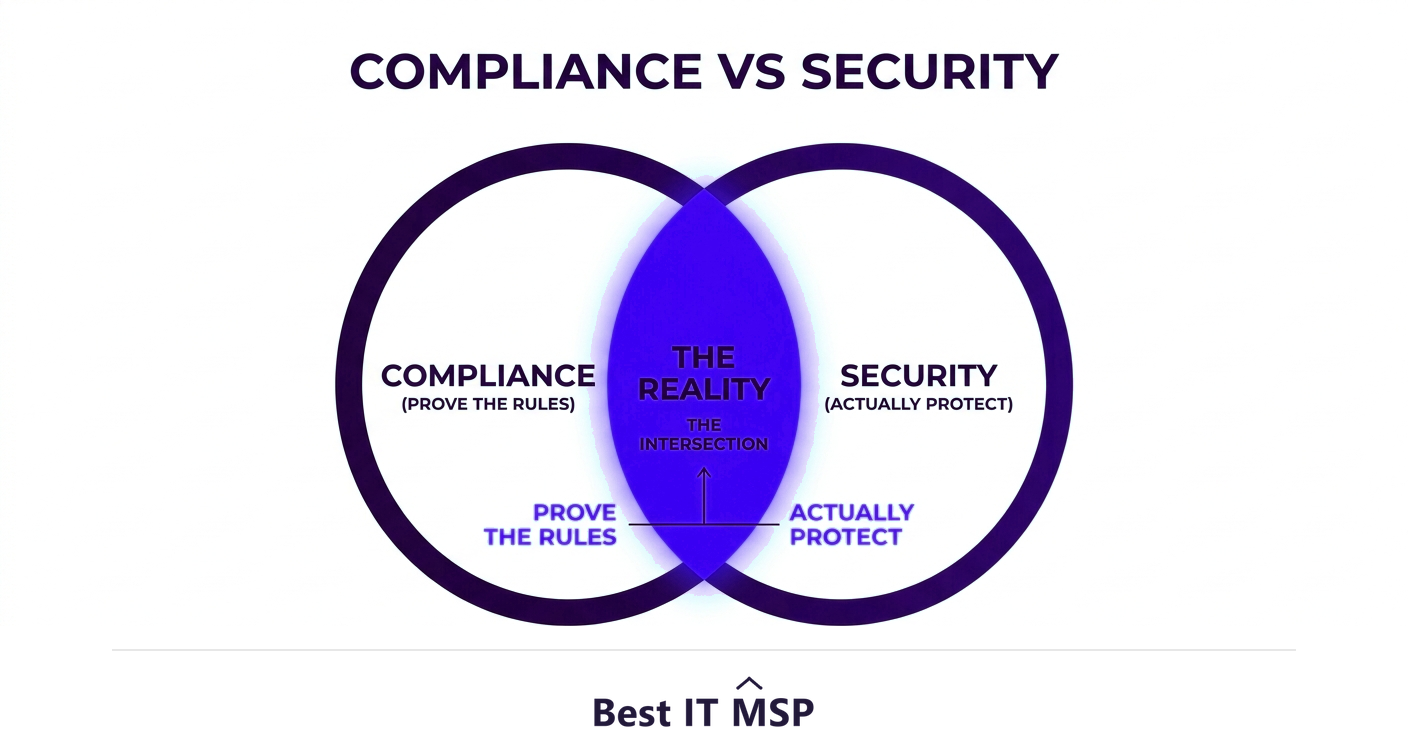
The goal is both. Use compliance frameworks as a strong baseline, they encode hard-won best practice, but treat real security as the actual objective, not just passing the audit. A business that chases the checkbox while ignoring the spirit ends up compliant on paper and breached in reality, which helps no one. Done right, the compliance process drives genuine security improvement, and genuine security makes compliance straightforward.
Getting compliant with help
Cybersecurity compliance is achievable for an SMB, but it takes expertise across both the technical controls and the specific frameworks, expertise that is scarce amid a global shortfall of about 4.8 million cybersecurity professionals. Many small and midsize businesses work with a managed IT or security provider experienced in their frameworks to run the gap assessment, implement controls, build the documentation, and prepare for the compliance audit. It is part of why the managed services market is projected to grow from about $330 billion in 2024 to about $879 billion over the next decade, as more systems and data move to the cloud, in a market where public cloud spending is forecast to top $723 billion in 2025. A partner who has guided others through the same audit dramatically reduces the time, cost, and risk.
If you face one or more compliance frameworks and are not sure where to start, an experienced provider can take you from gap assessment to a passed audit and ongoing maintenance. To find one, browse vetted, merit-ranked firms by city in the Best IT MSP directory, where ranking is earned on rating and verified data. (This guide is general information, not legal advice; confirm your obligations with a qualified compliance professional.)
FAQ
What is cybersecurity compliance?
Cybersecurity compliance means meeting the specific security rules and standards that apply to your business, and being able to prove it. Those rules can come from laws like HIPAA, industry standards like PCI DSS, customer requirements like SOC 2, or government programs like CMMC. Failing to comply where it applies can mean fines, lost contracts, and legal exposure.
What compliance frameworks do SMBs commonly face?
The most common are HIPAA (for health data), PCI DSS (for payment cards), SOC 2 (a widely requested attestation for B2B trust), CMMC (for defense contractors), and privacy laws such as the EU's GDPR and various U.S. state laws. Many businesses are subject to more than one, and because requirements overlap, one well-built program can satisfy several.
What is a compliance audit?
A compliance audit is the formal check that you meet a framework's requirements. Depending on the standard, it may be a self-assessment you document and attest to, or an examination by an external auditor or certified assessor. The auditor reviews your documentation, tests your controls, and often interviews staff, then reports whether you comply and where you fall short.
What are the steps to cybersecurity compliance?
Identify which frameworks apply and scope the data and systems involved, run a gap assessment against each framework's requirements, implement the missing controls while documenting everything, pass the compliance audit (self-assessment or external), and maintain compliance over time through monitoring, current documentation, and periodic re-assessment. Documentation and maintenance are essential.
Is compliance the same as security?
No. Compliance means meeting a defined set of rules; security means actually being protected. You can be technically compliant yet insecure, or genuinely secure yet non-compliant. The goal is both: use compliance frameworks as a strong baseline of best practice, but treat real security as the objective, not just passing the audit. Done right, each reinforces the other.
Should an SMB get help with compliance?
Often, yes. Compliance takes expertise across both technical controls and the specific frameworks, which is scarce and hard to hire. Many SMBs work with a managed IT or security provider experienced in their frameworks to run the gap assessment, implement controls, build documentation, and prepare for the audit, which reduces the time, cost, and risk of failing.
Best IT MSP is the independent directory of vetted managed IT and security providers across North America. Compare merit-ranked firms in your city experienced in HIPAA, PCI, SOC 2, and CMMC compliance. No pay-to-play.