Opening a second site: the IT decisions to make before the lease
Several IT decisions for a second office are properties of the building, not the network. Which carriers reach the suite, who owns the riser, and where the demarcation point sits are fixed by the address. Federal rules give a building owner 45 days to negotiate moving that demarcation point, and no regulator publishes a lead time for a business circuit.
- Three facts about internet service belong to the address, not to your provider. Which carriers have fiber in the building, who controls the riser, and where the demarcation point sits.
- A building owner can require a carrier to move the demarcation point to the minimum point of entry, and the carrier has 45 days to finish negotiating. A tenant has no equivalent right in the rule.
- The FCC map reports mass-market service by definition, and a dedicated business circuit is individually negotiated, so an address showing fiber proves nothing about your suite.
- No US regulator publishes an installation lead time for a business internet circuit. California's new voice standard sets five business days, and it covers basic phone lines at five lines or fewer.
- Federal rules protect the building owner's right to let other carriers in, not your right to pick one, so carrier access is a lease negotiation rather than a complaint.
Which IT decisions have to be made before the lease is signed?
Five IT decisions for a second office have to be made before the lease is signed, because each one is a property of the building rather than a choice about your network. Which carriers reach the suite, who controls the riser, where the demarcation point sits, where the comms room can go, and which address a 911 call will carry. Every one of them is cheap to settle while you still have leverage and expensive to settle afterwards.
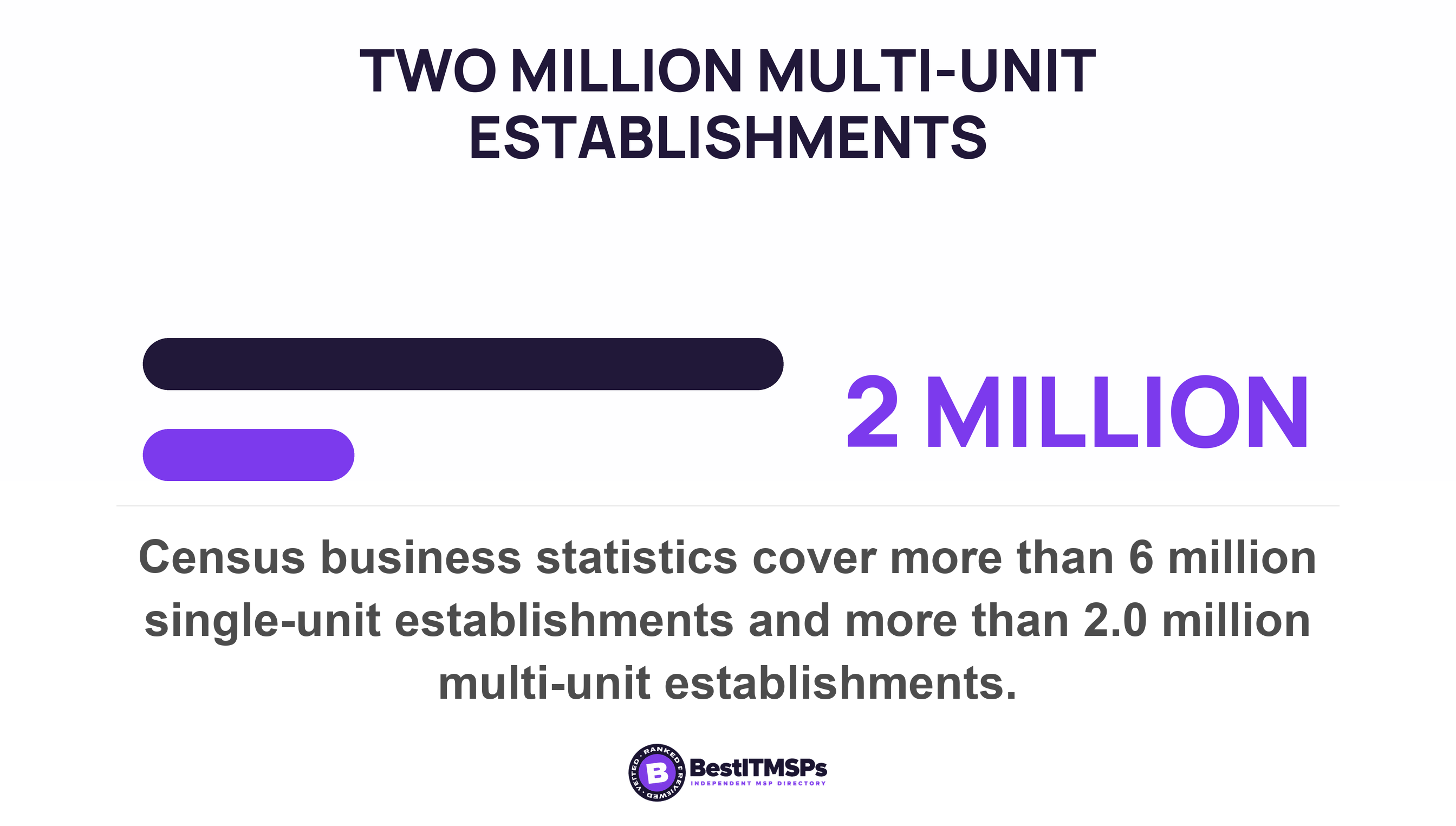
Second sites are ordinary. The Census Bureau's business statistics program covers more than 6 million single-unit establishments and more than 2.0 million multi-unit establishments, and it defines a multi-unit enterprise as one that owns or operates two or more establishments. Two million workplaces already sit inside a multi-site firm. The IT part of getting there is routine work that goes wrong mainly through ordering.
This guide covers the decisions that expire on signing. It does not cover how to link the two offices once they exist, which is answered in does a two-site business need SD-WAN. It does not cover cable grades or testing either, which belong in the structured cabling buyer's guide.
What about internet service belongs to the address
Four facts about internet service belong to the address rather than to your provider. Which carriers already have fiber into the building, who controls the riser and the pathways to your floor, where the demarcation point sits, and whether the owner has an arrangement with one carrier. None of them change because you sign with a different vendor.
The demarcation point is where the carrier's network ends and your wiring begins. Federal rules define the minimum point of entry as the closest practicable point to where the wiring enters a multiunit building. In a building wired after August 1990 the carrier may place the demarcation point at the minimum point of entry, and where it does not adopt that practice the multiunit premises owner shall determine the location of the demarcation point or points. Read that twice. The landlord often decides how far your paid-for cable run has to travel.
The owner also holds a right you do not. Where the demarcation point is not already at the minimum point of entry, the carrier must comply with a request from the premises owner to relocate the demarcation point to the MPOE, and it must negotiate terms in good faith and complete the negotiations within forty-five days. The rule gives a tenant no equivalent request. So ask the landlord to make it before you sign, while you still have something to trade. A demarcation point on your own floor is worth more than a month of free rent.
Fixed wireless is the fallback when no carrier has fiber in the building. Federal rules void most restrictions, lease terms included, on a one meter or smaller antenna used to receive or transmit fixed wireless signals, but only on property within the exclusive use or control of the antenna user. Exclusive use means a terrace or a balcony demised to you. It does not mean the shared roof, so roof access still has to be written into the lease.
Can a public tool tell you what internet an address can get?
One public tool reports internet service at an address, and it measures a different product from the one a business office buys. The FCC's National Broadband Map is built from the Broadband Data Collection, which requires fixed providers to report whether the reported service is available to residential customers and/or business customers. That business flag is real and useful. The scope behind it is the problem.
The data covers broadband internet access service, and the collection's own rules take that term's meaning from the FCC's open internet definitions. Those define it as a mass-market retail service by wire or radio, and they say mass-market excludes service offerings customized for the customer through individually negotiated agreements. A dedicated business circuit is individually negotiated almost by definition. The product your second site will lean on sits outside the data set that the only public map is built from.
Read the map as a floor. An address showing fiber tells you a mass-market product reaches the building. It does not tell you a dedicated circuit can be delivered to your suite, and it says nothing at all about when. Fiber availability at a street is not fiber availability in a riser. Only a written serviceability check from each carrier, against the exact suite number rather than the street address, answers that, so order one from three carriers before you sign and keep the replies.
How long does a new business internet circuit take to install?
No US regulator publishes an installation lead time for a business internet circuit. We looked across federal rules and state service quality orders and did not find one. Carriers quote a delivery date per order, inside a contract, and not as a published standard you can check before you commit.
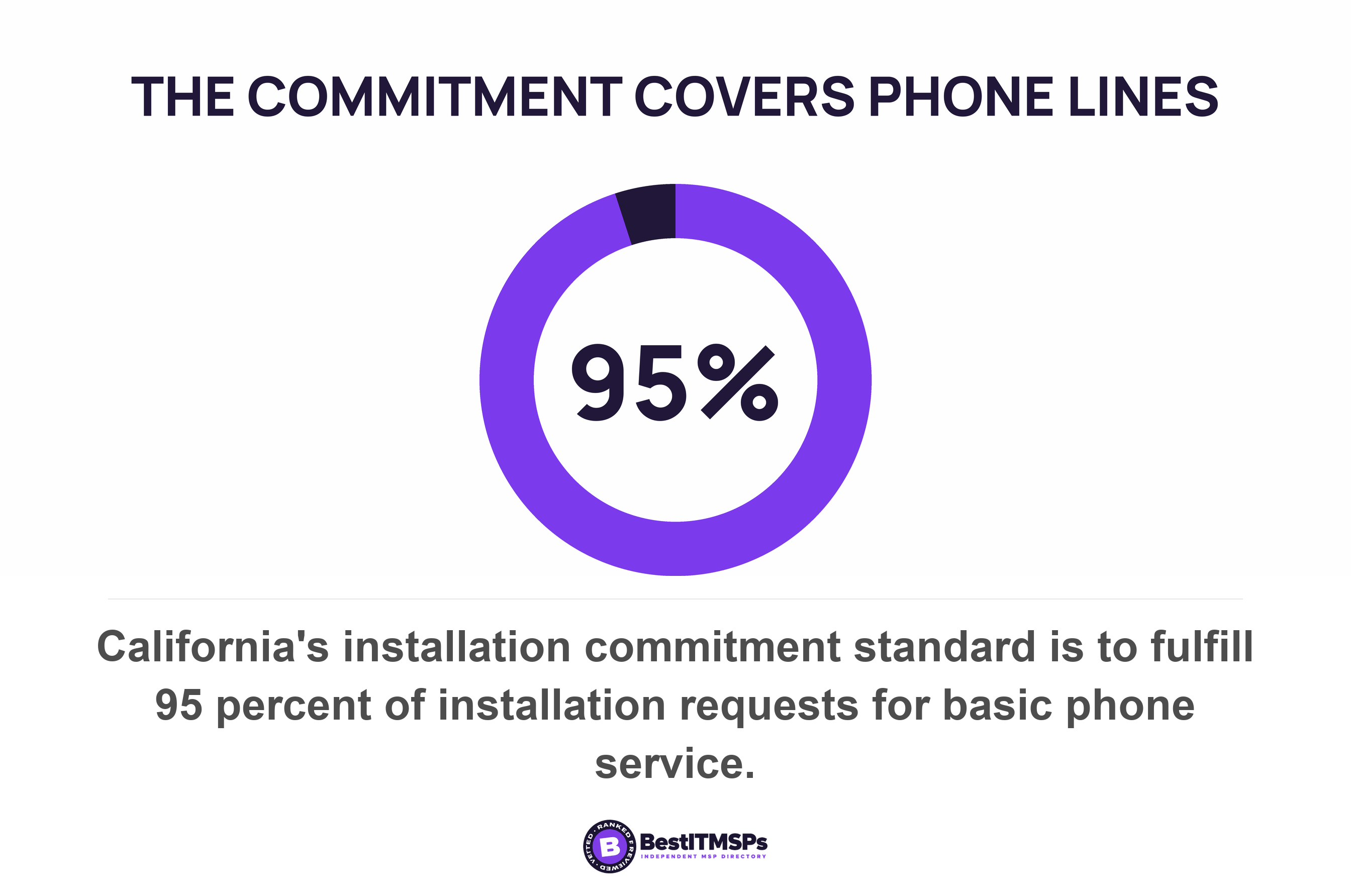
California publishes the closest thing to a deadline. Its current service quality order sets an installation interval whose current standard is five business days, with a commitment to fulfill 95% of the installation requests, as part of five minimum service quality standards for POTS. From January 1, 2027 the replacement order tightens that to 100% of the service orders for basic voice service to be completed within five business days, extends enforcement to fixed interconnected VoIP, and pays an automatic customer credit when a provider misses.
Now read the scope, because the scope is the whole point. The order requires carriers to establish basic service for POTS and VoIP within five business days of when a customer places an installation service order and to fulfill 100 percent of these service orders, and it applies to residential and small business customers. It has teeth: miss the five days and the carrier pays a base fine amount of $5 per day beginning on the sixth day as an automatic customer credit. But it is a phone-line rule. Nothing in it reaches the data circuit the office actually runs on. The one published installation deadline we could find in the country covers the single service your second site is least likely to depend on.
So treat the lead time as unknown and make it contractual instead. Ask each carrier for a site survey and a committed delivery date in writing, and ask whether special construction applies, which is the industry term for building new fiber to reach you. Then put that date in the lease as a contingency rather than in a project plan as an assumption.
Which physical decisions have to be made while the space is empty
Four physical decisions have to be made while the space is empty, because each one needs access above a ceiling, inside a wall or inside a door frame. The comms room location, the cabling routes, the power and cooling for that room, and the door hardware.
Put the comms room as close to the demarcation point as the floor plan allows. Distance from the minimum point of entry is your cost and not the carrier's, paid in cable, conduit and labor, and it is invisible in a carrier quote because the quote starts at the demarcation point.
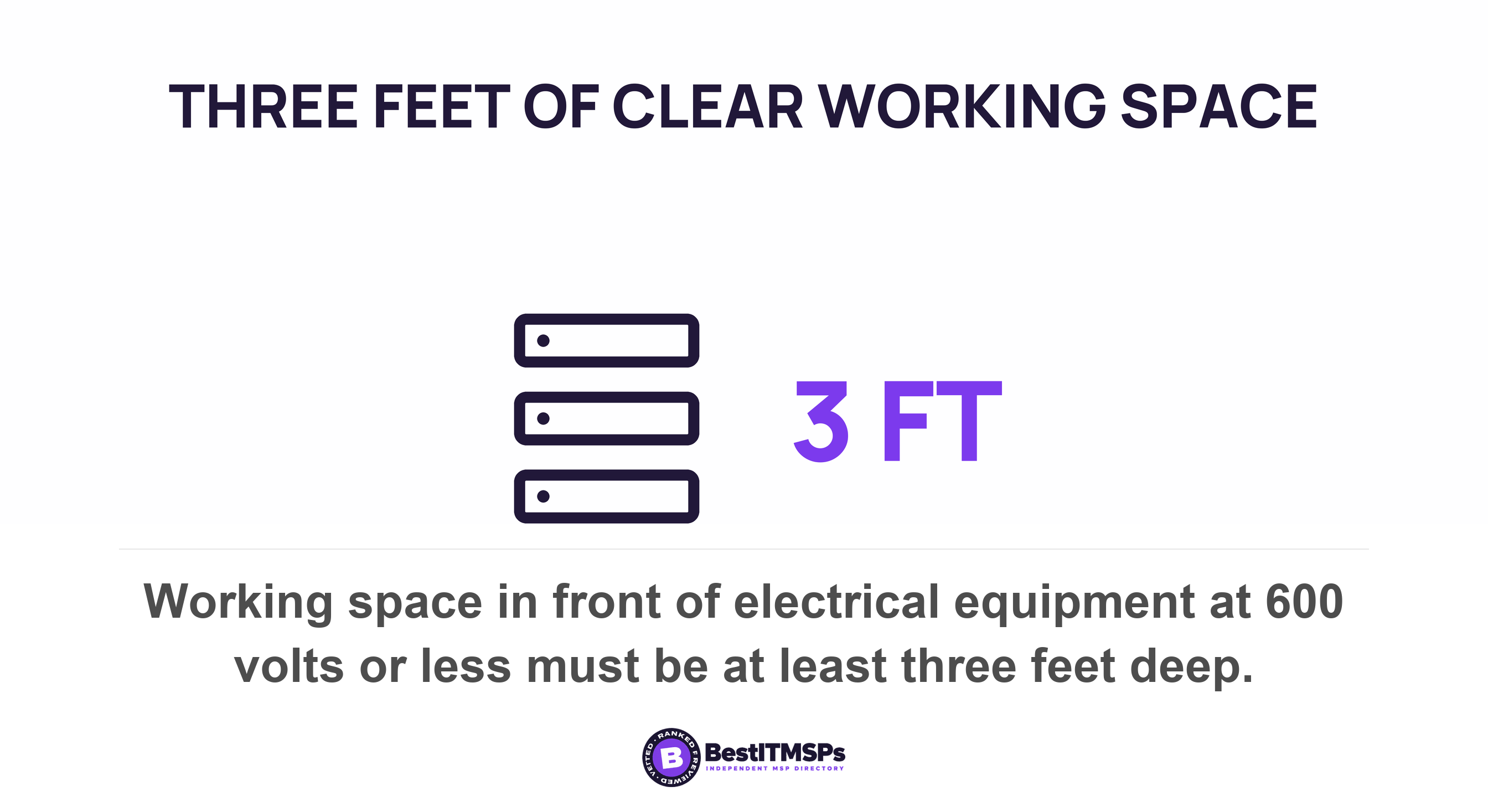
That room has a published minimum size, set by the electrical rule rather than by any network standard. Working space in front of equipment at 600 volts or less must be at least 0.9 m (3.0 ft) deep, must be at least the width of the equipment or 762 mm (30 in.), whichever is greater, and for anything installed since August 2007 must have at least 1.98 m (6.5 ft) of headroom. A cupboard that cannot hold that is not a comms room, whatever the floor plan calls it.
No federal rule sets a temperature for a server room. The number that governs is the operating range printed in your own equipment's specification, which makes the question for the landlord simpler than it looks. Ask whether the HVAC runs out of hours, and who pays for it when it does.
Cabling is cheapest while the ceiling is open and the walls are unfinished. Decide the outlet counts and the routes now, then specify the grades and the testing separately using the structured cabling buyer's guide.
Access control is a door decision before it is a software decision. Federal workplace rules require that employees must be able to open an exit route door from the inside at all times without keys, tools, or special knowledge, and that at least two exit routes must be available in a workplace. Badge readers, electric strikes and magnetic locks all have to live inside that requirement. Choose them while the frames are still out, because retrofitting a door costs more than specifying one.
What to check in the lease itself
Check six things in the lease. Alterations consent, riser access and pathways, roof access, who owns tenant-installed cabling at the end of the term, whether the landlord's shared internet is the only option, and whether the landlord has a deal with a carrier.
Federal rules limit the worst version of that last one, and not in the way most tenants assume. The protected right is the owner's. No common carrier may enter a contract, written or oral, that would in any way restrict a commercial building owner's right to permit any other common carrier to access and serve commercial tenants on that premises. Carriers also may not pay an owner on a graduated basis, or hold the exclusive right to provide the multiunit premise owner compensation in return for access. None of that is a right you hold. A landlord who simply never invites a second carrier breaks no rule, which is why this is a lease negotiation rather than a complaint.
One clause does help you read the lobby. Where a carrier holds the exclusive right to market its service to tenants of a multiunit premise, it must disclose that on written marketing aimed at tenants, say in plain language that it is not the only provider available, and make the disclosure clear, conspicuous, and legible. A flyer by the mailboxes carrying no such line is worth one question to the leasing agent.
Nothing federal decides whether your cabling is yours when you leave. The demarcation rules fix where the carrier's responsibility stops and say nothing about tenant improvements, so ownership of everything past that point is a lease question. Get it written. Get the removal obligation written too, because a make-good clause that says restore to shell can mean stripping out cable you paid to install.
A landlord's shared internet is a convenience and not a service you can enforce. You are not the subscriber, so the provider's service level agreement is not yours and an outage credit goes to the building owner. Read what an ISP SLA actually guarantees before you accept shared service as the primary connection, and plan it as the second path instead.
Emergency calling is tied to the new address
A phone system installed in a new office is in scope for the federal multi-line telephone system rules from its first day. Those rules apply to a multi-line telephone system that is manufactured, imported, offered for first sale or lease, first sold or leased, or installed after February 16, 2020. A fit-out is an installation. There is no older system to inherit an exemption from.
What the rules want is the address, at a level of detail only the lease produces. For on-premises fixed telephones, a dispatchable location had to be conveyed with a 911 call no later than January 6, 2021, and an on-site notification must be initiated contemporaneously with the 911 call and must be sent to a location where someone is likely to see or hear it. That means suite and floor, not just the street. Register it before anyone moves in, then place a test call and keep the result.
Do not carry the old site's records across. Our guide to E911 and remote workers covers the settings to check, and phone number porting problems covers moving the numbers themselves.
The pre-opening checklist, ordered by lead time
Work the list by lead time rather than by topic, because the long items decide your opening date and the short ones do not.
- Before you sign. Order a written serviceability check and a site survey at the exact suite address, from every carrier you would consider.
- Before you sign. Ask the landlord for the building's existing carrier list, the riser diagram, the demarcation point location, and who grants pathway access.
- Before you sign. Verify alterations consent, roof access, after-hours HVAC, and who owns tenant-installed cabling at the end of the term.
- Before you sign. Negotiate an abatement or a termination right if the primary circuit is not live by a named date.
- The day you sign. Place the circuit order, ask in writing for a committed delivery date, and ask whether special construction applies.
- Before the design is frozen. Fix the comms room next to the demarcation point, and check the electrical working clearance fits.
- Before the ceiling closes. Commit the cabling outlet counts and routes.
- Before the doors are hung. Choose door hardware and access control together.
- Before anyone moves in. Register the suite address for emergency calling, and schedule a test call.
- Before opening day. Install the second internet path, and route a real workload over it.
None of this guarantees the circuit lands on time, and no honest provider promises that. It moves every decision you can control to the point where it still costs nothing. The second path is worth planning now rather than later, and internet failover for small business covers how to test one. Then ask your current provider which of those ten lines they already own for your existing site. The answer tells you what the new one will feel like.
FAQ
What should I check about internet service before signing a lease for a second office?
Check four things at the address. Which carriers already have fiber in the building, who controls the riser, where the demarcation point sits, and whether the owner has a carrier arrangement. Federal rules let the multiunit premises owner determine the location of the demarcation point, so the landlord is the person to ask first.
How long does it take to install internet in a new office?
Nobody publishes a usable figure. No US regulator sets an installation lead time for a business internet circuit, and the nearest published standard is a California voice rule requiring carriers to fulfill 100 percent of these service orders within five business days for residential and small business customers. That is basic voice, not the data circuit your office runs on. Get a committed delivery date in writing instead.
Who owns the network cabling I install in a leased office?
The lease decides, not any federal rule. Demarcation rules only fix where the carrier's responsibility ends, placing it at the minimum point of entry in many buildings, and they say nothing about tenant improvements. Settle ownership and any removal obligation in writing before the fit-out starts.
Can my landlord force me to use one internet provider?
Not through a contract with the carrier. No common carrier may enter an agreement that would in any way restrict an owner's right to let other carriers serve commercial tenants. The rule protects the owner's choice rather than yours, so a landlord who never invites a second carrier breaks nothing. Negotiate access in the lease.
What has to be decided before the ceiling closes?
Three things, because each one is cheap while the space is open and expensive afterwards. Where the comms room sits, since it needs power, cooling and enough clear space in front of the equipment to work on it safely. How many cabling outlets go in each area, because adding one later means opening a finished ceiling. And where the access control and door hardware run, since those cables follow the same paths. Decide them at design freeze, not at fit-out, and get the outlet count in writing before anyone starts.
Best IT MSP is the independent directory of vetted managed IT and cybersecurity providers across North America. Organic ranking is earned on rating and verified data, and paid placement is always labelled. Take this checklist to three merit-ranked providers in the new city and compare who answers straight on lead times.