Your ISP SLA: what it guarantees, and what it actually pays
An ISP service level agreement guarantees a measurement, not your trading day. The remedy is a bill credit against the line rental, usually capped at one month of charges, and in most cases you have to claim it. AT&T states that credits are not automatically applied. The restore clock starts when you report the fault.
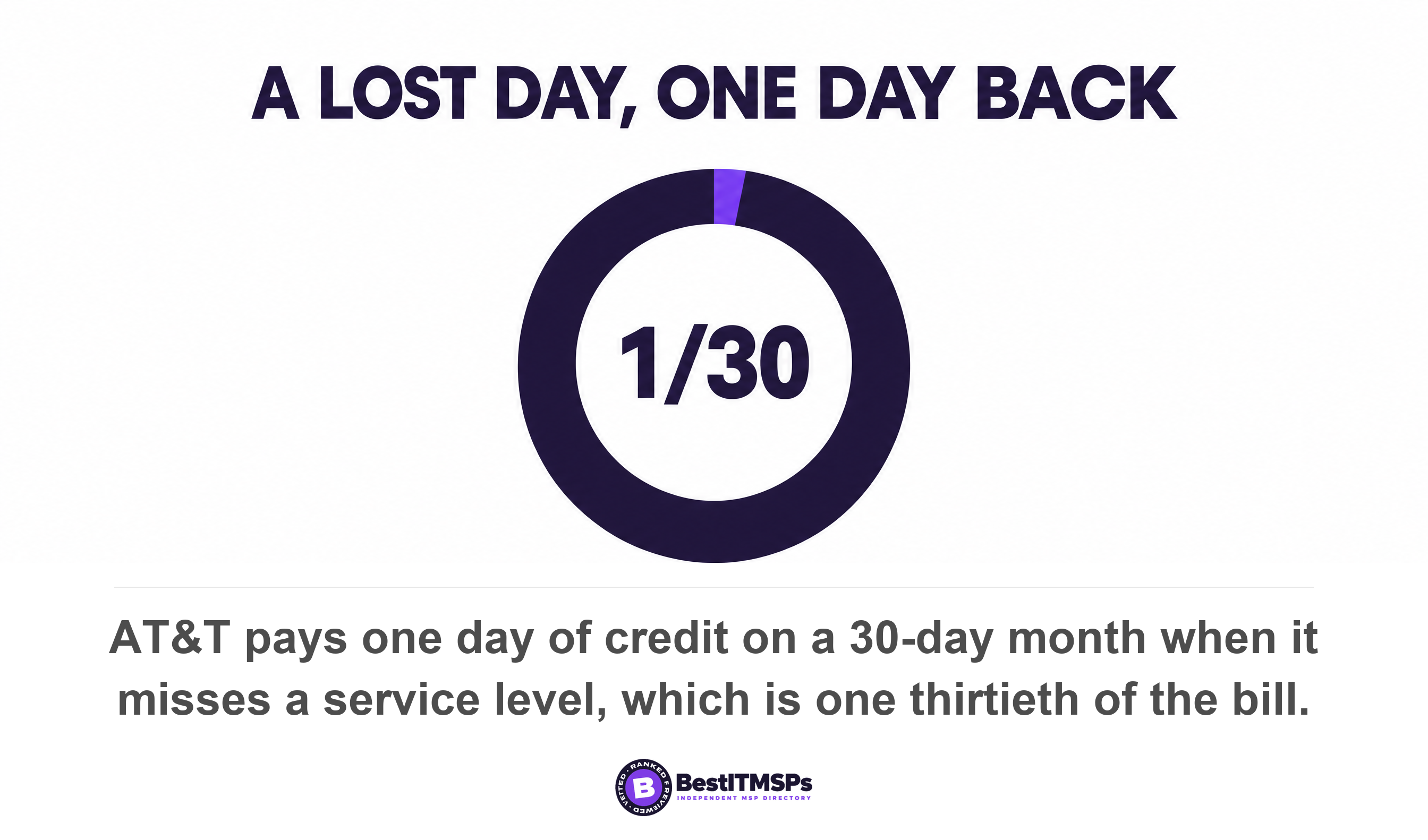
- The remedy is a bill credit on the affected line, not compensation for lost trade. AT&T states plainly that credits are not automatically applied.
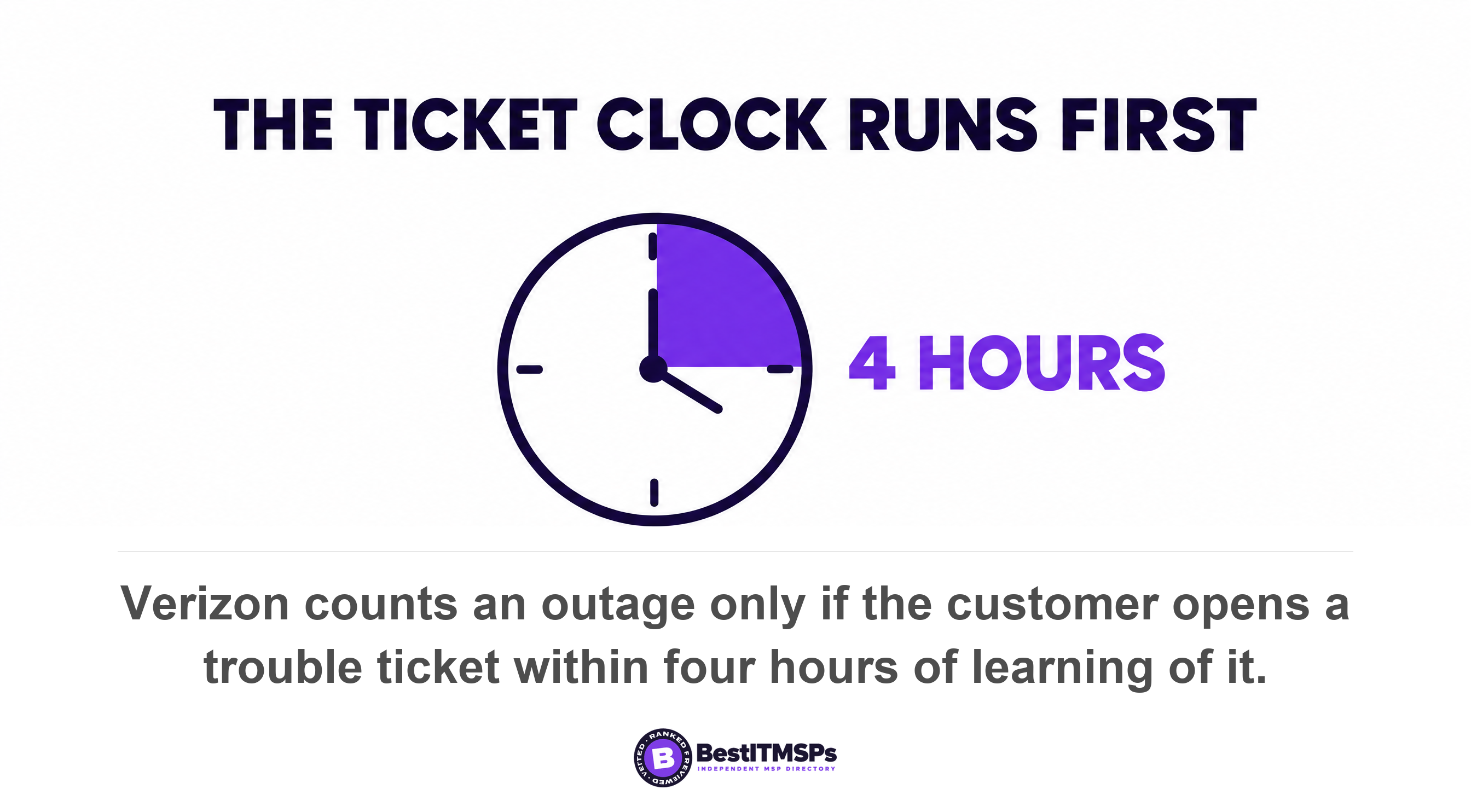
- The claim clock runs during the outage. Verizon counts an outage only if you open a trouble ticket within four hours of learning about it.
- Compare the credit formula, not the uptime percentage. One carrier pays one day of charges per outage, another pays one day of charges per hour.
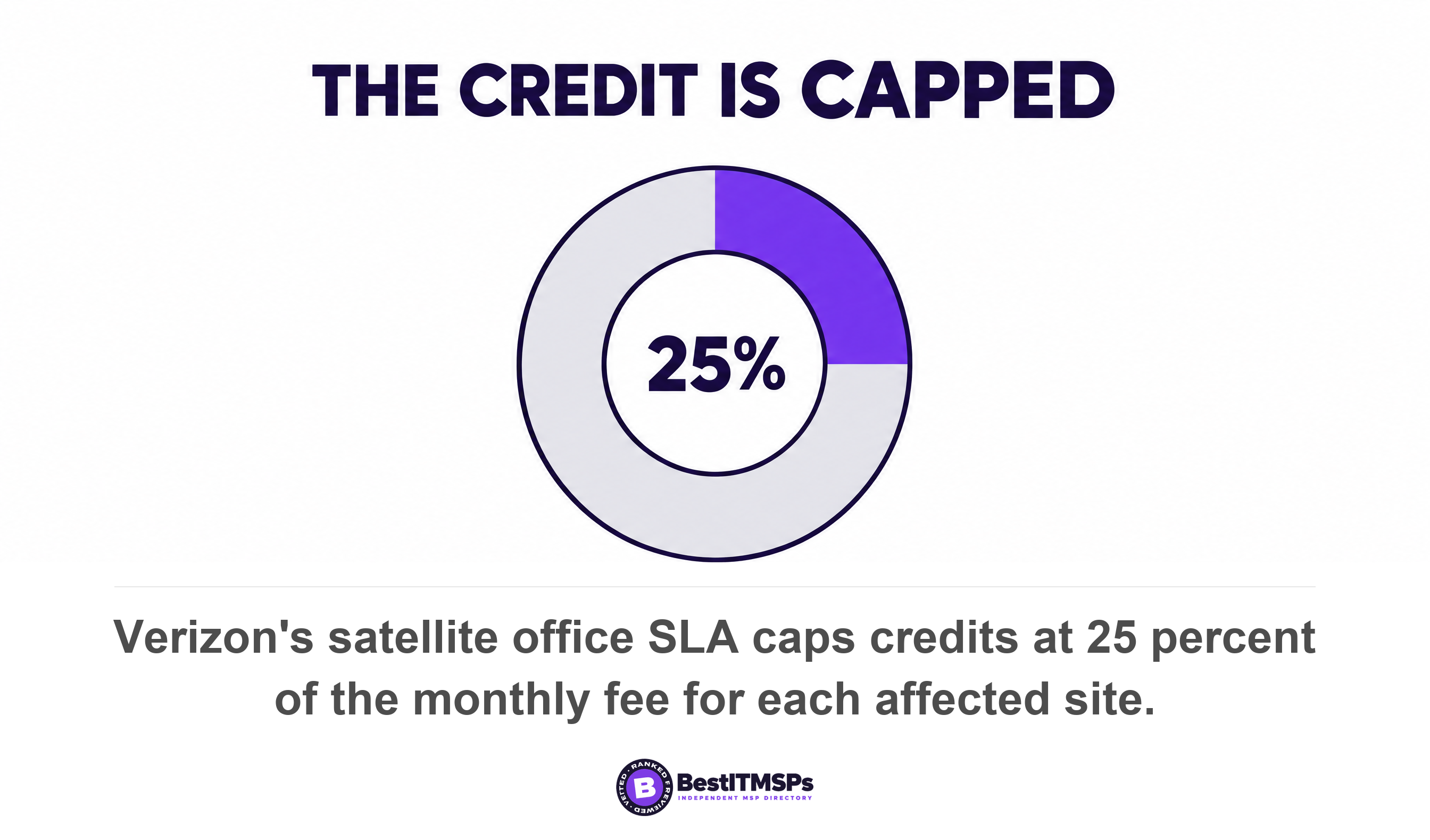
- Credits are capped. Verizon's satellite office terms cap them at 25 percent of the monthly fee and make the credit your sole remedy.
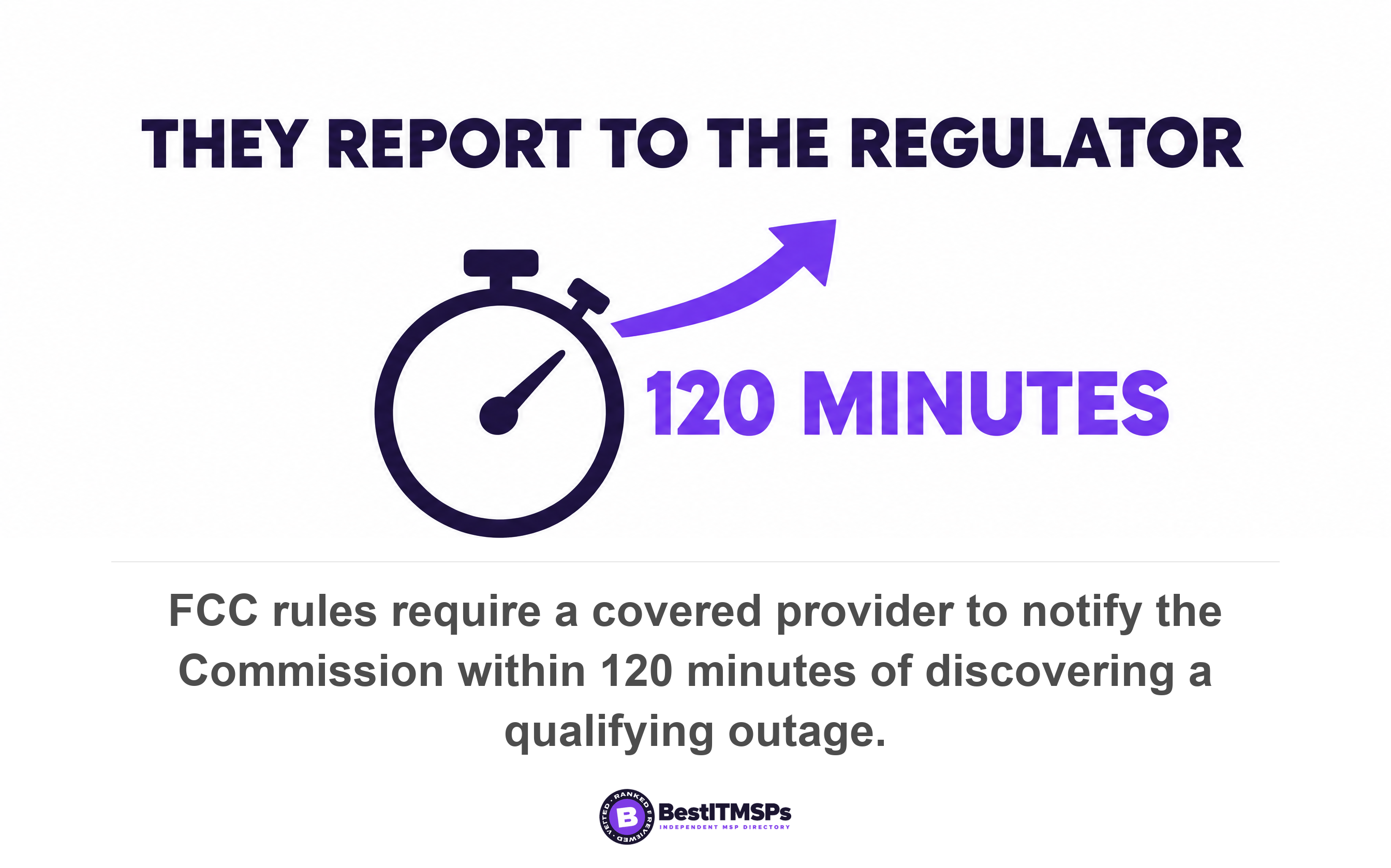
- No federal rule sets a minimum uptime or requires compensation. The FCC's outage rules make carriers report to the government within 120 minutes.
What does an ISP SLA actually guarantee?
An ISP SLA guarantees a measured level of network performance and sets a bill credit as the payment when the carrier misses it. It does not promise that your line stays up. It does not compensate you for a day of lost trading. The agreement is a measurement document with a refund attached.
Two different agreements get confused here, so name the one you mean. Your managed IT provider's service level agreement covers how fast a human answers your ticket, which we cover in SLA response time vs resolution. This post is about the carrier's agreement for the circuit itself, a separate contract with a separate counterparty, clock and remedy. Your provider cannot pay you for an outage on a line it does not own.
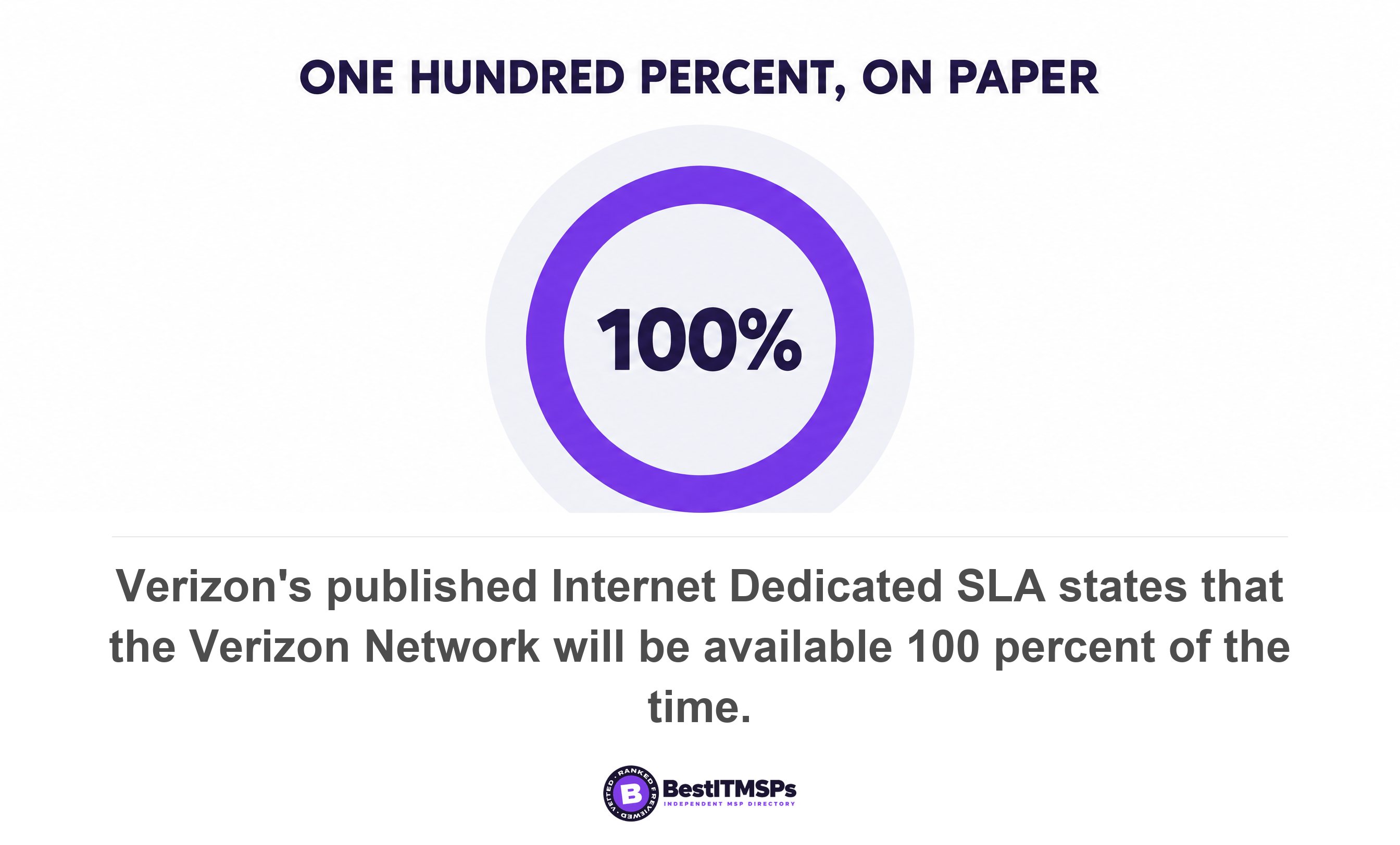
We read what two of the largest US carriers publish. Verizon's agreement for dedicated internet access states that the Verizon Network will be available 100% of the time. AT&T's published SLA for its business broadband commits to 99.9% network availability between its points of presence, measured over a calendar month, with round-trip latency of 40.0 ms or less between MegaPOPs and aggregate monthly packet loss no higher than 0.1%. Those are real, published numbers about a network, not about the hour your card terminal stopped working.
Read the definitions before the percentage, because the definitions decide what counts. AT&T defines a service outage as an event that results in the inability of Customer to transmit IP packets. Verizon measures the minutes the Verizon Network or a Verizon-ordered access circuit was unavailable, excluding scheduled maintenance. The word Verizon-ordered matters. A last-mile circuit you ordered yourself from the local telephone company sits outside the guarantee.
The remedy is a bill credit, and you have to ask for it
The remedy in every agreement we read is a credit against the monthly charge for the affected line, and in most cases you have to claim it yourself. AT&T puts it in one sentence. Credits are not automatically applied. Customer must apply by calling our Customer Care center listed on your bill.
The claim has a deadline and a required form. AT&T allows a request within 30 days after the event giving rise to the credit and requires that a Verifiable Trouble Ticket must accompany Customer's request for any SLA credit. Verizon allows 30 days from the date that the Internet Dedicated Service was unavailable for an availability credit, and 30 days after the month in which the time to repair standard was not met for the repair-time credit. Verizon's satellite office terms are tighter again, asking for a complete claim within 24 hours after the end of each month in which an SLA was missed.
The credits a carrier automates are the ones you could never detect
Here is the detail almost nobody reads to. Inside that same Verizon document, the latency and packet-delivery credits are applied automatically, while the availability and repair-time credits must be requested by the customer. So the carrier automates the remedy for two measurements no small business could ever verify on its own, and asks you to file a claim for the one event you definitely noticed. Nothing technical prevents an automatic availability credit. The outage already sits in the carrier's own ticket system, with a start time and an end time.
The clock that decides whether you have a claim at all runs during the outage. Verizon counts an outage only where the customer opens a trouble ticket within four (4) hours from learning of the outage. AT&T requires that the customer's point of contact must immediately notify AT&T Internet Customer Care of an occurrence. Open the ticket, write down the ticket number and the timestamp, and keep them where someone else can find them.
What the credit is actually worth
A full day offline buys back a small fraction of one month of line rental, and the size of the fraction depends on the credit formula rather than on the headline percentage.
AT&T pays one day's credit, calculated on a 30-day month, from the monthly recurring service fee when it misses a service level, and caps the total at one month's worth of the monthly service fee for any Internet Service line. A missed restoration is therefore worth about 3 percent of that month's charge, which is arithmetic on AT&T's own formula. It is worth the same 3 percent whether the line was down for 25 hours or 250.
Verizon's dedicated agreement pays far more for the same event. For each cumulative hour, or fraction of an hour, of unavailability it credits the pro-rated charges for one day of the monthly recurring charge, plus one day of telephone company line charges. An eight-hour outage earns eight days of credit, which works out at roughly 27 percent of the month. Again that is arithmetic on the published formula, not a figure Verizon states.
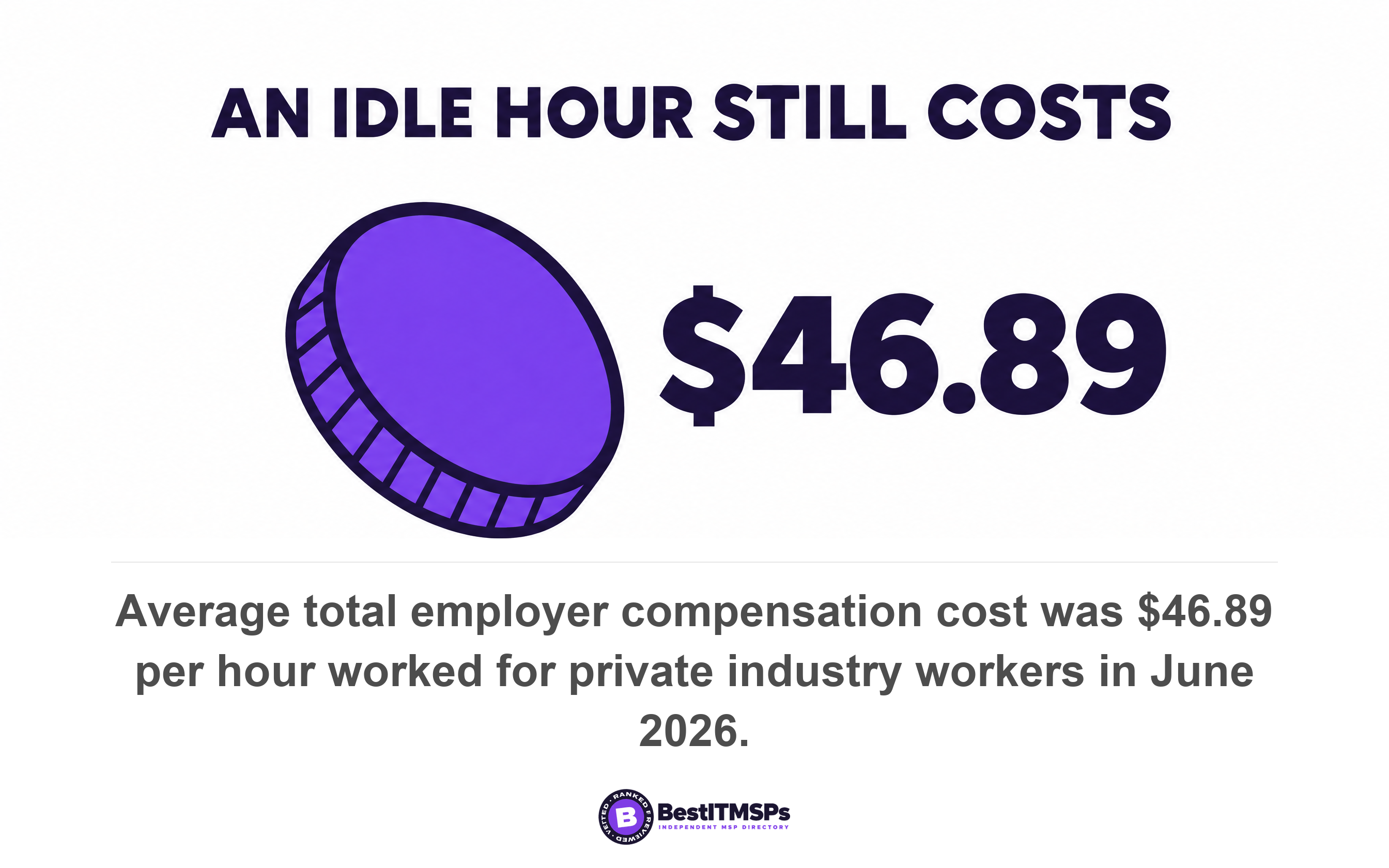
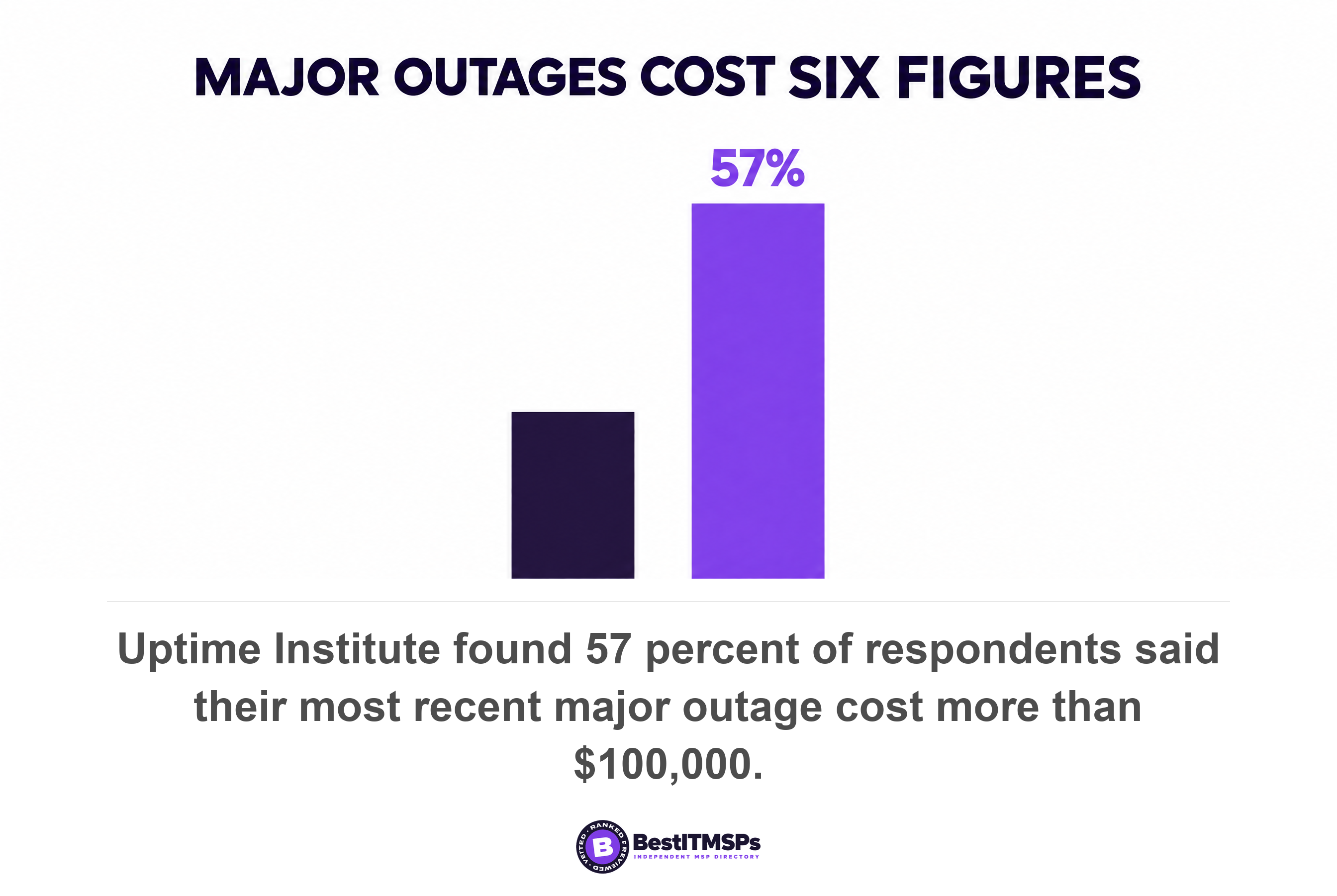
Now set either number against the loss. The Bureau of Labor Statistics put total employer compensation at $46.89 per hour worked for private industry workers in June 2026. Twelve people idle for eight hours is about $4,500 in payroll alone, before a single lost sale. On a $700 circuit, taken as an example, the AT&T-style credit is about $23 and the Verizon-style credit about $187. Uptime Institute found that 57 percent of respondents said their most recent major outage cost more than $100,000, and that one in five reported costs above $1 million.
A credit is not compensation. It is a partial refund of the service you did not receive, and you have to ask for it.
Why the uptime percentage tells you least
Compare the credit formula first and the availability figure second, because the percentage barely predicts the payment. Verizon publishes the higher promise at 100% availability and AT&T the lower one at 99.9%, and on an eight-hour outage Verizon's formula pays roughly eight times more. The percentage moved by one tenth of a point. The money moved by 800 percent.
Some agreements pay in tiers instead of per hour. Verizon's satellite office SLA credits 5 percent of the monthly fee for availability between 99.899 and 99.50 percent, 10 percent down to 95 percent, and 25 percent below that. A tier table is easier for a buyer to read and much easier for a carrier to cap. The same document scopes its packet loss target below 1 percent per month to In-Profile traffic only, so a metric can be as narrow as the carrier likes.
What a published ISP SLA excludes
Published agreements exclude whole categories of downtime, and most of those exclusions are reasonable. A carrier cannot fairly be charged for a fault inside your building or for a hurricane.
Scheduled maintenance is excluded in all three business agreements we read, and that is fair, because a planned window is announced in advance. Verizon defines it as maintenance at the Verizon hub to which Customer's circuit is connected, of which Customer is notified seven calendar days in advance. Force majeure is excluded in Verizon's dedicated agreement, in AT&T's SLA and in Verizon's satellite terms. So is damage you caused. Verizon excludes acts or omissions of Customer or its authorized users, and AT&T excludes power, equipment or systems not provided by AT&T along with periods when AT&T lacks access to the premises.
One exclusion is worth reading twice
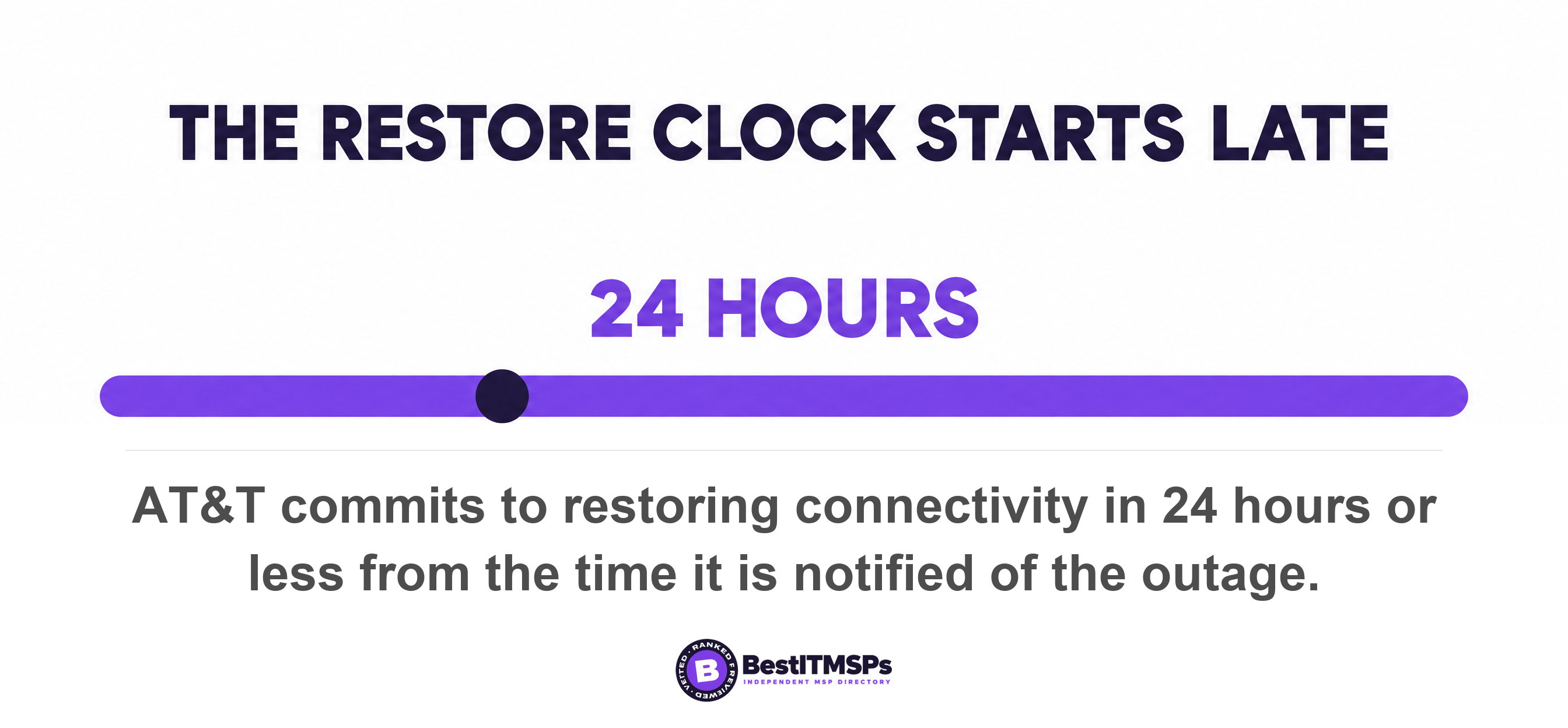
AT&T's 24-hour restoration commitment excludes any CPE failures and any outage involving access facilities, including Central Office (CO), Remote Terminal (RT), or Digital Subscriber Line Access Multiplexer (DSLAM) equipment. Access facilities are the local network between the exchange and your building, and customer premises equipment is the box on your wall. Between them they cover a large share of small-office faults. The restore commitment is strongest in the part of the network least likely to be the problem.
Verizon draws a similar line by ownership rather than by equipment type. It excludes telephone company circuits or equipment ordered by the Customer, Customer's applications or equipment, and, for repair time only, acts or omissions of third parties not affiliated with Verizon. So ask which party will have ordered the last mile into this building. The answer decides whether the guarantee reaches your wall or stops at the carrier's hub.
Is the credit your only remedy?
In two of the four documents we read, the credit is stated as the sole remedy, which means the lost trading day is not recoverable under those agreements at all. That single clause matters more than the uptime figure.
Verizon's satellite office terms state that a service credit is Customer's sole remedy for failure to meet any and all SLAs, and cap credits at 25 percent of the Monthly Fee for each affected site. Comcast's residential agreement is blunter and says it in capitals, that A CREDIT WILL BE YOUR SOLE AND EXCLUSIVE REMEDY FOR AN INTERRUPTION OF SERVICES. The same agreement disclaims liability for lost data, loss of profits, loss of earnings and loss of business opportunities, and states that Comcast will not be liable for any inconvenience, loss, liability, or damage resulting from any interruption of the Services.
Verizon's dedicated internet SLA is the interesting exception, and the finding is about where the clause lives rather than whether it exists. We could not find a cap on monthly credits, a sole-remedy clause or an exclusion of consequential damages anywhere in that document, and we say could not find rather than are not there, because proving a clause absent from a long contract page is harder than quoting one that is present. The one limit we did find inside it is narrow, that for denial of service events Customer may obtain no more than one credit per day. Either way the practical point stands, and it is the one to take to your own agreement: a ceiling you cannot see in the SLA is probably in the master agreement the SLA is attached to. So read the liability clause in the contract you sign, because an SLA can look generous while the agreement around it closes the door.
Expect one more rule in both documents. Verizon will not pay a repair-time credit if you already requested an availability credit for the same event, and AT&T withholds credits where you are entitled to other credits or remedies under your Service Agreement for the same interruption. One outage, one payment. AT&T also states that AT&T will be the only party to determine (in its sole discretion) whether AT&T has not met any of the SLAs, and that AT&T reserves the right to change or discontinue any or all of the SLAs.
Business-grade and consumer-grade, in contract terms
The contract difference between a consumer-grade line and a business-grade circuit is the repair clock, not the payment. Buyers assume they are paying for a bigger refund. They are paying for a shorter target.
Comcast's residential agreement offers a pro rata credit only for any Service interruption exceeding twenty-four (24) consecutive hours, gives you 120 days to request it, and limits it so that your pro rata credit will not exceed your fixed monthly charges for the Services that month. The same document provides the service as is and without warranty of any kind, either express or implied.
Now compare the clocks rather than the credits. A consumer-grade remedy only begins after a full day offline. Verizon's dedicated agreement sets a time to repair standard of 4 hours, with the clock starting when a trouble ticket is opened and ending with the restoration of the affected circuit. AT&T's business broadband sits between the two, committing that customer connectivity shall be restored in 24 hours or less from the time AT&T is notified of the outage. Note where that clock starts. Not when the line dropped, but when you told them.
The caps tell the same story from the other side. Comcast's residential cap of one month of charges matches AT&T's business cap of one month's worth of the monthly service fee, and both are larger than the 25 percent cap in one of Verizon's business products. The cap is not what the premium buys. A four-hour repair target is.
Does any regulator set a floor under business internet?
No federal rule we could find sets a minimum uptime for business internet or requires a carrier to compensate you for an outage. Service levels on a business circuit are contractual. If you have been assuming a regulator stands behind the line, that assumption is the expensive one.
What federal rules do require is reporting, and the distinction between reporting and compensating is the whole point. Under the FCC's outage rules a covered provider must notify the Commission within 120 minutes of discovering a qualifying outage, file an initial report not later than 72 hours after discovery, and file a final report not later than 30 days after discovery. A qualifying outage generally has to last at least 30 minutes and clear a scale threshold such as 900,000 user minutes. Outages affecting 911 facilities carry a separate notice no later than 30 minutes after discovery.
Read that list again and notice who gets told. The duty runs to the government, not to you, and the rule requires no refund, no bill credit and no other compensation to customers. Your outage can be formally reported to a federal agency, inside two hours, and still earn you nothing at all without a ticket number and a claim form.
The consumer-facing rule does not reach a negotiated circuit either. The FCC requires that any person providing broadband internet access service shall publicly disclose accurate information about its network practices, performance and commercial terms, and that a provider create and display an accurate broadband consumer label. The scope language covers mass-market service and excludes service offerings customized for the customer through individually negotiated agreements. A standardized small-business broadband plan sits inside that rule. A quoted, negotiated dedicated circuit sits outside it, which is the opposite of what most buyers would guess.
One carrier's own document shows the same shape in state law. Comcast's residential agreement carries separate outage provisions for Connecticut, Maine, New Jersey, New York and Ohio, and they cover television outages rather than internet service.
The clearest confirmation that claiming is the status quo comes from the attempt to change it. In May 2026 a US senator introduced the Outage Refund Guarantee Act, which would require cable, satellite, internet and telephone providers to issue credit for any service outage lasting more than four hours, set at 1/30 of the monthly bill for every period of four hours or more, and applied automatically to the consumer's account, without the need for the consumer to take any action. Read the last clause as a description of today. Legislators do not write a sentence removing a requirement that was never there. The Consumer Federation of America put the same point less diplomatically, saying the bill means the consumer should not be expected to beg for refunds on services they didn't get. The bill is introduced, not law, so nothing in it is a protection you have now. It is evidence about what you do not have.
Eight questions to ask before you sign a business internet contract
Ask these eight questions, and require the answers in the signed document rather than in an email from the account manager.
- Name the availability figure and the exact published document that states it.
- State the time to restore target, and the moment the clock starts.
- Confirm whether the credit is automatic or claimable, and the deadline for claiming it.
- Read the credit formula aloud, then multiply it by an eight-hour outage.
- List every exclusion, and establish which party orders the last mile.
- Check the monthly cap, and whether the credit is stated as your sole remedy.
- Require the ticket number and the open and close timestamps on every fault, in writing.
- Negotiate the escalation path and a named human contact for any outage past four hours.
Two of those answers change what you are buying. If the remedy is claimable, somebody in your office has to own the claim, because it is a fifteen-minute job on the day and worth nothing a month later. Give that job to a named person and put the carrier's outage reporting number in the same place as the fire drill. If the credit is capped at one month of charges, then the agreement has priced your worst possible year at one twelfth of the annual line rental, and priced everything above that at zero.
Keep your own outage log too, with the date, the start and end times, the ticket number and the name of whoever you spoke to. The agreements we read measure availability from the carrier's own records, and they make the trouble ticket the evidence.
Spend the argument on a second path, not on the credit
Negotiate the second circuit instead of the credit, because the credit is capped by design and a second path is not.
The arithmetic settles it. The most generous remedy in the agreements we read pays a few hundred dollars for a day offline, against an idle hour costing $46.89 per employee in employer compensation and 57 percent of major outages costing more than $100,000. Uptime Institute also reports that outages linked to fiber and connectivity issues are rising and more likely to result in extended disruptions. No amount of negotiating moves a capped credit far enough to cover that gap. Buying a different path does.
The technical half of that decision is internet failover, and we have already written it up in business internet backup: does anything fail over?. Read it beside MSP contract red flags and what is out of scope in a managed services agreement if you are renewing both contracts in the same quarter.
None of this makes a circuit immune to failure, and no honest carrier claims otherwise. Reading the agreement buys something smaller. It buys a document you have actually read, a ticket opened inside four hours, a claim filed while the evidence is fresh, and a realistic number for what the carrier owes you. A business that knows its credit is worth about $23 makes better decisions than a business that assumes somebody is on the hook for the day.
FAQ
Does my ISP have to pay me if the internet goes down?
No. Payment comes from your contract, not from a regulator, and usually only if you ask. AT&T states that credits are not automatically applied and that the customer must apply by calling customer care. The FCC's outage rules make a provider notify the Commission within 120 minutes of discovering a qualifying outage, and require no customer compensation.
How do I claim an ISP SLA credit?
Open a trouble ticket during the outage, keep the ticket number, then file a written claim. Verizon counts an outage only where you open a ticket within four (4) hours from learning of the outage, and requires the credit request within 30 days from the date that the Internet Dedicated Service was unavailable. AT&T requires a Verifiable Trouble Ticket with every request.
What does a 99.9 percent uptime SLA actually allow?
About 43 minutes of downtime in a 30-day month, which is arithmetic on the percentage rather than a published figure. AT&T commits to 99.9% network availability measured over a calendar month between its points of presence. Verizon's dedicated agreement goes further and states that the Verizon Network will be available 100% of the time, then pays by the hour when it is not.
Can I claim lost revenue from my internet provider?
Almost never under the agreement itself. Verizon's satellite office terms make a service credit Customer's sole remedy, and Comcast's residential agreement states that a credit is your sole and exclusive remedy for an interruption of services while disclaiming loss of profits, loss of earnings and loss of business opportunities. Read the liability clause in the master agreement, not only the SLA.
Is a business internet SLA worth paying more for?
Yes, for the repair clock rather than the payment. Verizon's dedicated agreement sets a time to repair standard of 4 hours, while Comcast's residential terms pay a credit only after an interruption exceeding twenty-four (24) consecutive hours. The monthly caps are broadly similar, so buy the response time and not the refund.
Best IT MSP is the independent directory of vetted managed IT providers across the US and Canada. Organic ranking is earned on rating and verified data, and paid placement is always labelled. Take these eight questions to three merit-ranked firms in your city and compare the answers side by side.