E911 and Remote Workers: The Gap in Your Phone System
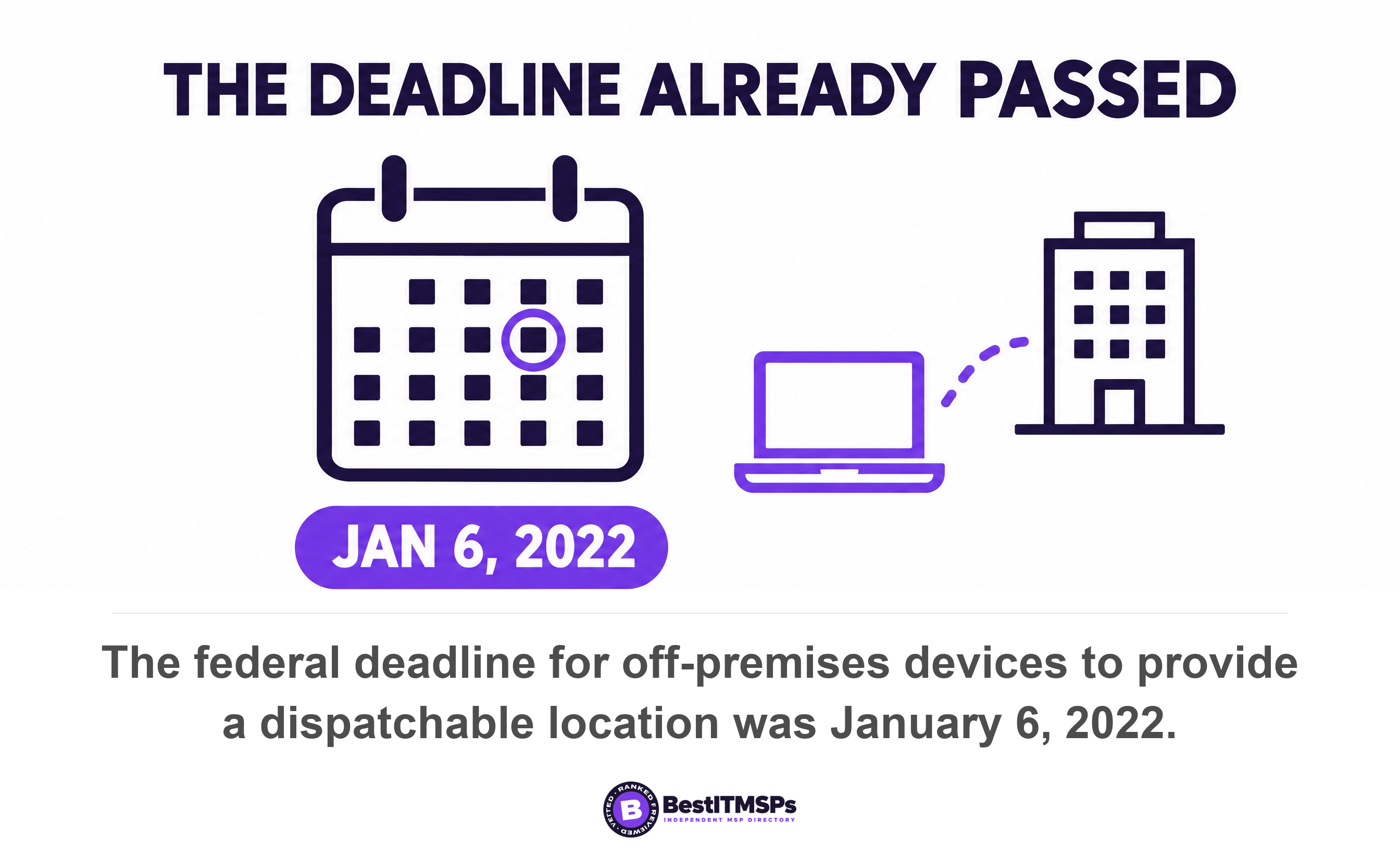
A softphone dialing 911 from home sends the emergency address stored against that user, which is usually your office. Kari's Law covers direct dialing and notification. RAY BAUM'S Act covers dispatchable location, and the off-premises deadline passed on January 6, 2022. Check the assigned address, enable user confirmation, then dial 933 to test.
- Two federal laws apply, not one. Kari's Law covers direct dialing and notification. RAY BAUM'S Act covers sending a dispatchable location.
- The off-premises deadline was January 6, 2022. The remote-worker gap is more than four years old, not a new problem.
- A static emergency address assigned to a user sits last on Microsoft's five-level location list, so it is what responders get from a kitchen.
- A 911 call carrying an unconfirmed address is screened before it reaches your local dispatcher. A user-confirmed address goes direct.
- The rules bind whoever installs, manages or operates the phone system. Buying a compliant system does not move that duty off your business.
E911 and remote workers: the address responders get is the one on file
A softphone that dials 911 from a kitchen table sends whatever emergency address is stored against that user. When the office emptied and nobody updated that record, the call reaches the dispatch center for a building your employee has not visited in two years, and the address on the dispatcher's screen is the office. Two federal laws govern this, Kari's Law and RAY BAUM'S Act, and the deadline for devices used away from your premises passed on January 6, 2022.
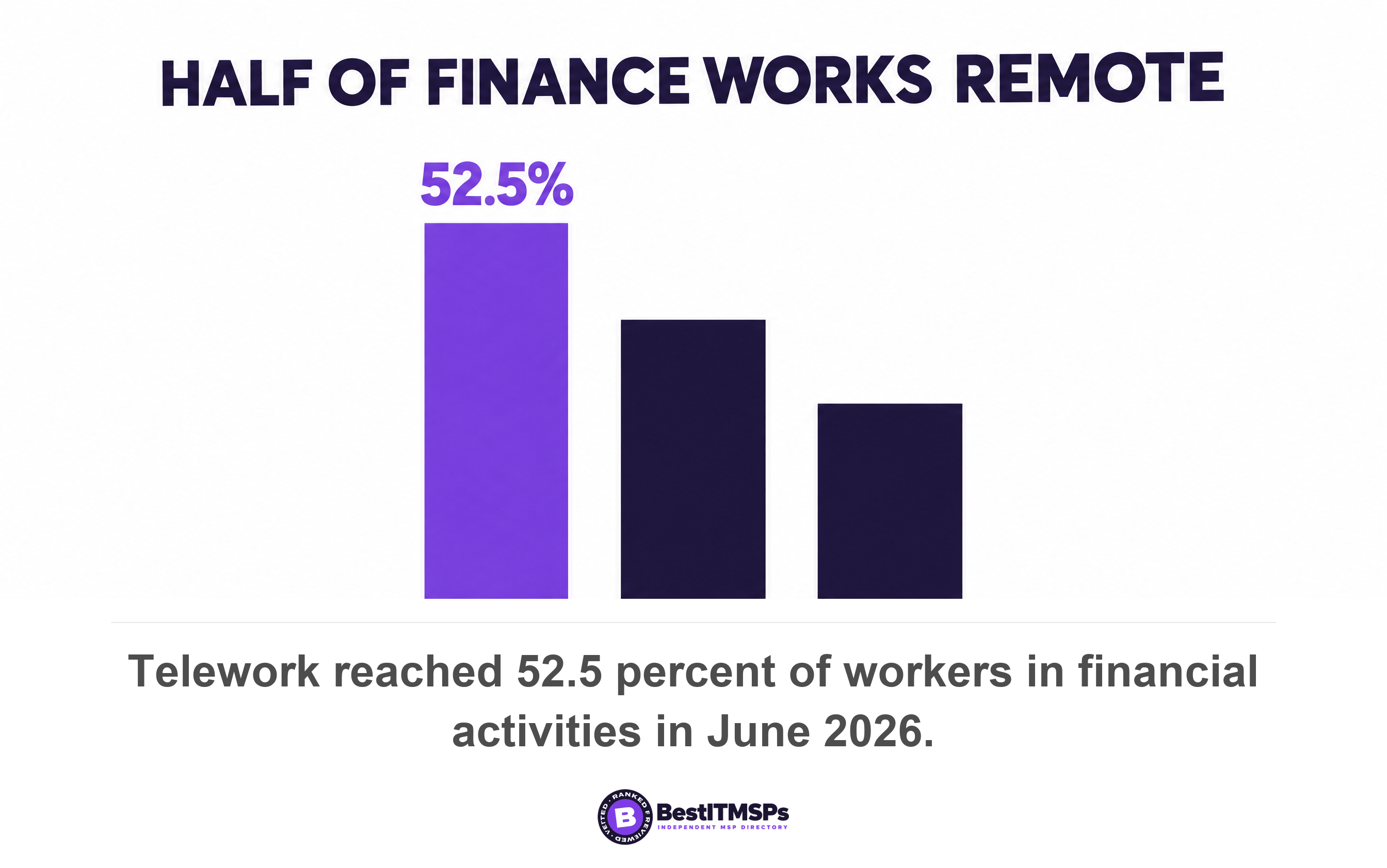
This is not a rare edge case. The Bureau of Labor Statistics recorded 22.6 percent of workers teleworking or working at home for pay in March 2026. In the industries that buy the most managed IT the share runs far higher, reaching 52.5 percent in financial activities, 47.2 percent in information and 41.8 percent in professional and business services in June 2026. Roughly half of a professional services payroll can dial 911 from a desk your phone system has never seen.
This is a buyer's guide and not legal advice. It names the rules and quotes them so you can put precise questions to the provider you already pay, rather than accepting a vendor summary of what the law says. Read it beside Phone Number Porting Problems, which covers what happens to your 911 record when you change carriers, and Call Recording Consent Rules, which covers a different obligation on the same phone system. If you are still choosing a platform, start with Hosted VoIP vs On-Premise.
The two federal laws, by name, and what each one requires
Two laws govern 911 from a business phone system, and they ask for different things. Kari's Law is about reaching 911 at all and telling someone it happened. RAY BAUM'S Act is about the location that arrives with the call. A provider that treats them as one requirement has not read either.
Kari's Law: dial 911 directly, and notify someone
Kari's Law requires direct dialing plus a notification. The statute makes it unlawful to operate a multi-line telephone system unless a user may directly initiate a call to 9-1-1 from any station, and the rule implementing it says that must work without dialing any additional digit, code, prefix, or post-fix. The old trunk-access 9 cannot sit between an employee and an ambulance, even where every other outside call still needs it.
The notification is the half most small firms have never configured. Where the system is able to be configured to provide the notification without an improvement to its hardware or software, one must be sent. It goes to a central location at the facility where the system is installed or to another person or organization regardless of location, must be initiated contemporaneously with the 911 call, must not delay the call to 911, and must arrive where someone is likely to see or hear it. Read the phrase about location again. You cannot put a security desk in an employee's spare room, but you can notify the office manager's phone the moment a remote worker dials 911, and the rule was written to allow exactly that.
RAY BAUM'S Act: send a location a dispatcher can act on
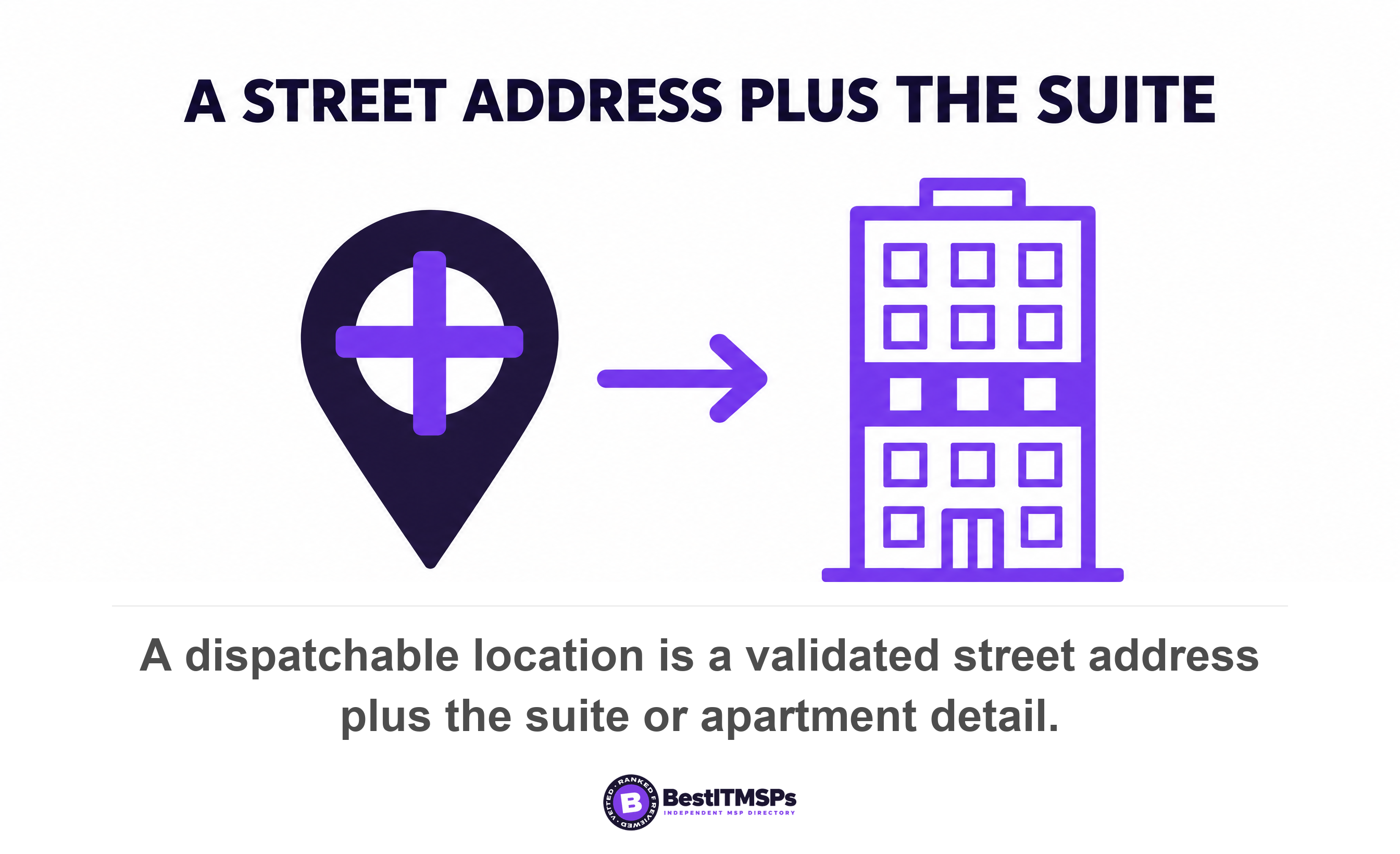
RAY BAUM'S Act requires a dispatchable location. Section 506 of the Act directed the Commission to conclude a proceeding to consider adopting rules to ensure that the dispatchable location travels with a 911 call, and defined the term as the street address of the calling party, and additional information such as room number needed to identify where that caller is. The FCC's own definition is tighter still. A dispatchable location consists of the validated street address of the calling party plus additional information such as suite, apartment or similar information.
That definition rules two things out. A latitude and longitude is not a dispatchable location. An unvalidated street address with no apartment number is only half of one. Both matter for a remote worker, because a home address typed in a hurry is the exact input the rule declines to accept.
The compliance dates are old. On-premises fixed telephones needed automated dispatchable location by January 6, 2021. On-premises non-fixed devices had until January 6, 2022 to provide it when technically feasible, and otherwise to fall back to dispatchable location based on end user manual update or alternative location information. Off-premises devices share that date, needing automatic dispatchable location, if technically feasible, and otherwise a manual update or enhanced location information, which may be coordinate-based. The regulation already anticipated the laptop in the kitchen and accepted a manual update as a valid answer. Somebody still has to make that update happen.
Who the rules obligate, and why a compliant phone system is not enough
The rules split the duties across two groups, and your business sits in the second one. Paragraph (a) binds a person engaged in the business of manufacturing, importing, selling, or leasing a multi-line telephone system. That is your vendor's problem, and it is why you can buy a compliant system off the shelf. Paragraph (b) binds a person engaged in the business of installing, managing, or operating one, and that is where a small business lands.
The definitions make it concrete rather than theoretical. An operator is a person responsible for the day-to-day operations of the MLTS. An installer is a person that configures the MLTS or performs the other tasks that get it ready to run. A manager is the entity that is responsible for controlling and overseeing implementation. A multi-line telephone system is not niche hardware either, covering systems such as Centrex and VoIP, as well as PBX, Hybrid, and Key Telephone Systems. So your MSP may well be the installer and the manager. You are almost certainly the operator, and the dispatchable location duty does not transfer with the invoice.
One date decides whether any of this reaches you. The compliance date for the subpart is February 16, 2020, and its requirements apply to a multi-line telephone system manufactured, imported, first sold or leased, or installed after that date. A key system that has sat untouched in a closet since 2017 is outside it. Here is the part worth sitting with. If you moved to a cloud phone system so people could work from home, you installed a new multi-line telephone system after February 2020. The migration that created your remote-worker problem is the same migration that pulled you inside the rule.
A second rulebook runs alongside that one, and it binds your provider rather than you. Where your service is interconnected VoIP capable of being used from more than one location, which describes nomadic VoIP on every laptop you issue, the provider must have obtained the Registered Location prior to the initiation of service, must give end users one or more methods of updating their Registered Location that allow an end user to update the Registered Location at will, and must obtain and keep a record of affirmative acknowledgement by every subscriber that the limits on E911 were explained. Ask for your acknowledgement record. A provider who cannot produce it probably never finished your setup.
Why your softphone sends the office address
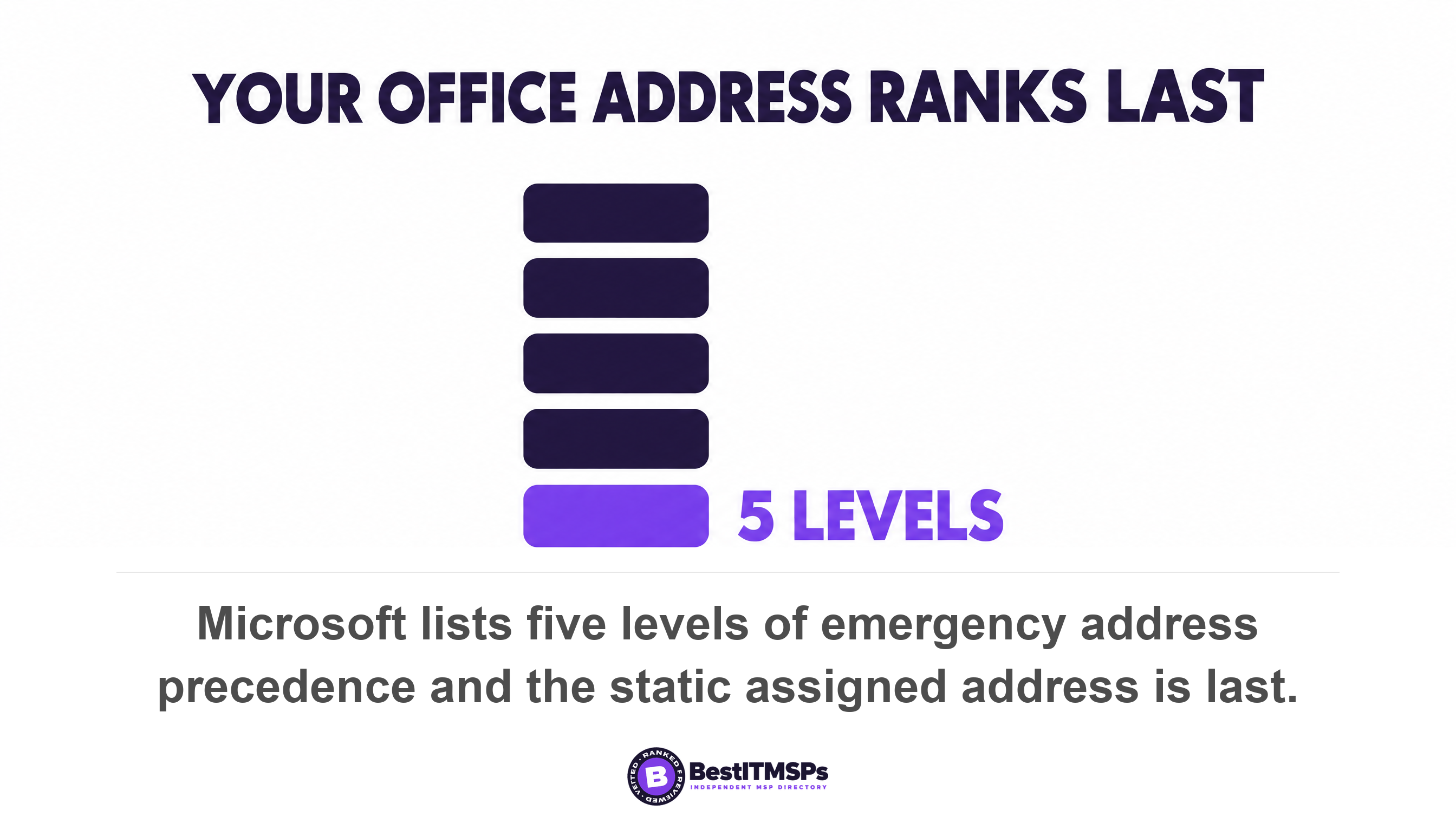
Your softphone sends the office address because the static address assigned to your user is the last item on the location list, and nothing above it matches from a kitchen. Microsoft publishes that order for Teams and it has five levels. A dynamically acquired address defined by the tenant administrator in the Location Information Service wins. Then an address the end user confirmed or edited for the network the client is on. Then an address automatically suggested by the operating system. Then an address the end user manually entered without service resolution. Last, and only last, an address the administrator statically associates to the phone number assigned to the user.
At the office, level one does all the work. An administrator maps network identifiers to validated addresses in the Location Information Service, and the client matches them in a fixed order, WAP, Ethernet switch/port, Ethernet switch, subnet, taking the first match. That is dynamic location routing working as designed, and it is why nobody notices a problem while everyone is in the building.
At home, that machinery is switched off by design. Teams attempts a dynamic policy or location lookup from the endpoint's IP address only if the user's external IP address matches an IP address in the trusted IP addresses you configured. A home broadband connection never matches, so the subnet route is closed before it starts. Switch and access-point requests still fire regardless of whether the external IP address matches, but your employee's home router and wireless access point are not in your Location Information Service either. Every level above the static fallback fails, so the fallback runs. That is not a product defect. It is the documented behavior of an emergency address nobody updated.
The screening detour almost nobody is told about
A 911 call carrying a static assigned address does not go straight to your local dispatcher. Microsoft's routing table is the most useful half page in this whole subject, and it sorts every type of emergency address into one of two call paths. An emergency address statically assigned to the user/number is screened and transferred to PSAP. So is an emergency address obtained from the operating system without confirmation for accuracy by the user, and so is a null address.
Now the other column. An emergency address obtained from the operating system with confirmation for accuracy by the user goes direct to PSAP. So does an address entered through address autosuggest and confirmed by the user, and so does a dynamically acquired emergency address defined by administrator.
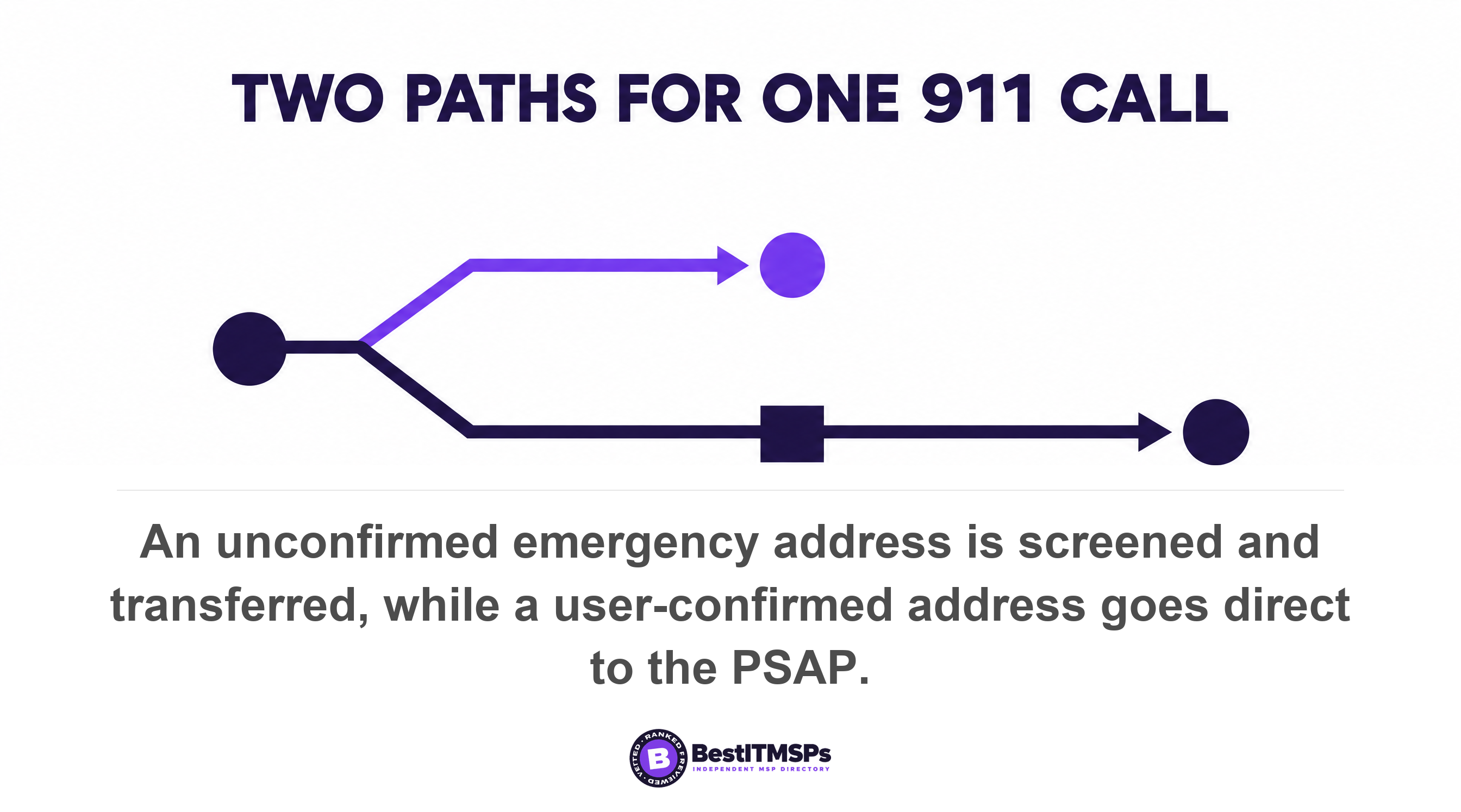
Read the difference carefully, because it is the finding in this article a vendor will not volunteer. The same laptop, in the same kitchen, either reaches the serving public safety answering point directly or detours through a screening center first, and what decides it is whether the person sitting there confirmed the address once. Confirming an address is a single interaction on the Calls tab. It is also the highest-leverage thirty seconds in your entire emergency calling setup, and nobody sells it to you, because there is nothing to sell.
The administrator side of that one interaction is two steps. Create an emergency calling policy with External location lookup mode turned on, then assign it to your remote staff. In PowerShell it is the ExternalLocationLookupMode parameter set to Enabled. Without that policy your users have no place to confirm anything, and Teams has nothing better than the fallback to send.
A provider who can show you the emergency address your remote worker's softphone sent last week is operating the control. A provider who says 911 just works is only selling you a phone system.
The settings to check, in order
Work the eight checks below in order, because each one feeds the next. Do them with the provider in the room, and write down the answers.
- Ask which of the two federal rules your provider says applies to your system, and get the answer in writing with the paragraph numbers.
- Confirm whether your phone system was installed after February 16, 2020, because that date decides whether the subpart reaches you at all.
- Request the affirmative acknowledgement record your interconnected VoIP provider must keep, plus the method it gives you to update your registered location at will.
- List every remote worker with a softphone, then read the emergency address currently assigned to each one and check it against where that person actually sits.
- Enable the emergency calling policy that lets remote users confirm their own emergency address, assign it, and then tell them to use it.
- Validate every address you assign and check it carries a geo code, because the emergency address must contain an appropriate geo code before it can be assigned to a network identifier for dynamic emergency calling.
- Configure the notification so a named person is alerted whenever anyone dials 911, including staff working off-premises, and name a deputy for when that person is out.
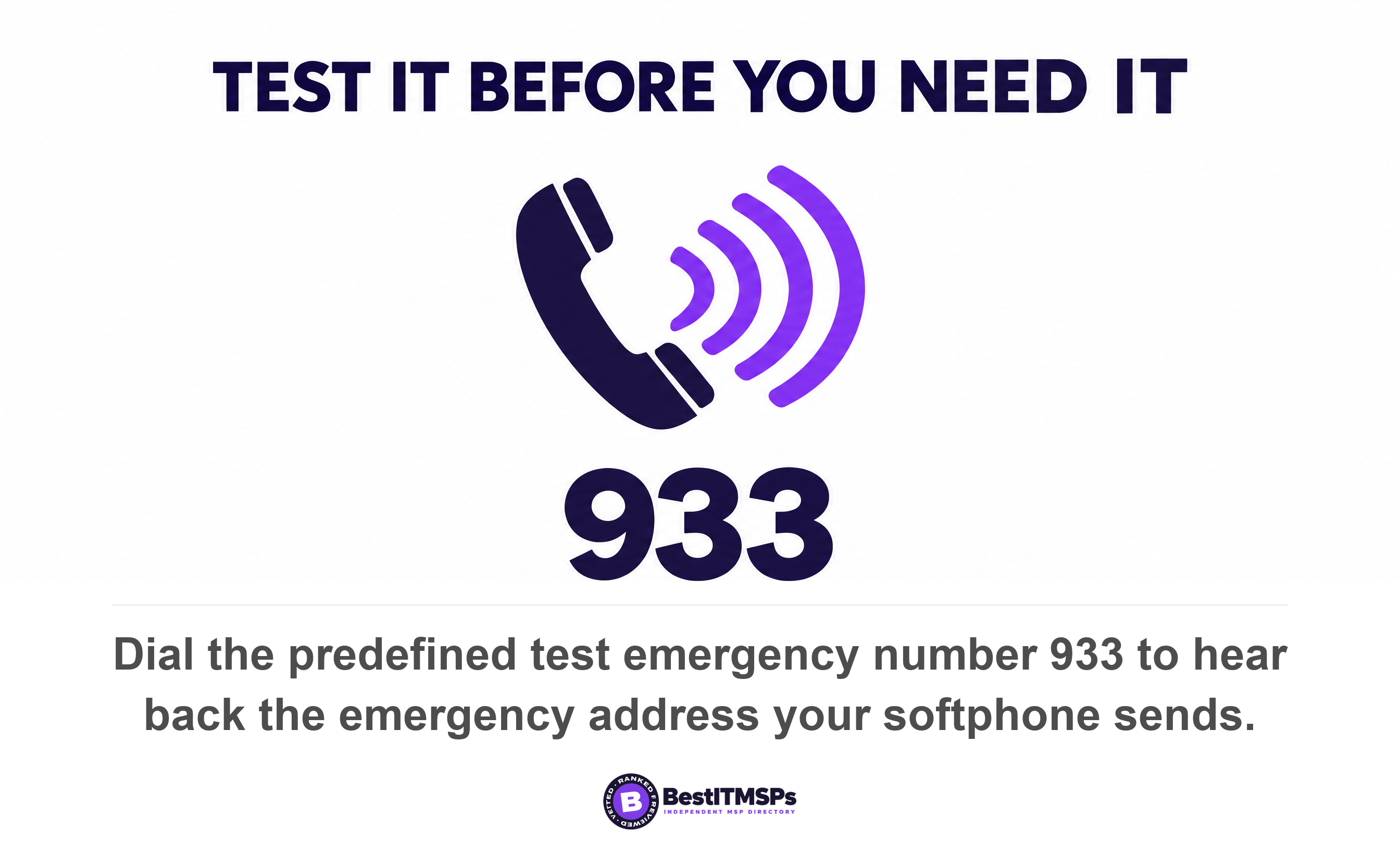
- Test it from a home connection. Calling Plan, Operator Connect and Teams Phone Mobile users in the United States or Canada can dial the predefined test emergency number 933, which echoes back the caller phone number, the emergency address and whether a real call would be routed automatically or screened first.
Four limits will catch you out if you skip them. Changes to network settings can take up to four hours to propagate and reach clients, so test the next day rather than the same hour. Dynamic emergency calling, including security desk notification, isn't supported on the Teams web client, so a browser-only user is outside the whole design. The work-from-home experience runs on Teams desktop on Windows and Mac only, because Teams phones don't support the work-from-home experience and Teams mobile supports automatic location detection but not the user entered experience. And a successful network match proves less than it looks, because Microsoft states plainly that a successful network-site match doesn't confirm that the client obtained an emergency address.
A home worker on a Teams desk phone is therefore a configuration you have to solve some other way, usually by registering a validated address against that specific device. Find those people before an incident does.
What a good answer sounds like, and what to walk away from
A provider worth paying answers in paragraph numbers, dates and screenshots. A weak one answers in reassurance and a compliance badge. Five answers should end the conversation.
- Naming Kari's Law and RAY BAUM'S Act as a single requirement, because they are two laws asking for different things.
- Quoting a penalty figure to close a sale instead of showing you the setting that fixes the problem.
- Treating a set of coordinates as a dispatchable location, when the rule asks for a validated street address plus the suite or apartment.
- Having no written answer for remote staff, more than four years after the off-premises deadline passed.
- Being unable to produce your affirmative acknowledgement record or to show you how you update your registered location.
None of this makes a 911 call from a spare bedroom as dependable as one from a staffed office, and no honest provider claims otherwise. It makes the call path visible, and it moves the address a dispatcher sees from stale to accurate for the cost of one policy and one conversation with your staff. Put the eight checks above to every provider on your shortlist and compare the answers side by side. This remains a buyer's guide rather than legal advice, so a regulated business should run its own conclusions past counsel before relying on them.
FAQ
Does Kari's Law apply to a small business?
Yes, where you install, manage or operate a multi-line telephone system. The rule binds a person engaged in the business of installing, managing, or operating one, and an operator is a person responsible for the day-to-day operations of the MLTS. The subpart's compliance date is February 16, 2020, so a system installed after it is in scope.
What is a dispatchable location, in plain terms?
A dispatchable location is the address a dispatcher can send an ambulance to. The regulation defines it as the validated street address of the calling party plus additional information such as suite, apartment or similar information. Coordinates alone do not qualify, and neither does a street address missing the floor or apartment number.
Does 911 know where my remote employee is?
Usually not, unless somebody configured it. Teams only attempts a dynamic lookup when the user's external IP address matches an IP address in the trusted IP addresses, which a home connection never does. The call then falls back to the address the administrator statically associates to the phone number, which is normally your office.
Who is responsible for E911 compliance, my business or my phone provider?
Both, in different places. Manufacturers and sellers carry the duties in paragraph (a), while installers, managers and operators carry those in paragraph (b). Your interconnected VoIP provider separately must obtain the Registered Location before service starts and let you update the Registered Location at will.
How do I test what address my softphone sends to 911?
Dial the test number from the connection you want to check. Calling Plan, Operator Connect and Teams Phone Mobile users in the United States or Canada can call the predefined test emergency number 933, which echoes back your number, the emergency address that would be sent, and whether the call would be screened first.
Best IT MSP is the independent directory of vetted managed IT and cybersecurity providers across the US and Canada. Organic ranking is earned on rating and verified data, and paid placement is always labelled. Take the eight checks above to three merit-ranked firms in your city and compare the answers side by side.