Structured Cabling: A Buyer's Guide
Structured cabling is the organized, standards-based system of cabling and hardware that forms the physical foundation of a business network. Instead of ad hoc runs of wire, it uses a planned design, horizontal and backbone cabling, patch panels, and labeled connections, so the network is reliable, fast, and easy to manage and expand.
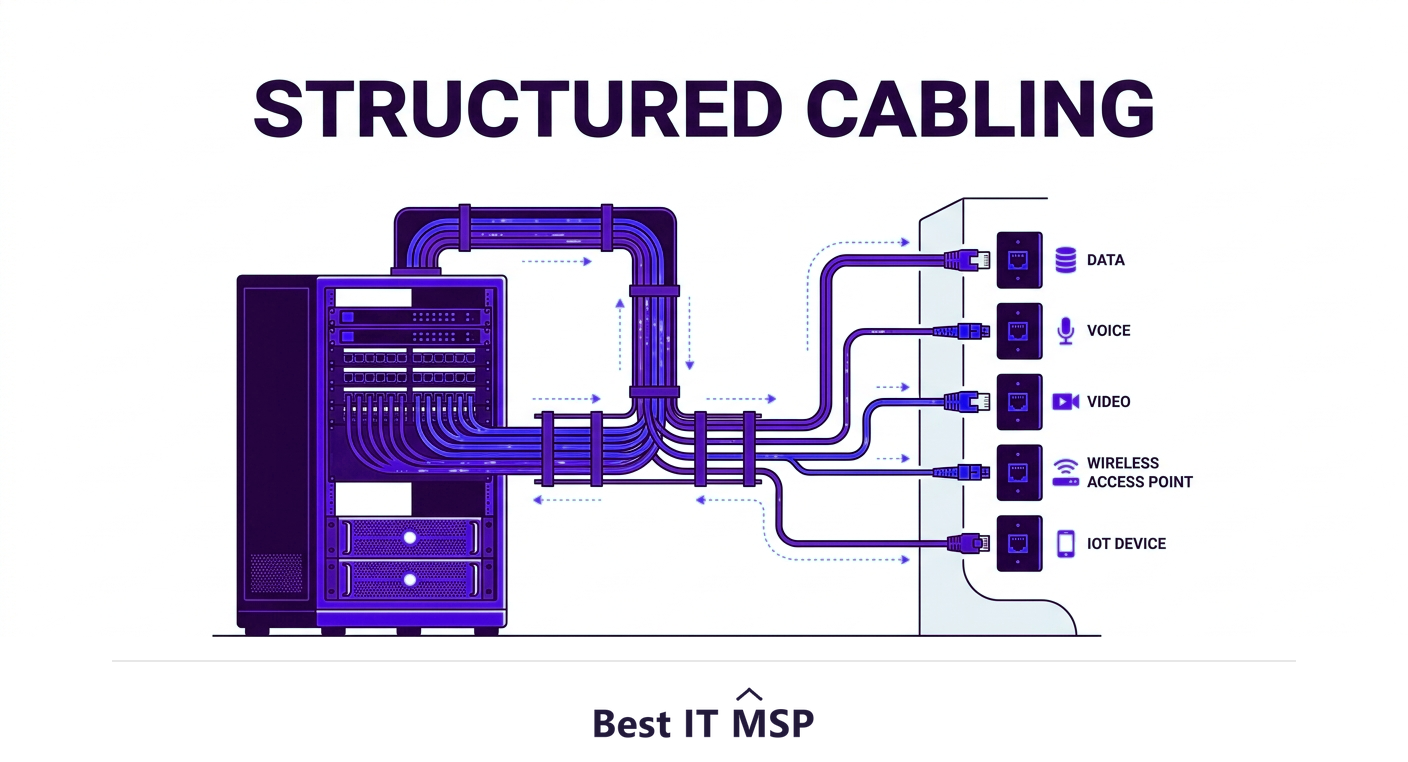
- Structured cabling is the organized, standards-based physical foundation of a business network.
- It replaces ad hoc wiring with a planned design, patch panels, and labeled, documented connections.
- The cable grade (Cat6, Cat6A, or fiber) determines speed and how long the system stays current.
- Good cabling supports everything that rides on the network: WiFi, VoIP, security, and cloud access.
- Poor cabling causes slowdowns and outages that are expensive and hard to troubleshoot later.
What is structured cabling?
Structured cabling is the organized, standards-based system of cabling, connectors, and hardware that forms the physical foundation of a business network. Instead of running cables ad hoc, point to point, whenever something needs connecting, structured cabling uses a deliberate, documented design: a consistent layout, labeled connections, patch panels, and a clear hierarchy that makes the whole network reliable, fast, and easy to manage and expand. It is the unglamorous infrastructure that everything else depends on. Your WiFi access points, phones, servers, cameras, and the cloud applications your team uses all ride on this cabling, so when it is done well, it quietly works for a decade or more, and when it is done badly, it causes problems that are slow and expensive to chase down.
This guide explains what structured cabling includes, the cable grades, design best practices, and common mistakes, so you can invest wisely. It pairs with our structured cabling overview and the network support services page, and connects to our guide on business WiFi and network design.
The components of structured cabling
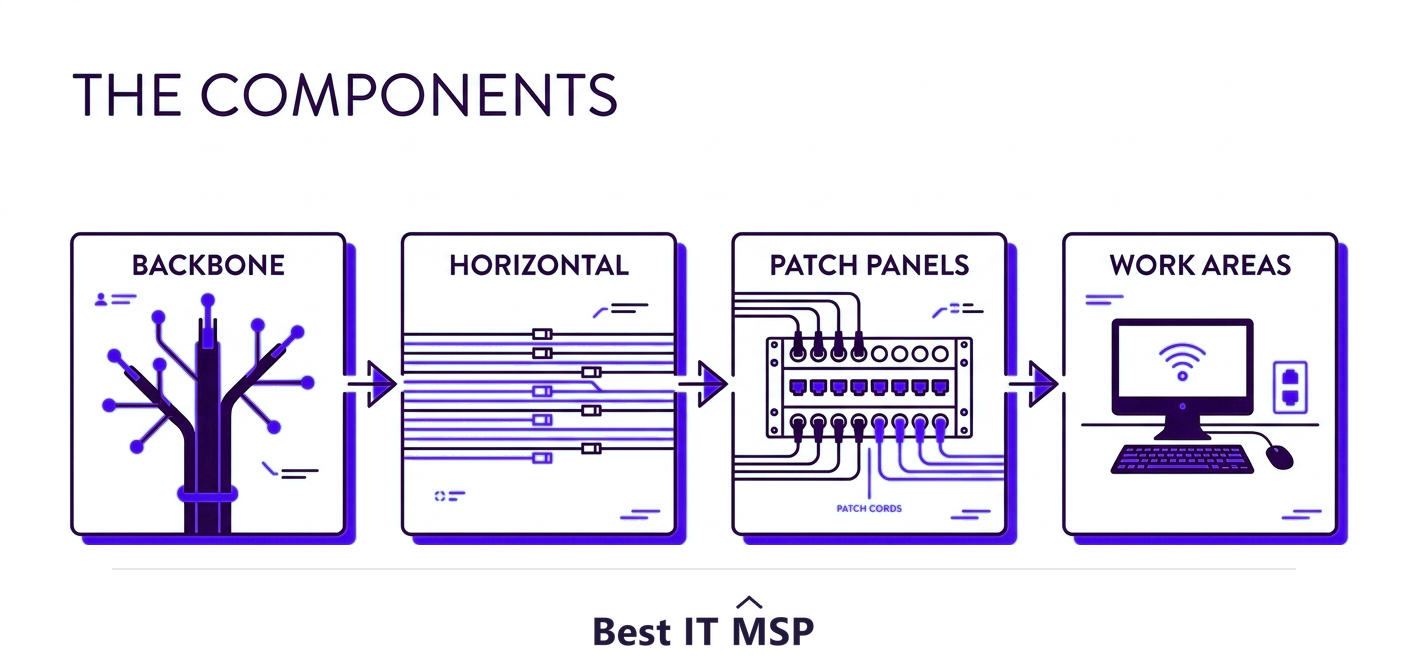
A structured cabling system is organized into standard parts that fit together predictably:
- <strong>Entrance facilities.</strong> Where outside services, like your internet connection, enter the building.
- <strong>Equipment and telecom rooms.</strong> The central spaces housing servers, switches, and patch panels that connect everything.
- <strong>Backbone cabling.</strong> The high-capacity cabling that connects rooms, floors, and buildings, the spine of the network.
- <strong>Horizontal cabling.</strong> The cabling that runs from a telecom room out to each work area outlet, the bulk of the wiring.
- <strong>Patch panels.</strong> The organized termination points that let connections be changed and managed cleanly, without re-running cable.
- <strong>Work area outlets.</strong> The wall jacks where devices, phones, computers, and access points, actually connect.
Designed and installed together to a standard, these parts make the network infrastructure organized, documented, scalable, and easy to extend or troubleshoot.
Why structured cabling matters
It is tempting to treat cabling as a commodity, but it is the layer everything else runs on, and the cost of getting it wrong is high and recurring. A poorly cabled network produces intermittent slowdowns and outages that are notoriously hard to diagnose, and downtime is expensive, costing most organizations more than $100,000 an hour. As businesses depend ever more on the network, with public cloud spending forecast to reach $723.4 billion in 2025 and 89% of organizations running a multi-cloud strategy, every cloud application, video call, and file transfer rides on this physical foundation. Good structured cabling supports all of it reliably and at full speed; bad cabling becomes the hidden bottleneck that throttles even a fast internet connection and frustrates everyone, adding to the 1.8 hours a day employees already lose searching for information and the 28% of the workweek consumed by email. The network infrastructure is only as fast as its weakest cable.
Cabling grades and standards
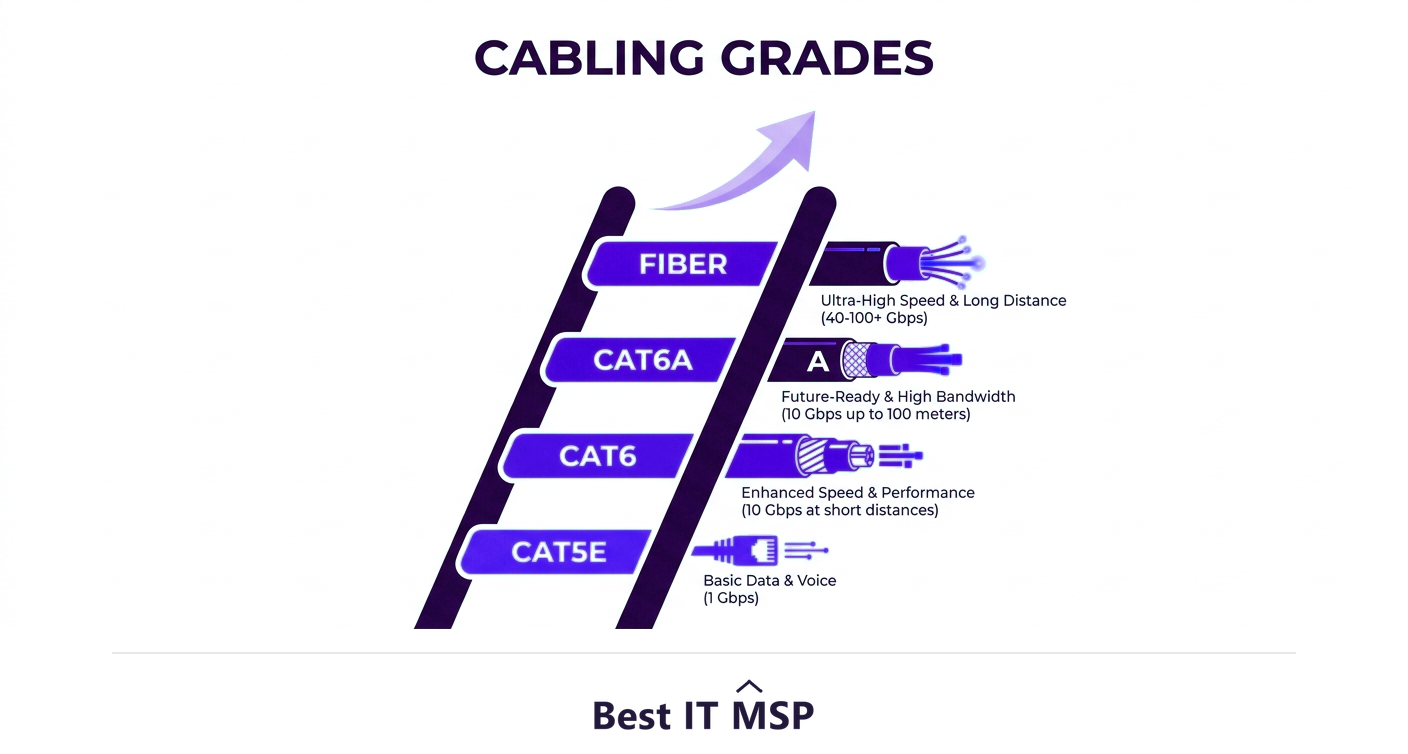
The grade of cable you install determines both the speed it supports today and how long it stays current. The common choices for copper Ethernet are Cat5e (adequate for basic gigabit but increasingly dated), Cat6 (a solid current standard for most offices), and Cat6A (which supports faster 10-gigabit speeds over longer distances and is the safer choice for future-proofing). For backbone runs, between floors or buildings, or where distance and bandwidth demand it, fiber optic cabling carries far more data over far greater distances. The right choice balances cost against how long you want the cabling to last; since cabling is meant to stay in the walls for 10 to 15 years, installing a higher grade than you need today is usually cheaper than re-cabling later. A professional designs this around your real and anticipated bandwidth.
Design and installation best practices
Good structured cabling follows a few enduring principles:
- <strong>Design for the future.</strong> Plan capacity and cable grade for where the business is heading, not just today's needs, so you do not re-cable in three years.
- <strong>Label and document everything.</strong> Every cable, port, and panel should be labeled and recorded, so future changes and troubleshooting take minutes, not hours.
- <strong>Keep runs clean and within limits.</strong> Respect maximum cable lengths and bend radii, and route cables tidily and away from electrical interference.
- <strong>Use quality components and certified installers.</strong> Cheap cable and connectors, or sloppy termination, undermine the whole system.
- <strong>Test and certify every run.</strong> Each cable should be tested to confirm it meets the standard before it is signed off.
These practices are what separate cabling that simply works from cabling that becomes a recurring headache.
Common cabling mistakes
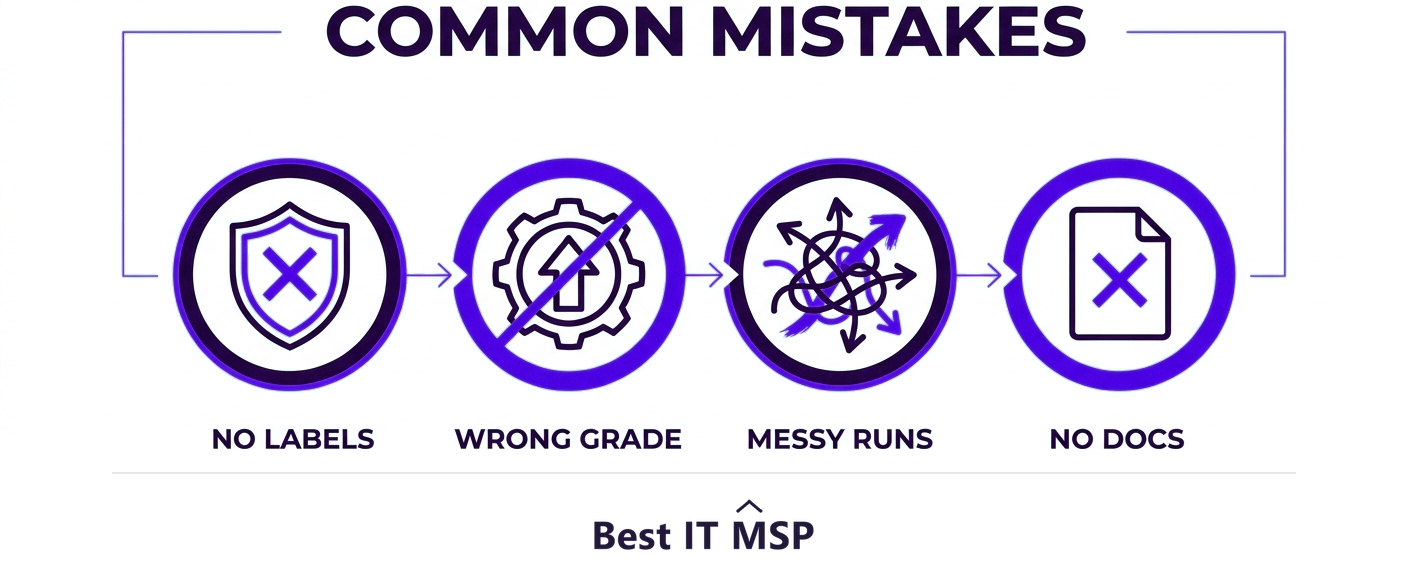
Most cabling problems trace to a short list of avoidable mistakes: no labeling or documentation, which turns every future change into detective work; choosing too low a cable grade to save money up front, then needing to re-cable when demand grows; messy, unmanaged runs that are impossible to trace and prone to damage; ignoring length and interference limits, which causes intermittent, maddening faults; and skipping testing, so faults are discovered only after everything is in use. Each of these is cheap to avoid during installation and expensive to fix afterward. Because the network underpins security too, sloppy infrastructure can also complicate defending it, and the average data breach costs $4.88 million and takes an average of 258 days to identify and contain. The lesson is consistent: pay for it done right once, rather than paying repeatedly to work around it done wrong.
Getting structured cabling right
Structured cabling is a long-term investment in the foundation everything else stands on. Done well, with the right cable grade, a future-ready design, clean installation, labeling, documentation, and testing, it disappears into the walls and reliably carries your WiFi, phones, servers, and cloud traffic for a decade or more. Done poorly, it is a hidden tax on performance and a source of outages no one can easily explain. Because it is infrastructure you live with for years, it is worth designing and installing properly the first time, which is why most businesses use experienced providers, part of a managed services market growing from about $330 billion in 2024 toward $879 billion over the next decade.
If you are planning a cabling project or fixing a troubled network, comparing vetted providers on merit is the place to start. Browse merit-ranked managed IT firms by city in the Best IT MSP directory, where ranking is earned on rating and verified data, not on who pays the most. You can also read our guide to business WiFi and network design.
FAQ
What is structured cabling?
Structured cabling is the organized, standards-based system of cabling, connectors, and hardware that forms the physical foundation of a business network. Rather than ad hoc point-to-point wiring, it uses a deliberate, documented design with backbone and horizontal cabling, patch panels, and labeled connections, making the network reliable, fast, and easy to manage and expand.
What are the components of a structured cabling system?
The standard components are entrance facilities (where outside services enter the building), equipment and telecom rooms (housing servers, switches, and patch panels), backbone cabling (connecting rooms and floors), horizontal cabling (running to each work area), patch panels (organized termination points), and work area outlets (the wall jacks where devices connect). Together they form an organized, documented system.
What cable grade should I use, Cat6, Cat6A, or fiber?
Cat6 is a solid current standard for most offices, while Cat6A supports faster 10-gigabit speeds over longer distances and is the safer choice for future-proofing. Fiber optic cabling is used for backbone runs between floors or buildings and where distance and bandwidth demand it. Since cabling stays in the walls for 10 to 15 years, installing a higher grade than you need today is usually cheaper than re-cabling later.
Why does structured cabling matter?
Because it is the physical layer everything else runs on, your WiFi, phones, servers, security cameras, and cloud applications all ride on it. Good cabling supports all of that reliably and at full speed, while poor cabling causes intermittent slowdowns and outages that are hard to diagnose and expensive, given downtime costs most organizations more than $100,000 an hour. It is the hidden foundation of network performance.
What are common structured cabling mistakes?
The most common are no labeling or documentation (turning every change into detective work), choosing too low a cable grade to save money then needing to re-cable, messy unmanaged runs that are hard to trace, ignoring length and interference limits (causing intermittent faults), and skipping testing so faults surface only after everything is in use. Each is cheap to avoid during installation and costly to fix afterward.
How long does structured cabling last?
Quality structured cabling is designed to remain in place for roughly 10 to 15 years, far longer than the network equipment it connects. This longevity is exactly why choosing an appropriate, future-ready cable grade and installing it cleanly matters so much: you are making an investment you will live with for over a decade, and re-cabling later is far more disruptive and expensive than doing it right the first time.
Best IT MSP is the independent directory of vetted managed IT providers across North America. Compare merit-ranked firms in your city that design and install structured cabling. No pay-to-play.