Why a 5.0 from 4 reviews tells you less than a 4.6 from 200
A 5.0 from 4 reviews is a sample, not a verdict. One ordinary 3-star review drops that listing to 4.6, while the same review moves a 4.6 built on 200 reviews by a hundredth of a star. Read the count first, then the score. In our directory, 61.8 percent of rated providers sit at exactly 5.0.
- Read the review count before the star rating. The count tells you how far one person can move the score.
- One ordinary 3-star review takes a 5.0 from 4 reviews down to 4.6. The same review moves a 4.6 from 200 reviews by a hundredth of a star.
- An average of four whole-star ratings moves in quarter-star steps, so a 4-review listing cannot land on 4.6 at all.
- Thin samples run extreme in both directions, so a 3.5 from 5 reviews is unmeasured rather than bad.
- In our data, 5,510 of the 11,153 providers rated exactly 5.0 carry fewer than 10 reviews.
Why a 5.0 from 4 reviews tells you less than a 4.6 from 200
A 5.0 from 4 reviews tells you less than a 4.6 from 200 because the review count sets how far one person can move the star rating. Four five-star reviews average 5.0. Add one ordinary 3-star review and that listing averages 4.6. Add the same review to a 4.6 built on 200 reviews and it averages 4.59. The score is only as stable as the sample behind it.
A perfect score is also the market default rather than a distinction. Across our directory, 61.8 percent of rated providers sit at exactly 5.0, and 5,510 of those 11,153 providers, 49.4 percent, carry fewer than 10 reviews. So about half the perfect scores on a city page rest on a sample one unhappy client would erase. We publish the review count beside the verified rating for exactly that reason. A 5.0 from 4 reviews is not a lie. It is a small sample, and the count is the only number on the listing that tells you so.
The decision underneath is expensive, which is why a thin signal matters here more than it does for a restaurant. Your provider holds administrator access to your systems, and Verizon found a third party involved in 48 percent of breaches, up 60 percent in a year. You are not picking a lunch spot.
This is the single-listing version of the question. The market-level picture, with every rating band and the full rating distribution, sits in what 24,491 provider records say about MSP star ratings. Below you get the arithmetic, the sample size a federal statistics agency treats as a floor, and a three-line check to run before your next call.
What a listing with 4 reviews can and cannot show you
A listing with 4 reviews can only land on five values between 4.0 and 5.0, because an average of four whole-star ratings moves in quarter-star steps. Those five values are 4.0, 4.25, 4.5, 4.75 and 5.0. A 4-review average cannot land on 4.6 at all. The gap between a 5.0 and the next value down is one person's single click. At 200 reviews one new review shifts the average by about a hundredth of a star, so the number on the page is doing real work.
One caveat belongs here, and it cuts in the same direction. Platforms filter and weight reviews, so a published score is not always the plain average of the ratings behind it. Fewer reviews still means more movement per review.
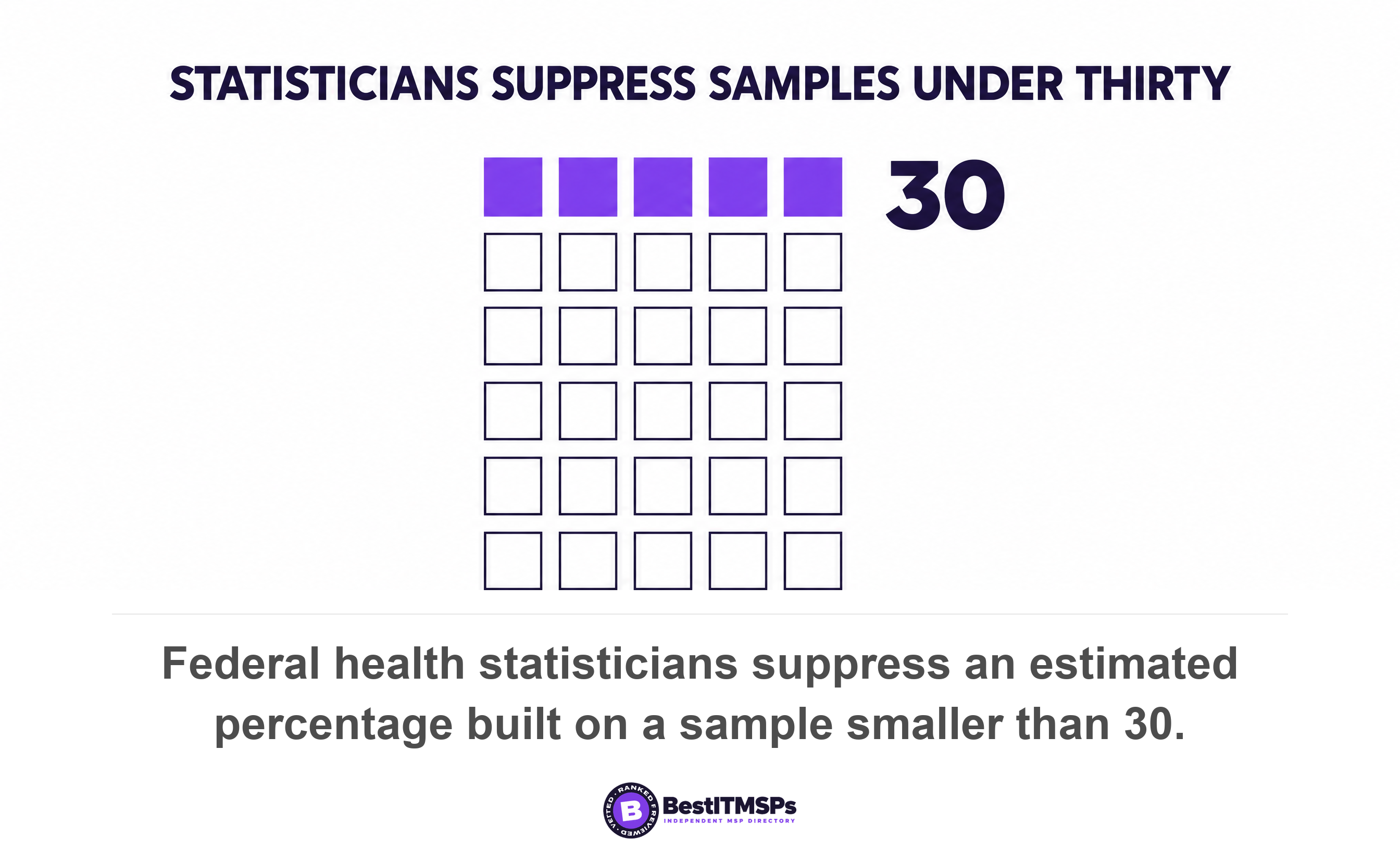
Professional statisticians treat this as a sample size question rather than a quality question. The National Center for Health Statistics, which publishes US federal health data, suppresses an estimated percentage when it rests on an actual sample size smaller than 30, because the variance of an estimated proportion is inversely related to the sample size. In plain terms, fewer cases means a wider spread of possible answers and less confidence in any one of them.
One scope note matters, and it is the honest one. A star rating is an average, not a percentage, and those same NCHS standards set no sample-size threshold for means or percentiles. The rule does not transfer to a star average. The reason behind it does, and 30 is a useful reference point for how much evidence a professional body wants before it publishes a number at all.
Thin ratings run extreme in both directions
A thin review history produces the highest scores on a page and the lowest ones, because the same small sample that lets four happy clients create a 5.0 lets one angry client create a 3.5. Take the same 4-review listing. Three five-star reviews and one one-star review average 4.0. One difficult onboarding, honestly reported by the client, and a good provider shows a 4.0 while a weaker provider with 200 reviews shows a 4.6.
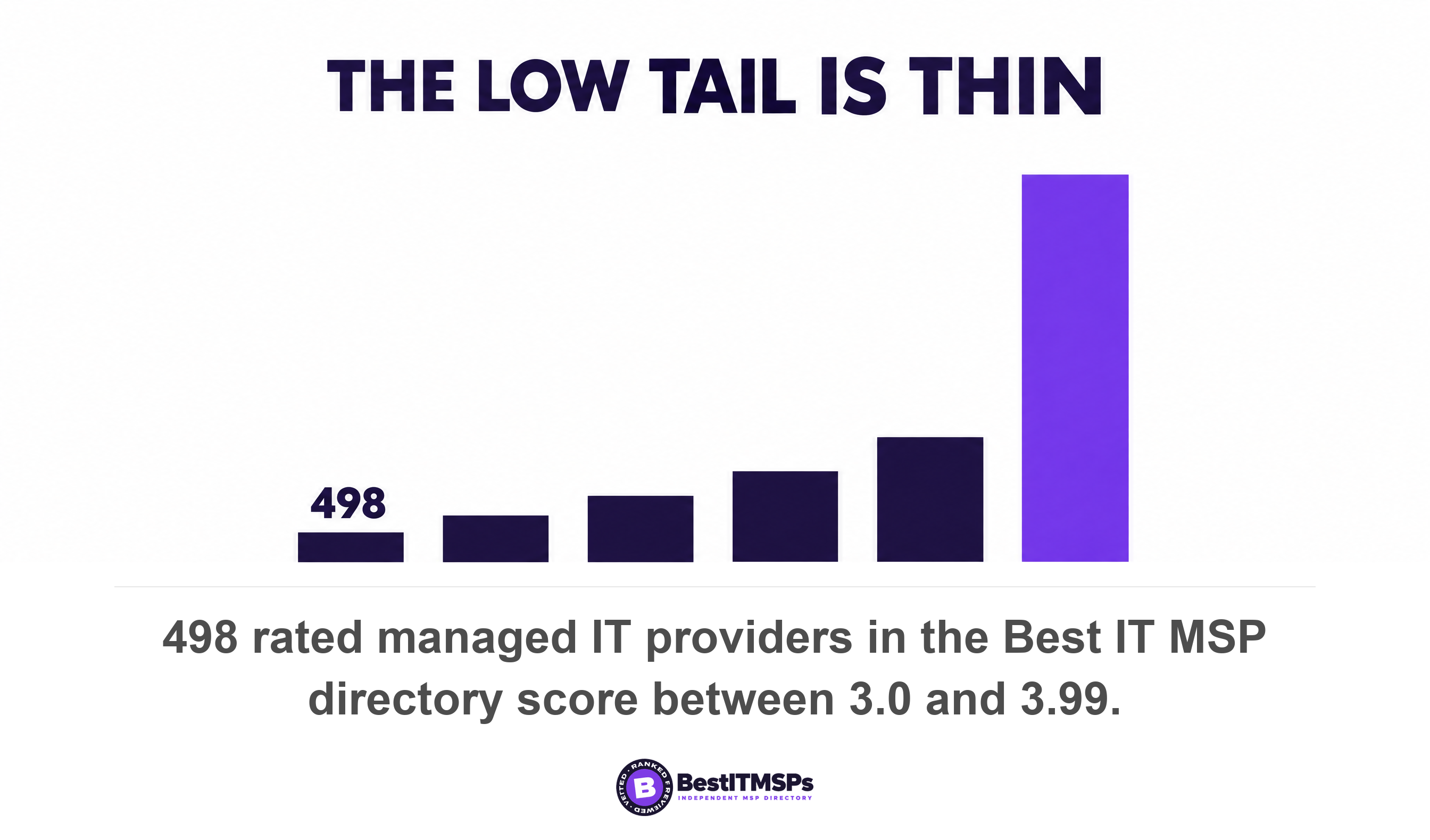
That breaks the most common shortlisting rule in this market. Dropping every provider rated below 4.0 removes thin samples rather than bad providers. Our own numbers say the low end is genuinely small. 498 rated providers score between 3.0 and 3.99 and 145 score below 3.0, out of 18,059 rows carrying both a rating and a review count. A low score is rare enough to be worth reading rather than reflex-rejecting.
Selection bias pushes the whole distribution upward, because reviews are volunteered rather than sampled. A happy client who gets asked writes one. The quiet majority never does. So a low score on a thin profile often means one unhappy client bothered and nobody else did, which is a different fact from a pattern of bad service.
At 200 reviews a 3.6 is a pattern. At 5 reviews it is an anecdote with a star attached.
So the count decides whether you believe the score at either end. Treat both extremes on a thin listing the same way, as unmeasured, and go and get the evidence yourself.
Turn each rating into a range, then compare the bottom of it
To compare two listings fairly, turn each rating into the range it could plausibly sit in, then compare the bottom of the two ranges instead of the two scores. Assume two clients you have not met are unhappy, and add two 2-star reviews in your head. The 5.0 from 4 reviews falls to 4.0. The 4.6 from 200 reviews holds at 4.57. The weaker-looking listing has the stronger floor. That is the whole comparison, and it takes about ten seconds per provider.
Call that rating confidence and give it its own column in your notes. Score, count, floor. The floor is the number you should rank on, because it is the one a single bad month cannot take away from you.
The market will rarely hand you 200 reviews
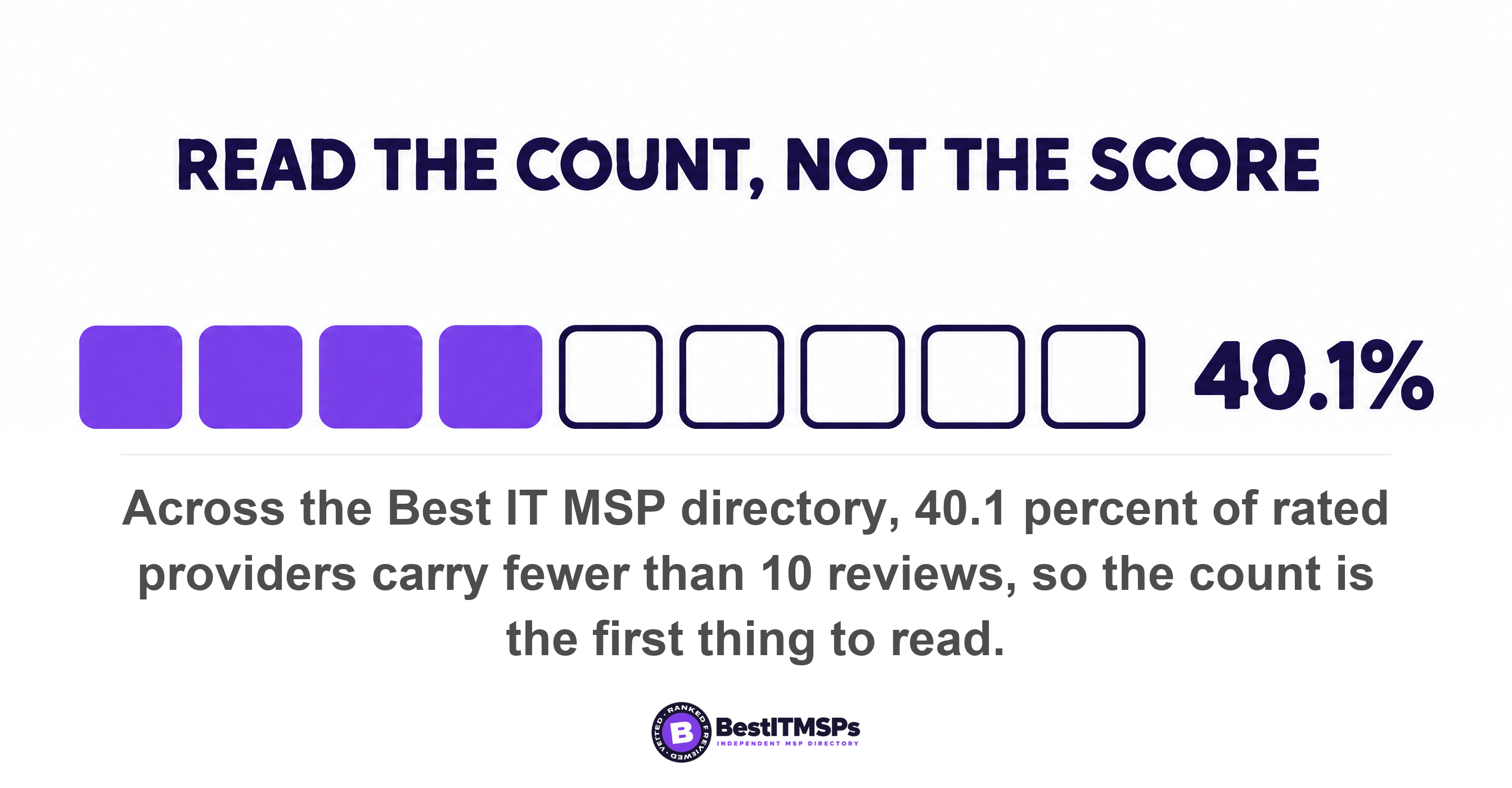
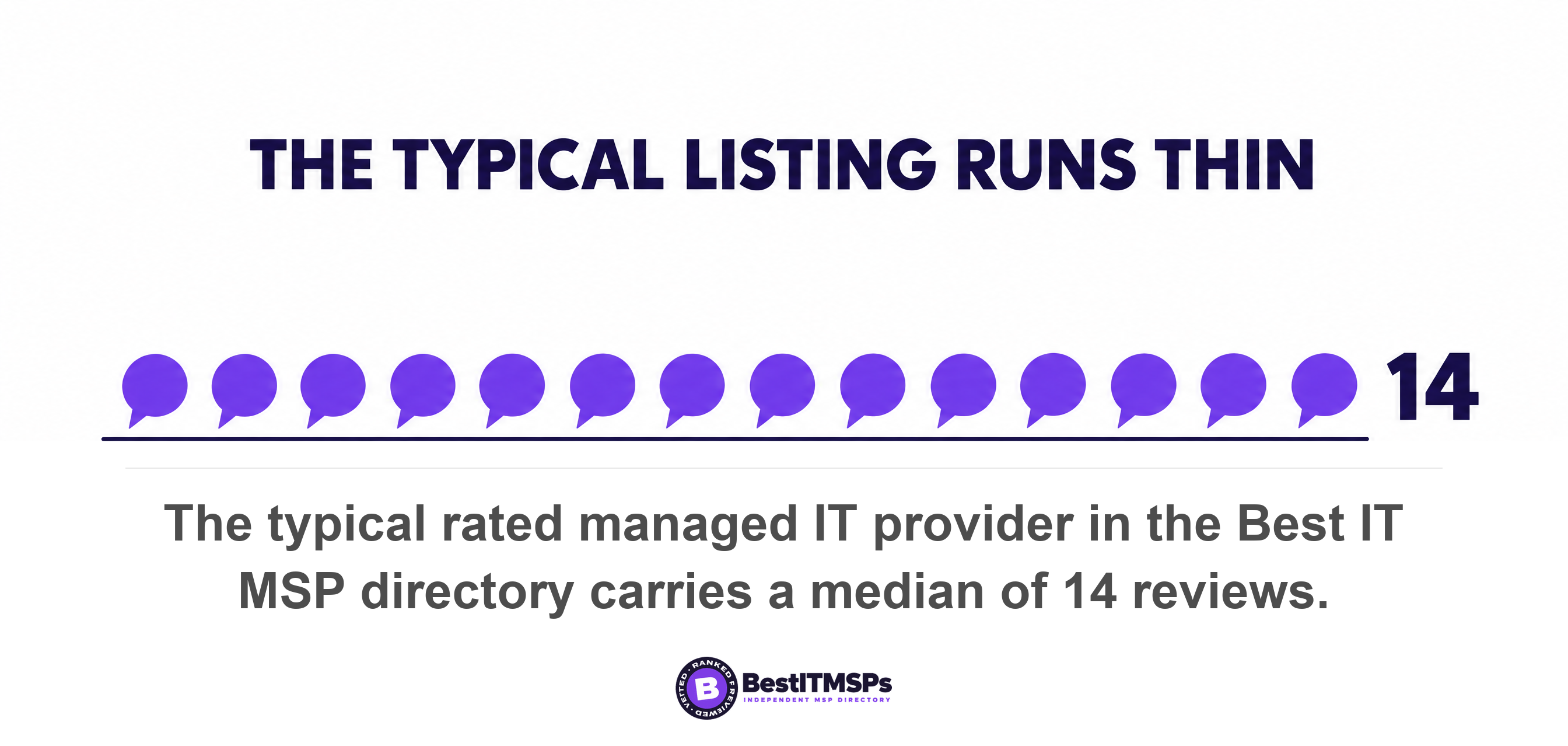
A review-count rule has to be set against the real market, and the real market runs thin. The typical rated provider carries a median of 14 reviews, 40.1 percent hold fewer than 10, and 93.6 percent hold fewer than 100. A rule such as only shortlist firms with 100 or more reviews excludes almost every local provider in a mid-sized metro, including strong small firms that simply never asked a client to write anything.
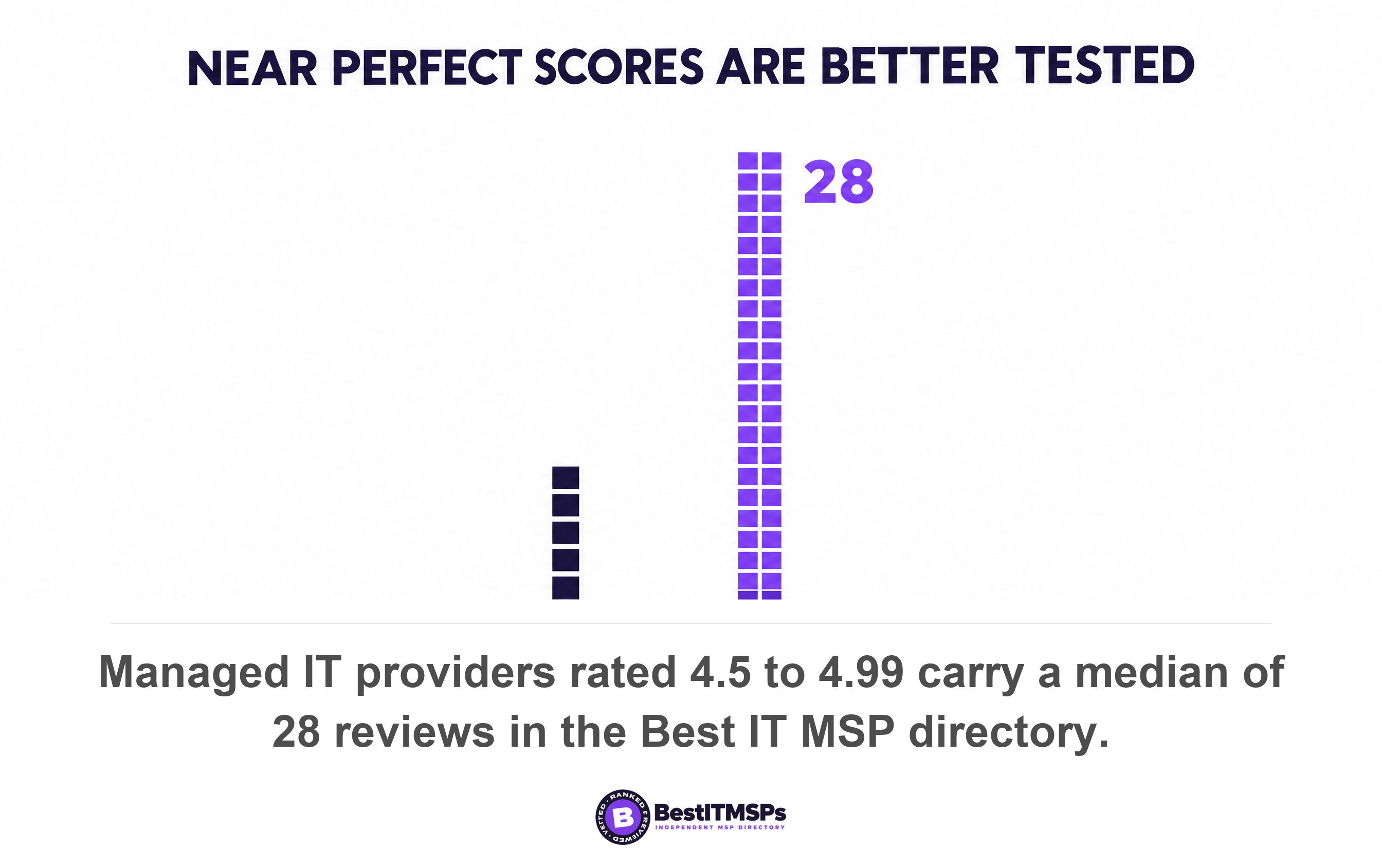
Compare inside one volume band instead. Providers rated 4.5 to 4.99 carry a median of 28 reviews, which makes that band the best-tested group on a typical city page and the easiest place to find two firms you can actually weigh against each other. Thin markets make the whole job harder, because fewer comparable providers means fewer competing quotes and less leverage on price. Our read on provider density by market covers how thin a roster runs.
What to check when the star rating tells you nothing
To judge a provider whose rating is unmeasured, check five things that do not depend on review volume.
- Read the three newest reviews in full. Review recency matters more than the average, because a provider's team changes faster than its score does.
- Check the dates on the whole set. Twelve five-star reviews posted inside one week is a campaign, and a recent review each quarter for three years is a track record.
- Compare the names and the sectors. One review from a firm your size in your industry is worth twenty from walk-in consumers.
- Ask who owns the site you are reading. Federal rules make it unlawful for a business to present a review site it controls as an independent source of reviews or opinions, with consumer reviews carved out of that prohibition.
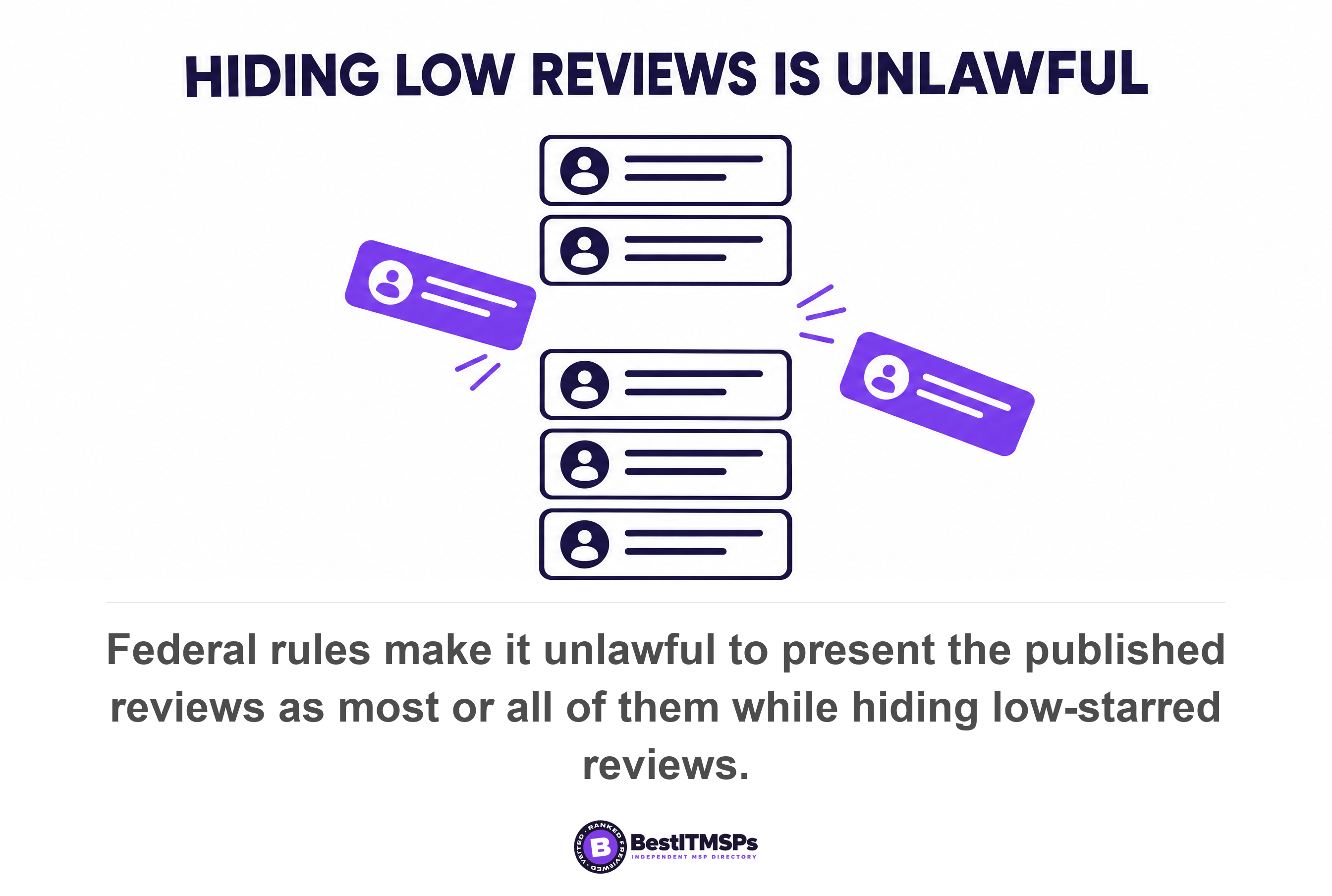
- Verify that you are seeing all of them. The federal rule on review suppression makes it unlawful to present the published reviews as most or all of them while hiding reviews for their star rating or their negative tone.
Then move off the platform entirely, because the measurable evidence was never in the stars. Ask for a client reference at your size and in your sector, the service level agreement with its response and resolution targets in writing, and the date and duration of the last tested restore. Those three answers carry more information than every star on the page. Our guides on how to choose a managed service provider and the questions to ask before hiring an IT provider carry the rest of the list.
How we counted, and what a star average does not cover
To produce these figures we read every city dataset the directory publishes, on 21 October 2026, under three rules.
- Counted 730 city datasets and 24,491 roster rows, excluding superseded files and build artifacts rather than taking every file in the folder.
- Used only the 18,059 rows carrying both a verified rating and a review count, which is 73.7 percent of the roster, and excluded unrated rows instead of scoring them as zero.
- Reported medians beside the bands, because a long tail of high-volume firms drags a mean upward and hides the typical firm.
The rating distribution stays top-heavy under every cut. 2,262 providers sit between 4.9 and 4.99 and 2,929 between 4.5 and 4.89, against 11,153 at exactly 5.0. A signal most of a market shares cannot rank that market, which is why our merit ranking uses verified rating plus firmographic data rather than rating alone.
Three limits apply to our own listings as much as to anyone else's. These are Google ratings, so they measure what reviewers chose to write rather than what a provider delivered. Each one was captured when its city was researched, so a live score moves after we record it. And no star average contains a ticket resolution time, a tested restore or a breach record. We label paid placement, and the full directory methodology is published in our evaluation process so you can check the method rather than trust it.
The three-line check to run before your next call
To read any provider listing in ten seconds, write three lines in your notes.
- Count first. Under 10 reviews is unmeasured, which is neither excellent nor bad.
- Floor second. Add two unhappy clients in your head and write down where the average lands.
- Text third. Read the three newest reviews and note the date of the oldest one you read.
Then screen rather than rank. Use the star rating to cut a long list to five, compare the floors to shortlist three, and spend the time you save on a client reference, the service level agreement and the last tested restore. A 5.0 from 4 reviews belongs on your shortlist. It just does not belong at the top of it, and the review count is the only thing on that listing honest enough to tell you.
FAQ
Should I rule out an IT provider with only a few reviews?
No. Treat a thin review history as unmeasured rather than bad. 40.1 percent of rated providers hold fewer than 10 reviews, so excluding them removes most of the local market, including strong small firms. Read the three newest reviews, then ask for a client reference at your size and the response targets in the service level agreement.
What does one bad review do to a provider's star rating?
It depends entirely on the review count. One ordinary 3-star review takes a 5.0 built on 4 reviews down to 4.6. The same review moves a 4.6 built on 200 reviews to 4.59. Federal statisticians suppress a percentage built on a sample size smaller than 30 for the same underlying reason.
Is a 3.5 rating from 5 reviews worse than a 4.6 from 200?
Not necessarily, and the review count is why. A 5-review average swings a long way on one unhappy client, so it reports an anecdote rather than a pattern. Our data shows the low end is small, with 498 rated providers between 3.0 and 3.99. Read the text of a thin low score before you reject it.
What should I check when a provider's star rating tells me nothing?
Check review recency, the sectors the reviewers come from, and whether you are seeing every review. The federal rule on review suppression makes it unlawful to present a filtered set as most or all reviews. Then verify off the platform with a client reference, the written service level agreement, and the date of the last tested restore.
Best IT MSP is the independent directory of vetted managed IT providers across North America. Every listing shows the review count beside the verified rating so you can weight it yourself. Organic ranking is earned on verified rating and firmographic data, and paid placement is always labelled.