In thin MSP markets, most listed providers also serve other markets
In the thinnest quarter of 730 managed IT markets, 58.5 percent of listed providers also appear in other markets, against 46.9 percent in the densest quarter. The median market lists 16 providers. Fewer local options means a larger share of your options are firms headquartered elsewhere.
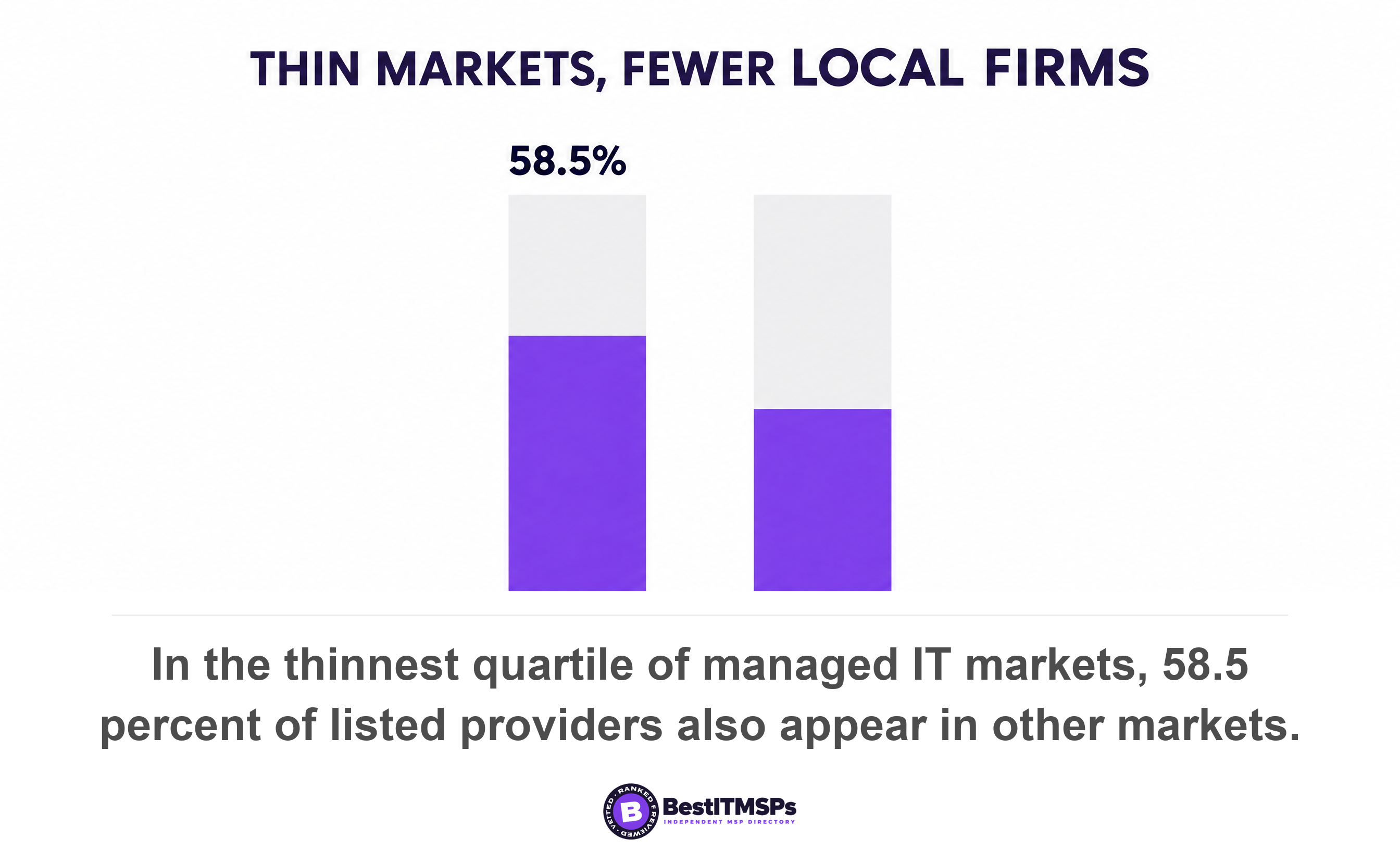
- A thin market is not just a shorter list. In the thinnest quartile 58.5 percent of listed providers also serve other markets, against 46.9 percent in the densest quartile.
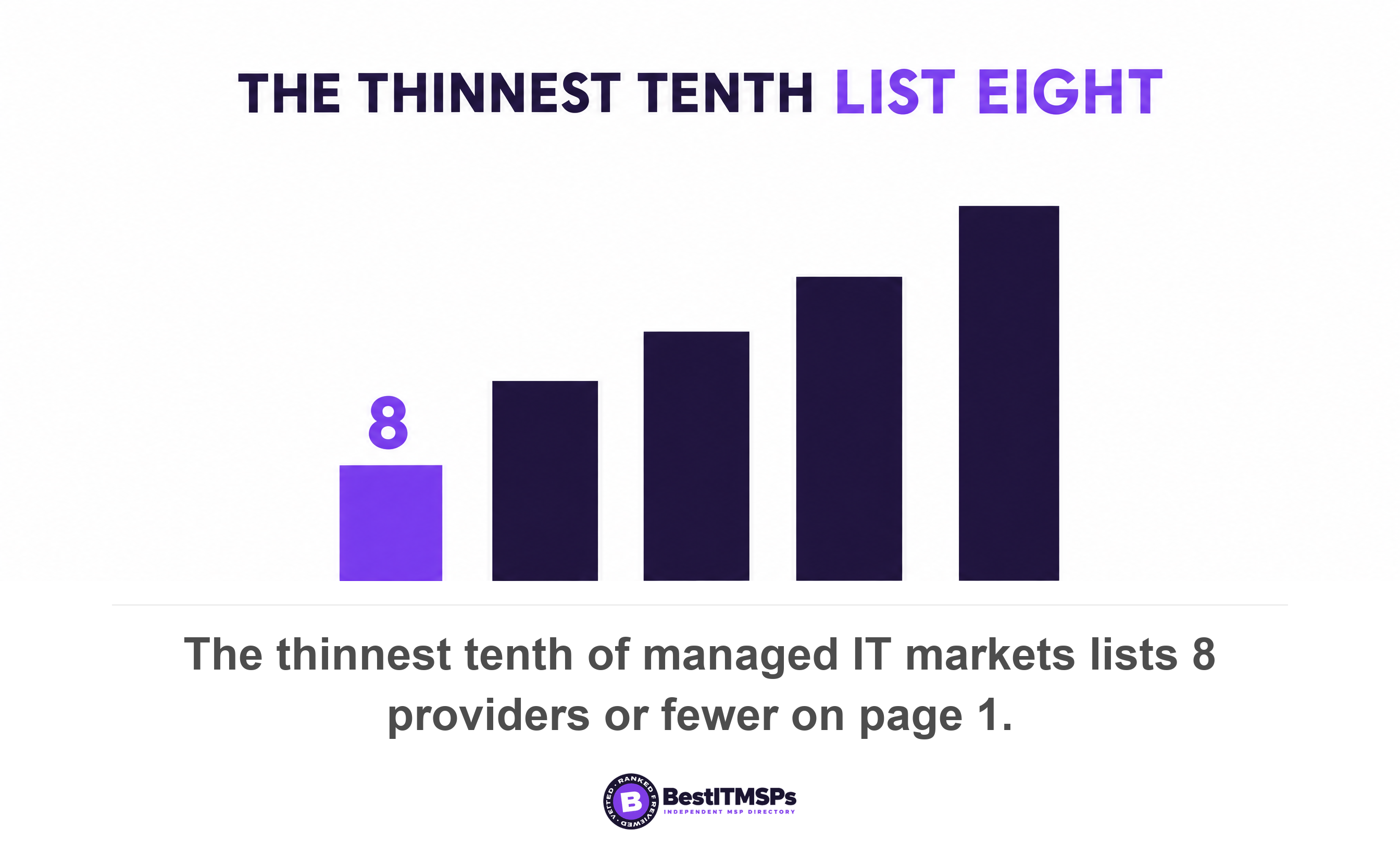
- The median market lists 16 providers. The bottom tenth list 8 or fewer, and 40 is our own page 1 cap rather than a market ceiling.
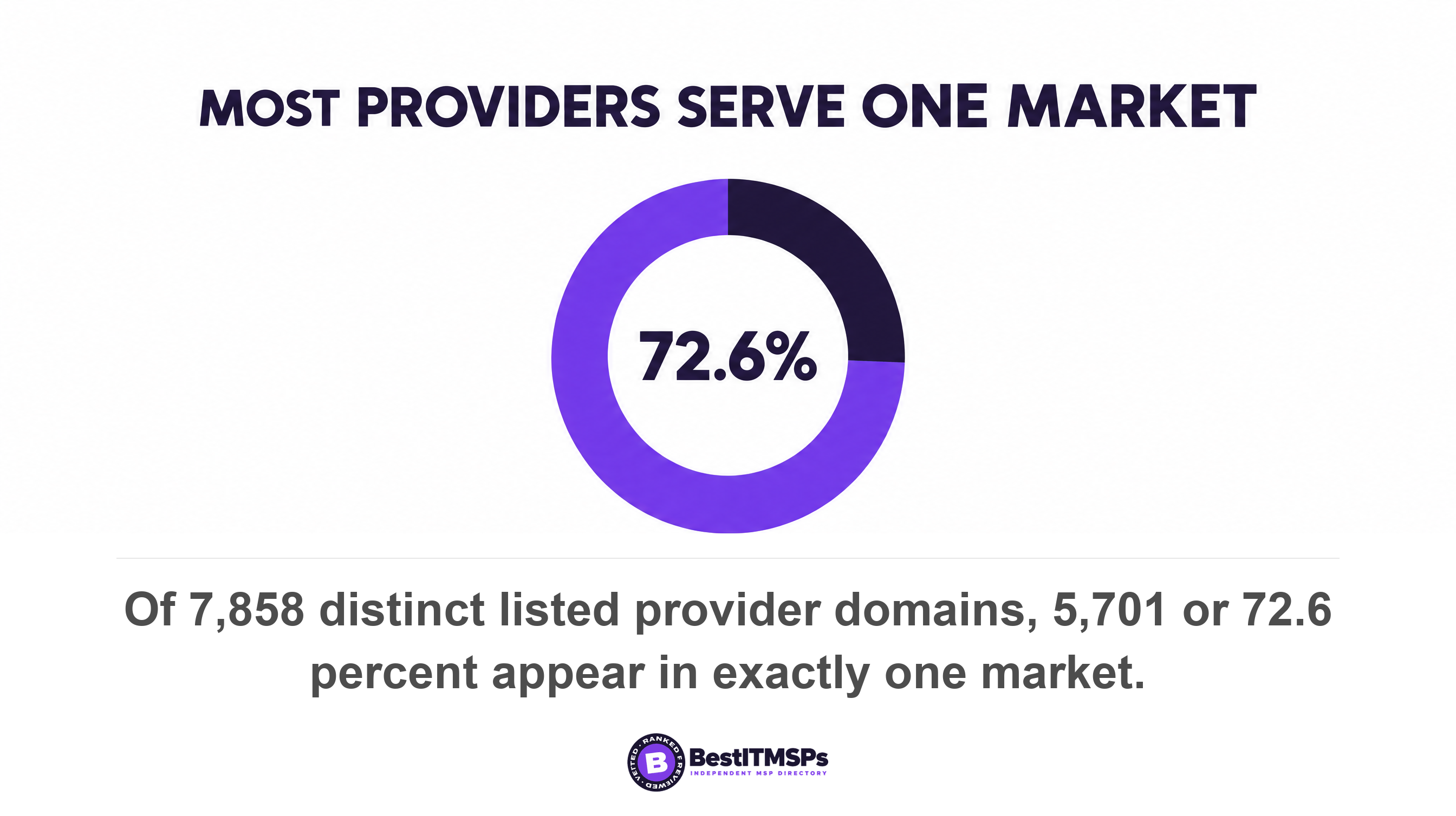
- Single-market firms are most of the provider population. Of 7,858 distinct listed domains, 5,701 appear in exactly one market.
- So a minority of firms fills a majority of the slots exactly where a buyer has fewest options to compare.
- This data measures composition, not price, quality or outcomes. It does not prove a distant provider serves you worse.
In thin MSP markets, most listed providers also serve other markets
In the thinnest quarter of managed IT markets, 58.5 percent of listed providers are firms that also appear in other markets. In the densest quarter that share is 46.9 percent. Fewer local options means a larger share of the options you do have belong to firms based somewhere else.
That inverts the intuition. A small market is supposed to mean small local firms, and a big metro is supposed to mean national brands. On composition, the data says the reverse. We counted provider density across 730 markets on 21 October 2026. The thinnest quartile covers 187 markets holding 1,605 listed providers between them. The densest quartile covers 202 markets holding 6,218 listed providers, and the two groups hold almost the same number of markets.
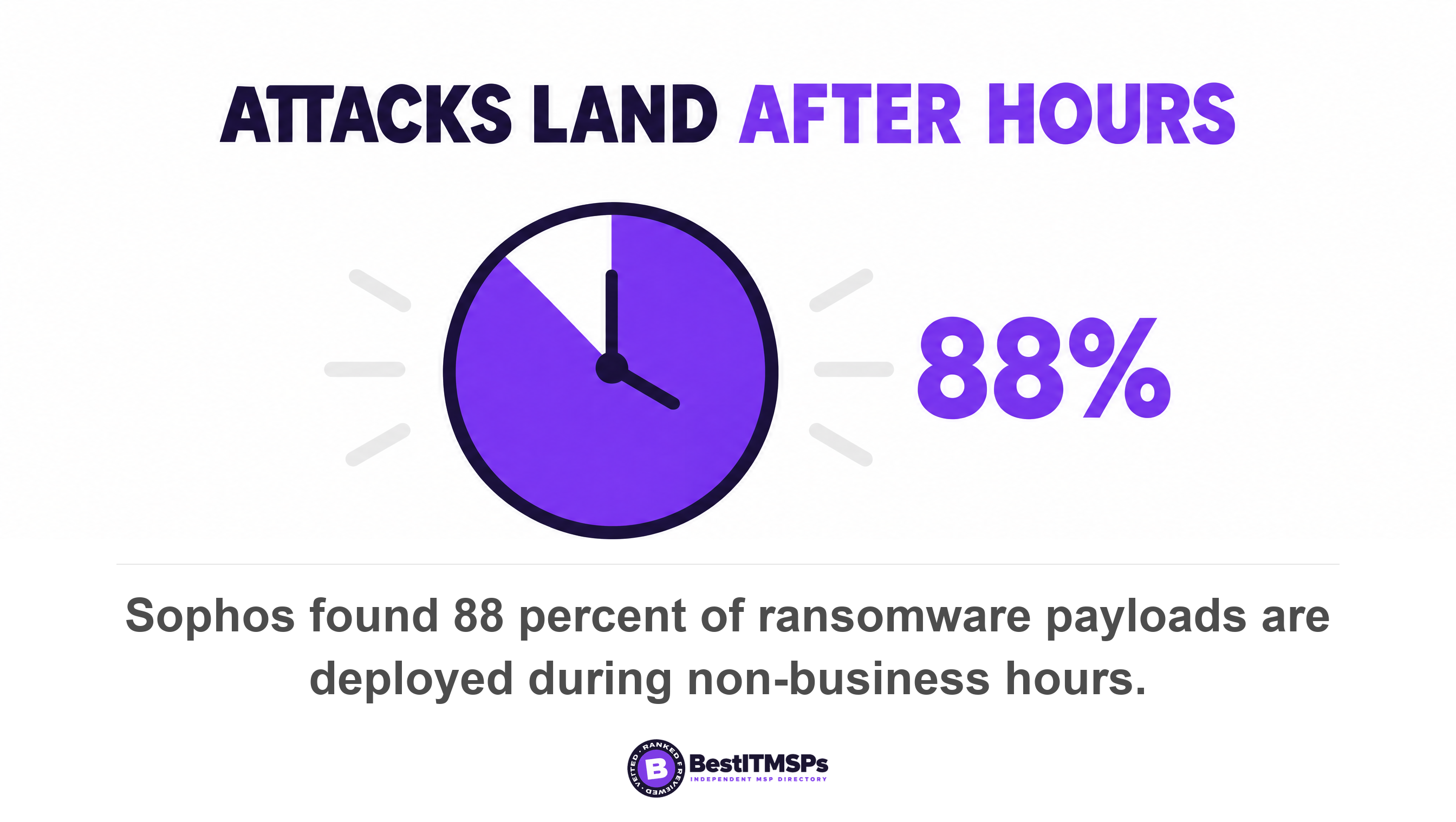
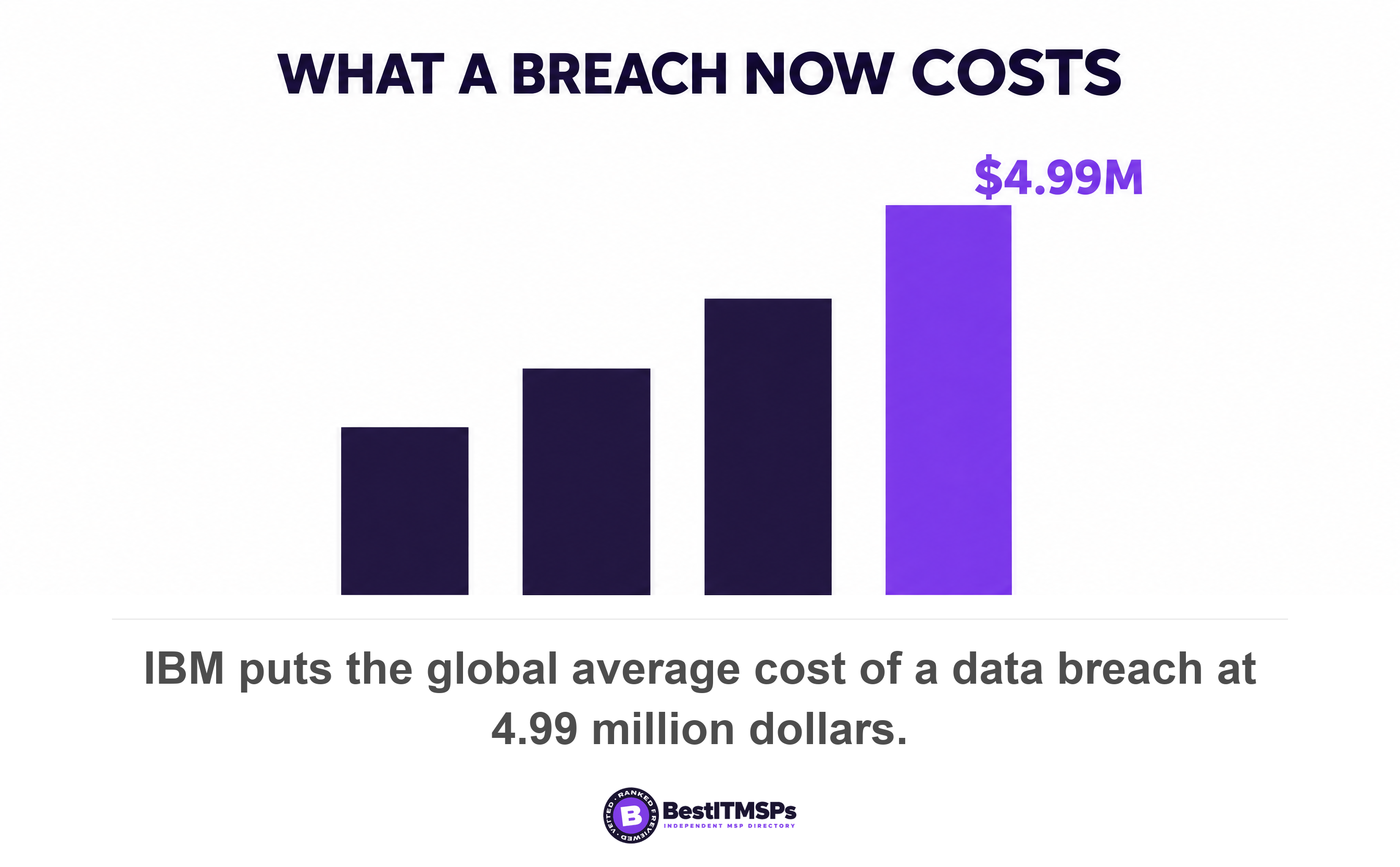
Composition matters more than the count, because the count only tells you how long your list is. Composition tells you who turns up. A firm that serves you from two hours away can run remote support perfectly well and still take half a day to dispatch an engineer. Sophos found 88 percent of ransomware payloads are deployed during non-business hours, so who answers at 2am is not a hypothetical question. The decision is expensive in either direction, because IBM puts the global average cost of a data breach at $4.99 million.
Below you get the full density distribution, the method behind it, and the questions that separate a real local presence from a service radius drawn on a map. This is the companion to what 24,491 provider records say about MSP star ratings, which covers the verified rating and review count side of the same dataset.
How many managed IT providers does a typical market list?
A typical market lists 16 managed IT providers. That is the median across 730 markets, and the spread around it decides whether your own short list is thin or normal.
- The bottom tenth. 8 listed providers or fewer.
- The bottom quarter. 11 or fewer.
- The median market. 16 providers.
- The top quarter. 22 or more.
- The top tenth. 34 or more.
- The full range. 1 provider at the thin end and 40 at the dense end.
The 40 at the top is our own cap, not a market ceiling. A city page ranks at most 40 providers on page 1, so the densest markets are floored by our design rather than fully measured. The thin end carries no such limit. A market that lists 9 providers lists 9 because 9 is what the research found.
Read your own market against that spread before you judge your search. Nine names is not a failed search in a market whose entire provider population sits near the bottom quartile. It is the market.
Most listed providers serve exactly one market
Most listed providers serve exactly one market. The dataset holds 7,858 distinct listed provider domains, and 5,701 of them, 72.6 percent, appear on exactly one market's page 1.
Hold that beside the first finding, because together they say something neither says alone. Single-market firms are the large majority of the provider population. Yet in the thinnest markets, firms that also serve elsewhere hold 58.5 percent of the listings. A minority of the firms fills a majority of the slots exactly where a buyer has fewest options to compare. That is market concentration seen from the buyer's side of the table, and it is the part worth acting on.
Two explanations fit that pattern, and our data tests neither. Publishing a wide service area costs a provider almost nothing, so franchise networks and regional firms list coverage in markets where few independent local firms compete for attention. Dense metros already hold enough independent firms to fill a page on their own. Treat both as plausible mechanisms rather than measured ones.
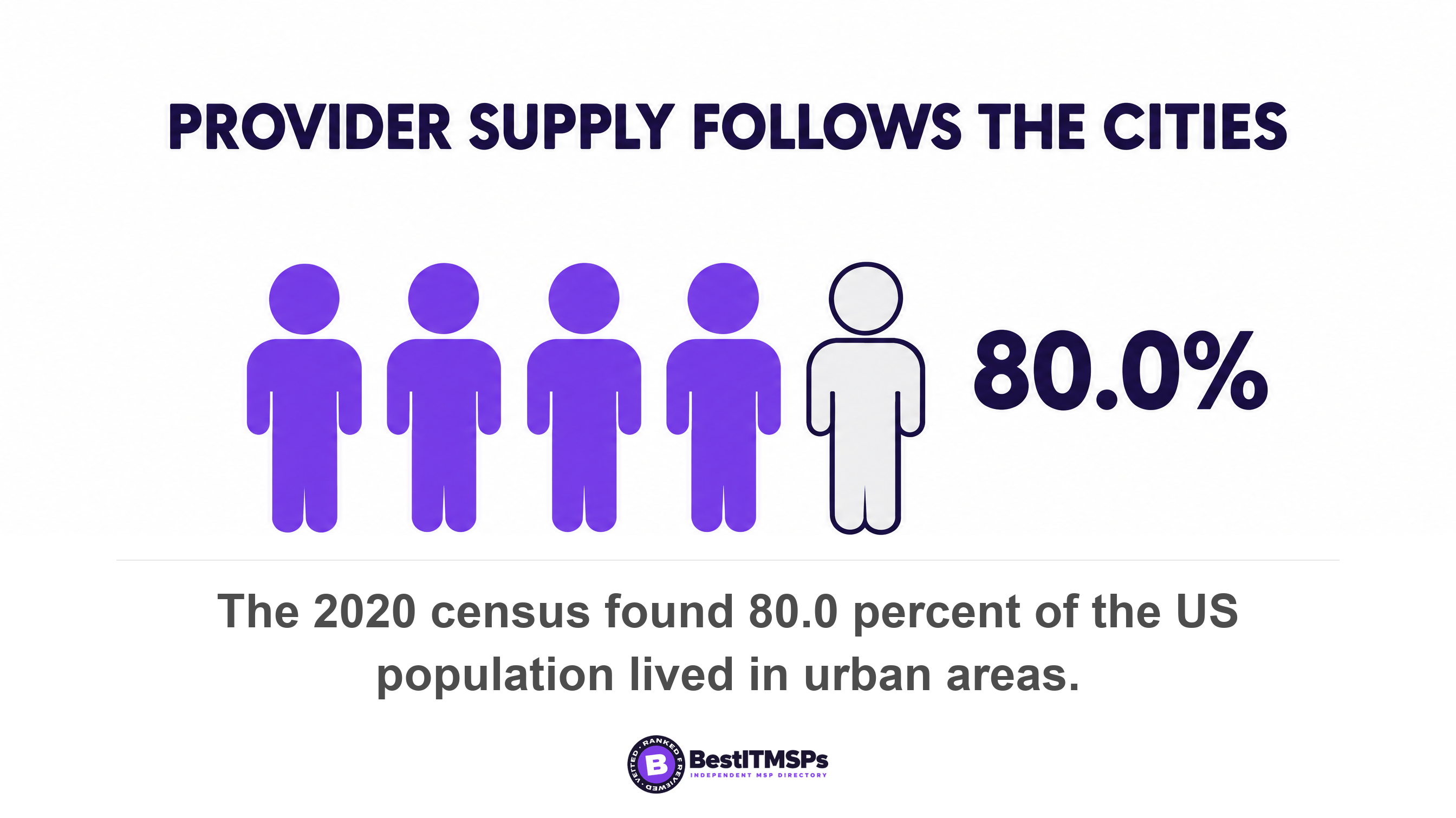
The geography underneath is not controversial. The Census Bureau found 80.0 percent of the US population lived in urban areas at the 2020 census, down from 80.7 percent in 2010. Provider supply follows that concentration. Buyers outside it still need the same remote support, the same after-hours support and the same on-site response as a buyer downtown.
What local means in an MSP's marketing
Local means one of three different things on a provider's website, and the word itself does not tell you which. It means an office with engineers inside your market, a branch office that holds an address and no staff, or a service radius drawn on a map from an office two hours away.
Each one gives you a different Tuesday. An office with engineers can dispatch someone the same morning. A branch office routes the call to a regional hub. A service radius means remote support by default and on-site response by exception, scheduled around the drive. All three can run competent managed IT. Only the first puts a person in front of a failed server within the hour.
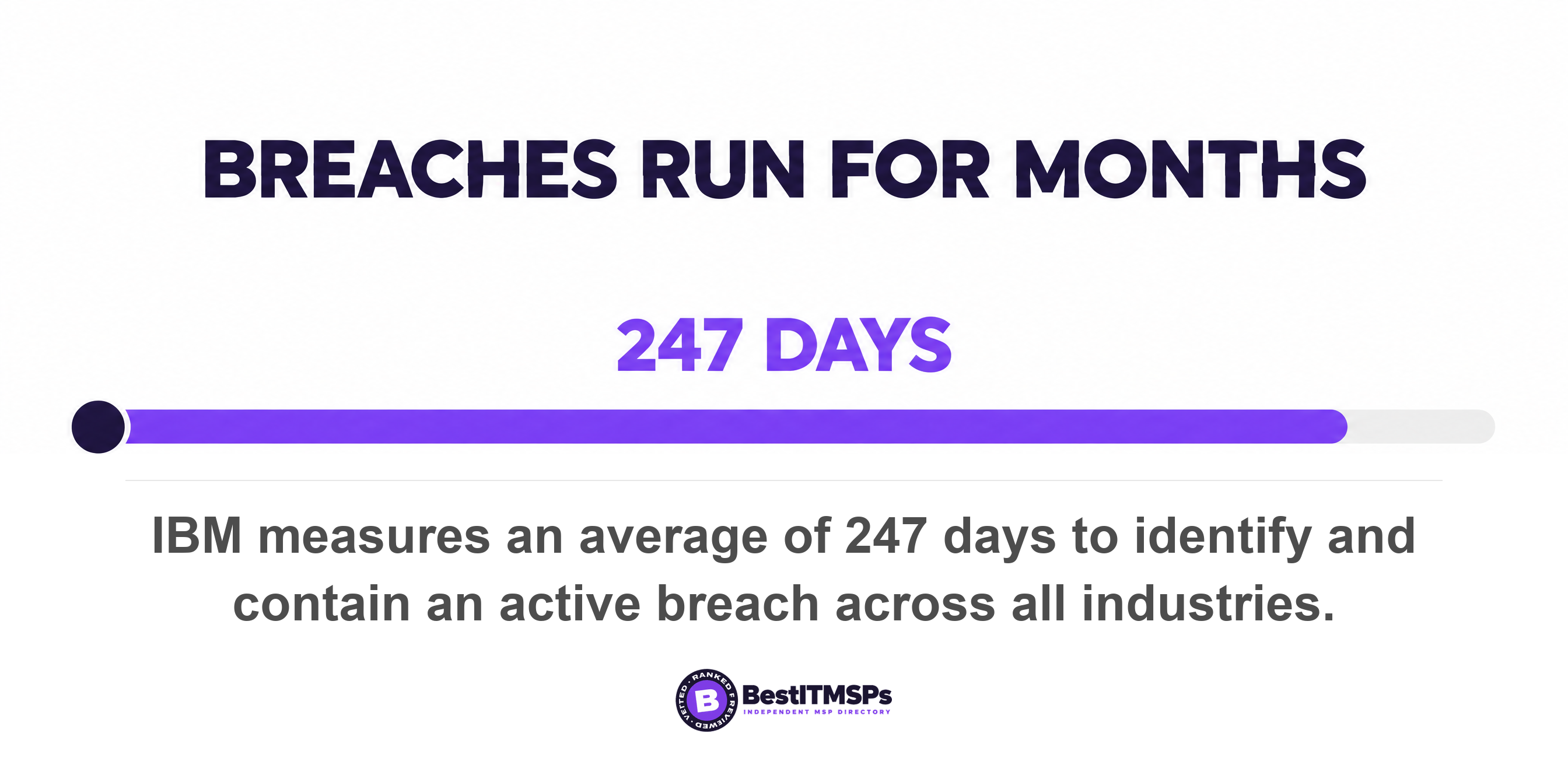
After-hours support is where the difference bites hardest. Sophos analysed 661 incident response and managed detection cases handled between November 2024 and October 2025 and found 88 percent of ransomware payloads are deployed during non-business hours. IBM measures an average of 247 days to identify and contain an active breach across all industries. Neither number improves because a provider's van is parked nearby. Both get worse when nobody escalates until an office opens in another time zone.
Federal guidance puts that obligation on you rather than on the brochure. CISA, the NSA and the FBI warned that attackers work to exploit provider-customer network trust relationships and advised that customers should ensure their contractual arrangements specify that their MSP implements these measures and controls, including how and when MSPs notify the customer of an incident affecting the customer's environment. A service level agreement that names an on-site response window is the only version of local you can enforce.
Five questions that show whether a provider is actually local
To test a local presence, ask the five questions below and write down the answers. Each has a checkable answer, and a vague answer is itself the finding.
- Ask for the street address of the office that would hold your account, and how many engineers sit in it.
- Ask where the engineer who comes on-site drives from, and the furthest client that office serves today.
- Ask who answers at 2am, in which time zone, and whether that team is the same one you reach at 2pm.
- Ask for the on-site response window written into the service level agreement, not the one on the website.
- Ask which of a firm's listed markets hold a staffed office, if the firm appears in several markets.
Then compare the answers across three firms rather than scoring one in isolation. A transparent provider names a street, a headcount and a number of hours. A provider who answers in coverage language is describing a service radius and calling it an office.
Coverage is a claim about a map. An office is a claim you can drive to.
What a thin market does to your shortlist
A thin market costs you comparable quotes and the leverage that comes with them. With the thinnest tenth of markets listing 8 providers or fewer and 58.5 percent of listed providers in the thinnest quartile also serving other markets, you hold fewer like-for-like bids to negotiate against and a smaller pool of local references to call.
The evidence behind each option thins with the list. A shorter list carries fewer rated firms to compare, and in a market of 8 listed providers one unrated firm removes a meaningful part of your choice. How much a score is worth depends on the review count behind it, which our companion post on MSP star ratings covers in full.
Three moves follow from these numbers, and all three widen the shortlist on purpose instead of by accident.
- Include at least one firm whose nearest staffed office you could drive to this week.
- Widen deliberately into the adjacent metro, because a multi-market provider already reaches you by exactly that logic.
- Compare firms on one basis, matching verified rating, review count and contracted on-site response rather than brand size.
A vetted shortlist of three beats a long list of ten, and none of this says a distant provider serves you worse. It says the trade is real and nobody prices it for you. The FBI logged 1,008,597 complaints and $20.877 billion in reported losses in 2025, and Verizon found ransomware in 48 percent of all breaches, up from 44 percent the year before. The cost of a slow response does not care where a firm is incorporated. It cares who is awake.
How we counted, and what this data cannot tell you
To produce these figures we measured every city dataset the directory publishes, on 21 October 2026, under the four rules below.
- Scope. 730 markets, after deduplicating the 159 data files that share a slug by the slug each one declares and excluding every build artifact sitting beside the real city files.
- Listed means page 1. A provider counts as listed when it appears on page 1 of a city page, which is what a buyer actually sees.
- Density is capped at 40. Page 1 ranks at most 40 providers, so the densest markets are floored by design rather than measured.
- Multi-market means a repeat appearance. A listed provider is multi-market when its domain also appears on another market's page 1, and 7,858 distinct domains sit behind the listed rows.
Five limits apply, and they are why this is a market map rather than a verdict on any single firm.
- It does not measure price. No quote, no rate card and no contract value sits anywhere in this data.
- It does not measure quality or outcomes. No ticket resolution time, no tested restore and no breach record either.
- It does not prove a distant provider serves worse. The finding describes composition, not performance.
- A multi-market firm may hold a real office in your market. Plenty do. The data sees a listing, not a lease.
- We name no individual thin market. Some market names in the data are ambiguous or shared with a larger city, and a count alone does not make a specific city under-served.
Publishing the directory methodology is the point, because a figure nobody can verify is marketing. We rank providers on verified rating and firmographic data, we label paid placement, and we do not sell IT services. The wider standard we screen against sits in our evaluation process. Read it beside how to choose a managed service provider when you start to compare firms, and treat density as context for your search rather than a score for your city.
FAQ
How many managed IT providers are in my city?
The median market lists 16 providers. Across 730 markets we counted, the bottom tenth list 8 or fewer and the top tenth list 34 or more. Page 1 caps at 40 providers, so the densest markets are floored rather than fully measured.
Does a thin local market mean worse IT providers?
No. A thin market means fewer options and a different mix. In the thinnest quartile, 58.5 percent of listed providers also serve other markets, against 46.9 percent in the densest quartile. The data measures composition only. It records no price, no quality and no outcome.
How many MSPs serve more than one city?
Most do not. Of 7,858 distinct listed provider domains, 5,701, or 72.6 percent, appear in exactly one market. The firms that repeat across markets are a minority of the provider population, yet they hold the majority of listings in the thinnest markets.
Is a national MSP worse than a local one?
Our data cannot answer that, and no honest directory claims otherwise. What changes is who dispatches an engineer on-site and who answers overnight. Sophos found 88 percent of ransomware payloads are deployed during non-business hours, so test the after-hours path before you sign.
How do I tell if an MSP is really local?
Ask for the street address of the office holding your account, the headcount in it, and where the on-site engineer drives from. Then get the on-site response window into the service level agreement. CISA advises customers ensure their contractual arrangements specify that their MSP implements these measures and controls.
Best IT MSP is the independent directory of vetted managed IT providers across North America. Organic ranking is earned on verified rating and firmographic data, and paid placement is always labelled. Open the ranked list for your city, then take the five local-presence questions into every call.