MSP vs Hiring IT Staff: At What Headcount Does a Provider Cost More?
There is no clean crossover headcount, because a provider and a hire are not substitutes. Naive invoice math puts the break near 70 to 80 users. Ticket volume says 125. Coverage says never, since one employee works about 22 percent of the hours in a year. Co-managed usually wins.
- No clean crossover headcount exists. A provider sells breadth and continuity, a hire sells depth and presence, and the two are not substitutes.
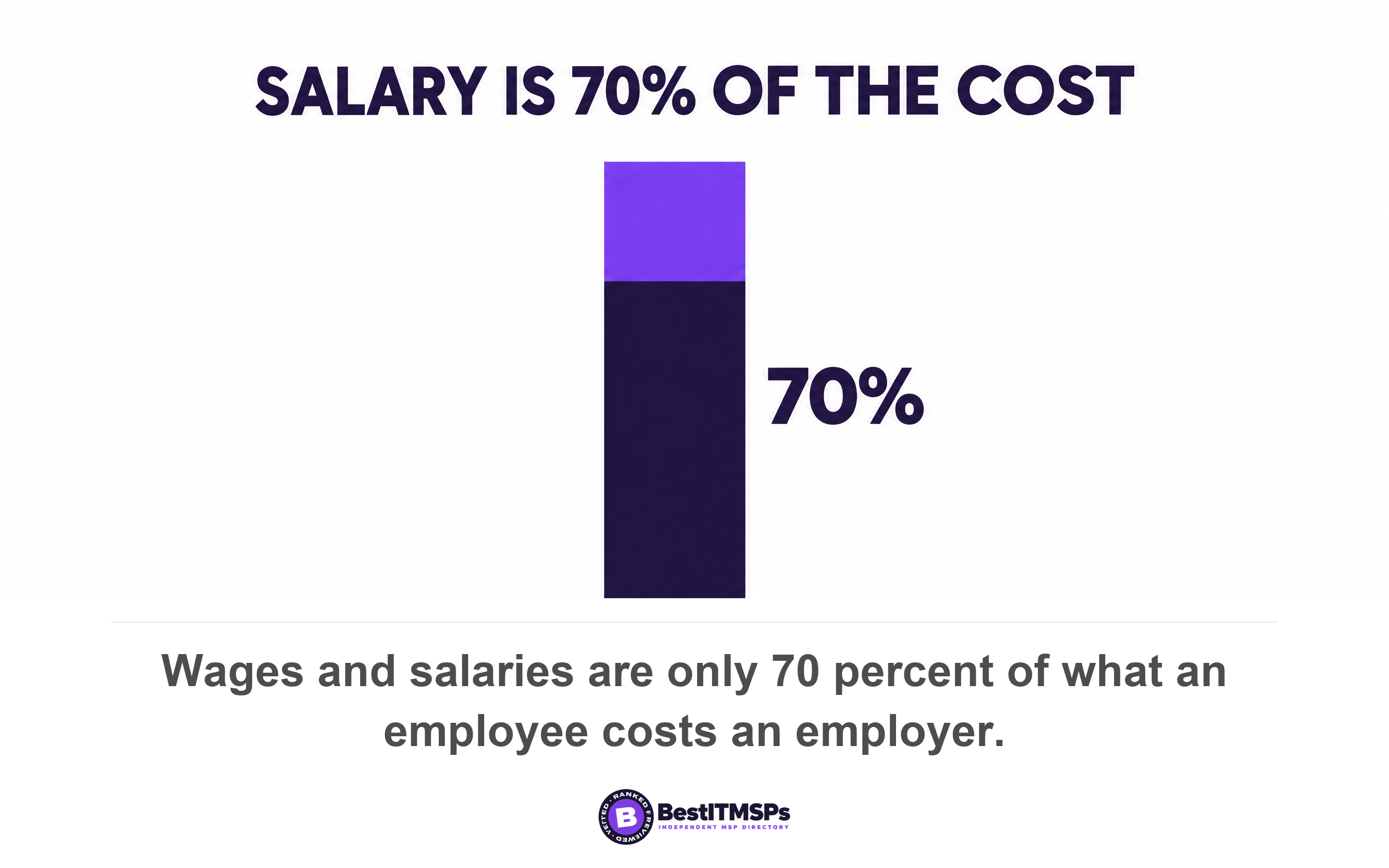
- Total cost of employment runs about 1.43 times salary. BLS puts wages at 70.0 percent of total compensation and benefits at the other 30.0 percent.
- Three honest calculations give three answers. Cost math breaks near 70 to 80 users, ticket math near 125 users, and coverage math never breaks at all.
- One salaried employee is at the desk for about 1,900 of the 8,760 hours in a year, and 88 percent of ransomware payloads land outside business hours.
- Co-managed IT is the honest answer for most growing SMBs. Give the hire the in-the-building work and keep the bench, the on-call rota and the RMM with the provider.
At what headcount does an MSP become more expensive than hiring?
No single headcount exists, because a managed provider and an internal hire are not substitutes. The naive comparison, monthly invoice against annual salary, puts the break near 70 to 80 users. That number is wrong in both directions, and the three calculations below show you why.
Three honest calculations give three different answers. On cost alone, one generalist hire costs about the same as a fully managed contract for 70 to 80 users. On ticket volume, the work does not fill a full-time person until roughly 125 users. On coverage, a single hire never catches up, because one salaried employee is at the desk for about 1,900 of the 8,760 hours in a year. That disagreement is the answer. You do not outsource and hire the same thing.
Best IT MSP is an independent directory. We do not sell IT services, so nothing changes for us if you decide to hire, and this article names the cases where you should. For the provider side of the number, read How Much Do Managed IT Services Cost? and Per User vs Per Device Pricing. For the model comparison, read Managed IT vs In-House IT.
What does one IT hire actually cost, line by line?
One IT hire costs about 1.43 times the salary before you buy a single tool, and six lines explain the gap. Employer taxes, benefits, recruitment cost, training and certification, tooling licences your provider currently supplies, and holiday cover.
The Bureau of Labor Statistics measures the first part of that gap directly. For private industry workers it found wages and salaries are 70.0 percent of total compensation and benefits the other 30.0 percent, at $46.89 per hour worked. Divide a salary by 0.70 and you have the employer's real cost. Almost nobody applies that ratio before comparing an invoice with a salary offer.
- Salary. BLS puts the median wage for a computer user support specialist at $61,860 and a computer network support specialist at $76,220, and for a network and computer systems administrator at $99,130. A generalist who can run a help desk and also patch servers sits between them, so this worked example assumes $85,000. That is an assumption, not a quote.
- Employer taxes. The employer share of Social Security and Medicare is 7.65 percent of wages up to a $184,500 wage base. Federal unemployment tax is 6.0 percent on the first $7,000, usually 0.6 percent after the state credit. State unemployment insurance sits on top of both.
- Benefits. Health insurance, retirement contributions and paid leave. BLS costs paid leave alone at 8.1 percent of total compensation for full-time private workers, which is the holiday cover line stated as money.
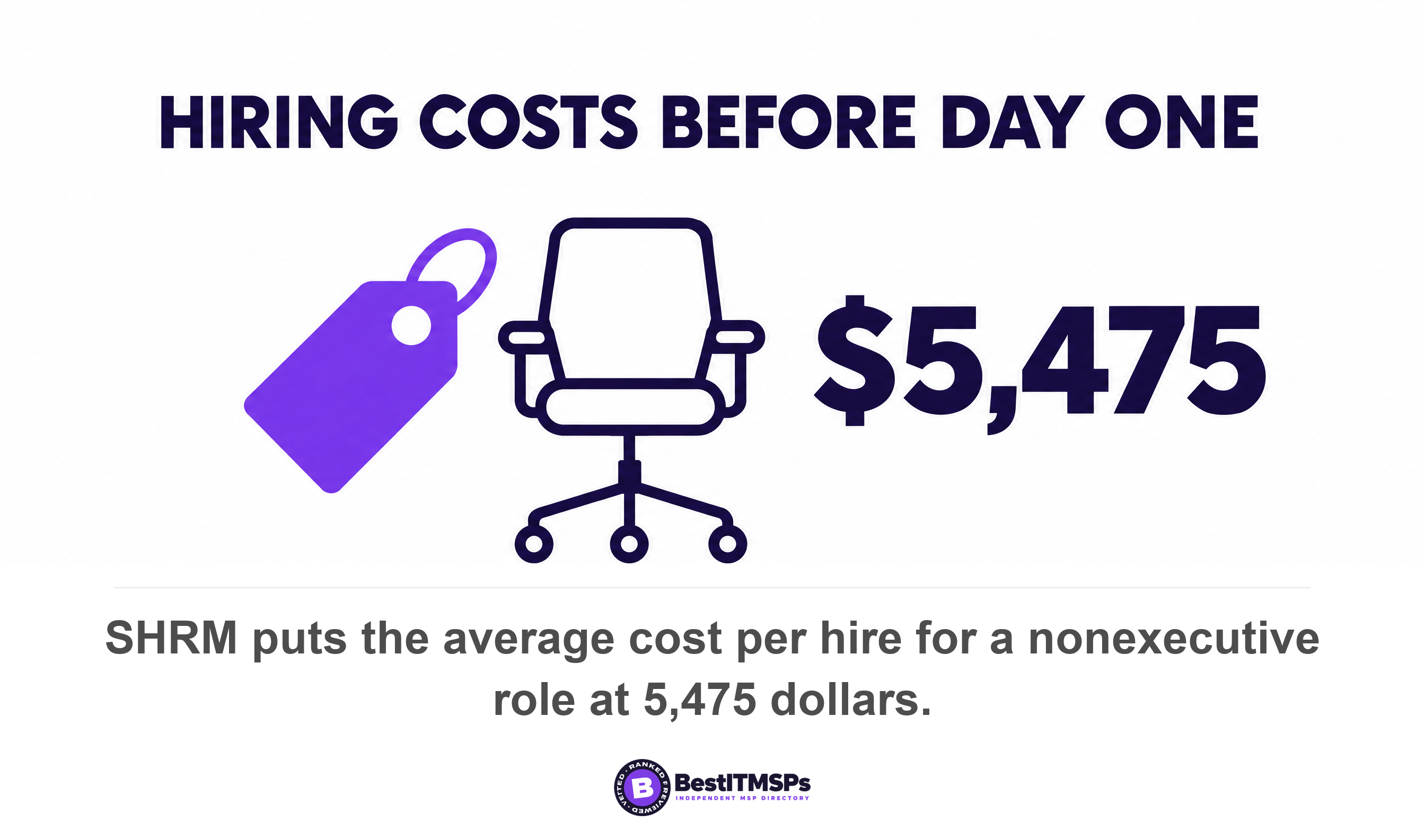
- Recruitment cost. SHRM's 2025 benchmarking survey puts the average cost per hire for a nonexecutive role at $5,475, roughly $1,300 a year spread across median tenure.
- Training and certification. Microsoft role-based certifications expire unless renewed, on a 12 month renewal frequency. Budget exam fees, courseware and the days off the desk.
- Tooling licences. RMM, remote access, documentation, patching, the backup console, endpoint protection and the ticketing system. Your provider buys all of it at volume today.
Add the first five lines to an $85,000 salary and the real number is about $126,000 a year, before tooling. Tooling licences are the line to get right, because the per-endpoint stack your provider buys wholesale is the one you inherit at list price. Treat any per-endpoint figure as an assumption until your provider sends the actual list. At an illustrative $25 per endpoint per month across 60 endpoints you add $18,000, taking the hire to roughly $144,000. Set that against the midpoint of the $100 to $250 per user per month range in our own pricing guide and the naive crossover lands between 70 and 80 users.
Why is the monthly invoice the wrong thing to compare?
The monthly invoice is the wrong comparison because it buys breadth and continuity, while an in-house hire buys depth and presence. One internal employee gives you one person's skills, deep, in the building, and nothing at 2am, nothing on holiday, and nothing in a discipline they have not practised.
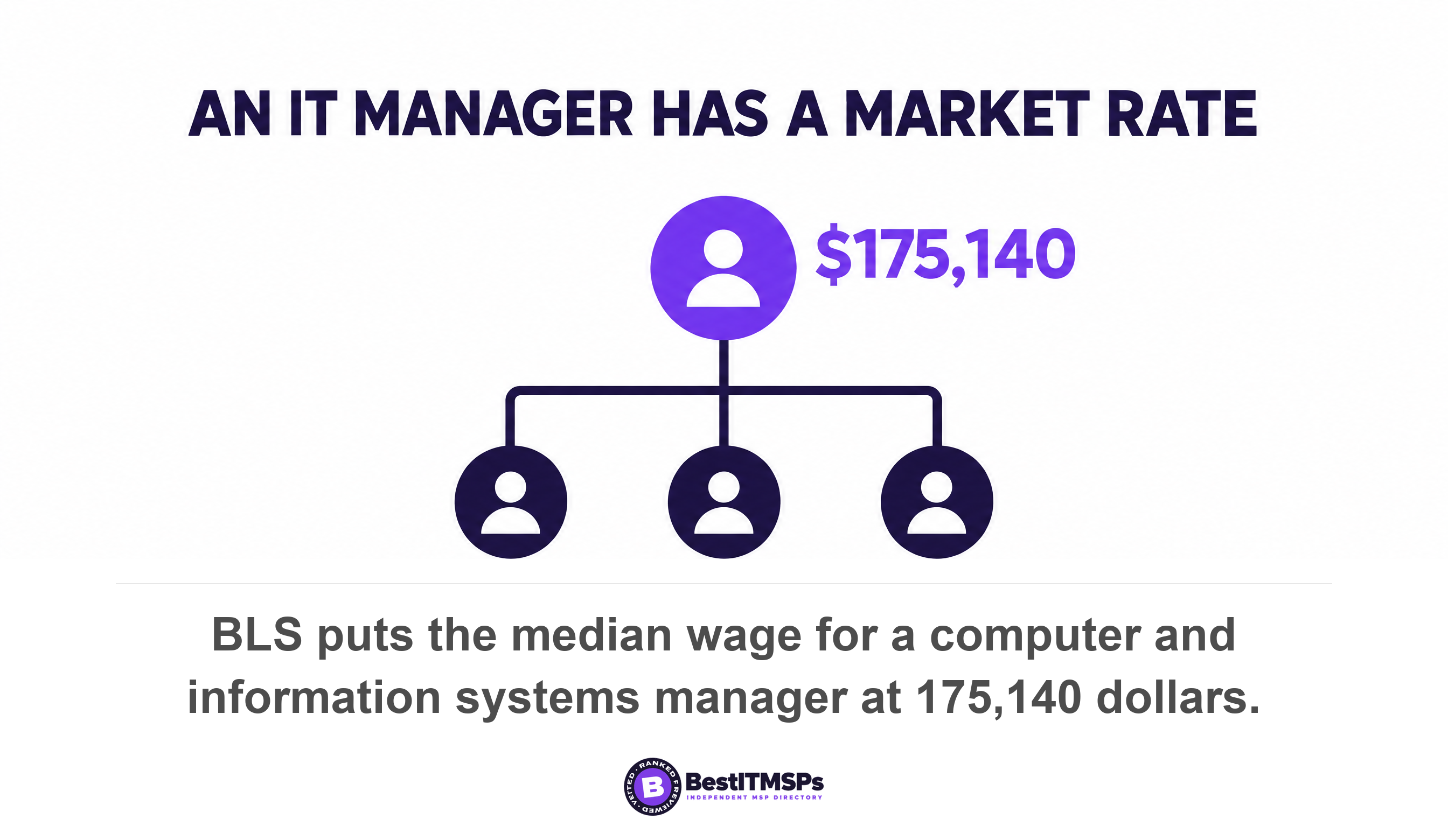
Price the disciplines separately and the mismatch is obvious. BLS medians put a help desk specialist at $61,860, a network and computer systems administrator at $99,130, an information security analyst at $129,180, and a computer and information systems manager at $175,140. That is $465,310 of salary, or about $665,000 of total cost of employment at the BLS ratio. Your first IT hire is one of those four people. A managed contract sells you a thin slice of all four, plus the vCIO conversation an internal IT manager would otherwise own.
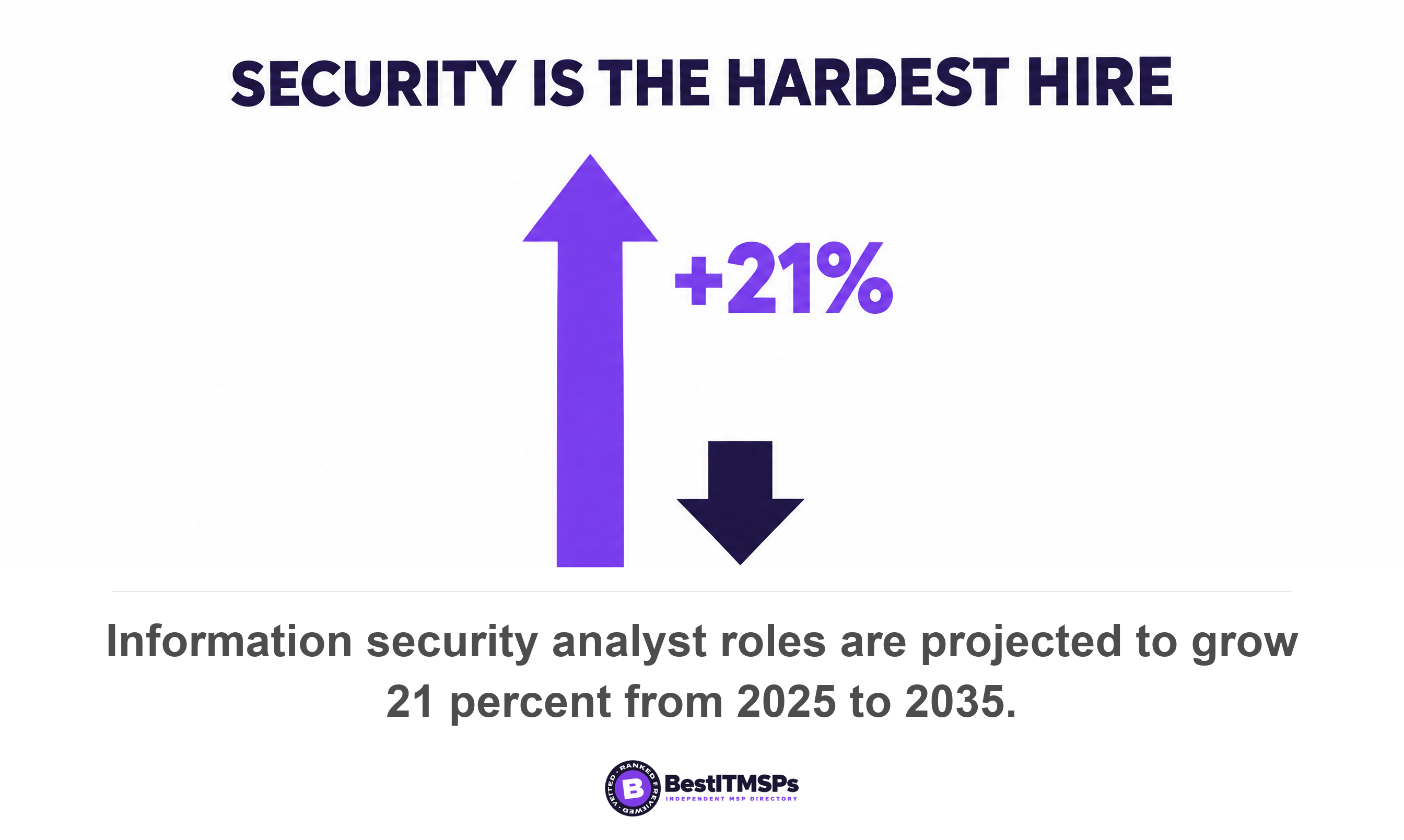
Bench strength is the part buyers underprice. Security is the clearest case, because BLS projects information security analyst employment growing 21 percent between 2025 and 2035 while computer support specialist roles decline 3 percent over the same decade. The discipline you most need to add is the hardest one to hire and retain. A contract also scales with a line item, where a hire scales with a recruitment round that takes months.
How much of the year does one IT hire actually cover?
One IT hire covers about 22 percent of the year. A year holds 8,760 hours, a full-time employee is paid for 2,080 of them, and after public holidays and annual leave roughly 1,900 land at the desk. The other 78 percent of the year has nobody in it.
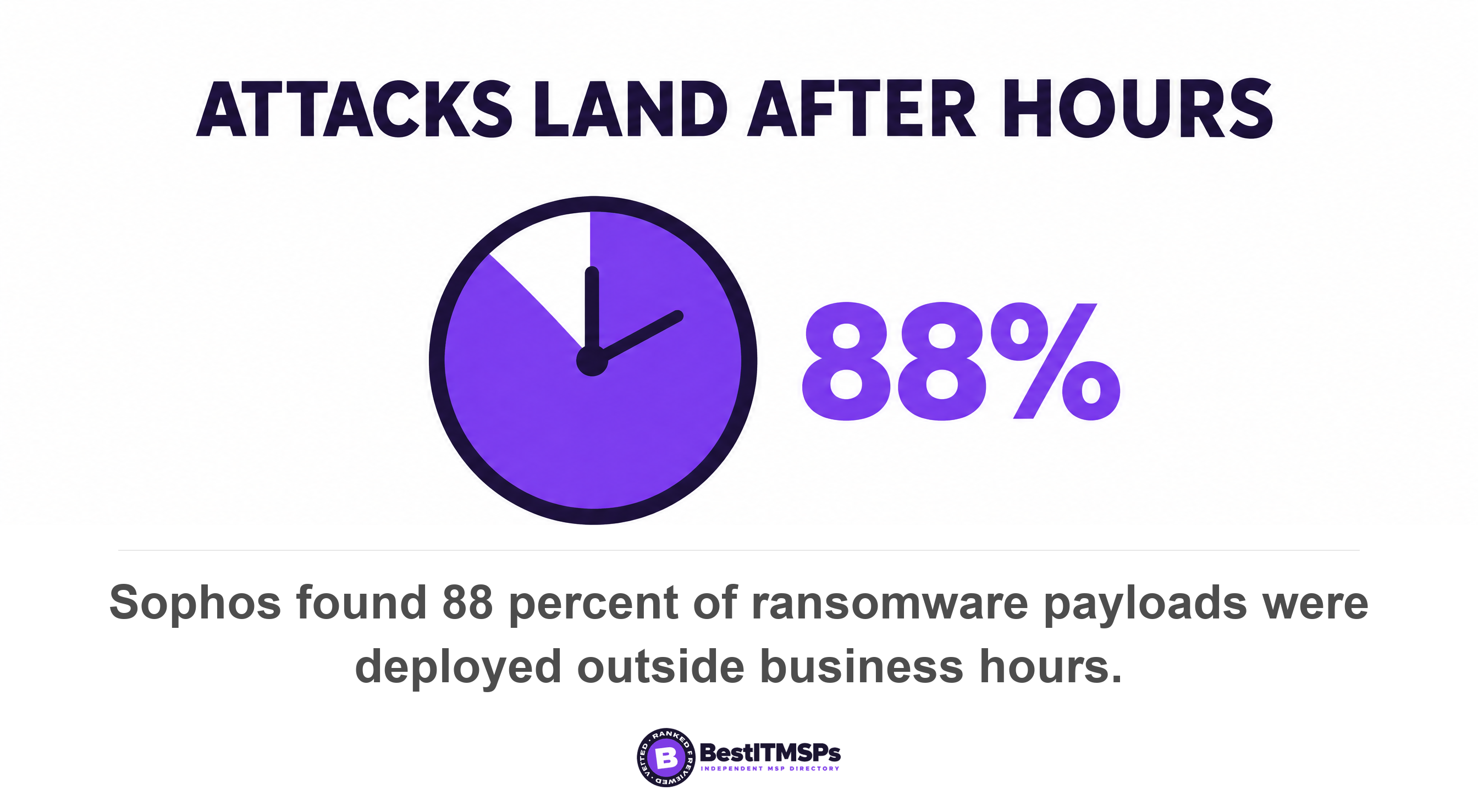
That gap is where the expensive incidents live. Sophos found 88 percent of ransomware payloads were deployed outside business hours and measured a 3.4 hours from first entry to the Active Directory server. Verizon put ransomware in 48 percent of all breaches, up from 44 percent the year before. A lone technician asleep at 2am cannot escalate to anybody, and an on-call rota of one person is a rota that fails the first night they are on a plane. Contractual after-hours cover with a named escalation path is the thing a single employee cannot provide at any salary.
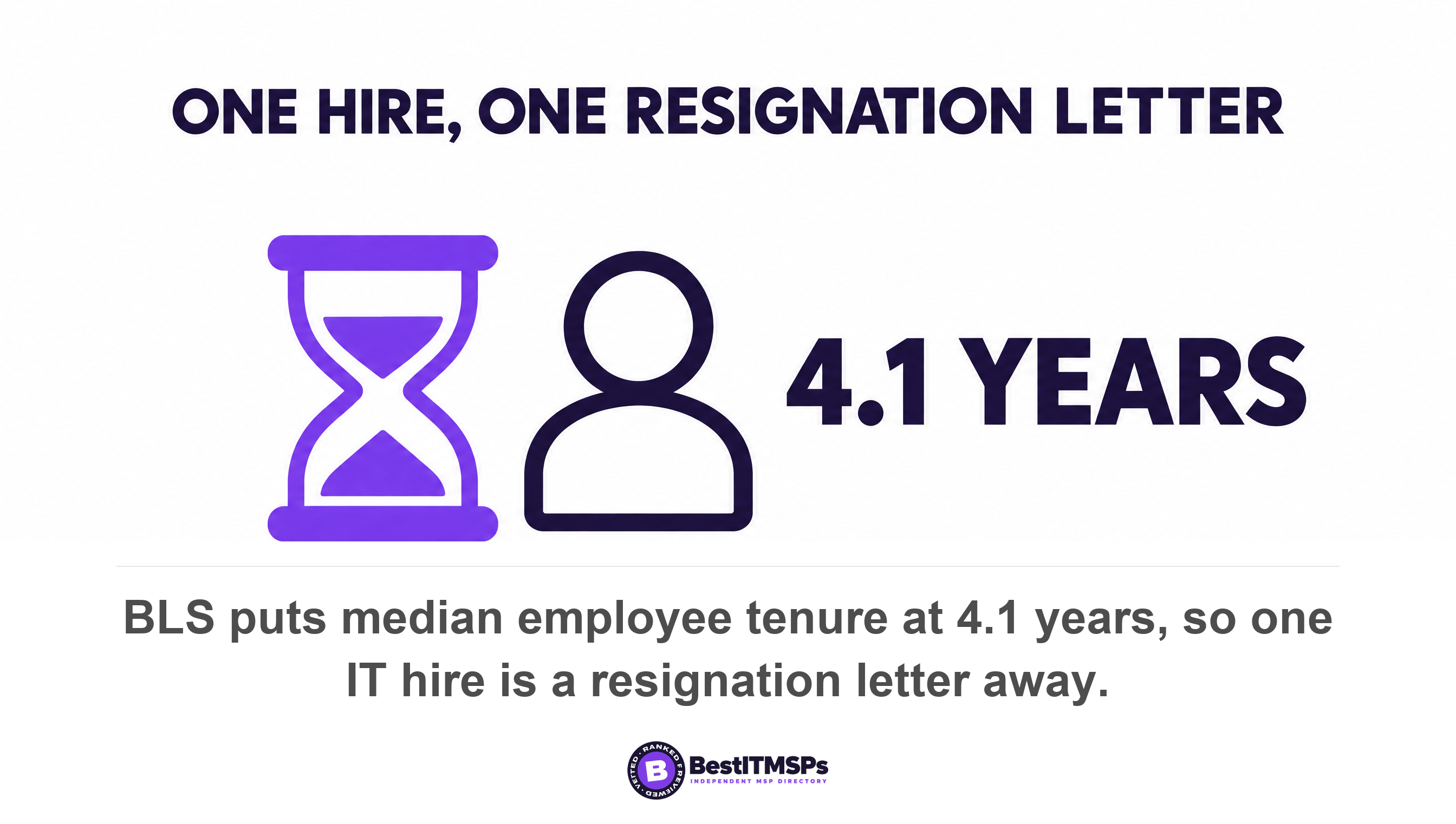
Holiday cover is the same arithmetic with a human face. With one hire, every unplanned absence is a full outage of your IT function, and nobody covers the fortnight they are away. BLS puts median employee tenure at 4.1 years, and 3.0 years for workers aged 25 to 34, so your single point of failure is also one resignation letter away. Replacing them means competing in a live market, because BLS projects about 48,700 openings a year for computer support specialists, almost all of them from workers leaving the occupation.
How do you work out your own service desk ratio?
To work out your own service desk ratio, convert ticket volume into hours instead of counting people. Ask your provider for 12 months of ticket counts and average handle time, multiply them, then divide by the 1,900 hours a full-time technician actually has available.
Run it on a 50 person company. At one ticket per user per month that is 600 tickets a year, and at 45 minutes average handle time that is 450 hours, under a quarter of one person's year. Run the arithmetic backwards and the ratio appears. At 60 percent utilisation a full-time technician has about 1,140 hours for tickets, which is roughly 1,520 tickets, or about 125 users at the same rate. The ticket rate and the handle time are assumptions here, and they are the only two inputs that matter, so replace them with your own.
Now look at the disagreement. Cost math breaks near 70 to 80 users, ticket math near 125, and coverage math never breaks at all. Three defensible calculations, three different answers, which is the clearest evidence that a single crossover headcount does not exist. The ticket math tells you one more thing. If most of your tickets are password resets and printer queues, you are about to hire a person to do the cheapest line on your invoice while the hard disciplines stay uncovered.
A provider who can hand you 12 months of ticket counts and handle times is helping you decide. A provider who will not is the answer to a different question.
Why co-managed IT is the honest answer for most growing SMBs
Co-managed IT is the honest answer for most growing SMBs because it splits the work by what presence buys rather than by what the invoice says. The hire takes what benefits from being in the building. The provider keeps what benefits from a bench.
- Give the hire the in-the-building work, meaning hardware moves, new starter setup, the plant floor or clinic equipment, and the user training nobody remotes into.
- Give the hire your business knowledge, meaning the line-of-business application nobody else understands, vendor management for it, and first-line ticket triage.
- Keep with the provider after-hours cover, the on-call rota, the team that monitors overnight, and the escalation path at 2am.
- Keep with the provider the RMM, patching at scale, backup verification, and the tooling licences bought at volume.
- Keep with the provider project capacity and the vCIO seat, until an internal IT manager genuinely owns the roadmap.
Co-managed also protects the hire you just made. A single technician carrying the on-call phone, the help desk queue and the security alerts burns out, and then you are recruiting again against a 4.1 year median tenure. Our Co-Managed IT Explained guide covers the operating model, so the point here is purely commercial. If you move only first-line work internally, negotiate the contract down to the services you still consume rather than paying a full per-user rate for a thinner scope.
When is hiring internal IT genuinely the right call?
Hiring internal IT is the right call, if any of four conditions describes your business. We have no stake in the answer, because we do not sell IT services, and in these four cases the arithmetic genuinely favours the employee over the provider.
- One discipline, deep and physical. A manufacturer with a plant floor, a clinic with imaging equipment, or a lab with instruments calls one specialist skill constantly and a provider's bench almost never.
- Technology is what you sell. If your product is software or data, the knowledge belongs on your payroll, and no provider acquires it fast enough to matter.
- Scale with a stable estate. Above roughly 150 to 250 users with predictable systems, ticket volume genuinely fills a person and a second hire finally gives you holiday cover. That is where an internal IT manager earns the title.
- Presence is the real complaint. If the actual problem is that nobody ever walks the floor, no service level agreement fixes it. Hire for presence and keep the provider for the bench.
Be fair to the other side of the trade. A provider is its own concentration risk, holding administrator credentials, tooling licences and years of institutional memory about your estate. Test that before it matters, using Could You Leave Your IT Provider?. The useful question is not which option is cheaper. It is which single point of failure you would rather manage, and the honest answer is not automatically the one you already pay for.
What to ask before you decide
Settle this decision with six numbers rather than a feeling. Request all six in writing this week, then run the three calculations above on your own figures instead of ours.
- Request 12 months of ticket counts, split by category, with average handle time per category.
- Request the full list of tooling licences your provider supplies, with product names, seat counts and list prices.
- Request the after-hours log, meaning every incident outside business hours in 12 months and the time to first human response on each.
- Request a priced co-managed quote beside your current fully managed quote, scoped to only the work you would keep.
- Request the exit terms covering data, documentation and administrator credentials returned inside a stated window.
- Request a salary benchmark from two recruiters for the role you would actually post, not the title you would like to post.
The answer moves with the shape of your work, not with your headcount. A 40 person architecture practice with one application and quiet nights lands somewhere different from a 200 person manufacturer running two shifts. Our own directory holds 24,491 provider roster rows across 730 city datasets, so if your provider is the problem rather than the model, replacing them costs a fraction of a hire and takes weeks rather than months. None of this buys perfect coverage, and no honest provider or employee promises it. It buys a decision you can defend.
FAQ
At what headcount does an MSP become more expensive than hiring?
No single headcount exists. Compared on cost alone, one generalist hire matches a fully managed contract at roughly 70 to 80 users. Ticket volume says 125. Coverage never catches up, because paid leave alone costs 8.1 percent of total compensation and one employee works about a fifth of the year.
What does an IT employee actually cost beyond salary?
About 43 percent on top of the salary, before tooling. BLS measures wages at 70.0 percent of total compensation and benefits at 30.0 percent. Add employer Social Security and Medicare of 7.65 percent, an average recruitment cost of $5,475, certification renewals, and the tooling licences your provider supplies today.
How many users can one IT person support?
Work it out from tickets, not headcount. A full-time technician has about 1,900 hours a year. At 60 percent utilisation and 45 minutes average handle time that is roughly 1,520 tickets, or about 125 users at one ticket per user per month. Median tenure is 4.1 years, so plan the replacement too.
Can you keep your MSP after hiring internal IT?
Yes, and most growing SMBs should. Co-managed IT gives the hire the in-the-building work and keeps after-hours cover, security escalation and the RMM with the provider. Sophos found 88 percent of ransomware payloads were deployed outside business hours, which is exactly when one employee is unavailable.
When is hiring internal IT the right choice?
Hire internally when one discipline is deep and physical, when technology is your product, when a stable estate passes roughly 150 to 250 users, or when presence is the real complaint. BLS projects information security analyst roles growing 21 percent to 2035, so security stays the hardest discipline to staff internally.
Best IT MSP is the independent directory of vetted managed IT providers across North America. Organic ranking is earned on rating and verified data, paid placement is always labelled, and we do not sell IT services. Ask three merit-ranked firms in your city to price a co-managed scope beside their fully managed one, then compare both against the hire.