When to escalate past your account manager to the owner
Escalate past your account manager when a failure you already raised has recurred, and the remedy you need sits above their authority. Bring dated instances, the contractual term each one missed, and one named remedy. A federal buyer cannot mark a supplier down for a deficiency it never notified, and gives 10 days to cure.
- Escalate on a repeat, not on a bad week. The interagency guidance banks follow escalates significant issues such as material or repeat audit findings.
- A federal buyer rating a supplier Marginal must reference the management tool that notified the contractor of the deficiency. An instance you never reported is a grievance, not a finding.
- Name one remedy before you send anything. An account manager can apologize and promise. Only an owner reassigns engineers, changes scope, or moves money.
- State the interval. The standard federal default clause gives 10 days to cure a specified failure, extendable in writing, which is a defensible shape to borrow.
- Offer a right of reply. Federal practice gives a contractor 14 calendar days to rebut an evaluation and sends disagreements above the contracting officer.
When should you escalate past your MSP's account manager?
Escalate past your account manager when three things are true at once. A failure you already raised has happened again. The remedy you need sits above their authority. And you can show both in writing, with a date against each instance.
Order matters in those three tests. One bad week is one bad week, and every provider has them. A failure that returns after you reported it is a different thing, because the report was the part that was supposed to prevent it. Recurrence is what turns a service problem into a commercial one.
Supervised buyers are told to escalate on exactly that signal. The Interagency Guidance on Third-Party Relationships, issued jointly by the Federal Reserve, the FDIC and the OCC, says ongoing monitoring should escalate significant issues or concerns, such as material or repeat audit findings. Read the word repeat. The trigger is not severity on its own, and the examples given are examples rather than a closed list.
Three signals say the problem has outgrown your account manager. Each one is visible in a record you already hold.
- Recurs. The same root problem returns after you reported it, so reporting it changed nothing.
- Drifts. Actions agreed in a meeting carry no owner and no date, then reappear on the next agenda unchanged.
- Exceeds. The fix needs money, people or a change of scope, and your account manager has to go and ask somebody else.
A pleasant account manager is the hardest version of this. Nobody is rude, every meeting is agreeable, and the open items are the same ones from March. Pleasantness is not the problem. Authority is. An account manager can apologize and promise. The three things you actually want, which are a different engineer, a dated remediation plan, and a change to scope or price, all live above the person you have been talking to.
Escalating an incident is not the same as escalating a relationship
An incident escalation moves one broken thing to someone who can fix it faster. A relationship escalation moves a pattern of broken things to someone who can change how the service is run. Your agreement documents the first in detail and usually says nothing about the second.
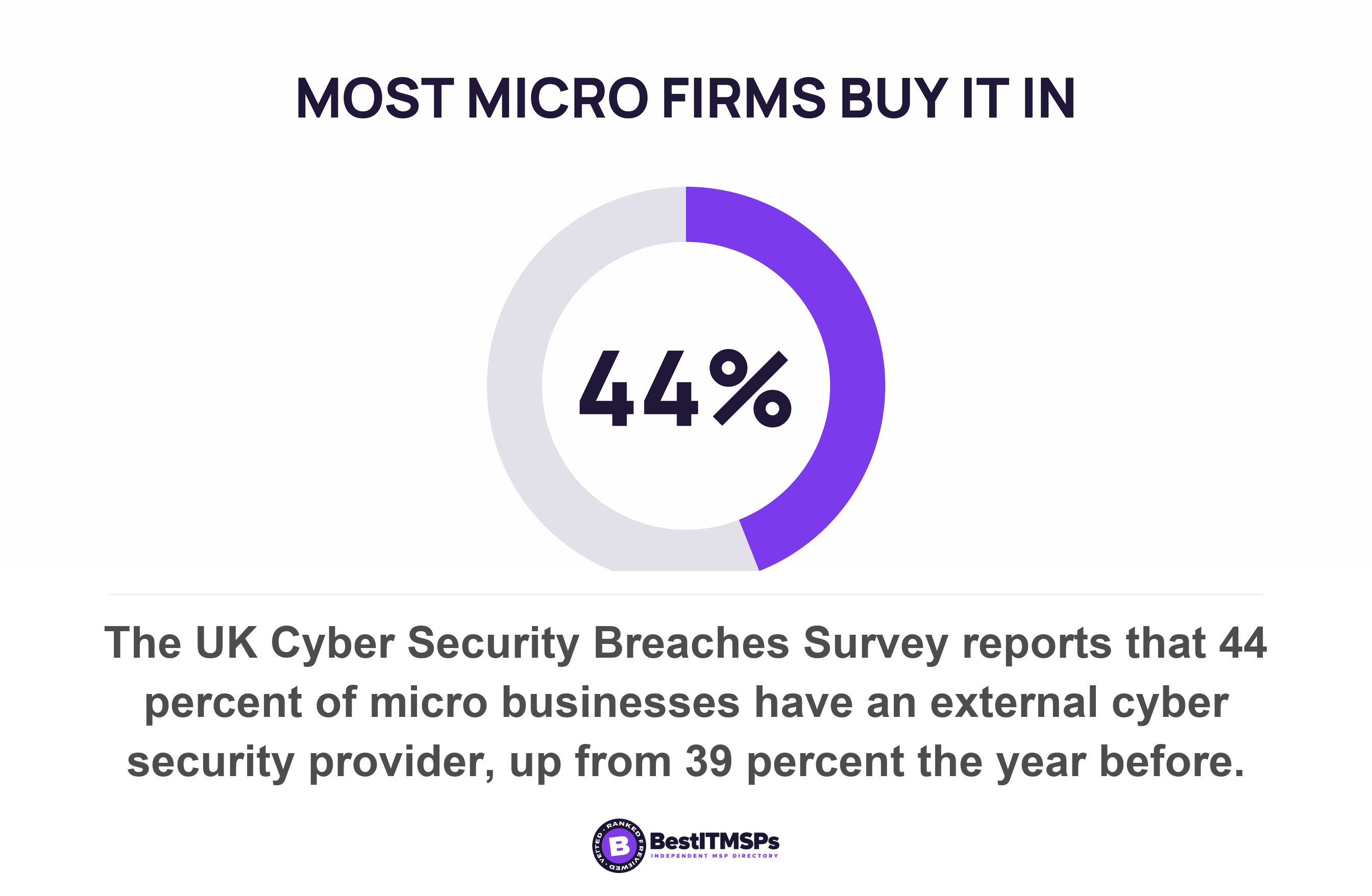
That gap matters more than it used to, because more small firms now depend on an outside firm for the whole function. The UK Cyber Security Breaches Survey reports that 44% of micro businesses have an external cyber security provider, up from 39% the year before. Scope that figure honestly. It covers UK micro businesses and cyber security specifically, not every IT service everywhere. The direction is the useful part.
Published escalation guidance is written about incidents, in its own words. The UK National Cyber Security Centre ties escalation to severity, stating that the severity level will inform how quickly the incident needs to be handled and who it might need to be escalated to, and that the people escalated to must have the authority to make critical decisions. Both sentences describe an event in progress. Neither describes a managed service provider whose service has been quietly mediocre for six months.
The contract guidance draws the same line. CISA's goal on managing risks from managed service providers says contracts should detail how and when MSPs notify the customer of an incident affecting the customer's environment. That is a notification clock for security events. Read across the whole goal set and the contract content is security content. We found no goal addressing service quality, pricing or commercial performance, which is a boundary of scope rather than an oversight, because these are cybersecurity goals.
So the escalation path in your contract is almost certainly an incident escalation path, and it will not carry a commercial complaint. For the incident version, including how to walk the route on a quiet Tuesday, read how to test your MSP's escalation path. This post is about the other case, where nothing is on fire and nothing is improving either.
What makes a commercial escalation land is a record, not a feeling
A commercial escalation lands when it arrives as evidence. Four parts carry it. Specific instances with dates, the contractual term each instance missed, what you already asked for and when, and one named remedy.
The federal government keeps the largest supplier performance record in the country and publishes the rules for keeping it. Its evaluations should be based on objective facts supported by program and contract or order performance data. That is the bar worth copying. Not an impression of the service, but facts tied to the record your contract already generates.
The same regulation names the dimensions worth recording. Past performance information includes, for example, a contractor's record of conforming to requirements and to standards of good workmanship, adherence to schedules, including the administrative aspects of performance, and reasonable and cooperative behavior and commitment to customer satisfaction. Note the phrase for example. The list is illustrative rather than closed, so treat it as a starting agenda.
The test a federal buyer passes before marking a supplier down
To record a supplier as underperforming, a federal buyer has to show that it told them. The rating definitions say so directly. A rating of Marginal means performance does not meet some contractual requirements, and it should be supported by referencing the management tool that notified the contractor of the contractual deficiency. The step below it, Unsatisfactory, means performance does not meet most contractual requirements and recovery is not likely in a timely manner.
Run that test on your own list before anyone else sees it. Take each instance and find the moment you notified them, with a date. An instance with no such moment is a grievance rather than a finding, and it is the first one your provider will reach for. That is not a technicality. It decides whether the meeting is about the service or about whether your complaint is fair.
An instance you never reported is a grievance. An instance you reported, with a date, is a finding.
Most of the written record already exists, and your provider holds it. Ticket history, meeting minutes and the action list from the last quarterly business review are all exportable. Ask for the export inside a normal review, before you raise anything, because a request that arrives after a complaint changes what comes back and how long it takes. For the half hour that produces those minutes, read the one-page service review.
The structure regulated buyers use, and why you can borrow it
Borrow the structure from third-party risk guidance, and be clear that none of it binds you. Banks are supervised on how they manage their suppliers. A 20-person accounting firm is not. The documents are still the cleanest free statement of what competent supplier management looks like.
The agencies make the non-binding part explicit themselves. The interagency guidance states that supervisory guidance does not have the force and effect of law, and that it does not impose any new requirements on banking organizations. Nothing in it is a rule you are breaking by ignoring it. It is a method written by buyers who have to do this properly, published for free.
Three parts of that method transfer to a small business without changing a word.
- Monitor on a stated basis. The guidance notes that monitoring may be conducted on a periodic or continuous basis, which for most firms means a recurring date rather than a dashboard.
- Record what arrives. Its documentation section names risk and performance reports required and received from the third party as part of ongoing monitoring among the records to keep.
- Plan the alternative early. Its termination section asks buyers to weigh options for an effective transition of services, such as potential alternate third parties to perform the activity.
One control decides whether any of this happens at all. NIST's catalogue of security controls, reproduced by FedRAMP, requires an organization to define and document organizational oversight and user roles and responsibilities with regard to external system services and to monitor control compliance by external service providers on an ongoing basis. That control is written for security compliance, and the half that transfers is the first one. Somebody owns the oversight, by name. Without that, oversight is whoever happens to be annoyed that week, which is how a three-month irritation becomes a two-year contract.
The sequence that gives your provider a fair chance
To escalate in a way that can still end well, run four steps in order. Raise it at the working level. Document what happens next. Escalate once, in writing, with one remedy and a date. Only then consider formal notice.
Step one is not a courtesy, and the federal rules put it first as well. The stated policy is to try to resolve all contractual issues in controversy by mutual agreement at the contracting officer's level. The contracting officer is the day-to-day counterpart, which in your case is the account manager or the service delivery manager. Escalating before that conversation has genuinely happened costs you both the argument and the goodwill.
Step two has a published floor. Federal past performance evaluations shall be prepared at least annually and at the time the work under a contract or order is completed. Annual is the floor rather than the ambition. For a provider you depend on daily, a short written note each quarter is enough, as long as it sits somewhere other than your memory.
Step three needs a stated interval, and there is a defensible one to borrow. The standard federal default clause allows termination for certain failures only if the contractor does not cure such failure within 10 days, or more if authorized in writing by the Contracting Officer, after receipt of the notice from the Contracting Officer specifying the failure. Ten days is deliberately short, because it sits immediately in front of a termination. For a remediation plan rather than an exit, 30 days with a mid-point check reads as fair to both sides and is long enough to move an engineer or change a rota. That interval is our judgment, not a published figure.
Step three also owes them a reply. Federal practice gives a contractor up to 14 calendar days from the date of notification of availability to submit comments or a rebuttal, and agencies must provide for review at a level above the contracting officer to resolve disagreements about an evaluation. That is a published two-way ladder. The supplier can contest the record, and somebody more senior settles it. Offer the same. It costs nothing, and it removes the one objection your provider can raise cheaply, which is that they were never given a chance to answer.
Step four belongs to your own agreement rather than to any guidance. What a formal notice must contain, how long the cure period runs and what it triggers all sit in the contract you signed. Read termination for convenience for the right to leave without proving fault, and MSP contract red flags for the terms that make notice expensive.
What to put in the escalation note, and what to leave out
Write the escalation as one short factual note to one person. Six things belong in it, and the brevity does real work, because length reads as grievance.
- Name the recipient and say in one line why it is them, such as asking for a decision only an owner can make.
- List three to five specific instances with dates, one sentence each.
- Quote the contractual term each instance missed, with its clause number.
- State what you already asked for and when, so the record of notification sits on the page.
- Ask for one remedy, in one sentence, with a date you want it agreed by.
- Offer a reply window and a meeting, so there is a route that is not defensive.
Four things weaken the note, and all four are tempting. A list of every irritation since 2024, because volume reads as grievance rather than pattern. A reference to what you pay, which turns a service conversation into a price negotiation. A threat to leave, which does the same thing faster. And adjectives. Unacceptable, appalling and disappointing each tell the reader how you feel and nothing about what happened.
Assume the owner is hearing this for the first time. Account managers filter upward, and the pleasant ones filter hardest, because absorbing friction is how they understand the job. A first escalation is usually new information rather than a second refusal, which is why a factual note outperforms an angry one by a wide margin. If you are already past that point, the tone still pays, because the record you are building may end up in front of a successor provider.
What your contract gives you, and what it does not
Your agreement offers four remedies for poor performance, and three of them are weaker than they look. A service credit pays out in service rather than cash. A cure period buys time rather than a fix. Termination rights cost notice, transition work and money. A notice period runs on a calendar you agreed to years ago.
The remedy worth escalating for is the one your service level agreement probably does not name. A written remediation plan that says what the provider will remediate, who owns each action, and by when. Three to five actions, a date against each, and a review date. It is cheap for a competent provider to produce and close to impossible for an incompetent one, which is exactly why it is the right thing to ask for.
| What you want | Where it usually lives | Covered in |
|---|---|---|
| Money back for downtime | The SLA credit schedule, usually capped at a slice of one month's fee | What an SLA service credit is worth |
| Time to fix before you act | A cure or remediation period inside the termination clause | MSP contract red flags |
| The right to leave without proving fault | A termination for convenience clause, which many agreements omit | Termination for convenience |
| Help during the handover | A wind-down or transition assistance clause | Switching MSPs: the transition playbook |
| A named engineer, or a plan with dates | Usually nowhere, which is why it is the thing to escalate for | This page |
Read the clause before you cite it. Agreements in this market differ far more than their marketing does, and the notice period is the single number that decides how much leverage you actually hold.
If nothing changes, what to have ready before you switch
Gather four things before you give notice. Your administrative credentials, your documentation, your data in a format you can read without your provider, and a shortlist of alternatives you have already spoken to.
Transition assistance is worth asking for in writing, and the federal clause shows the shape of a reasonable version. On written notice, a contractor must furnish phase-in, phase-out services for up to 90 days after this contract expires and negotiate in good faith a plan with a successor. Two details matter in that sentence. The 90 days is conditional on the written notice rather than automatic, and the plan is negotiated with the incoming provider rather than written by the outgoing one.
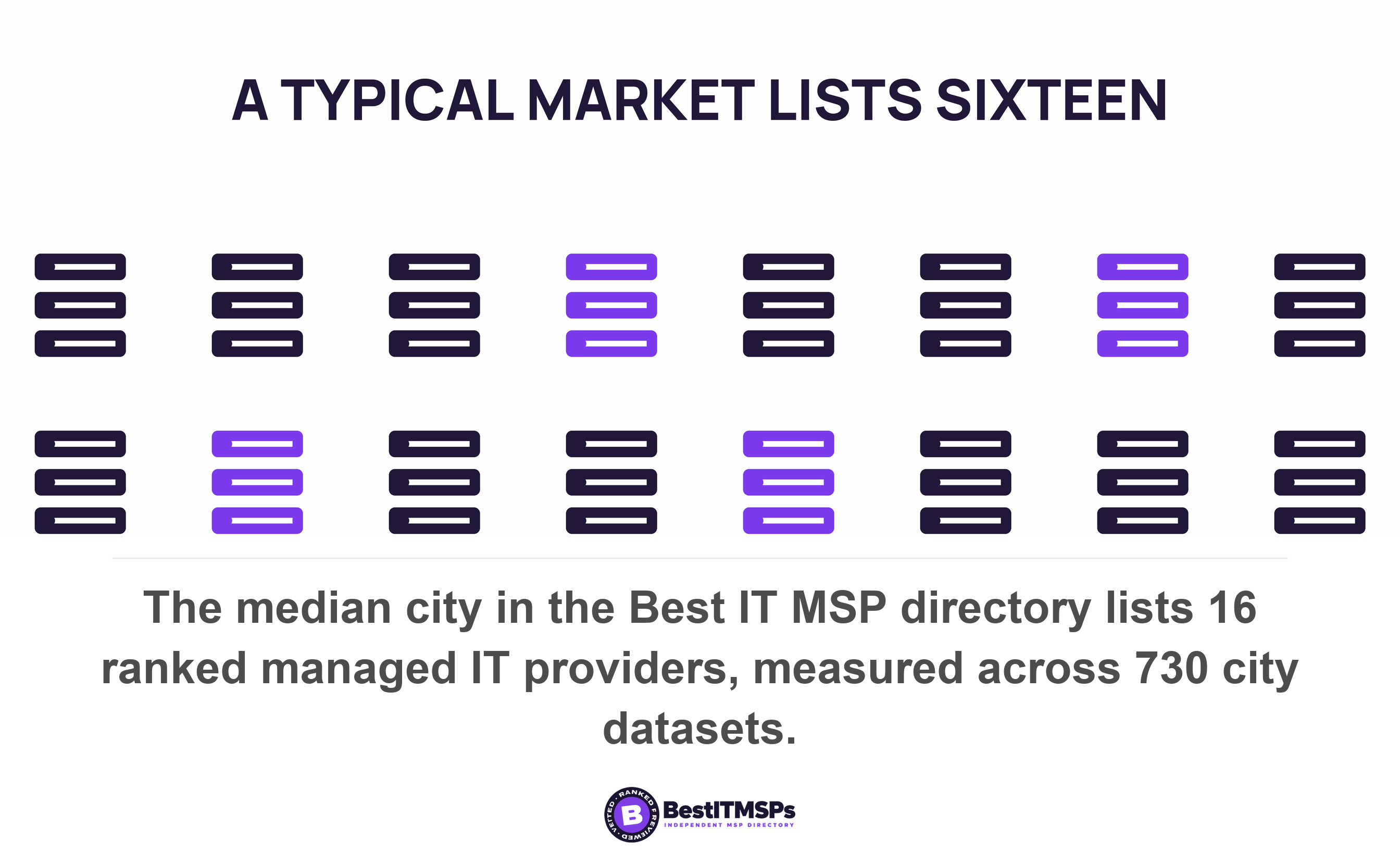
Line up the alternatives before you need them, because the shortlist takes longest. Most markets are not thin. Across our own 730 city datasets, the median city lists 16 ranked managed IT providers. Supervised buyers are told to do this in advance too, weighing options for an effective transition of services, such as potential alternate third parties as part of planning rather than as a reaction.
The mechanics of leaving are a separate job, and two posts already cover them. Read could you leave your IT provider for what you own against what your provider holds, and switching MSPs for the sequence that avoids downtime.
Most escalations do not end in a switch. A provider that produces a dated plan and then meets it has usually been badly managed rather than badly intentioned, and that is a fixable problem. Best IT MSP is independent and does not sell IT services, so we rank providers on verified rating and firmographic data and label paid placement.
FAQ
When should I escalate past my MSP account manager?
Escalate when a failure you already raised has recurred and the remedy you need sits above your account manager's authority. Bring dated instances and the contractual term each one missed. Interagency third-party guidance escalates on material or repeat audit findings, so recurrence is the signal that matters.
How do I complain to my MSP's owner without wrecking the relationship?
Send one short factual note to one person, with three to five dated instances, the clause each one missed, a single named remedy, and a reply window. Leave out price and any threat to leave. Federal policy resolves issues first at the contracting officer's level, which is your working level.
How long should I give my IT provider to fix a problem?
State an interval in the letter rather than leaving it open. The standard federal default clause allows 10 days to cure a specified failure, extendable in writing, and it is short because it precedes a termination. For a remediation plan, 30 days with a mid-point check is a fairer shape.
What evidence do I need before escalating a complaint about my MSP?
You need dated instances, the contractual term each one missed, and proof that you reported it. A federal buyer rating a supplier Marginal must reference the management tool that notified the contractor of the contractual deficiency. Ticket history and meeting minutes usually supply all three.
Is escalating an incident the same as escalating a complaint about my provider?
No. Incident escalation moves one broken thing to somebody who can fix it faster, and your contract documents it. The NCSC ties escalation to severity, noting that the severity level will inform how quickly the incident needs to be handled. A relationship complaint has no such clause, so you build the route.
Best IT MSP is the independent directory of vetted managed IT providers across the US and Canada. Organic ranking is earned on verified rating and firmographic data, paid placement is always labelled, and we do not sell IT services. Open the ranked list for your city, then ask three firms how they handle a service complaint.