How to Test Your MSP's Escalation Path Before You Need It
An escalation path is the named route a stuck problem takes to someone senior enough to fix it. Most are never walked until an outage. Test yours on a live low-severity ticket this week, check that every level names two reachable people, and confirm escalation reassigns the work rather than only sending a notification.
- An escalation path is the only clause in your contract made of names, so it goes out of date on its own. US information-sector employers recorded 68,000 separations in a single month.
- Escalation in most agreements is a notification event. Ask in writing whether it also moves the ticket to a different engineer, and to whom.
- Every level needs two contact methods and two people. One named engineer with one mobile number is a single point of failure.
- The people you escalate to need the authority to spend money and approve a restore, not just the seniority to apologize.
- You can test the whole path on a live low-severity ticket. No fake emergency, no production change, about 40 minutes of your time.
What is an MSP escalation path, and what are you actually testing?
An MSP escalation path is the documented route a stuck problem takes from the service desk to someone senior enough, and empowered enough, to end it. Your managed IT contract names one. Testing it means walking that route on a quiet Tuesday, with a real ticket, before an outage makes the walk compulsory.
Three things get tested, and all three are testable in under an hour. Whether the contact details reach a human being. Whether escalation changes who is working on the problem. Whether the person it reaches holds the authority to act, meaning the authority to approve the spend or the change that ends the incident.
Google's site reliability engineers use a blunt trigger for when a problem has outgrown the person holding it. They declare an incident if you need to involve a second team in fixing the problem, if the outage is visible to customers, or if the issue is unsolved even after an hour's concentrated analysis. That is an escalation trigger written in one line. Your service level agreement probably has nothing that clear.
CISA treats this as a procurement question rather than an IT one. Its performance goal on managing risks from managed service providers states that contracts should detail how and when MSPs notify the customer of an incident affecting the customer's environment. Read that sentence twice. The standard is written about notification timing, which is the first clue to what your escalation path actually promises you.
Why the first use of an escalation path is usually its first test
Because nothing in a managed IT agreement requires anyone to walk it. The clause is signed, filed, and left alone until a P1 lands at 2am and somebody reads it for the first time with a clock running.
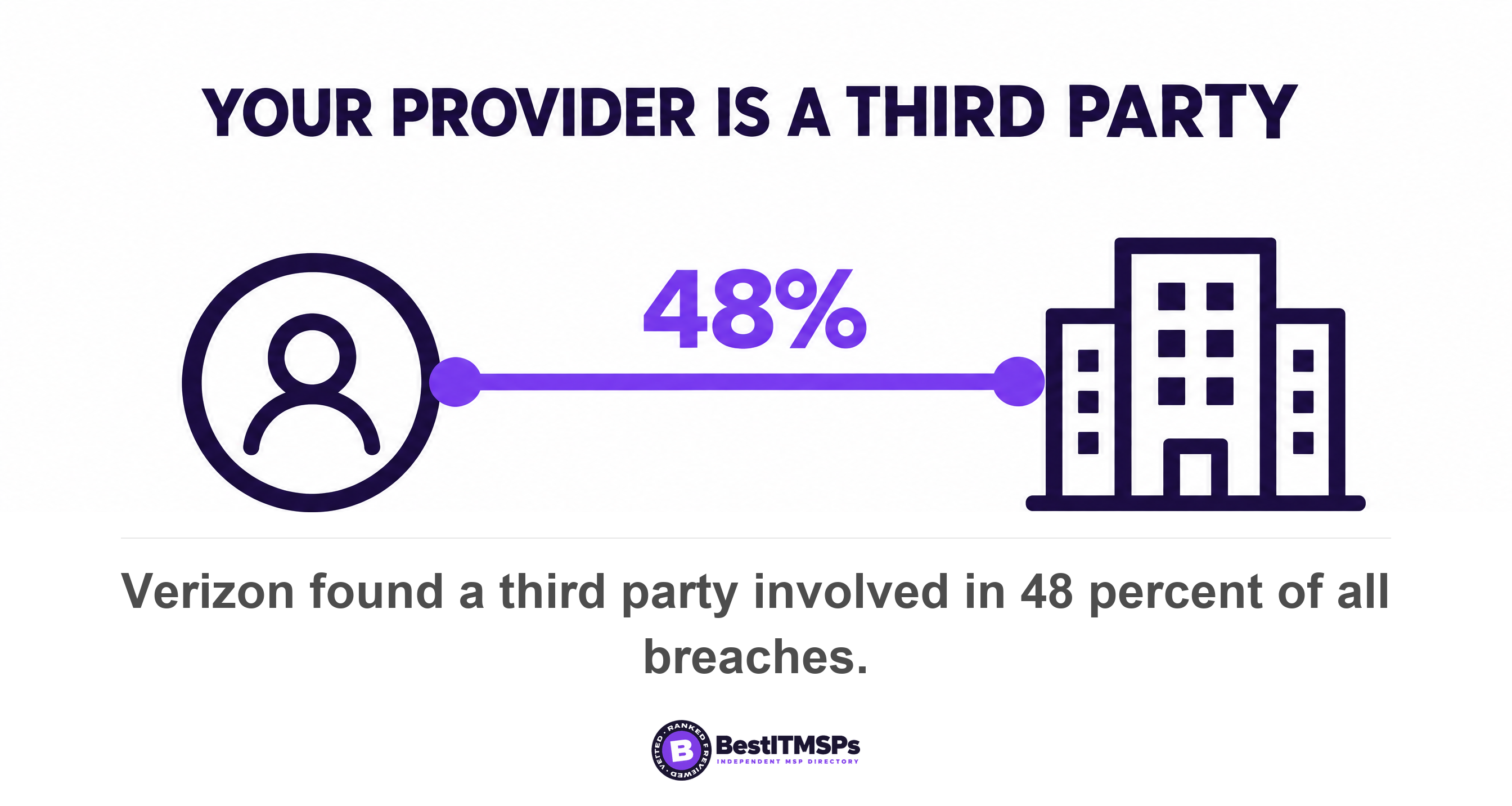
The odds of needing it are not small, and your provider sits inside them. Verizon reported that breaches involving a third party now account for 48 percent of all breaches, and that third-party supply chain breaches jumped 60 percent in a year. Your IT provider is your largest third party, so the escalation path has to work in both directions.
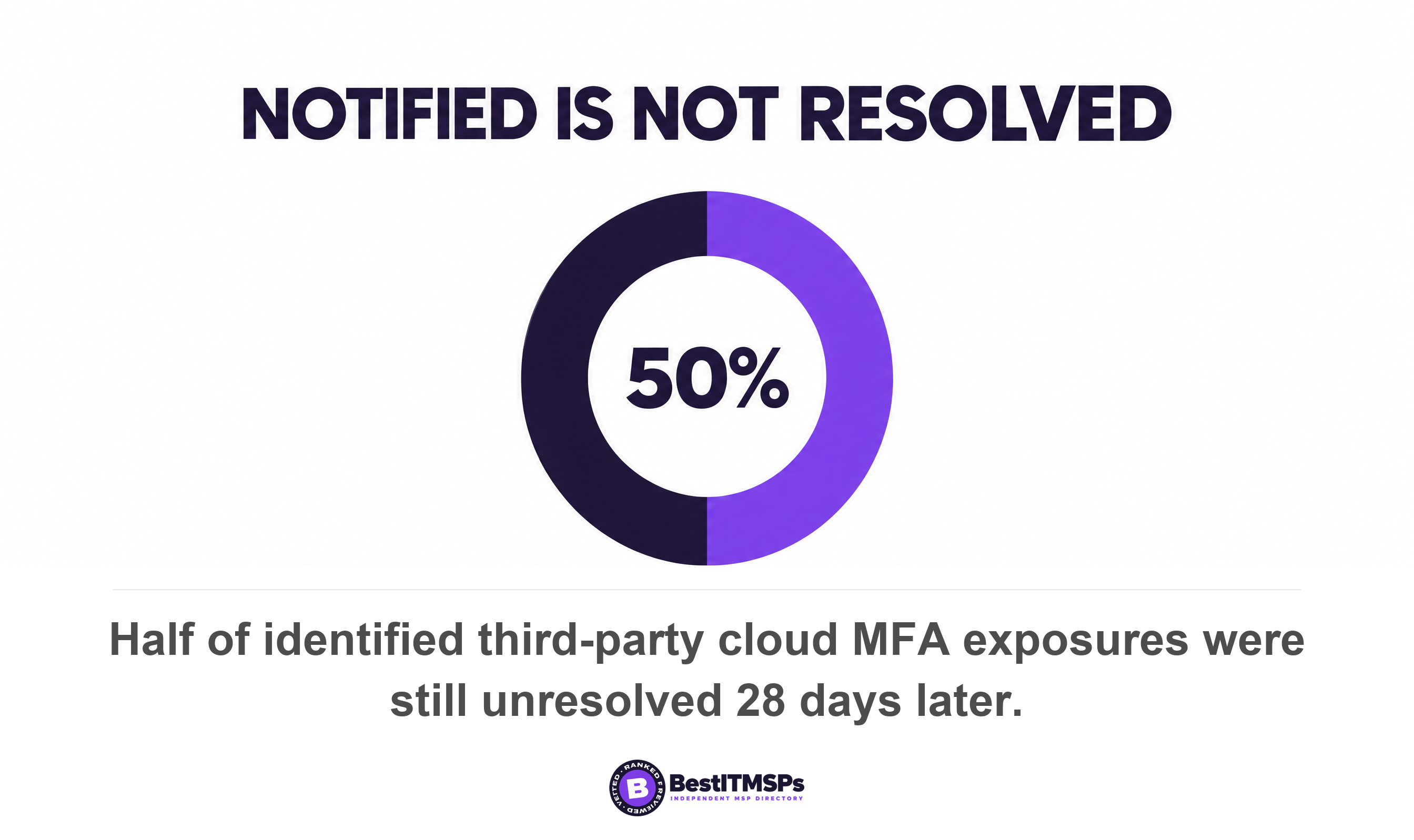
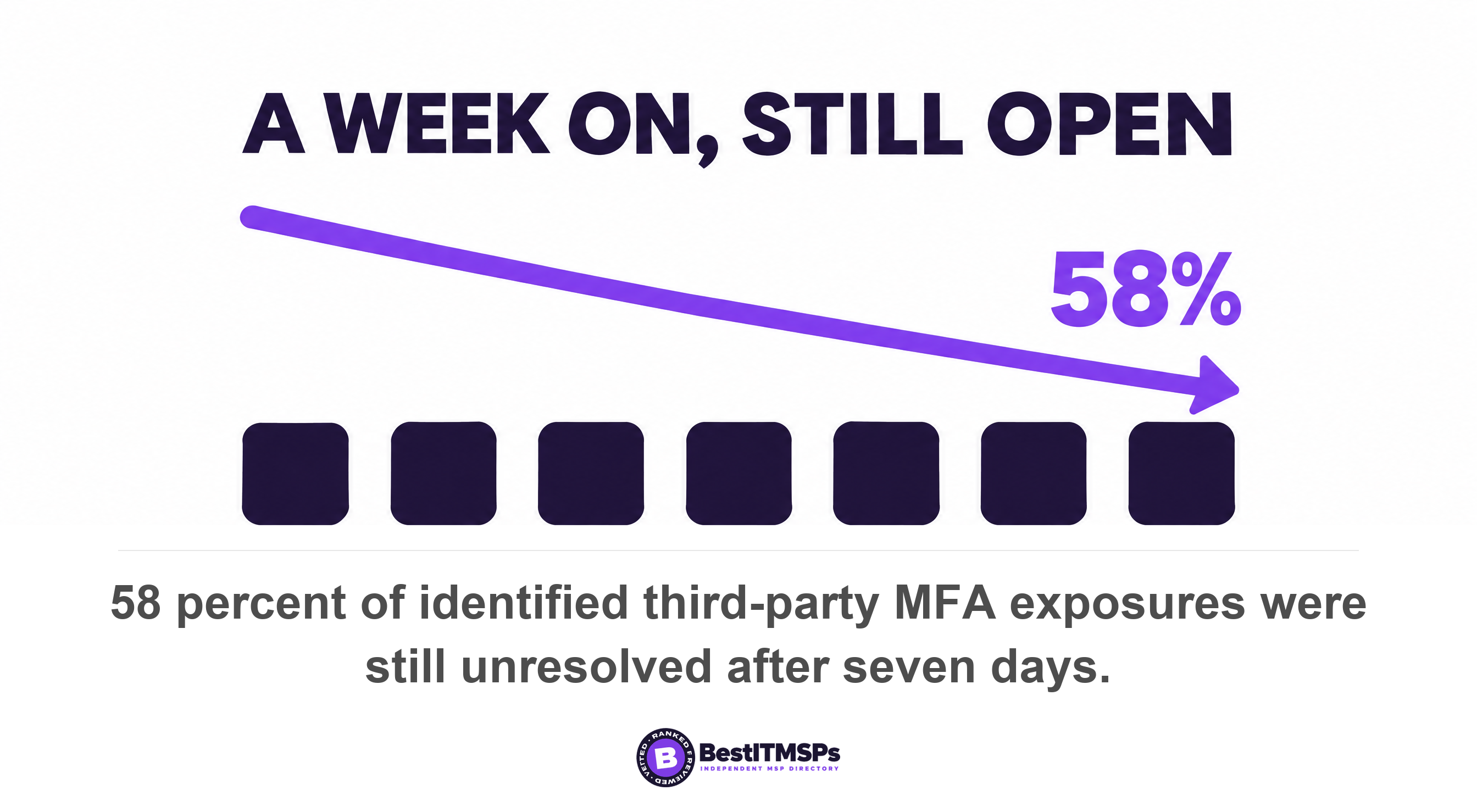
Knowing about a problem is not the same as closing it, and Verizon measured that gap directly. Across a survival analysis of 7,513 third-party cloud-based multi-factor authentication exposures, 58 percent were still unresolved seven days after they were identified and 50 percent were still unresolved after 28 days. Every one of those was known. Somebody had been told. Four weeks later, half were still open.
CISA's remedy is a calendar rather than a document. Its goal on managing incident response plans asks organizations to develop, maintain, update and regularly drill them, with realistic exercises involving all stakeholders, reviewed and drilled, at a minimum, on an annual basis. An escalation path nobody has drilled is a hypothesis, not a control.
This post covers the communication and authority route for any service failure, not only a security one. For the full security rehearsal, read test your MSP's incident response. For the clocks that govern the ticket itself, read first response vs resolution SLA.
Escalation is a notification promise, not a reassignment promise
Escalation in most managed IT agreements means somebody more senior is told, not that somebody more capable takes over. That single distinction decides whether your escalation path shortens an outage or merely widens the audience watching it. A path that reassigns work puts a person who can contain the fault on it. A path that only notifies adds a spectator.
The standards that govern vendor escalation are written as notification clocks. CISA's supply chain goal asks that procurement documents and contracts, such as service level agreements, require vendors to notify the procuring customer of security incidents and vulnerabilities within a risk-informed time frame that you set. The UK National Cyber Security Centre tells organizations to document who the escalation points of contact are, along with their contact details including out of hours, and how quickly the escalation needs to occur. Both describe a message arriving on time. Neither describes a different engineer picking up the work.
So ask the reassignment question separately, and ask it in writing. At each level, who becomes the accountable owner of the ticket, and does the previous owner stop or carry on? Google's incident guidance is strict here, reserving changes to one group and stating that the operations team should be the only group modifying the system during an incident. Two people improvising on the same server at 3am is how a one-hour outage becomes a four-hour one.
A notification-only escalation is still worth something. It creates a record, and it puts an account manager or a service delivery manager on the hook in front of their own management. It does not move the work. Know which one you bought, because the two feel identical in a contract and nothing alike at 2am.
If escalation at 60 minutes sets a flag and emails a manager, the ticket has not moved. It has only been witnessed.
The seven fields a usable escalation matrix must name
To make an escalation matrix usable, require seven fields on every level of it. The UK National Cyber Security Centre supplies the reasoning for most of them, so none of this is an unusual ask of a provider.
- Name the person at each level, with their job title, rather than a tier number or a shared inbox.
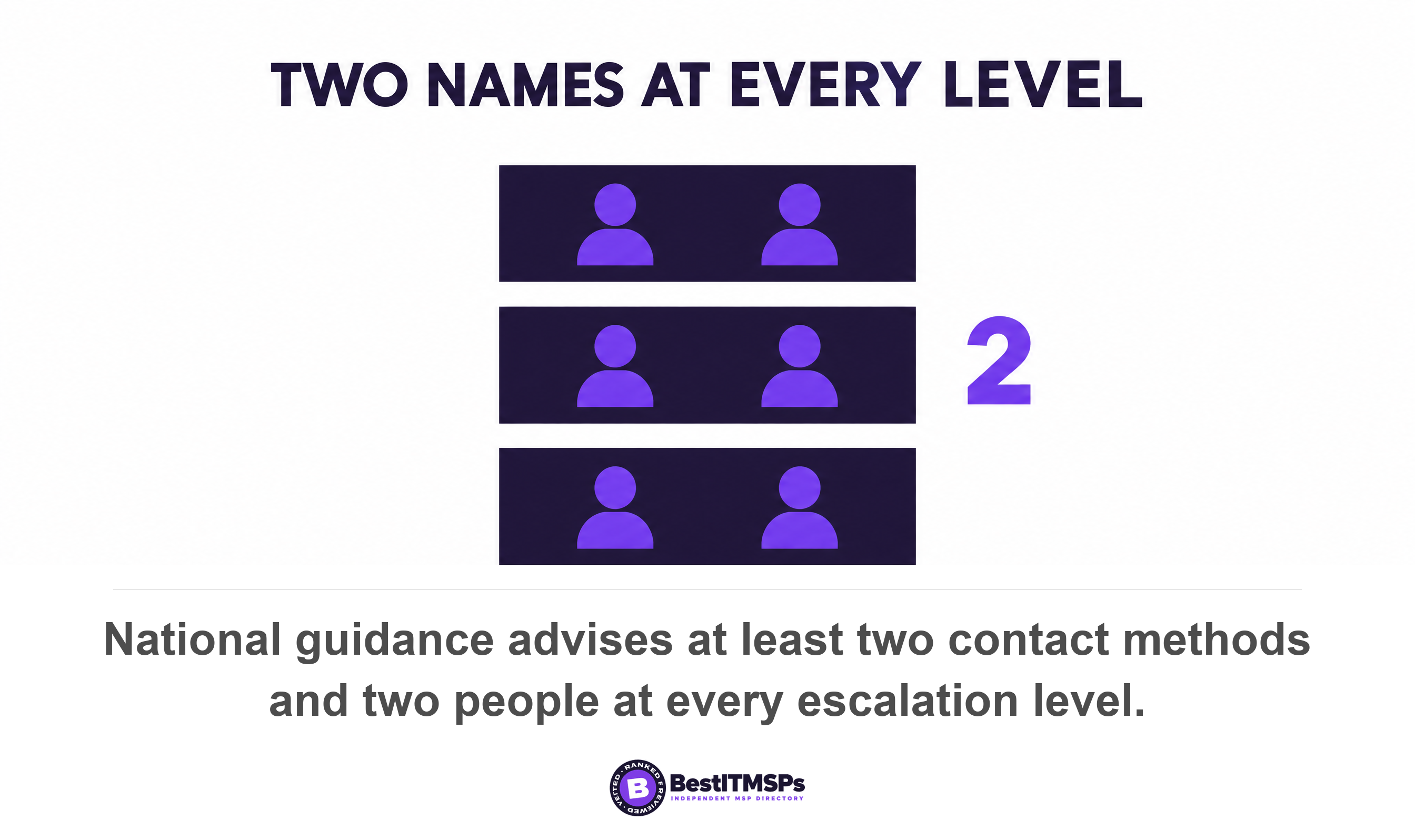
- List two contact methods and two people per level. The NCSC advises including at least 2 contact methods and 2 or more people or group details and tells organizations to always consider the risk of people being unavailable.
- State the trigger in both time and impact, so minutes elapsed at a given severity level is one route and business impact is another.
- Record the out-of-hours contact separately, because the weekday route and the Sunday route are rarely the same path.
- Define the decision authority at each level, since the NCSC is explicit that the people escalated to must have the authority to make critical decisions.
- Identify the deputy, because the NCSC asks for deputies and a process to enable others to make decisions should the primary contact not be available.
- Fix one point of coordination, as the NCSC states there must be a central point of coordination, no matter who is involved.
Then ask about the bridge. The NCSC recommends a conference line that should be always available for urgent incident calls. A standing number that exists today beats setting up a call while an outage runs, and it is a one-line request that tells you immediately whether your provider has ever run a long incident.
Severity levels sit underneath all of this. How they should be defined, and who gets to grade your outage, is covered in first response vs resolution SLA. For this exercise, take your existing severity level definitions as given and test only what the escalation matrix does with them. The rest of the paperwork a provider should be able to hand over sits in documents your MSP should provide.
Who is allowed to say yes at 2am
The person you escalate to needs delegated authority, which is a different thing from seniority. The NCSC asks organizations to identify the people who are empowered, or who hold delegated authority, to make critical decisions, and notes that a high or critical severity incident is likely to always need to go up to CIO or board level.
Four decisions are worth naming in advance, and each one has stalled a real incident somewhere this month.
- Authorize spend. Name who can approve overtime, an emergency vendor callout, or a hardware purchase at midnight.
- Approve recovery. Name who can trigger a failover and who can restore a production system from backup.
- Declare the end. Name who closes the incident and releases the on-call rota.
- Speak publicly. Name who talks to customers and who can update the status page.
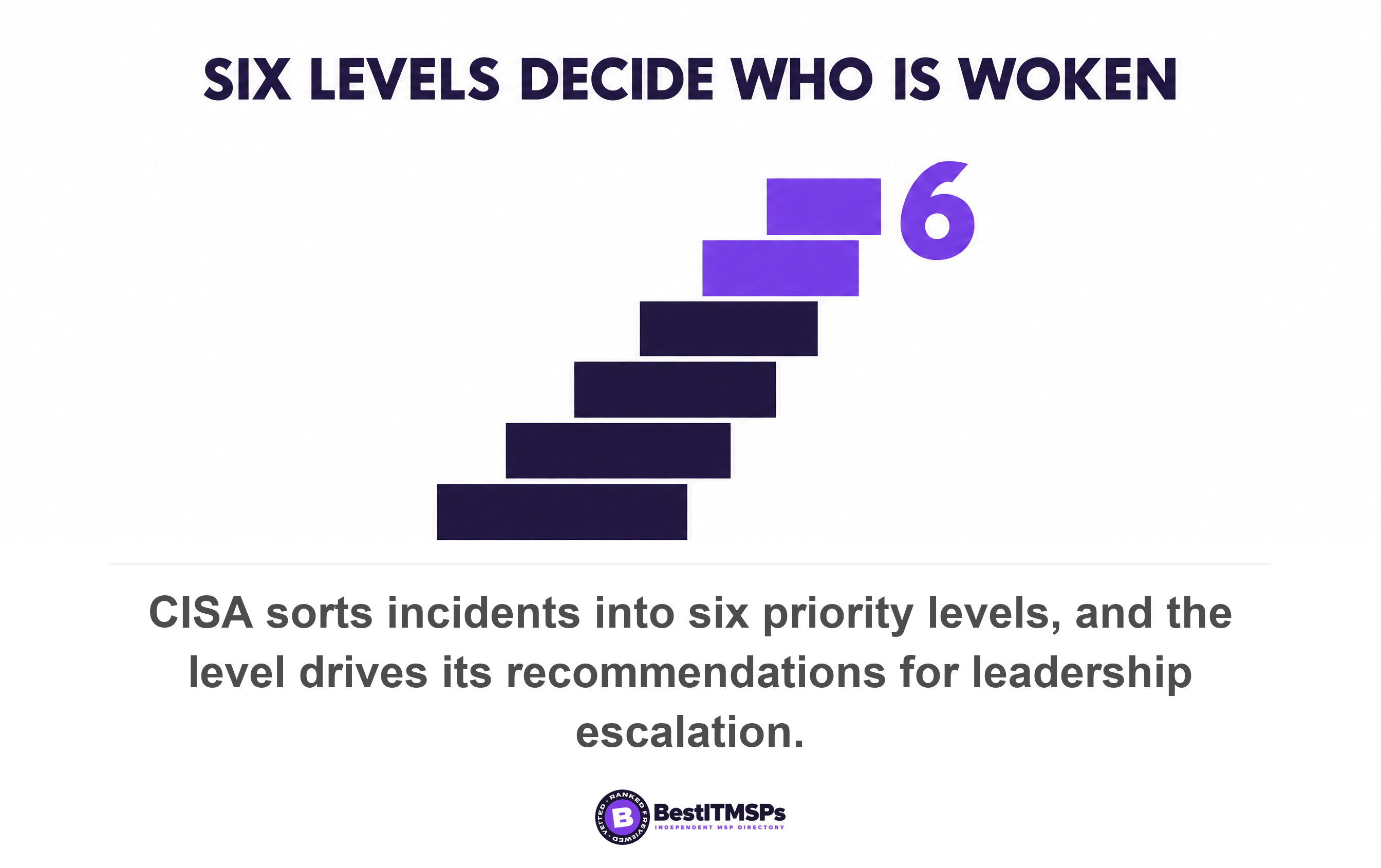
Grade the route by business impact, then let the grade decide who is woken. CISA works this way on its own incidents, sorting them into six priority levels that run from Baseline through Low, Medium, High and Severe to Emergency, where the level assigned drives its reporting requirements and its recommendations for leadership escalation. Borrow the structure rather than the labels. Three levels are plenty for a 40-person business, as long as each one names a different person.
One person should hold the whole picture. Google's framework gives that job to an incident commander who holds the high-level state about the incident and who structures the incident response task force, assigning responsibilities according to need and priority. In a small business that person is usually yours rather than your provider's, which is worth settling before the day you need it.
Authority to touch your systems during a security event is a separate question, covered in what 24/7 monitoring actually means. The authority that matters here is narrower and more mundane. It is the authority to spend, approve and decide while most of your business is asleep.
The 40-minute drill you can run this week
To rehearse the escalation path without inventing an emergency, run four checks against a real low-severity ticket and a real phone number. The whole drill costs about 40 minutes of your time and changes nothing in production.
- Request the current escalation matrix in writing, with a deadline of two business days. A provider that operates the path sends a one-page document. A provider that does not sends a portal link and a promise.
- Verify every name on it. Check that each person still works there and still holds that role. One leaver at level two means the matrix is already out of date, and nobody was going to tell you.
- Escalate a ticket you already have open, through the documented channel, and start a clock. Pick something genuinely minor, such as a slow printer or a broken mailbox rule. Record the time you escalate, the time anyone replies, and whether the name in the assignee field changed.
- Call the out-of-hours contact and say plainly that this is a scheduled test. Time how long it takes to reach a person, then ask two questions. Who are you, and who is above you on my escalation path? A reachable engineer who can answer both is the thing you are paying for.
The assignee field is the part most buyers skip, and it is the whole point of the drill. If the ticket never changed hands, your escalation did not reassign anything. It sent a notification, which is exactly what the contract promised and almost certainly not what you assumed.
Tell your provider you are doing it, at least the first time. CISA recommends validation exercises run both announced and unannounced, including incident simulations and table-top exercises, and is explicit that the findings must be addressed. An announced first run finds more, because the aim is to repair the path rather than to catch anyone out. An unannounced 10pm call tests staffing instead, which is a different test and belongs with what 24/7 monitoring actually means.
Then write down what you found, with an owner and a date against each gap. CISA's goal on identifying adverse events expects clear criteria so that a suspected event is escalated under the protocol outlined in the incident response plan. Your drill is how you learn whether that protocol survives contact with a Tuesday afternoon, which is the cheapest possible day to find out.
What a good answer sounds like, and what a bad one sounds like
Judge the answers on specifics, because escalation is one of the few parts of a managed IT contract where good and bad sound nearly identical. Four pairs separate them.
- Good. Two named people at every level, each with two contact methods and a deputy. Bad. One named engineer and the account manager's cell number.
- Good. Escalation at 60 minutes reassigns the ticket to a named senior engineer who is listed by name. Bad. Escalation at 60 minutes sets a flag and emails a manager.
- Good. A standing bridge number, plus a status page that updates while the outage is still running. Bad. We will email you when we know more.
- Good. A written post-incident review inside five business days, shared with you. Bad. A verbal debrief at the next account meeting.
A communication plan is a separate artifact from the escalation matrix, and CISA asks for both. Its goal on establishing incident communication procedures says to design a plan that identifies stakeholders and mechanisms for coordination and communications during an incident, keeps senior leadership updated on major incidents, and follows set procedures for talking to media. Ask which of your people appear on that list, by name, and when they were last asked.
Two working habits separate a provider that genuinely runs incidents from one that improvises. It keeps a record while the incident is open, which Google calls the incident commander's most important responsibility, a living incident document that can be messy but must be functional. And it hands over properly, because the role must be clearly handed off at the end of the working day, with the outgoing commander not leaving the call until receiving firm acknowledgment of handoff. Ask what happened at the last shift change on a long incident and listen for a process rather than a hero.
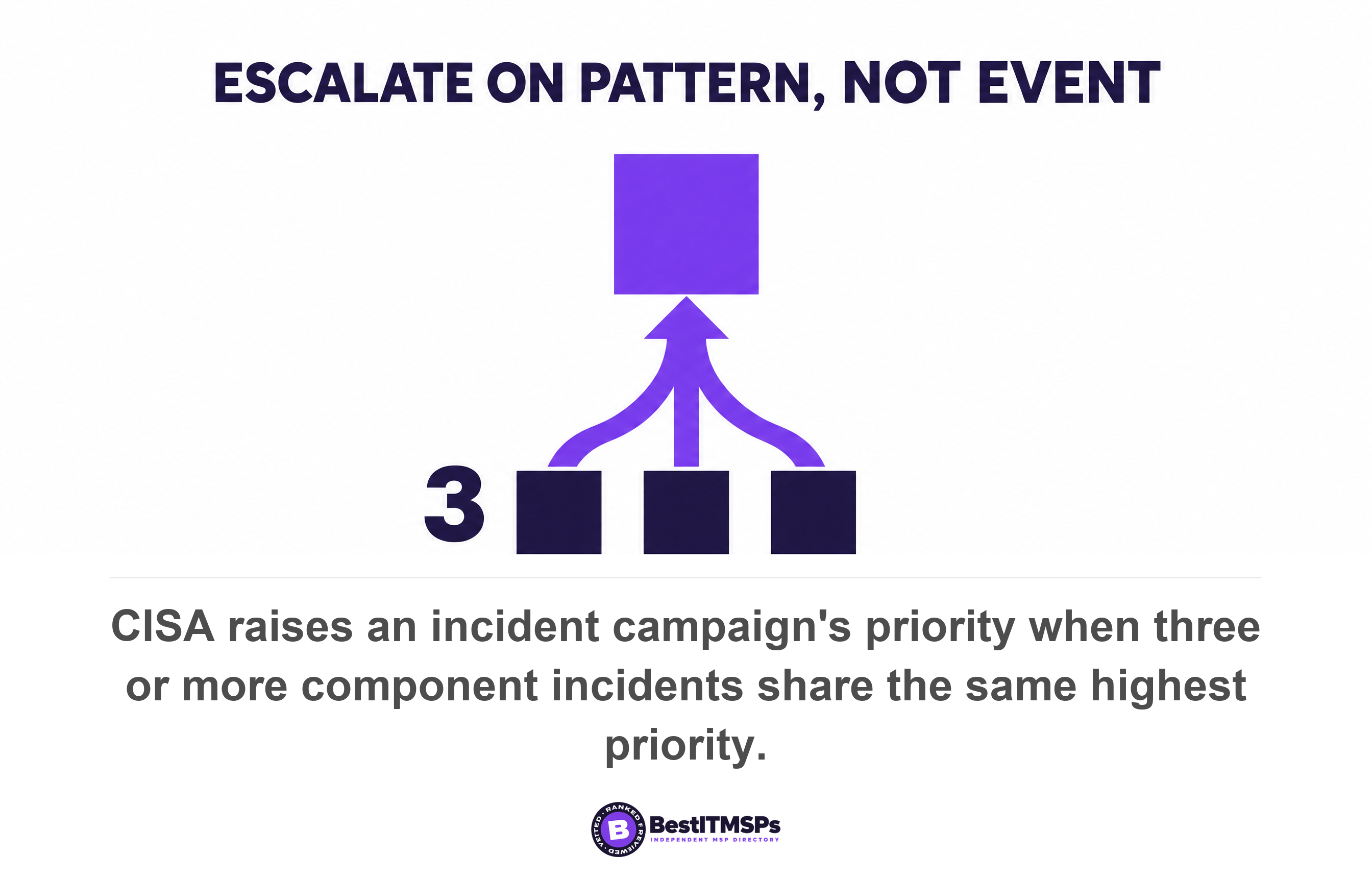
Good providers also escalate on pattern, not only on event. CISA scores an incident from 0 to 100 across eight weighted categories, then raises a campaign's priority to the next level when three or more component incidents share the same highest priority. Three repeat tickets on the same system in one week is the same signal. Almost no managed IT agreement escalates on it, so ask your provider what does.
Then ask what changed afterwards. CISA expects a post-incident analysis to identify areas for improvement and refine the incident response plan. A post-incident review that produces no edit to the escalation matrix was a meeting, not a control.
Put the escalation path on a calendar, because the matrix rots
Review the escalation matrix on a fixed schedule, because it is the only clause in your contract made of names. Processes hold their value for years. People move in months.
The churn is measurable. US Bureau of Labor Statistics figures for August 2026 record 68,000 total separations in the information sector in that single month, a monthly rate of 2.5 percent, alongside a 4.1 percent monthly separations rate across professional and business services. That is the background rate at which a document made of names goes stale, and nothing in your agreement obliges anyone to send you the new version.
Three cadences keep it current, and all three are calendar entries rather than projects.
- Re-request the matrix quarterly and compare it line by line with the copy you hold.
- Walk the full path once a year, which matches the floor CISA sets for drilling a plan.
- Re-run the drill immediately after a change of provider, an acquisition of your provider, or a change in your own key staff.
NIST now frames incident response as part of cybersecurity risk management rather than an IT procedure, publishing its current recommendations in April 2025 as SP 800-61 Revision 3, a Cybersecurity Framework 2.0 Community Profile aimed at improving the efficiency and effectiveness of detection, response and recovery activities. Escalation is the slice of that you can test yourself, with no tooling, no consultant and no budget.
None of this buys a perfect incident, and no honest provider promises one. It buys a path you have walked, a document you can trust, and a contractual answer to a question most buyers only ask once, at the worst possible hour. Read it beside MSP oversight discipline, which is the meeting where you keep all of this current. Best IT MSP is independent and does not sell IT services, so we rank providers on verified rating and firmographic data and publish our evaluation method in full.
FAQ
What is an escalation path in an MSP contract?
An escalation path is the documented route a problem takes from the service desk to someone senior enough to resolve it. A usable one names people, contact methods, trigger times and decision authority at every level. The UK NCSC advises documenting who the escalation points of contact are, along with their contact details including out of hours.
What should an escalation matrix include?
An escalation matrix should carry seven fields per level, covering the named person and title, two contact methods, the time and impact trigger, the out-of-hours contact, the decision authority, the deputy, and one point of coordination. The NCSC asks for at least 2 contact methods and 2 or more people or group details at each level.
How do I test my MSP's escalation path without causing an outage?
To test it safely, escalate a real low-severity ticket through the documented channel and time what happens. Record whether the assignee changed, then call the out-of-hours contact as a scheduled test. CISA recommends validation exercises run both announced and unannounced, and an announced first run usually finds more gaps.
Does escalation mean a different engineer takes over my ticket?
Not usually. Most agreements treat escalation as notification, and CISA's own supply chain goal is written that way, asking contracts to require vendors to notify the procuring customer within a risk-informed time frame. Ask in writing who becomes the ticket owner at each level, and whether the first engineer stops work or continues.
How often should an escalation matrix be reviewed?
Review it quarterly and walk it fully once a year. CISA sets the floor, saying incident response plans should be reviewed and drilled, at a minimum, on an annual basis. The staff churn justifies the quarterly check, with BLS recording 68,000 separations in the information sector in a single month.
Best IT MSP is the independent directory of vetted managed IT providers across the US and Canada. Organic ranking is earned on verified rating and firmographic data, and paid placement is always labeled. Ask three merit-ranked providers in your city for their escalation matrix and compare what comes back.