What your IT bill does when your headcount drops
Your provider's own service fee can usually fall within a month. The software licenses it resold you often cannot change until the subscription renews. Four contract devices hold the floor. A minimum charge, a committed term, a notice period, and a count read on one date. Fix all four in writing.
- Four contract devices stop a per-user bill falling. A minimum monthly charge, a committed term, a notice period for reducing seats, and a billable user count read on one fixed date.
- Your provider's service fee and the software license it resells are separate obligations. One can flex this month. The other usually cannot move until the subscription renews.
- Microsoft advises partners to consider a monthly term for any customer who looks like a payment risk. The term on your licenses reflects credit risk and discount, not your headcount.
- A license does not have to be canceled when someone leaves. Microsoft's terms let it move to a new person as soon as employment ends, with no 90 day wait.
- Ask for the count as a trailing monthly average, the way the IRS measures workforce size, instead of a snapshot taken on the day you signed.
What happens to your IT bill when your headcount drops?
Most of it stays where it is. Your provider's own service fee can usually fall within a month of your asking, because it pays for labor your provider can redeploy. The resold software license often cannot change until the subscription renews.
That split is the whole answer, and almost no invoice shows it. A single line reading 48 users at one blended rate bundles two different promises. One is people. The other is money your provider has already committed to a vendor and cannot get back. Ask for a reduction and you get one answer, that nothing can change until renewal, which is true of half the bill and false of the other half.
Shrinking is ordinary. The Bureau of Labor Statistics counted 7.2 million gross job losses from contracting and closing private-sector establishments in the fourth quarter of 2025, and 5.8 million of those jobs went from establishments that contracted rather than closed. Small firms move most. Businesses with 20 to 49 employees shed 761,000 jobs in that single quarter while gaining 815,000. Across the economy, 1.6 million layoffs and discharges were recorded in August 2026 alone, inside 5.1 million total separations.
This post covers the service fee and the master services agreement that governs it. For how a user gets counted in the first place, read per-user or per-device pricing. For the license half and the reports that expose it, read a license and billing audit of your MSP. For a seasonal peak rather than a genuine contraction, read seasonal staff and software licensing.
Where the downward friction actually lives
The friction is contractual, not technical. Four devices hold a per-user bill up when your headcount falls, and each one sits in a different document.
- A minimum monthly charge. A floor on the invoice, set in dollars or in seats, below which the fee does not go.
- A committed term with a committed quantity. The term fixes how long you pay. The quantity fixes how many you pay for.
- A notice period for reducing the count. A reduction you ask for in March takes effect in May, where the clause says 60 days.
- A count read on one date. The billable user number is taken on a fixed day, so a departure the next day is paid in full.
Two of the four are documented and two are not. Your software vendor publishes its windows, quoted below. No public standard sets a normal notice period for a seat reduction, and no vendor publishes one. That absence is the finding. Where your agreement is silent, the answer becomes whatever your provider decides on the day you ask.
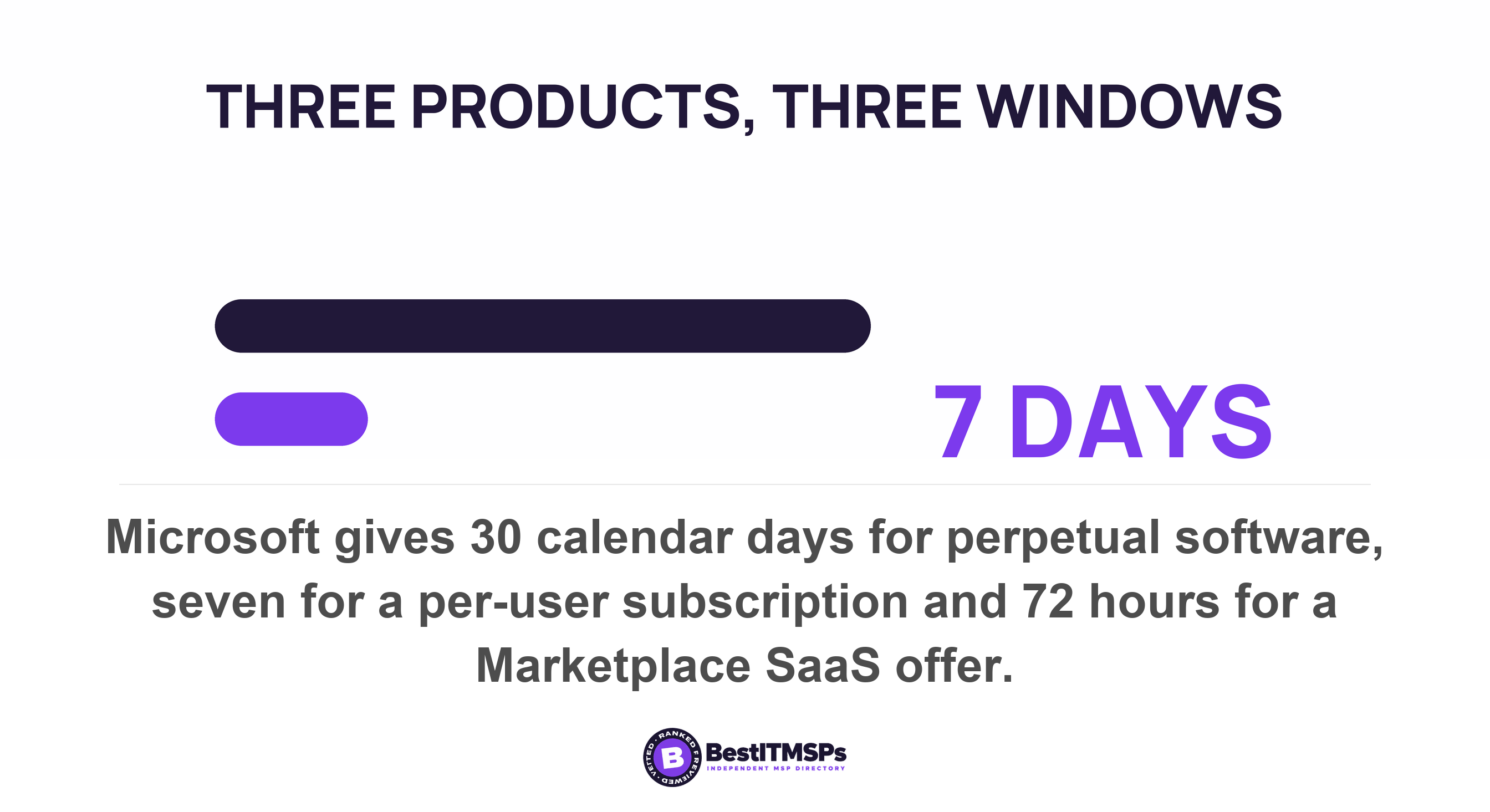
The vendor side supplies the hardest limit. Microsoft's Partner Center cancellation policy gives a per-user subscription a prorated refund within seven calendar days of purchase, and states that the cancellation window doesn't reopen until the subscription itself renews into a new term. The same page gives a full refund within 30 calendar days for perpetual software and a full refund within 72 hours for a Microsoft Marketplace SaaS offer. Three product types, three windows, one invoice line.
A per-user bill that only moves upward is not per-user pricing. It is a fixed fee with a growth clause.
Why a minimum commitment is legitimate
A minimum exists so the contract binds both sides, which is a real purpose rather than a trick. Federal procurement rules say it outright. The Federal Acquisition Regulation requires an indefinite-quantity contract to require the Government to order and the contractor to furnish at least a stated minimum quantity, and sets the floor's limits in one sentence: to ensure that the contract is binding, the minimum quantity must be more than a nominal quantity, but it should not exceed the amount that the Government is fairly certain to order. A promise to buy almost nothing is not a promise, and a floor set above what the buyer is fairly certain to need is not a floor either. Both halves of that sentence are worth quoting at a provider, because the second half is the one that argues for you.
The standard clause goes further, and its wording is the part to borrow. FAR 52.216-22 says the quantities listed are estimates only and are not purchased by this contract, and that the Government shall order at least the quantity designated in the schedule as the minimum. Read that twice. The estimate is not bought. Only the minimum is bought. Most managed services agreements invert it, treating your headcount on signing day as the quantity purchased.
That is the federal government's rule for its own buying rather than a law that governs your agreement. Use it as the cleanest free public statement of why a floor exists, then read the floor in your own contract. So negotiate the size of the minimum seat count and the date it is measured, rather than whether a minimum exists at all. A provider that staffs a help desk for your account carries a fixed cost and is entitled to a floor. A floor set at 48 seats when 31 is your real baseline is a different thing, and moving it is worth more than any discount on the rate.
Your provider's fee and your licenses are two different obligations
Your provider can flex its own fee and cannot flex a license it has already bought. Knowing which is which tells you who you are arguing with, and it is the one question that changes the outcome.
Microsoft documents the liability in a single sentence. Its cancellation policy holds the partner responsible for payment of any outstanding amounts regardless of whether the customer can't pay or refuses to pay, naming dissolution of the business relationship, bankruptcy and commercial disagreement with the partner. Your provider owes that money whatever happens to your headcount. A refusal to drop the license line is often not margin protection. It is a bill somebody else has to pay.
Then comes the part no sales call mentions. Microsoft advises partners to consider two options for a customer who looks like a payment risk. Asking them to purchase a monthly term subscription option that allows for subscription cancellation at the end of any month, or not selling to that customer. So the term on your licenses was set partly as a judgment about whether you would pay, and partly for the annual discount. It was not set because your headcount is steady. You can ask for that monthly term yourself, for the same reason a cautious provider would have given you one.
Two asks follow and both are cheap. Itemize the invoice so the service fee and the resold licenses are separate lines with separate counts. Then ask which of the two can be reduced this month. A provider who answers both halves is being straight with you. A provider who answers only that the contract says no has merged two obligations into one refusal.
What happens to the license when someone leaves?
It can move to another person, and when employment ends it can move immediately. Microsoft's license terms for all software let a customer reassign a License to another device or user, but not less than 90 days since the last reassignment of that same License. Three exceptions lift the wait, and the middle one is yours. Permanent hardware failure or loss, termination of the user's employment or contract, or temporary reallocation to cover a user's absence or the unavailability of a device that is out of service.
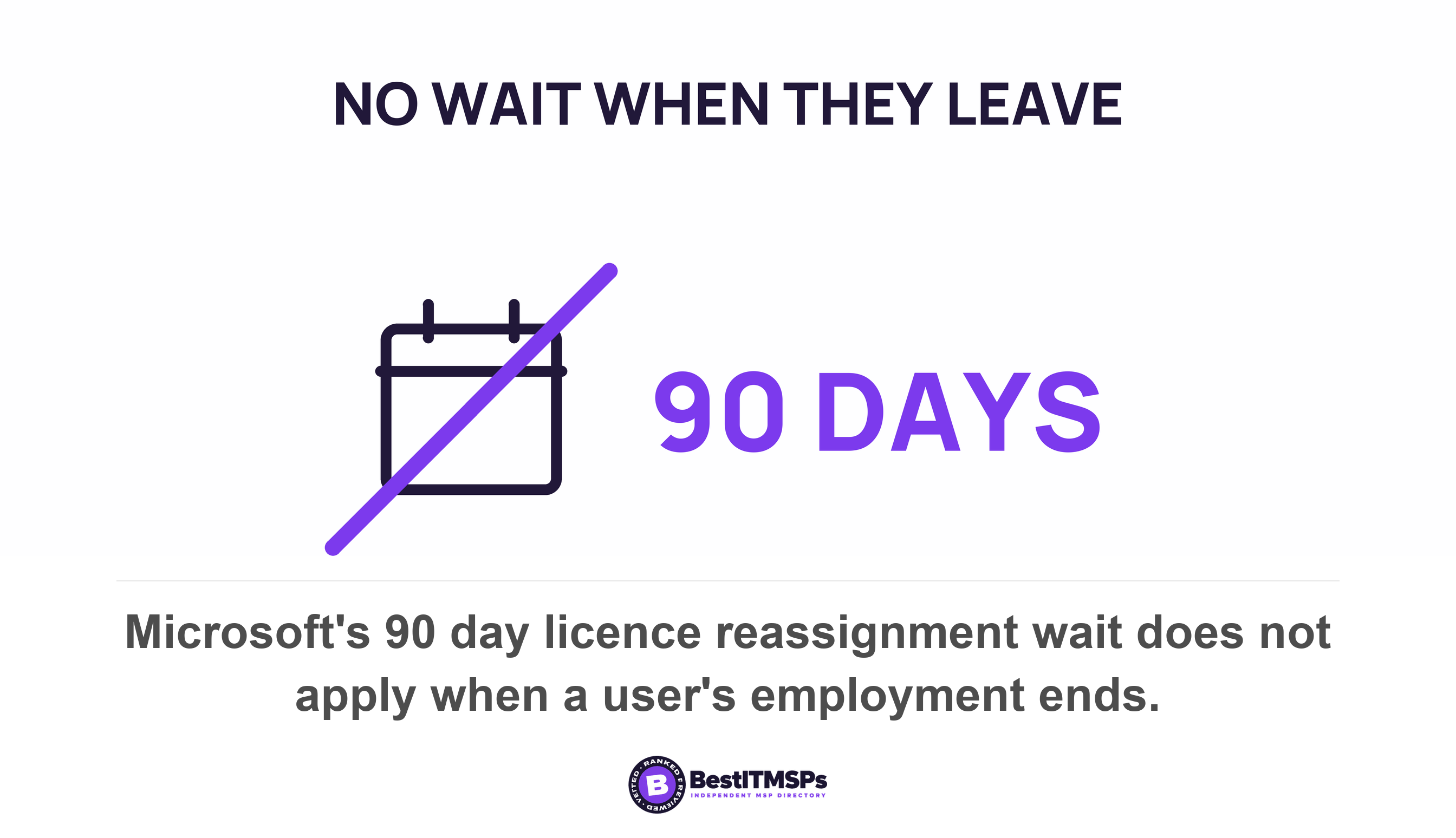
That reframes the question for a business shrinking in one place and hiring in another. You do not need a reduction. You need a reassignment, and it costs nothing extra, because that seat already sits inside the count you pay for. The same terms require you to remove the software or block access from the former device or to the former user, so somebody still has to do the offboarding.
A genuine contraction is the harder case. Where you are not replacing the person, the seat has to be removed rather than moved, and that lands you back on the renewal date. Our license and billing audit sets out the reports that show how many seats are already idle.
One caveat on that source, and it matters. The Product Terms page carries no effective date and no version number, and Microsoft revises these terms. We read the clause on 22 October 2026. Read it again before you rely on it, and ask your provider to confirm the current wording in writing.
Should the count be read on a date or as an average?
Read it as a trailing monthly average, because an average follows a workforce that moves and a snapshot does not. A count taken on the first of the month charges a 42-person business for 42 people in a month when it averaged 36.
The federal government already publishes the method, so you are not inventing anything. The IRS measures employer size as the average size of an employer's workforce during the prior year. The calculation adds the monthly full-time employee counts and then divides that total number by 12, and an employer counts as large when it has at least 50 full-time employees, including full-time equivalent employees, on average during the prior year.
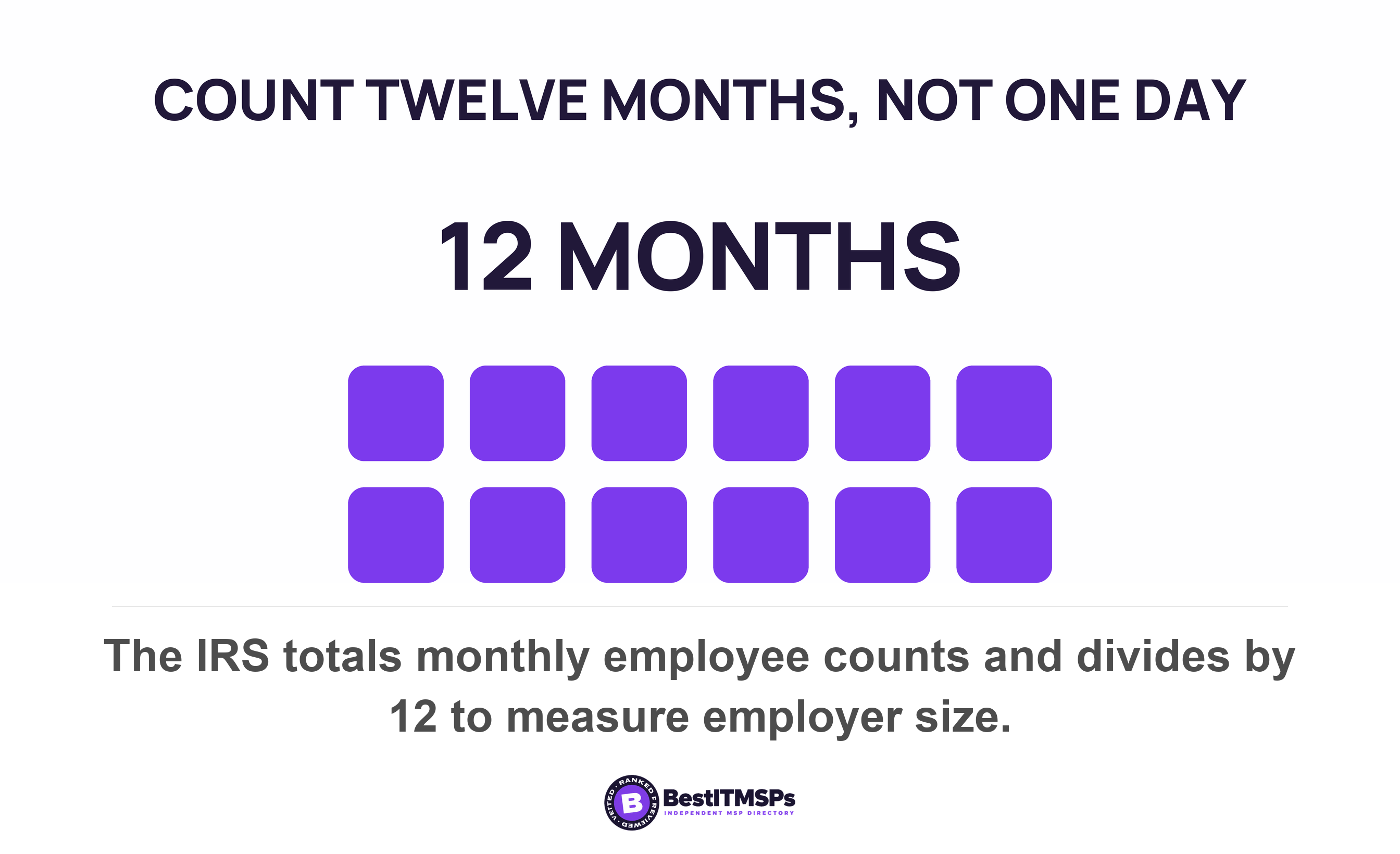
Hand your provider that sentence. A twelve-month trailing average costs a growing business slightly more and a shrinking business considerably less, and it ends the argument about which day the count is read. A quarterly average is a fair compromise where a provider will not take an annual one.
The wording that removes the asymmetry
Five clauses close the gap, and each is short enough to add at renewal.
- State the minimum seat count and the dollar floor, and set both at your trough rather than your signing-day headcount.
- Define the true-up as bidirectional, with the same cadence in both directions and a named floor it cannot pass.
- Fix a notice period for a reduction in days, and make it the same number of days as the notice for an increase.
- Take the billable user count as a trailing monthly average, naming the number of months.
- Itemize resold licenses separately from the service fee, each with its own count, term and renewal date.
Add one more line where your provider will take it. Where a license cannot be reduced before renewal, the service fee attached to that seat falls anyway from the month the person leaves. That separates the two obligations in the contract rather than only on the invoice, and it is the single clause that makes a bill follow the business downward.
None of this makes an IT bill shrink automatically, and no honest provider promises that. It makes the floor visible and the bill explainable, which is the part you can hold somebody to.
Three things to ask your provider this week
Ask for the floor, the split and the next date. Every answer already sits in a system your provider uses daily.
- Show me the minimum monthly charge and the minimum seat count in our agreement, and the date that count was set.
- Split our last invoice into your service fee and resold licenses, with the count behind each line.
- Tell me the earliest date each subscription can be reduced, and the notice you need for a service fee reduction.
Judge the answers on willingness rather than on the numbers. A provider who produces all three inside a week is behaving well even when the news is bad. A provider who cannot say what the minimum is has told you nobody set one, so the floor is wherever your headcount stood the day you signed.
FAQ
Can my MSP reduce my bill when staff leave?
Your provider's own service fee can usually fall, often within a month, because it pays for labor it can redeploy. Resold software licenses often cannot change until the subscription renews. Microsoft states that the cancellation window doesn't reopen until the subscription itself renews into a new term. Ask which half of your invoice is which.
Is a minimum seat count in a managed IT contract normal?
Yes, and it serves a purpose. Federal procurement rules require an indefinite-quantity contract to require the Government to order and the contractor to furnish at least a stated minimum quantity, because a promise to buy nothing is unenforceable. Negotiate the size of the floor and the date it is measured, rather than its existence.
What happens to a Microsoft license when an employee leaves?
It can be reassigned to somebody else straight away. Microsoft's terms bar reassignment within 90 days since the last reassignment of that same License, then lift the bar for termination of the user's employment or contract. A business shrinking in one place and hiring in another needs a reassignment, not a reduction.
Should my IT provider bill on a headcount snapshot or an average?
An average follows a workforce that moves. The IRS measures employer size as the average size of an employer's workforce during the prior year, adding the monthly counts and dividing that total number by 12. Ask for a trailing monthly average, name the number of months, and the argument about which day the count is read disappears.
Why does my provider say it cannot remove the licenses?
Often because it genuinely cannot. Microsoft holds the partner responsible for payment of any outstanding amounts regardless of whether the customer can't pay or refuses to pay, including after a commercial disagreement. That money has already left your provider. The service fee attached to the seat is a separate question, and that one can move.
Best IT MSP is the independent directory of vetted managed IT providers across the US and Canada. Organic ranking is earned on rating and verified data, paid placement is always labelled, and we do not sell IT services. Take the three asks above to three merit-ranked firms in your city and compare the answers side by side.