Hosted VoIP vs On-Premise Phone Systems
Hosted VoIP runs your business phone system in the cloud, with the provider managing everything and you paying a per-user monthly fee, while an on-premise system uses PBX hardware you own and maintain on site. Hosted VoIP wins on lower upfront cost, easy scalability, rich features, remote-work support, and no hardware to maintain.
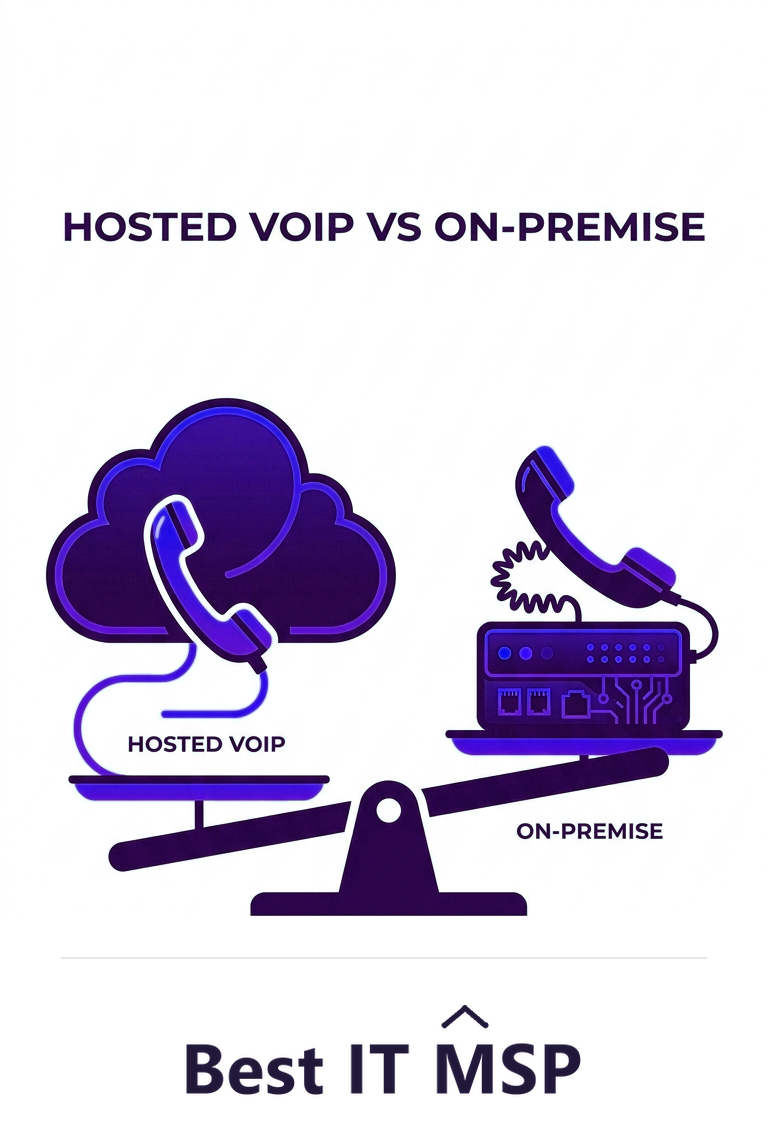
- Hosted VoIP runs your phone system in the cloud for a per-user monthly fee, with the provider managing it.
- An on-premise system uses PBX hardware you own, maintain, and house on site.
- Hosted VoIP wins on upfront cost, scalability, features, and support for remote and hybrid work.
- On-premise can suit organizations wanting full control or with large existing hardware investment.
- Reliable hosted VoIP depends on a solid network, so call quality is really a network-quality question.
How did we compare hosted VoIP and on-premise phone systems?
A phone system is bought once and then lived with for years, so this comparison is weighted toward the running experience rather than the launch price.
- The dimensions. The shape of the cost, how you add or remove users, where new features come from, and who is responsible when it stops working.
- The evidence. Cloud adoption comes from Gartner and Flexera, the cost of downtime from ITIC, and breach cost from IBM. Each is linked at the point it is used.
- No vendor ranking. This compares approaches, not products. It names no vendors and recommends no supplier.
- Independence. Best IT MSP does not sell IT services or security services, and does not appear in its own rankings.
One caveat belongs before the table rather than after it. Hosted VoIP moves the phone system onto your internet connection, which makes the quality of that connection the quality of your phones.
What is the difference between hosted VoIP and an on-premise phone system?
When a business updates its phone system, the central decision is where the system lives. Hosted VoIP (Voice over Internet Protocol) runs your phones in the cloud: the provider owns and manages all the underlying equipment, and your calls travel over the internet, with you paying a per-user monthly fee. An on-premise phone system uses a PBX (private branch exchange), hardware you buy, own, house, and maintain in your own building. Both deliver modern business calling, but the models, and their costs, scalability, and upkeep, differ sharply. With work increasingly distributed and cloud-first, hosted VoIP has become the default for most businesses, but on-premise still has its place. This guide compares them so you can choose well.
It pairs with our VoIP and business phone systems overview and the managed IT services hub. The shift to cloud-delivered phones mirrors the broader move to the cloud, with public cloud spending forecast to reach $723.4 billion in 2025.
What is hosted VoIP?
Hosted VoIP is a cloud phone system. Instead of housing call-routing hardware on site, you connect IP phones or apps to a provider that runs the phone platform in its data centers and routes your calls over the internet. You manage users and settings through a web portal, and you pay a predictable per-user monthly fee that typically bundles in a rich set of features, voicemail-to-email, auto-attendants, call routing, mobile and desktop apps, and often video and messaging as part of unified communications. Because it is cloud-based, hosted VoIP lets employees make and take business calls from anywhere, on a desk phone, laptop, or mobile, which is exactly what remote and hybrid work need. There is no PBX hardware for you to buy or maintain; the provider handles all of it.
What is an on-premise phone system?
An on-premise system keeps the phone system's brain, the PBX, in your own building. You purchase the hardware up front, house it, and are responsible for maintaining, updating, and eventually replacing it. Modern on-premise systems are usually IP-based too, so they still use VoIP technology internally, but the equipment and its management sit with you rather than a provider. The appeal is control: you own the system outright and can configure it exactly as you wish, with no dependence on a provider's platform. The cost is that you carry the full burden of buying, powering, securing, maintaining, and upgrading that hardware, plus the expertise to run it, and scaling means buying and installing more equipment.
How do hosted VoIP and on-premise compare on cost, scale and maintenance?
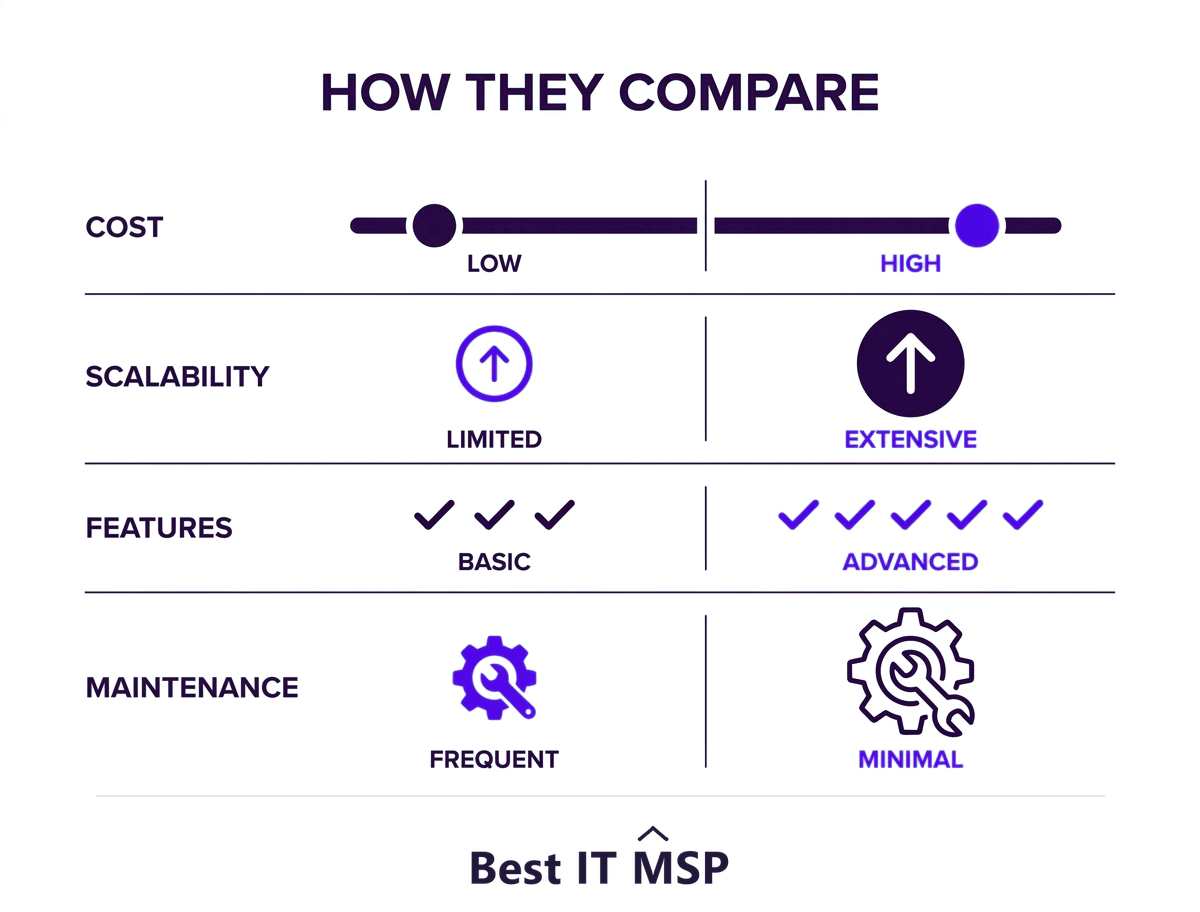
The two models diverge on the factors that matter most. Cost: hosted VoIP has low upfront cost and a predictable monthly fee, while on-premise demands a large capital purchase plus ongoing upkeep. Scalability: hosted VoIP is effortlessly scalable, adding or removing users in the portal in minutes, where on-premise requires buying hardware. Features: hosted providers continuously add capabilities, including unified communications, while on-premise features depend on what you bought and can upgrade. Maintenance: with hosted VoIP the provider maintains everything; with on-premise you do. Reliability: hosted VoIP shifts uptime to the provider's redundant infrastructure and supports failover to mobile if your office internet drops, which matters because phone downtime is lost business, and an hour of downtime costs most organizations more than $100,000.
| Dimension | Hosted VoIP | On-premise |
|---|---|---|
| Up-front cost | Little or none | PBX hardware bought outright |
| Ongoing cost | A per-user monthly fee | Maintenance, licences and eventual replacement |
| Adding a user | A change in an admin console | Often new hardware or licences |
| Where features come from | The provider, updated centrally | The system you bought, at the version you bought it |
| Who fixes an outage | The provider | You, or whoever you contract |
| What it depends on | Your internet connection | Your on-site hardware and power |
Which costs less, a capital purchase or a monthly fee?
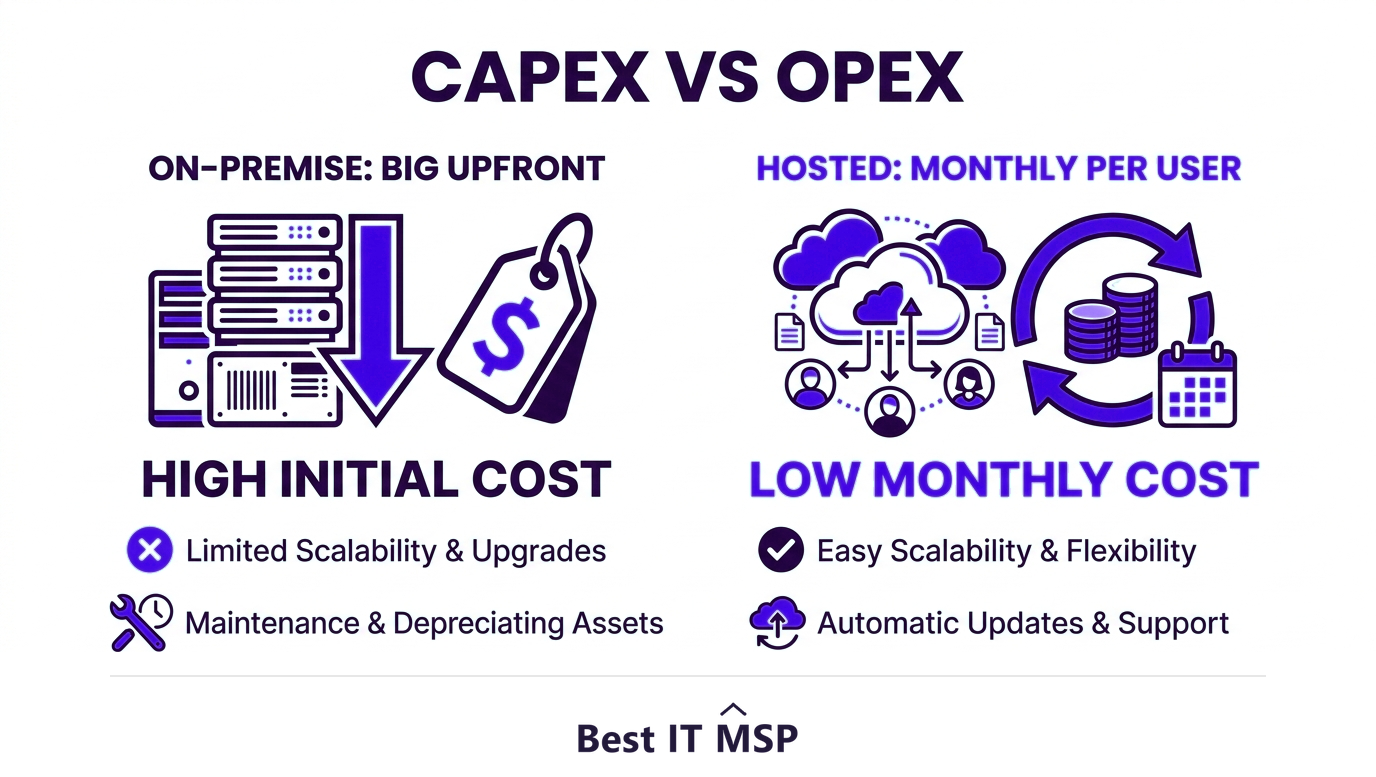
Cost is often the deciding factor. An on-premise system is a significant capital expense: hardware, installation, and the expertise to run it, plus maintenance and a major spend again when it reaches end of life. Hosted VoIP converts that into a predictable per-user operating expense with little to no upfront hardware, which is far easier for most businesses to budget and lets you reduce or scale costs up and down with headcount as you migrate away from owned hardware. This mirrors the broader appeal of cloud services and is reflected in how widely organizations have adopted them, with 89% now running a multi-cloud strategy. For a growing or seasonally variable business, the ability to add and remove users without buying hardware is a real, recurring advantage.
When does on-premise still make sense?
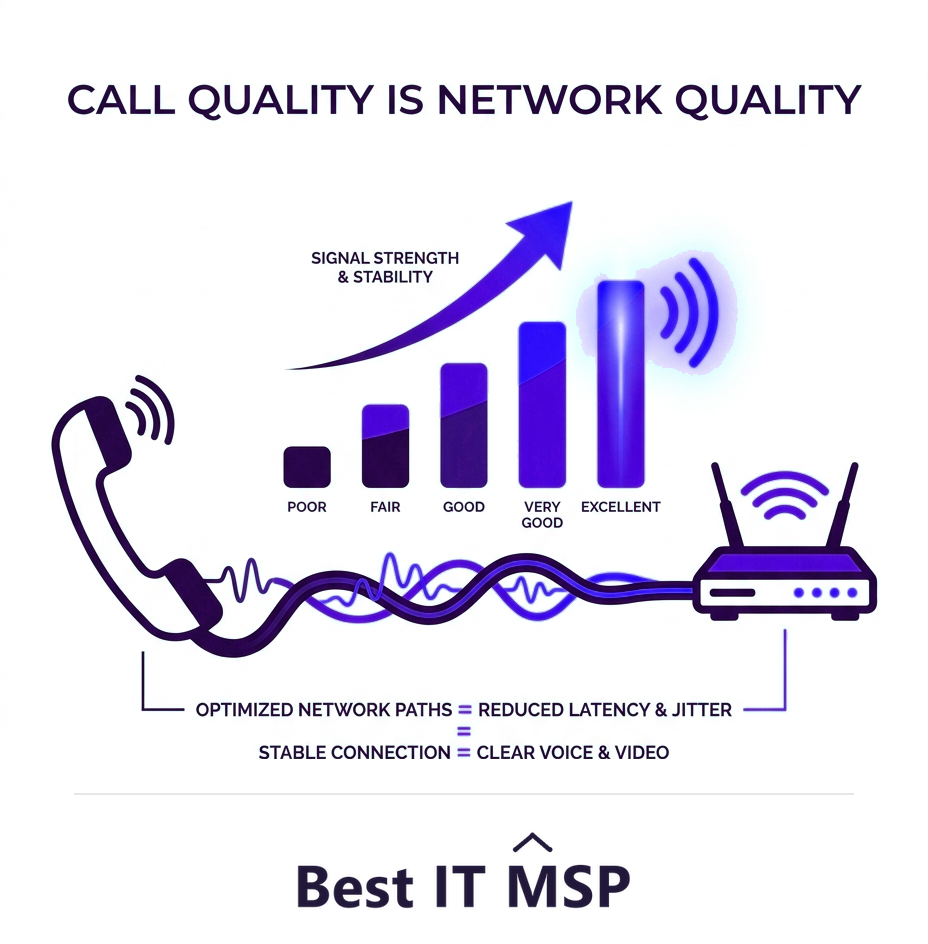
On-premise is not obsolete. It can make sense for organizations that have recently invested heavily in PBX hardware, that have very specific control or integration requirements, or that operate where internet connectivity is unreliable enough to make cloud calling risky. But there is a truth that applies to both, and especially to hosted VoIP: call quality is really a network-quality question. VoIP calls ride your internet and internal network, so good call quality depends on adequate bandwidth and on prioritizing voice traffic so a big download never garbles a call. This is why hosted VoIP works best on a well-designed network, and why phone and network decisions go together. Security matters too: VoIP systems can be targets for toll fraud and eavesdropping, and with the average data breach costing $4.88 million and taking an average of 258 days to identify and contain, securing and monitoring the phone system is part of doing it right. Automation helps, saving breached organizations an average of $2.22 million.
There is a regulatory dimension that rarely comes up in a sales conversation. A hosted provider is an interconnected VoIP provider in the FCC's terms, and carries reporting duties an on-premise PBX owner does not. Qualifying providers must report network outages lasting at least 30 minutes, and an interconnected VoIP provider must file a notification within 240 minutes of discovering an outage that potentially affects a 911 facility. That is worth knowing in both directions: your provider is accountable to a regulator for availability, and if you run the PBX yourself, nobody is.
- How many sites and how many users? A single office of ten is a different problem from four sites of twenty-five, and this is the question that most often settles it.
- What can your internet connection actually carry? Hosted VoIP is only as good as the link beneath it. If the connection is marginal, fix that before choosing a phone system.
- Is there capital to spend, or only budget? On-premise front-loads the cost and hosted spreads it. Neither is cheaper in the abstract.
- Who answers when the phones stop at nine in the morning? On-premise makes that your problem. Hosted makes it a support ticket. Decide which you would rather own.
How do you get the phone decision right?
For most businesses today, hosted VoIP is the stronger choice: lower upfront cost, effortless scalability, rich unified communications features, support for remote and hybrid work, and no hardware to maintain. On-premise still fits organizations with heavy existing investment or specific control needs. Either way, the system is only as good as the network it runs on, so treat phones and network as one decision, and keep both well managed. The complexity of doing this well is part of why so many businesses lean on managed providers, a market growing from about $330 billion in 2024 toward $879 billion over the next decade.
If you are choosing between hosted VoIP and an on-premise phone system, comparing vetted providers on merit is the place to start. Browse merit-ranked managed IT firms by city in the Best IT MSP directory, where ranking is earned on rating and verified data, not on who pays the most. You can also read our guide to the benefits of cloud computing.
FAQ
What is the difference between hosted VoIP and on-premise phone systems?
Hosted VoIP runs your phone system in the cloud, with the provider owning and managing the equipment and you paying a per-user monthly fee. An on-premise system uses PBX hardware you buy, house, and maintain in your own building. Hosted VoIP avoids upfront hardware and maintenance; on-premise gives you full ownership and control of the equipment.
Is hosted VoIP cheaper than an on-premise phone system?
Usually, at least in upfront cost. Hosted VoIP requires little to no hardware investment and charges a predictable per-user monthly fee, while on-premise demands a large capital purchase plus ongoing maintenance and eventual replacement. Hosted VoIP also lets you scale costs with headcount, which is a recurring advantage for growing or seasonally variable businesses.
Is hosted VoIP reliable?
Yes, when the network supports it. Hosted VoIP shifts uptime to the provider's redundant infrastructure and can fail over to mobile apps if your office internet drops. The key dependency is your network: because VoIP calls travel over the internet, call quality depends on adequate bandwidth and prioritizing voice traffic, so reliable hosted VoIP requires a well-designed network.
When does an on-premise phone system still make sense?
On-premise can make sense for organizations that recently invested heavily in PBX hardware, that have very specific control or integration requirements, or that operate where internet connectivity is unreliable enough to make cloud calling risky. For most other businesses, especially those with remote or hybrid staff, hosted VoIP is now the more practical default.
Does VoIP call quality depend on my internet?
Yes. VoIP calls travel over your internet connection and internal network, so call quality is really a network-quality question. Good quality depends on having adequate bandwidth and on prioritizing voice traffic so that large downloads or video do not garble calls. This is why phone and network decisions should be made together, and why a well-designed network underpins good VoIP.
What are the security risks of VoIP?
VoIP systems can be targets for toll fraud, where attackers hijack the system to place expensive calls, and for eavesdropping on calls if traffic is not encrypted. As with any internet-connected system, they need securing, monitoring, and patching. Given the average data breach costs $4.88 million, treating the phone system as part of your overall security, not an afterthought, is important.
Best IT MSP is the independent directory of vetted managed IT providers across North America. Compare merit-ranked firms in your city that deploy hosted VoIP and business phone systems. No pay-to-play.