MSP Reviews 2026: Why Nearly Two-Thirds of Providers Have a Perfect Rating
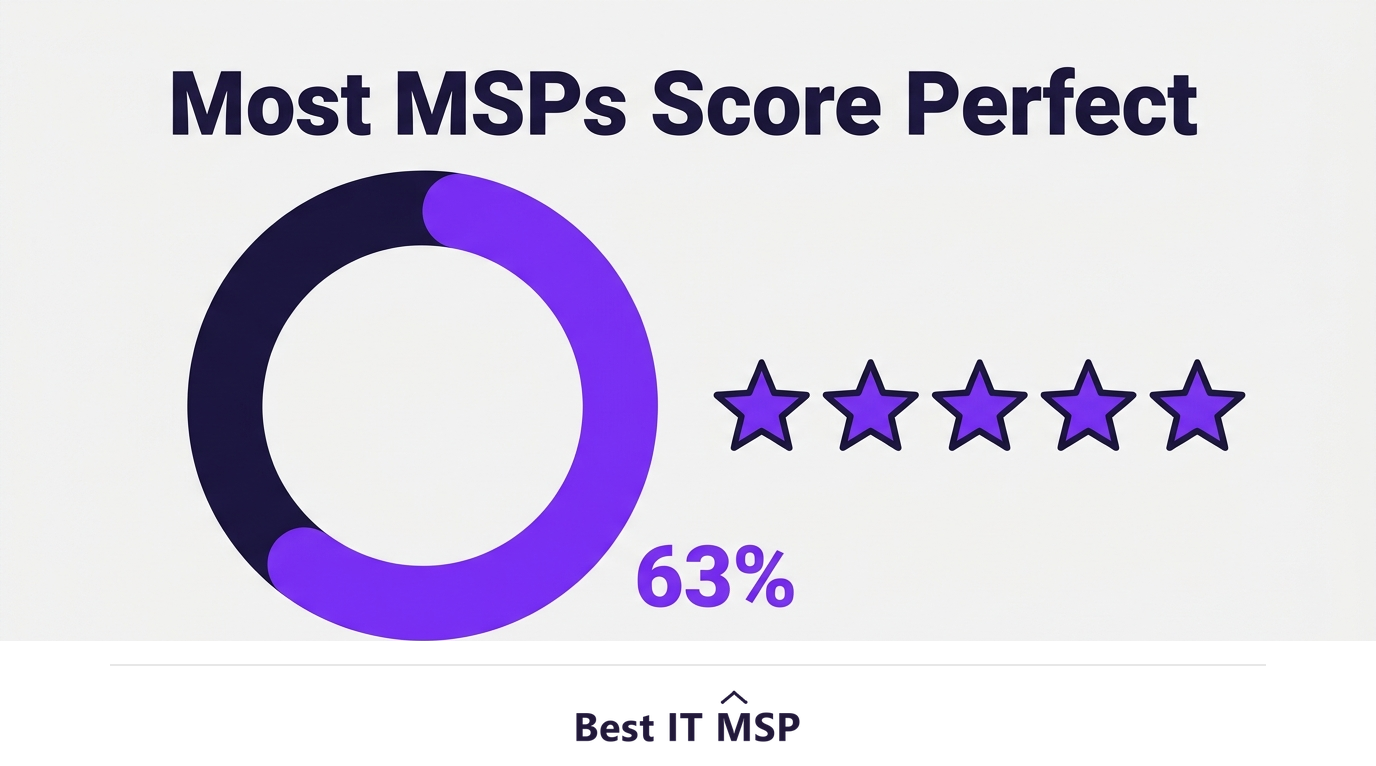
We measured 11,965 managed IT providers and 287,205 Google reviews. 63% hold a perfect 5.0, and most of those ratings rest on fewer than 10 reviews.
By Best IT MSP Editorial Team · Published October 8, 2026 · 8 min read · Free to read
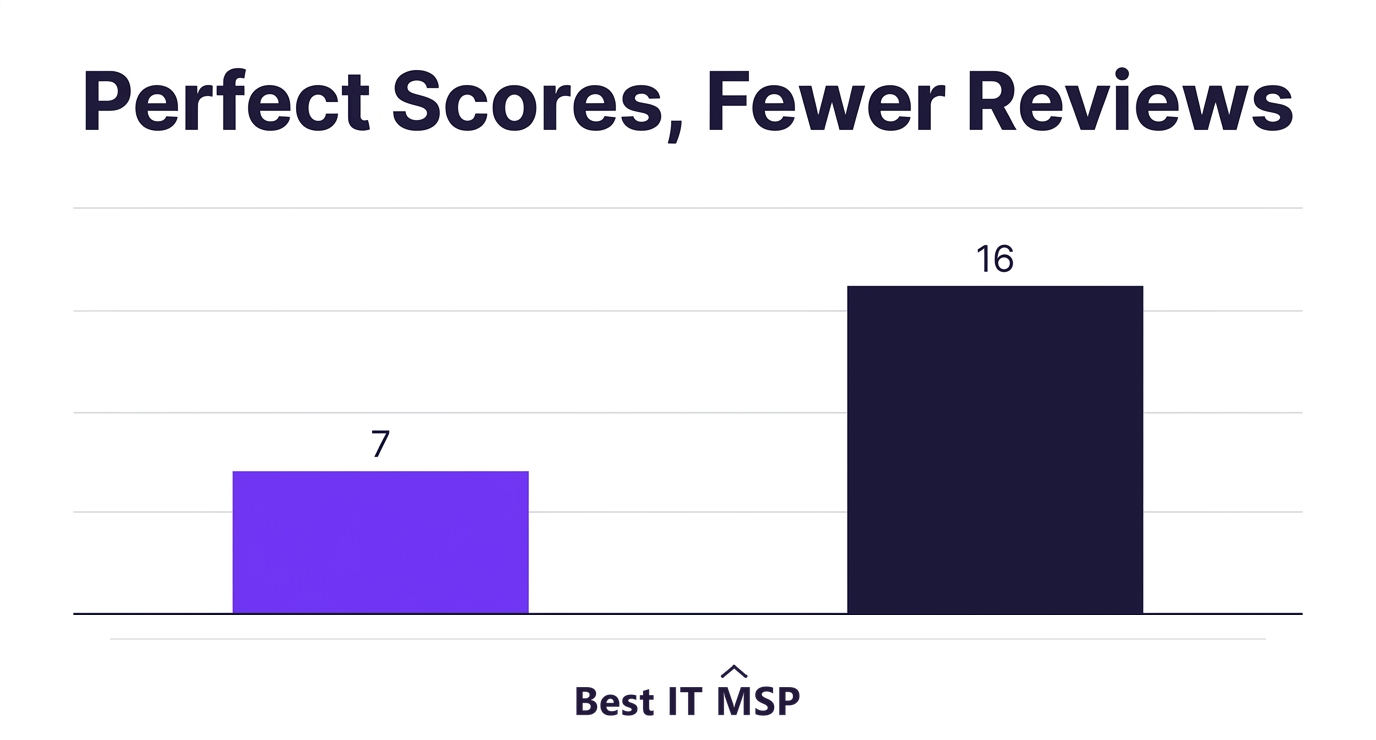
Nearly two-thirds of managed IT providers hold a perfect 5.0 star rating. That sounds like a strong market. It is mostly a thin one. Across 11,965 rated providers, the median 5.0 firm has just 7 reviews, against 16 for everyone else. The rating is not measuring quality. It is measuring silence.
Reviewed by Best IT MSP Editorial Team · Updated October 2026
Chart showing 62.9 percent of managed IT providers hold a perfect 5.0 star rating
Key takeaways
63% of managed IT providers hold a perfect 5.0 rating, so the star number separates almost nobody.
The median 5.0 provider has 7 reviews. The median provider rated below 5.0 has 16.
60% of perfect-rated providers have fewer than 10 reviews, and a quarter have fewer than 3.
Buyers say they want 20 to 99 reviews before they trust a rating. Half this market is under 10.
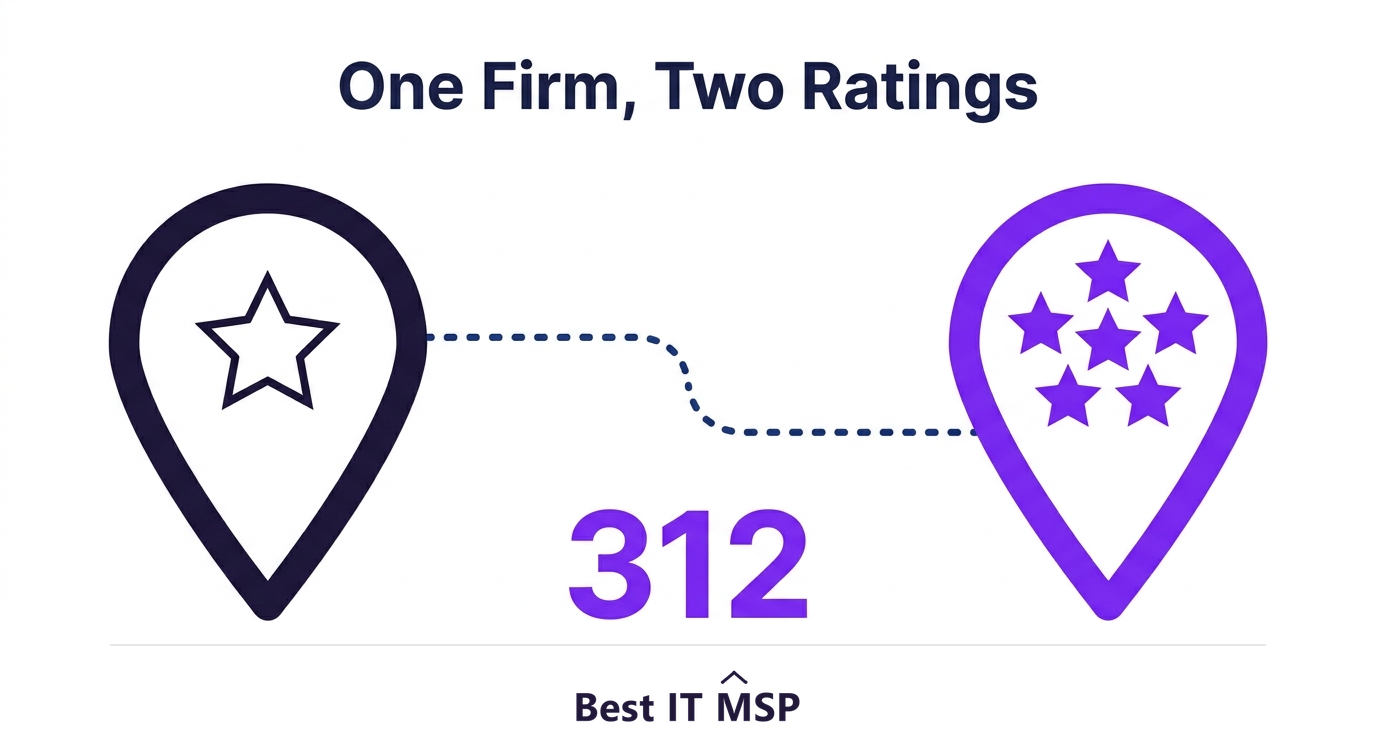
312 providers are scored differently by different offices of the same business, one pair ranging from 0.0 to 5.0.
Nearly two-thirds of managed IT providers have a perfect rating
A perfect star rating is the most common rating in managed IT services. We measured every provider in the Best IT MSP directory and found that 7,524 of 11,965 rated providers, or 62.9 percent, sit at exactly 5.0. That is not a market full of flawless firms. It is a market where the headline number has stopped doing any work.
The dataset behind this report covers 618 city rosters and 287,205 Google reviews. Every provider in it is a real business with a Google Business Profile, a published address, and a service line we checked against its own website. We rate and rank them for a living, so this is the question we care about most: when a buyer looks at a star rating, what are they actually seeing?
The answer is uncomfortable. The star rating tells you almost nothing about which provider to choose. The review count tells you a great deal, and most buyers never look at it.
Bar chart comparing a median of 7 reviews for perfect-rated providers against 16 for all others
A perfect rating usually means a thin one
Perfect ratings cluster where reviews are scarce. The median provider rated 5.0 has just 7 reviews, while the median provider rated below 5.0 has 16. Firms with a perfect score have not out-performed the rest. They have been reviewed less than half as often.
The pattern gets starker the closer you look at the perfect-score group.
A quarter of them, 1,894 providers, have fewer than 3 reviews.
39 percent have fewer than 5.
60 percent, 4,480 providers, have fewer than 10.
77 percent have fewer than 20.
This is arithmetic, not scandal. Three happy clients produce a 5.0. So does one. A firm with 140 reviews has almost certainly met a difficult client, a bad week, and a billing dispute, and its average reflects all three. Half of all rated providers in the directory carry fewer than 10 reviews, so for half this market the star rating rests on a sample too small to mean much either way.
The same thinness cuts downward. Of the providers rated below 3.0, most sit on a single review. A 1.0 built from one angry customer is no more informative than a 5.0 built from two happy ones. Depth is the signal. The star is the headline.
Buyers want 20 to 99 reviews. Half this market has under 10.
Set that threshold against our data and the gap is wide. The median provider has 10 reviews. Most perfect-rated firms would fail the test that most buyers say they apply. The mismatch is not that providers are hiding anything. It is that business IT is a low-volume, high-trust purchase. Clients sign multi-year agreements and rarely write about it afterwards.
Treat the star rating as a pass or fail gate, then stop using it. Once a provider clears roughly 4.5, the number has told you everything it can. From there you should compare review count, recency, and what the written reviews actually describe. A firm with 4.6 across 90 reviews is a far more verified choice than a 5.0 across 4.
Stars cannot rank what stars cannot separate
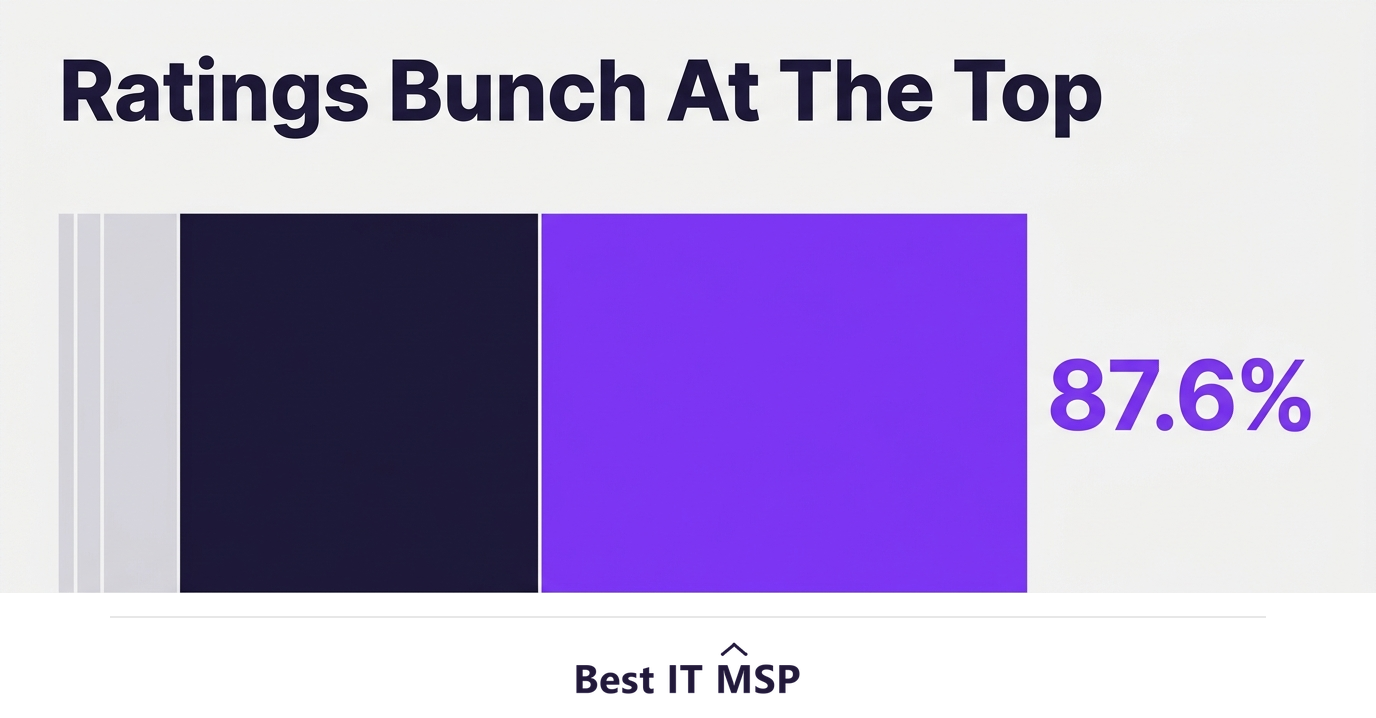
Star ratings fail as a ranking signal because they are bunched at the top. 87.6 percent of rated providers sit at 4.5 or above. Nearly nine in ten firms occupy half a star of range. No buyer can order a shortlist with that, and neither can a directory.
Here is the full spread across 11,965 providers.
5.0 exactly: 7,524 providers, 62.9 percent.
4.5 to 4.9: 2,962 providers, 24.8 percent.
4.0 to 4.4: 883 providers, 7.4 percent.
3.0 to 3.9: 450 providers, 3.8 percent.
Below 3.0: 143 providers, 1.2 percent.
This is why we do not rank on the raw average. Our rosters use a weighted score that pulls every rating toward the market average until a provider has enough reviews to have earned its position. A 5.0 on 3 reviews lands below a 4.8 on 120, because the second firm has proved something the first has not. The method is published on every city page, and it exists for exactly the reason this report describes.
Two providers range from 0.0 to 5.0 across their own locations.
One runs from 1.0 at one office to 5.0 at another.
A fourth spans 2.6 to 5.0, a fifth 3.0 to 5.0.
A buyer who searches a provider's name in one suburb and a colleague who searches it in the next can reach opposite conclusions about the same business. Neither is misreading anything. Each is reading a different office's record. Multi-site firms are where the star rating becomes least reliable, and they are also where the biggest regional providers live.
The practical move is to find the listing for the office that would actually serve you, not the one that ranks highest. Ask which location your account sits with, then check that location's reviews. The help desk support you receive comes from a specific team, and so does the record worth reading.
How to shortlist a provider without trusting the stars
To shortlist managed IT services properly, rank candidates on review depth and verified detail rather than the star rating. Five checks do most of the work, and all five are free.
Require a floor on review count. Twenty is a defensible minimum and matches what most buyers say they want.
Read the review distribution, not the average. A firm with a handful of 3-star reviews among 80 is normal. A firm with nothing but 5s and 11 reviews is unproven.
Check recency. A rating built in 2021 describes a company that may no longer exist in the same form.
Verify the address on the provider's own website, not on a directory. A landing page for your city is not an office in it.
Ask for the service level agreement in writing before you compare prices, and confirm who answers the phone at 7pm.
None of this means ratings are useless. A credible rating from a local, independent source is a good starting filter, and a provider that has earned 90 reviews at 4.7 has told you something real. Use the star rating to rule firms out. Use the review count, the distribution, and the written detail to choose between the ones that remain.
Diagram showing one provider scored 0.0 at one office and 5.0 at another
Why does the same MSP show different ratings in different cities?
Because the rating belongs to a Google listing, not to the company. We found 312 providers whose own locations disagree about their rating, including two that span 0.0 to 5.0. Check the listing for the office that would actually serve your business.
Review count first, then the review distribution, then recency. After that, verify the office address on the provider's own site and get the service level agreement in writing. Those five checks separate providers that a star rating cannot.
Best IT MSP ranks the managed IT providers in every city on rating and verified data, with review depth shown next to every score. Browsing is free, and organic ranking is earned rather than sold.