Unified Communications Explained
Unified communications (UC) brings a business's communication channels, voice calling, video conferencing, instant messaging, presence, and file sharing, into one integrated platform instead of separate, disconnected tools. It builds on VoIP, which delivers the voice layer over the internet, and is most often consumed as UCaaS, a cloud service.
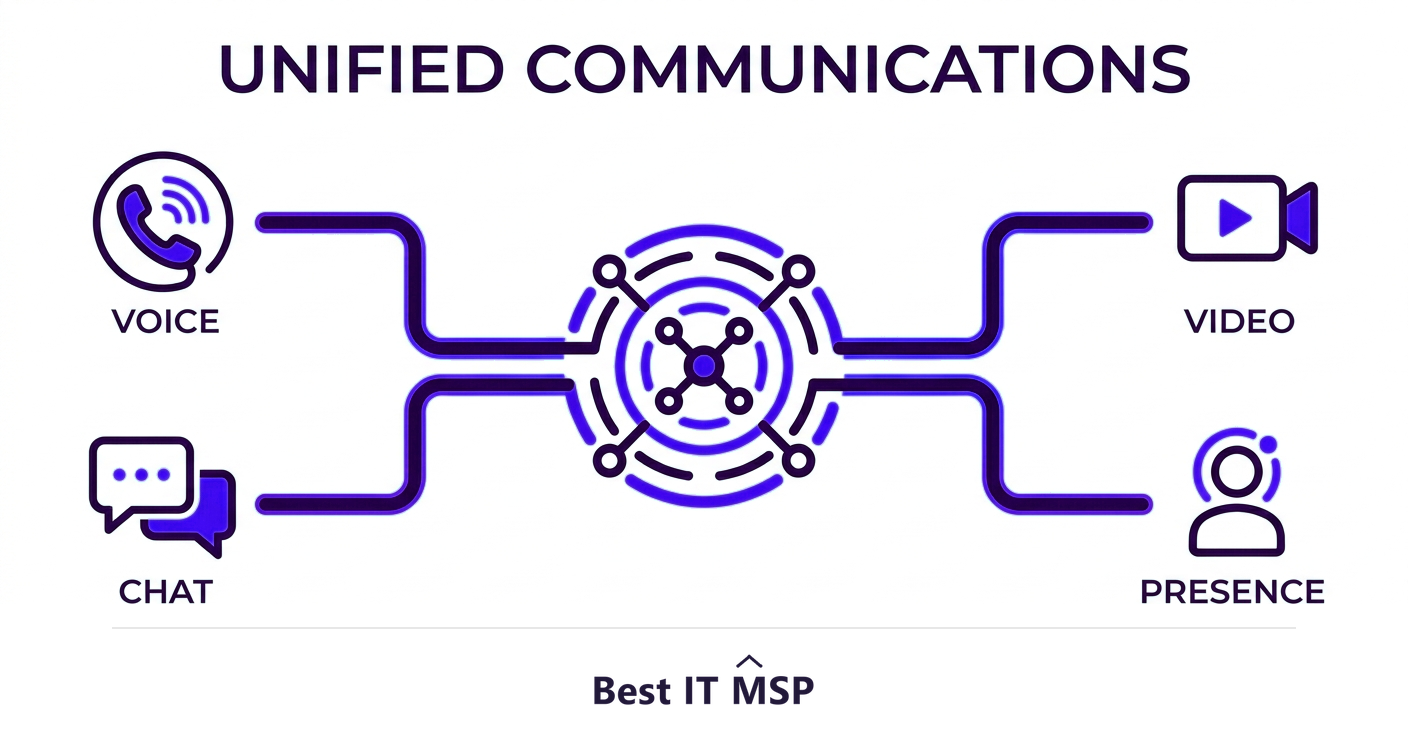
- Unified communications integrates voice, video, messaging, presence, and file sharing into one platform.
- It builds on VoIP, which provides the internet-based voice layer that UC extends.
- UCaaS delivers unified communications as a cloud service with no hardware to maintain.
- The payoff is smoother collaboration, lower cost, and strong support for remote and hybrid work.
- Consolidating disconnected tools into one platform cuts friction, cost, and management overhead.
What is unified communications?
Unified communications, or UC, is the integration of a business's many communication channels, voice calls, video meetings, instant messaging, presence (seeing who is available), and file sharing, into one connected platform. Instead of juggling a separate phone system, a different video tool, a chat app, and email that do not talk to each other, unified communications brings them together so people can move between a chat, a call, and a video meeting in one seamless flow without switching tools or losing context. The goal is simple: make communicating and collaborating frictionless, wherever people are. As work has become more distributed, UC has shifted from a nice-to-have to the backbone of how modern teams operate.
This guide explains what unified communications includes, how it relates to VoIP, what UCaaS means, the benefits, and who needs it. It pairs with our VoIP and business phone systems overview and the managed IT services hub, and builds on our comparison of hosted VoIP vs on-premise.
What unified communications brings together
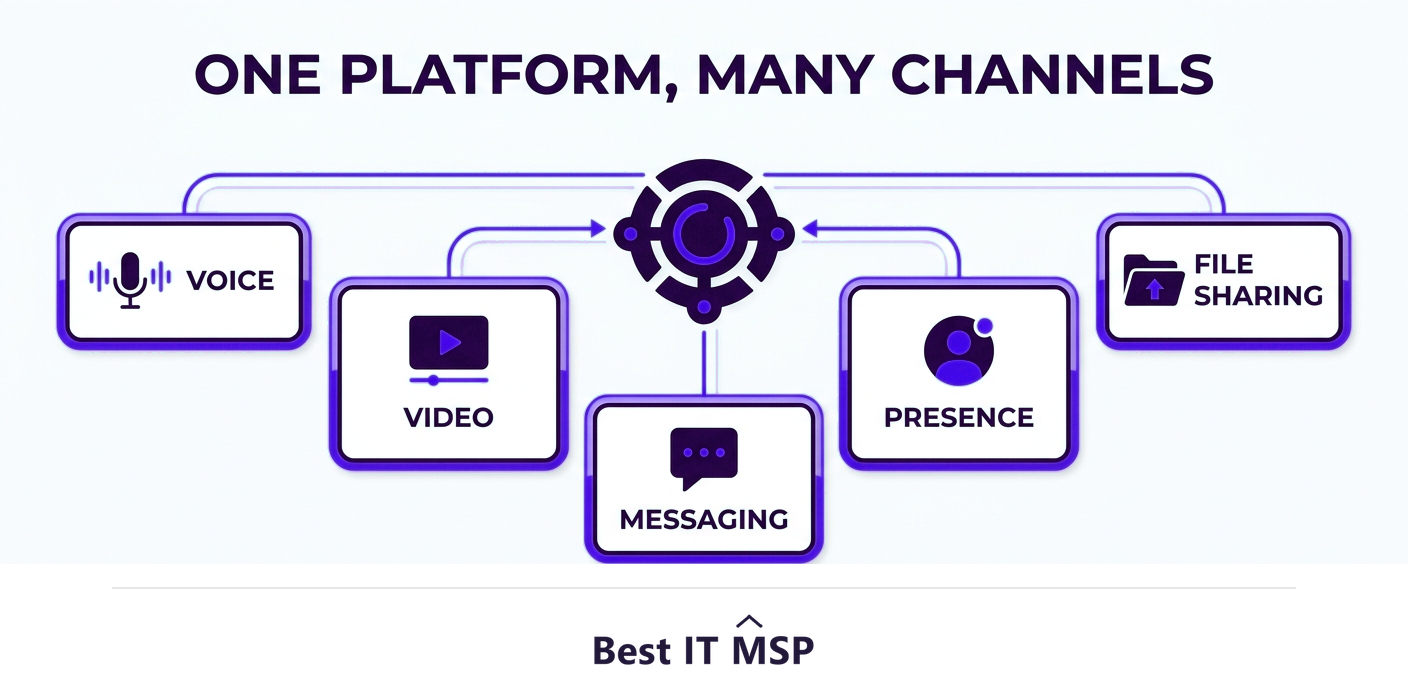
A UC platform unifies the channels people use to work, into one experience:
- <strong>Voice calling.</strong> Business phone service, usually delivered over VoIP, that works from a desk phone, laptop, or mobile.
- <strong>Video conferencing.</strong> Built-in video meetings without a separate tool, for one-to-one or group calls.
- <strong>Instant messaging and team chat.</strong> Quick, persistent conversations and channels that replace much of internal email.
- <strong>Presence.</strong> Seeing at a glance who is available, busy, or away, so you reach people the right way.
- <strong>File sharing and collaboration.</strong> Sharing and co-working on files inside the same platform where you talk.
- <strong>Integration.</strong> Connecting with the other tools you use, like email, calendars, and business applications, so communication fits your workflow.
Bringing these into one integrated platform is what turns scattered tools into a single, coherent way to communicate and collaborate.
How unified communications relates to VoIP
People often ask how VoIP and unified communications connect. The simplest way to put it: VoIP is the voice layer, and unified communications is the bigger platform built around it. VoIP (Voice over Internet Protocol) carries phone calls over the internet rather than traditional phone lines, and it is the technology that makes modern cloud calling possible. Unified communications takes that internet-based voice capability and surrounds it with video, messaging, presence, and collaboration in one system. So VoIP unified communications, the phrase, captures the reality that today's business phone systems are rarely just phones, they are the voice component of a broader UC platform. You can have VoIP without full UC, but most modern UC platforms include VoIP as their calling foundation.
UCaaS: unified communications in the cloud
Most businesses now consume unified communications as a cloud service, known as UCaaS (Unified Communications as a Service). Rather than installing and maintaining UC hardware on site, you subscribe to a cloud platform that delivers all the channels over the internet for a predictable per-user fee, with the provider handling the infrastructure, updates, and reliability. This is the same cloud model transforming the rest of IT, with public cloud spending forecast to reach $723.4 billion in 2025 and 89% of organizations running a multi-cloud strategy. UCaaS makes enterprise-grade communications affordable and lets businesses scale their communications up or down effortlessly, and because it is cloud-based, it lets employees communicate and collaborate from anywhere on any device, which is exactly what remote and hybrid work require.
The benefits of unified communications
Consolidating communication into one platform pays off in several ways:
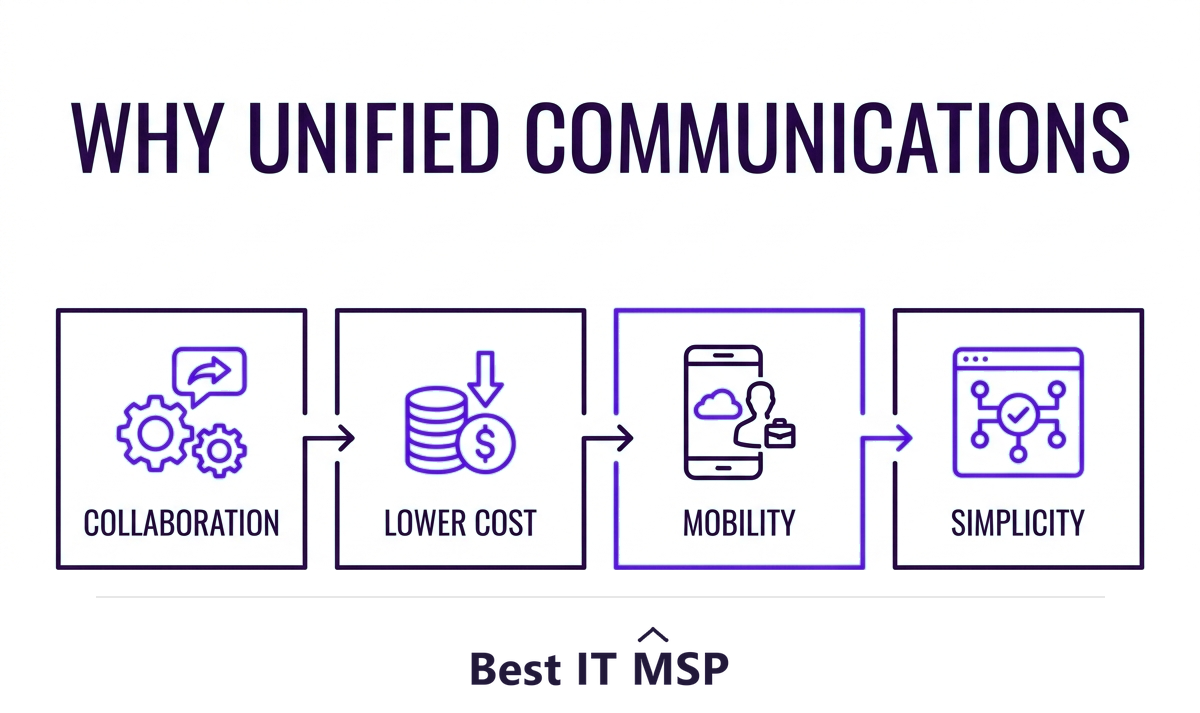
- <strong>Smoother collaboration.</strong> Moving between chat, call, and video without switching tools removes friction and speeds up work.
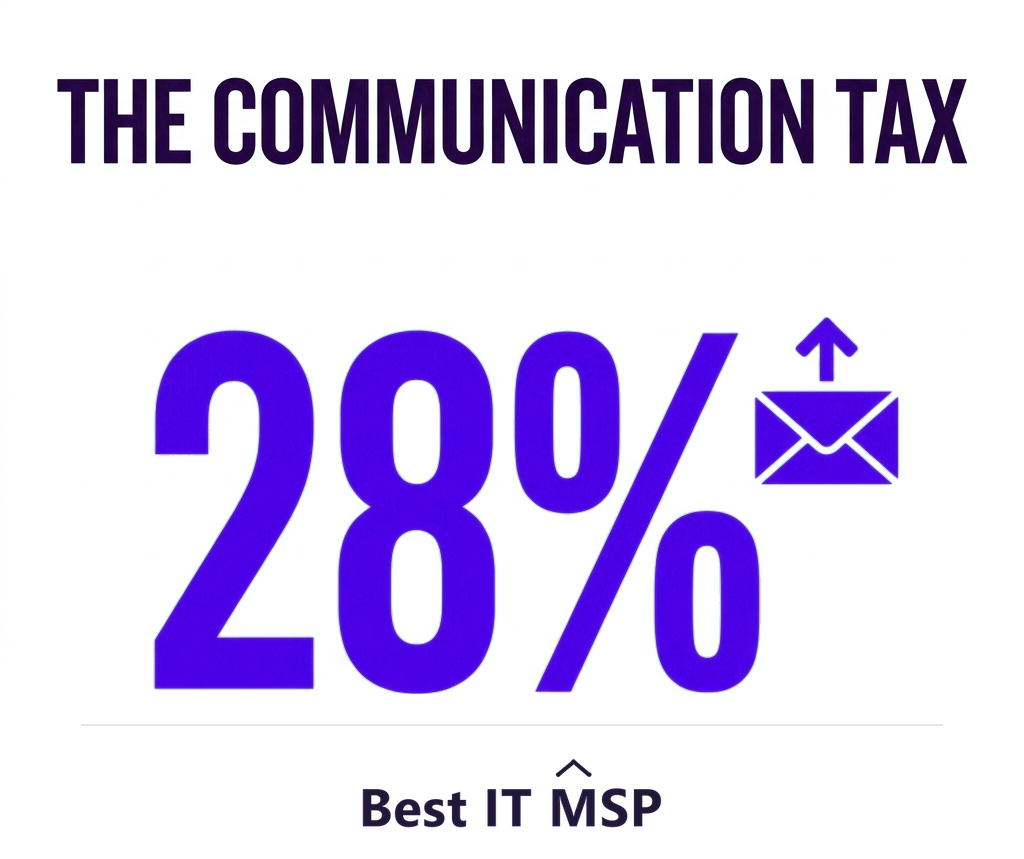
- <strong>Less email overload.</strong> Team chat replaces much of the internal email that consumes about 28% of the workweek, cutting a real productivity tax.
- <strong>Lower cost.</strong> One integrated platform usually costs less than several separate tools and phone lines, and shifts spending to a predictable per-user fee.
- <strong>Remote and hybrid support.</strong> Everyone communicates the same way from anywhere, on any device.
- <strong>Simpler management.</strong> One system to administer and secure instead of many disconnected ones.
- <strong>Better reach.</strong> Presence and integrated channels help people connect on the first try, which matters when downtime or missed communication is costly, an outage alone costs most organizations more than $100,000 an hour.
On-premise vs cloud UC, and who needs it
Unified communications can be deployed on-premise, with the platform hosted on your own servers, or in the cloud as UCaaS. On-premise gives full control but carries the cost and burden of owning and maintaining the hardware; UCaaS removes that and adds easy scalability, which is why the cloud model dominates for most businesses today. As for who needs it: almost any organization with more than a handful of people benefits, but it is especially valuable for businesses with remote or hybrid staff, multiple locations, or teams that collaborate heavily, where disconnected tools create the most friction. The productivity stakes are real, with employees already spending about 1.8 hours a day searching for information; the last thing they need is fragmented communication on top. Security matters as well, because a UC platform carries a business's calls, messages, and shared files, and with the average data breach costing $4.88 million, the platform should be secured and monitored like any other critical system. The complexity of deploying, integrating, and securing UC well is part of why businesses lean on managed providers, a market growing from about $330 billion in 2024 toward $879 billion over the next decade.
Getting unified communications right
Unified communications is, at heart, about removing the friction between people and the conversations they need to have. By integrating voice, video, messaging, presence, and collaboration into one cloud platform, it makes work faster and simpler, supports the way teams actually operate today, and usually costs less than the patchwork of tools it replaces. The keys to doing it well are choosing the right platform for how your team works, integrating it with your existing tools, and running it on a solid, well-managed network so call and video quality hold up.
If you want help choosing or deploying unified communications, comparing vetted providers on merit is the place to start. Browse merit-ranked managed IT firms by city in the Best IT MSP directory, where ranking is earned on rating and verified data, not on who pays the most. You can also read our guide to hosted VoIP vs on-premise phone systems.
FAQ
What is unified communications?
Unified communications (UC) is the integration of a business's communication channels, voice calling, video conferencing, instant messaging, presence, and file sharing, into one connected platform. Instead of juggling separate, disconnected tools, people move seamlessly between chat, calls, and video without switching apps or losing context, making communication and collaboration frictionless from anywhere.
How does unified communications relate to VoIP?
VoIP is the voice layer and unified communications is the broader platform built around it. VoIP carries phone calls over the internet, providing the calling foundation, while UC surrounds that voice capability with video, messaging, presence, and collaboration in one system. Most modern UC platforms include VoIP as their calling component, which is why the two are so closely linked.
What is UCaaS?
UCaaS (Unified Communications as a Service) is unified communications delivered as a cloud service. Instead of installing and maintaining UC hardware on site, you subscribe to a cloud platform that provides all the channels over the internet for a predictable per-user fee, with the provider handling infrastructure, updates, and reliability. It makes enterprise-grade communications affordable, scalable, and accessible from anywhere.
What are the benefits of unified communications?
UC delivers smoother collaboration by letting people move between chat, call, and video without switching tools; less email overload through team chat; lower cost by replacing several separate tools with one platform; strong support for remote and hybrid work; simpler management of a single system; and better reach through presence and integrated channels. Together these cut friction, cost, and overhead.
Who needs unified communications?
Almost any organization with more than a handful of people benefits, but UC is especially valuable for businesses with remote or hybrid staff, multiple locations, or teams that collaborate heavily, where disconnected communication tools create the most friction. If your people regularly switch between separate phone, video, and chat tools, unified communications will streamline how they work.
Should unified communications be cloud or on-premise?
Both are possible. On-premise UC hosts the platform on your own servers, giving full control but carrying the cost and burden of owning and maintaining hardware. Cloud-based UCaaS removes that and adds easy scalability and anywhere access, which is why it dominates for most businesses today. The cloud model is usually the more practical choice unless you have specific control requirements.
Best IT MSP is the independent directory of vetted managed IT providers across North America. Compare merit-ranked firms in your city that deploy unified communications and VoIP. No pay-to-play.