IT Support for Law Firms: A Complete Guide
IT support for law firms is specialized because law firms hold highly sensitive client data, carry an ethical duty to protect it, work with huge volumes of documents, and cannot tolerate downtime during deadlines.
- Law firms hold highly sensitive client data and carry a professional duty to protect its confidentiality.
- Document management and reliable access to case files are core to how a firm operates.
- Downtime during a deadline or trial is unacceptable, so reliability and fast support are essential.
- Security and compliance failures can mean ethical violations, lost clients, and serious liability.
- Generalist IT often misses the legal stakes, so most firms choose IT support experienced with law firms.
Why law firms need specialized IT support
Law firms are not ordinary small businesses when it comes to technology. They hold some of the most sensitive information their clients possess, financial records, personal details, trade secrets, litigation strategy, and they carry a professional and ethical duty to keep it confidential. They run on documents, often enormous volumes of them, that must be organized, searchable, and instantly available. And they work to hard deadlines and court dates where downtime is simply not an option. Layer on the regulatory and ethical rules governing how attorneys handle data, and it is clear why IT support for law firms is a specialized discipline rather than a generic service. This guide explains what makes legal IT different, what good support includes, and why experience with law firms matters.
It pairs with our IT support for law firms overview and the cybersecurity services page, and connects to our guide on SharePoint document management.
The challenges that make legal IT different
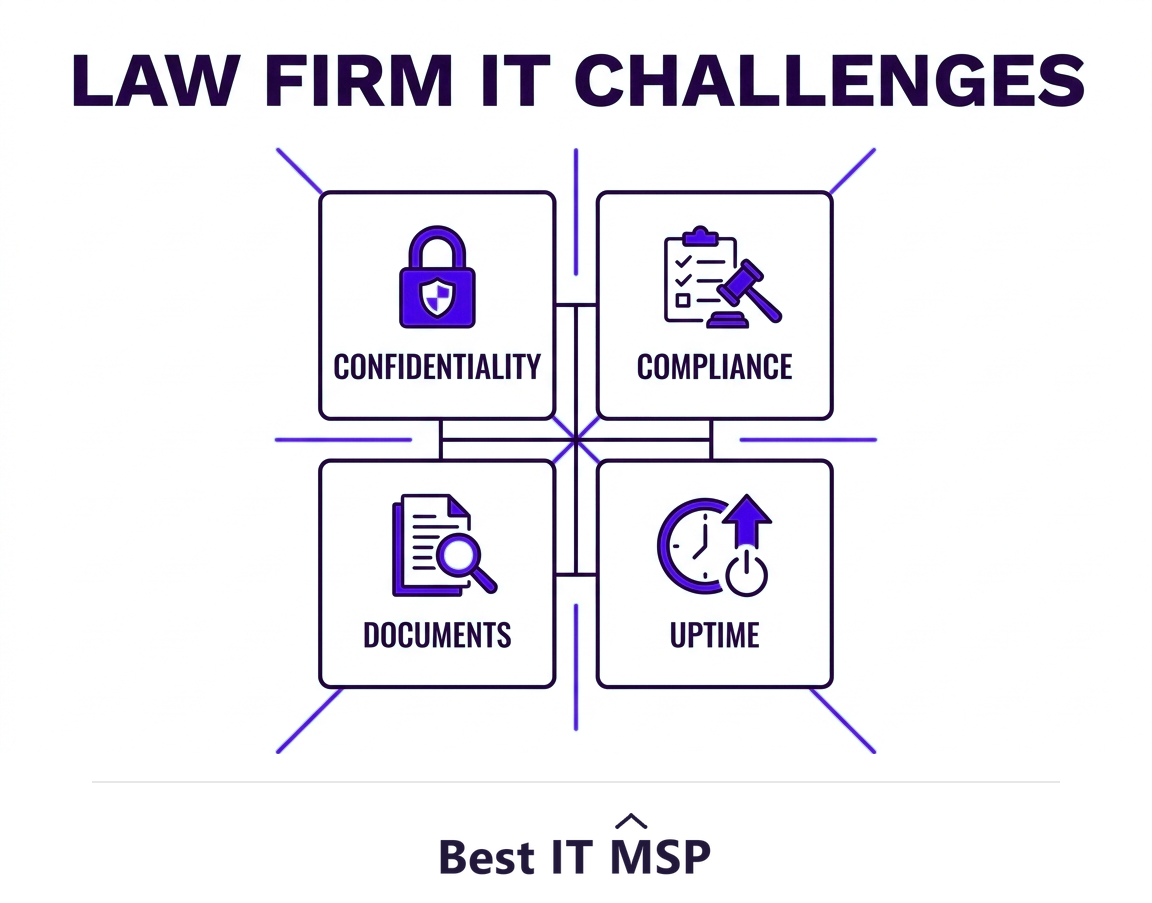
Four pressures shape what a law firm needs from its technology:
- <strong>Client confidentiality.</strong> Attorneys are bound to protect client information, so a data breach is not just costly, it can be an ethical and professional failure.
- <strong>Compliance and the duty of competence.</strong> Bar rules and a growing duty of technology competence expect attorneys to take reasonable steps to safeguard client data, on top of regulations like HIPAA for firms handling medical records.
- <strong>Document-intensive work.</strong> Cases generate vast volumes of documents that must be securely stored, version-controlled, searchable, and accessible from anywhere.
- <strong>Zero tolerance for downtime.</strong> A system outage before a filing deadline or during trial can have real legal consequences, so reliability is paramount, and downtime costs most organizations more than $100,000 an hour.
What good law firm IT support includes
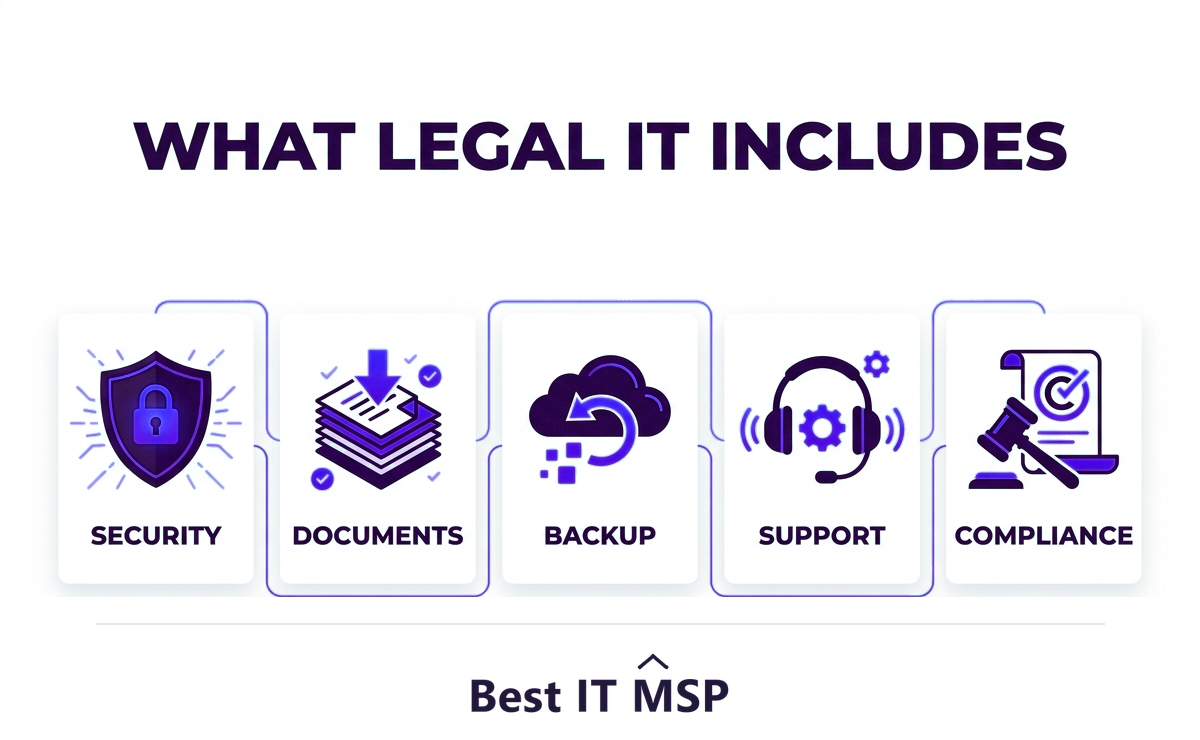
Effective IT support for a law firm covers the full set of legal-specific needs:
- <strong>Strong cybersecurity.</strong> Layered defenses, encryption, and monitoring to protect confidential client data against the threats law firms increasingly face.
- <strong>Document management.</strong> Secure, organized, searchable storage with version control and access controls, often built on platforms designed for legal work.
- <strong>Reliable backup and recovery.</strong> Tested backups so case files and client data can always be recovered after ransomware, failure, or error.
- <strong>Secure remote and mobile access.</strong> Attorneys work from courtrooms, home, and the road, so secure access from anywhere is essential.
- <strong>Responsive help desk.</strong> Fast, knowledgeable support, because a technical problem during a deadline cannot wait.
- <strong>Compliance support.</strong> Help meeting the security and confidentiality obligations the firm carries and staying compliant, with the documentation to prove it.
Security and confidentiality: the heart of legal IT
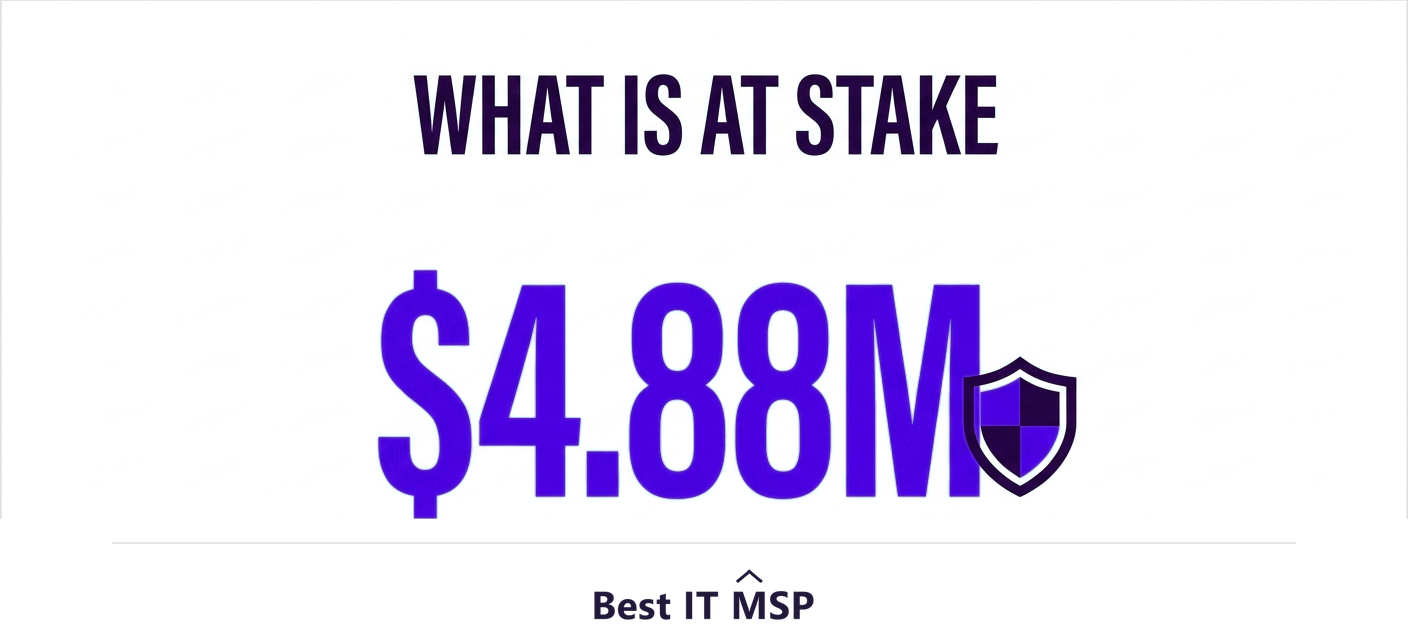
For a law firm, security is not just an IT concern, it is an ethical obligation and a business-critical one. A breach exposes confidential client information, can violate professional duties, and can permanently damage the trust a firm depends on, on top of direct costs, with the average data breach reaching $4.88 million. Law firms are also attractive targets precisely because of the valuable data they hold, and attacks usually start with people, the human element is involved in 68% of breaches, so protecting a firm means combining strong technical defenses with training. The slow pace of detection makes it worse, with breaches taking an average of 258 days to identify and contain; a firm needs monitoring that catches intrusions fast. Automation helps, saving breached organizations an average of $2.22 million, but the foundation is treating client confidentiality as the non-negotiable it is.
Compliance and the duty of technology competence
Beyond general security, law firms face specific obligations. Professional conduct rules in most jurisdictions now include a duty of technology competence, meaning attorneys are expected to understand the technology they use well enough to protect client data and to take reasonable safeguards. Firms handling healthcare matters may fall under HIPAA, those handling payment data under PCI, and many face client-driven security requirements, large corporate clients increasingly audit their outside counsel's security before sharing sensitive matters. Meeting these obligations is not optional, and demonstrating that you meet them is becoming a competitive necessity. Good legal IT support helps a firm implement the right controls and produce the documentation that clients, regulators, and bar authorities expect, turning compliance from a worry into a strength.
Why generalist IT often is not enough
A capable generalist IT provider can keep computers running, but legal work raises the stakes in ways that reward specific experience. A provider who understands law firms knows the legal technology that attorneys rely on, the document management and practice-management platforms they use, grasps the confidentiality and compliance obligations, appreciates why a deadline-day outage is a genuine emergency, and can speak to the security questions a firm's clients now ask. This is why so many firms choose specialized legal IT support, and why the broader managed services market continues to grow from about $330 billion in 2024 toward $879 billion over the next decade, with finding qualified security talent made harder by a global shortfall of about 4.8 million cybersecurity professionals. The right partner brings both the technical depth and the legal context, so technology supports the practice rather than putting it at risk.
Getting law firm IT right
For a law firm, technology is inseparable from professional responsibility. The right IT support protects client confidentiality with serious security, keeps case documents organized, secure, and instantly available, guarantees reliability when deadlines loom, backs everything up, and helps the firm meet its compliance and ethical duties. Because the stakes are uniquely high, this is one area where choosing a provider with genuine legal experience pays off, both in risk avoided and in the confidence to tell clients their information is safe.
If you are evaluating IT support for your law firm, comparing vetted providers on merit is the place to start. Browse merit-ranked managed IT firms by city in the Best IT MSP directory, where ranking is earned on rating and verified data, not on who pays the most. You can also explore the full managed IT services hub.
FAQ
Why do law firms need specialized IT support?
Because law firms hold highly sensitive client data, carry a professional and ethical duty to keep it confidential, work with huge volumes of documents that must be organized and instantly available, and cannot tolerate downtime during deadlines or trials. Generic IT often misses these confidentiality, compliance, and reliability stakes, which is why most firms choose IT support experienced with the legal field.
What does IT support for law firms include?
It includes strong cybersecurity to protect confidential data, secure and searchable document management with version control, reliable tested backups, secure remote and mobile access for attorneys working from courtrooms and home, a responsive help desk for deadline-day issues, and compliance support to meet the firm's security and confidentiality obligations with proper documentation.
What are the biggest IT risks for law firms?
The biggest risks are data breaches that expose confidential client information, which can violate professional duties and destroy client trust on top of the average breach cost of $4.88 million; ransomware that locks up case files; and downtime during critical deadlines. Law firms are attractive targets because of the valuable data they hold, and most attacks start with people.
Do law firms have to comply with cybersecurity rules?
Yes. Professional conduct rules in most jurisdictions now include a duty of technology competence, expecting attorneys to safeguard client data with reasonable measures. Firms handling healthcare matters may fall under HIPAA and those handling payment data under PCI, and many large clients now audit their outside counsel's security before sharing sensitive matters, making strong, documented security a competitive necessity.
Is generalist IT support enough for a law firm?
Often not. A generalist can keep computers running, but legal work raises the stakes in ways that reward specific experience: understanding legal document and practice-management platforms, the confidentiality and compliance obligations, why a deadline-day outage is an emergency, and the security questions clients now ask. Specialized legal IT support brings both technical depth and legal context.
How does IT support protect client confidentiality?
Through layered cybersecurity including encryption, access controls, and continuous monitoring; secure document management that limits who can see what; reliable backups so data is never lost; secure remote access so attorneys can work safely from anywhere; and security awareness training, since the human element is involved in most breaches. Together these uphold the confidentiality attorneys are ethically bound to protect.
Best IT MSP is the independent directory of vetted managed IT providers across North America. Compare merit-ranked firms in your city with experience supporting law firms. No pay-to-play.