Cloud Computing Benefits for Business
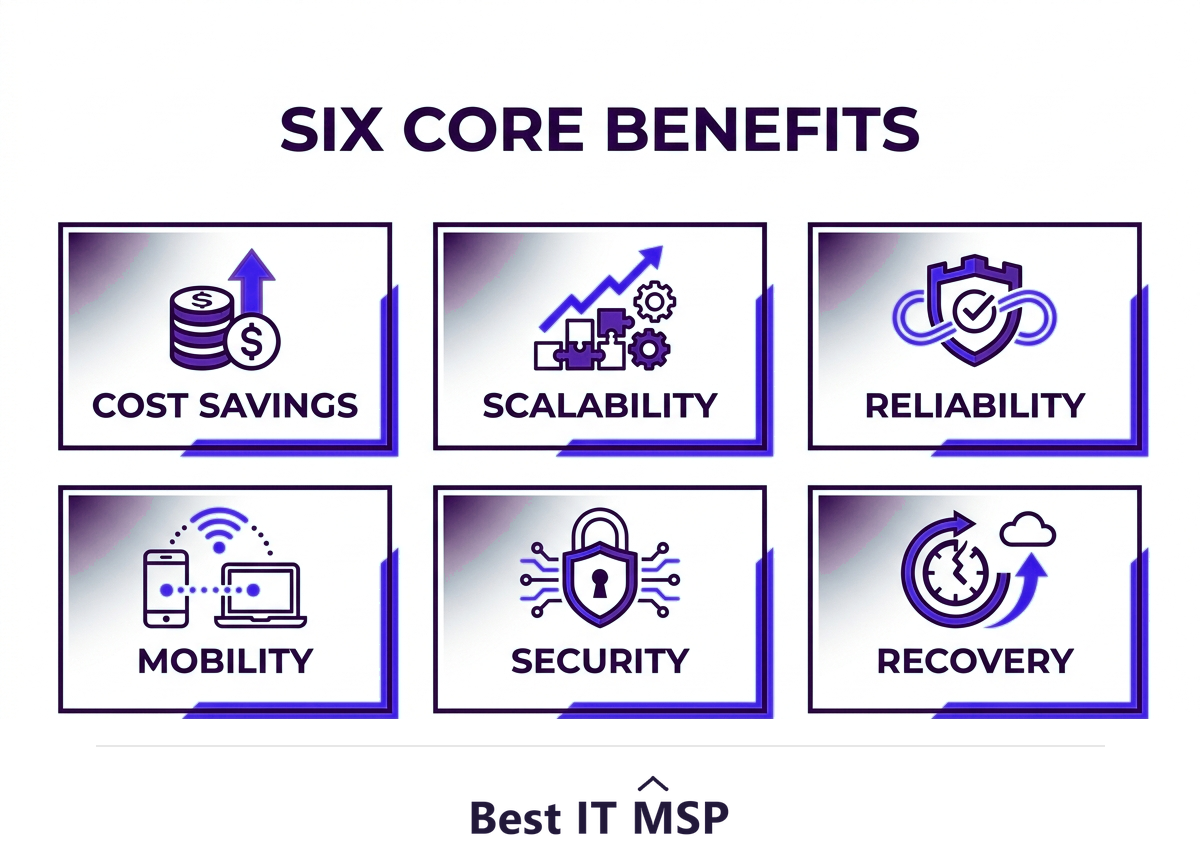
The main cloud computing benefits for business are lower and more predictable costs, on-demand scalability, higher reliability and uptime, support for remote work and collaboration, enterprise-grade security, and built-in disaster recovery. Managed cloud databases add the same advantages to data workloads.
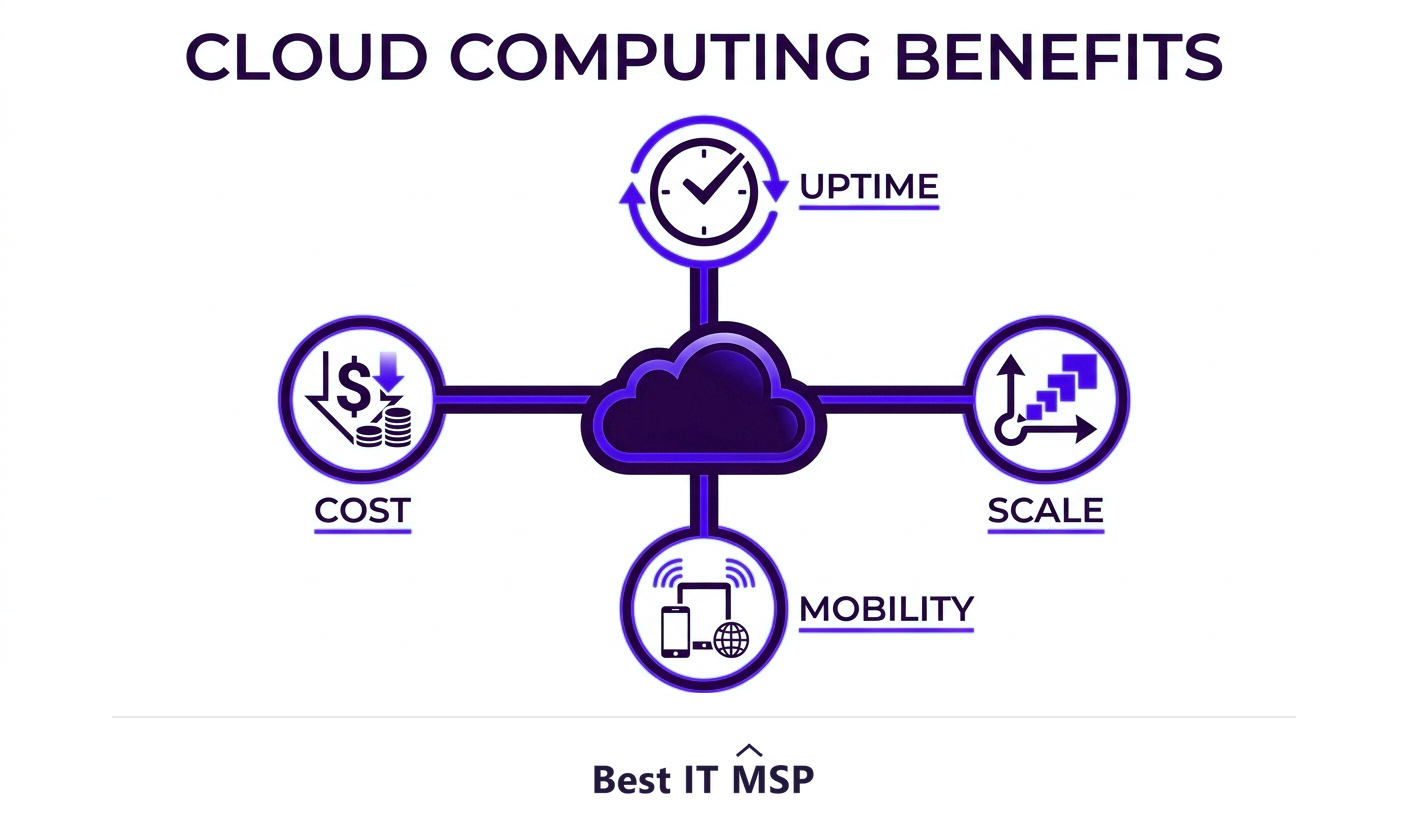
- Cloud computing turns large upfront hardware costs into predictable, pay-as-you-go operating costs.
- Scalability lets you add or remove capacity on demand instead of buying for peak load.
- Cloud platforms deliver reliability, uptime, and disaster recovery that are hard to match on-premises.
- The cloud enables secure remote work and real-time collaboration from anywhere.
- The benefits depend on correct configuration, because most cloud failures are customer misconfigurations, not platform faults.
What are the benefits of cloud computing?
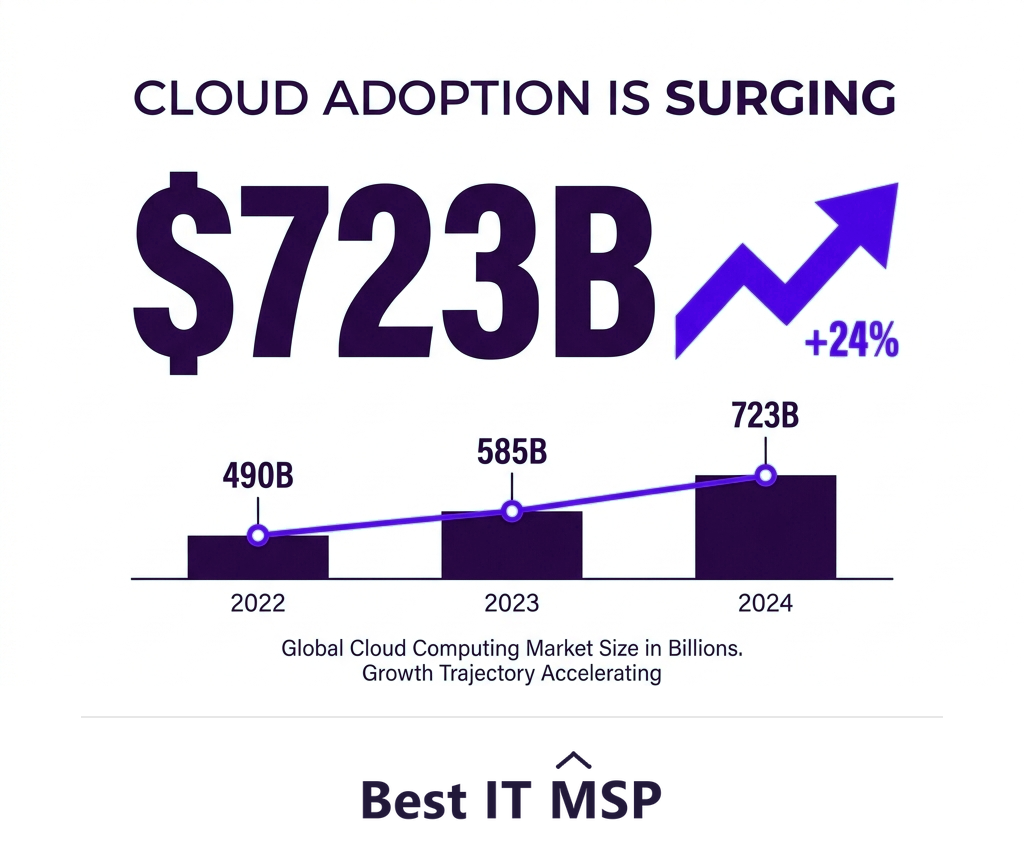
Cloud computing has moved from a trend to the default way businesses run their technology, and the reasons are practical. Instead of buying, housing, and maintaining your own servers, you rent computing power, storage, and software from a provider like AWS, Microsoft Azure, or Google Cloud, and access it over the internet. The cloud computing benefits that follow, lower costs, instant scalability, better reliability, and easier remote work, are why adoption keeps accelerating, with worldwide public cloud end-user spending forecast to reach $723.4 billion in 2025 and 89% of organizations now running a multi-cloud strategy.
This guide walks through the real, business-level benefits of cloud computing, including the advantages of managed cloud databases, and the one caveat that determines whether you actually realize them. It pairs with our cloud security overview and the managed IT services hub.
Cost savings: from capital expense to predictable spend
The first benefit most businesses notice is cost. On-premises IT requires large capital purchases, servers, storage, networking gear, plus the space, power, cooling, and staff to run them, and that hardware is obsolete in a few years. Cloud computing turns that capital expense into a predictable operating expense: you pay for what you use, monthly, and the provider handles the hardware. For a growing business this is transformative, because it removes the need to buy expensive capacity years ahead of demand and lets you reduce spend when you need less. Done well, the cloud is genuinely cost-effective, though realizing those savings requires actively managing usage so costs do not creep. The cost case is a big reason adoption keeps climbing year after year.
Scalability and flexibility on demand
Scalability is where the cloud shines brightest. When demand spikes, a busy season, a product launch, a viral moment, you can scale capacity up in minutes, then scale back down when it passes, paying only for what you used. On-premises, you would have to buy hardware for peak load and let it sit idle the rest of the year. This flexible, elastic capacity means a small business can handle enterprise-scale demand without enterprise-scale investment, and it lets teams experiment and innovate quickly because spinning up a new environment is a few clicks rather than a procurement project. The ability to migrate workloads and grow without re-architecting everything is a core reason the cloud is so scalable.
Reliability and uptime
Major cloud providers operate redundant data centers across multiple regions, with uptime guarantees that are extremely hard and expensive to replicate in a single office server room. Hardware fails, power goes out, and internet links drop, but a well-architected cloud deployment can keep running through all of it. That reliability has a direct financial payoff, because downtime is costly: an hour of outage costs most organizations more than $100,000. For many businesses, the cloud delivers a level of reliable, always-on availability they simply could not afford to build and maintain themselves.
Remote work and collaboration
Because cloud services are accessed over the internet, your team can securely access the same applications, files, and data from the office, from home, or from the road. This makes modern remote work and hybrid work possible, and it lets people collaborate in real time on shared documents and systems rather than emailing versions back and forth. Tools like Microsoft 365 and Google Workspace are cloud platforms precisely because that anywhere-access and live collaboration is so valuable. The cloud effectively turns your business applications into something every authorized employee can reach and collaborate in, wherever they are, on whatever device they use.
Built-in security and disaster recovery
It surprises some people, but moving to the cloud can improve security. Major providers invest more in protecting their infrastructure than almost any individual business could, with physical security, encryption, monitoring, and compliance certifications built in. The cloud also makes disaster recovery dramatically easier and cheaper: instead of trucking backup tapes offsite, your data is replicated across regions, and you can recover quickly from ransomware, hardware failure, or a natural disaster. That matters when the average data breach costs $4.88 million and organizations that use security automation extensively save an average of $2.22 million per incident. The cloud lets a small business stand behind enterprise-grade protection and recovery, provided it is configured to take advantage of them.
Cloud database benefits
The same advantages apply to your data layer through managed cloud databases. A cloud database is a database that runs as a managed service, like Amazon RDS, Azure SQL Database, or Google Cloud SQL, so the provider handles the heavy operational work. The cloud database benefits are concrete:
- <strong>No infrastructure to manage.</strong> The provider runs the servers, patching, and maintenance, so your team focuses on the application, not the database engine.
- <strong>Automatic scaling.</strong> Storage and performance grow with demand, so the database stays fast as you grow.
- <strong>Built-in backups and high availability.</strong> Automated backups and multi-zone replication protect data and keep it available.
- <strong>Strong security defaults.</strong> Encryption, access controls, and monitoring come built in, helping you secure sensitive data.
- <strong>Predictable cost.</strong> You pay for the capacity you use rather than over-provisioning hardware for peak load.
The caveat: benefits depend on doing it right
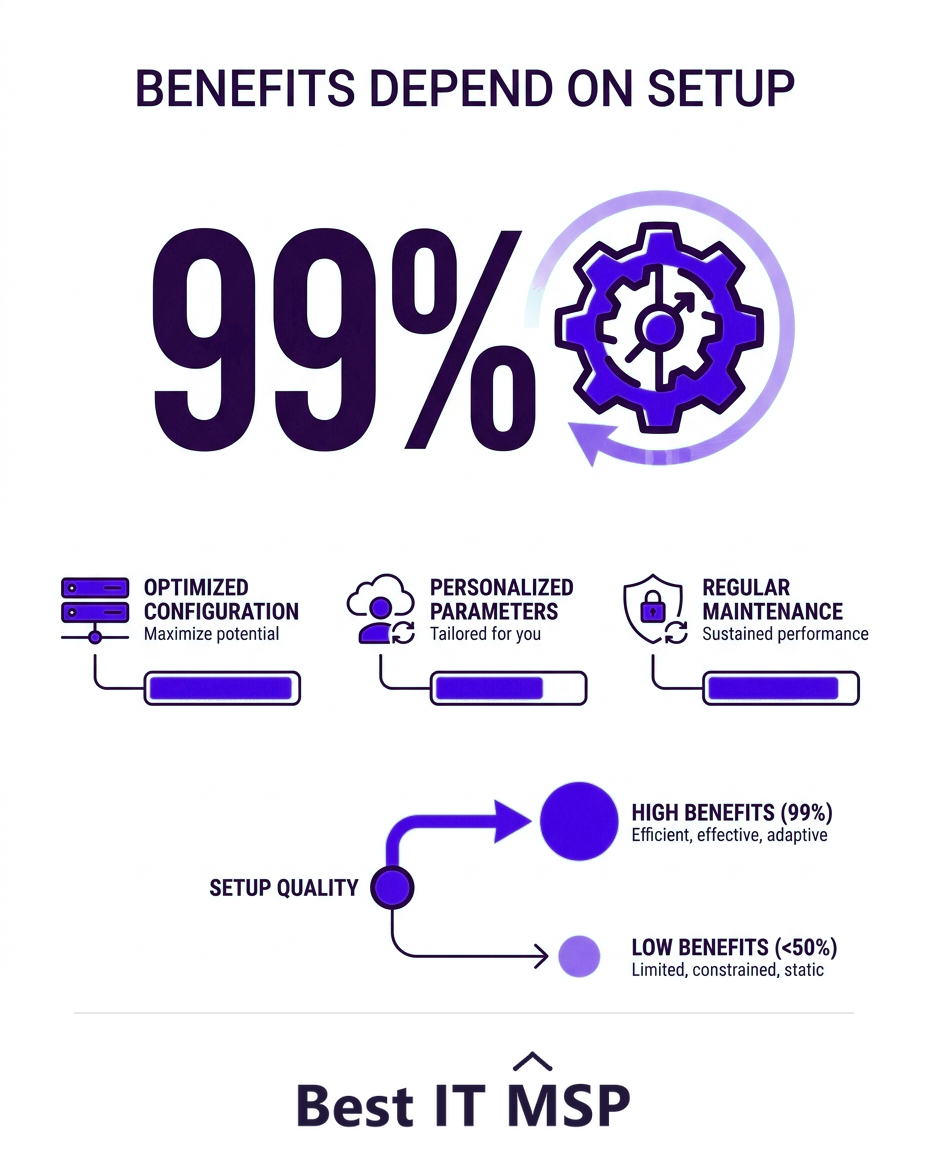
Here is the honest part: none of these benefits are automatic. The cloud is a powerful tool, but it has to be configured, secured, and managed correctly to deliver. Costs can balloon if usage is not watched, and security can suffer if settings are wrong, which is the norm rather than the exception, since Gartner projects that through 2025, 99% of cloud security failures will be the customer's fault. Misconfiguration is also why breaches take so long to catch, an average of 258 days to identify and contain. The benefits are real, but they reward businesses that treat the cloud as something to actively operate, not as a set-and-forget service.
Realizing the benefits of the cloud
Cloud computing offers a genuinely compelling combination: lower and more predictable costs, on-demand scalability, strong reliability, secure remote work, enterprise-grade security, and built-in disaster recovery, extended to your data through managed cloud databases. The businesses that capture all of it are the ones that plan their migration, configure the platform properly, and keep operating it well, often with expert help. The reward for that discipline is a technology foundation that scales with the business instead of holding it back, which is why the managed services market is growing from about $330 billion in 2024 toward $879 billion over the next decade. Learn more in our cloud security guide.
If you want help moving to the cloud or getting more from the cloud you already use, comparing vetted providers on merit is the place to start. Browse merit-ranked managed IT firms by city in the Best IT MSP directory, where ranking is earned on rating and verified data, not on who pays the most.
FAQ
What are the main benefits of cloud computing for business?
The main benefits are cost savings (turning large hardware purchases into predictable pay-as-you-go spend), on-demand scalability, higher reliability and uptime, support for secure remote work and real-time collaboration, enterprise-grade built-in security, and easier, cheaper disaster recovery. Managed cloud databases extend these same advantages to your data workloads.
Does cloud computing actually save money?
It can, by replacing large capital purchases and the cost of running your own data center with a predictable operating expense where you pay only for what you use. You also avoid over-buying capacity for peak demand. The savings are real but not automatic, because cloud costs can creep without active management, so monitoring and optimizing usage is essential.
Is the cloud more secure than on-premises?
It can be, because major providers invest heavily in physical security, encryption, monitoring, and compliance that most businesses could not match on their own. However, under the shared responsibility model you remain responsible for securing your data, identities, and configurations, and most cloud breaches trace to customer misconfiguration, so security depends on setting the cloud up correctly.
What are the benefits of a cloud database?
A managed cloud database removes infrastructure management (the provider handles servers, patching, and maintenance), scales storage and performance automatically, includes automated backups and high availability, ships with strong security defaults like encryption and access controls, and offers predictable, pay-for-use cost instead of over-provisioned hardware.
How does the cloud support remote work?
Because cloud services are accessed over the internet, employees can securely reach the same applications, files, and data from anywhere and on any device. Cloud platforms like Microsoft 365 and Google Workspace also enable real-time collaboration on shared documents, which is why the cloud is the foundation of modern remote and hybrid work.
What is the catch with cloud computing?
The benefits depend on configuring and operating the cloud correctly. Costs can balloon without usage management, and security can fail through misconfiguration, which Gartner projects accounts for 99% of cloud security failures through 2025. The cloud rewards businesses that actively plan, secure, and manage it, which is why many bring in a managed IT provider.
Best IT MSP is the independent directory of vetted managed IT providers across North America. Compare merit-ranked firms in your city that plan, secure, and manage cloud environments. No pay-to-play.