Shadow AI: How to Write an AI Use Policy Before It Costs You
Shadow AI is staff using unapproved AI tools with company data. Incidents involving it more than doubled to 43% of breached organisations, and those breaches cost more than the global average. The fix is not banning AI, which does not work.
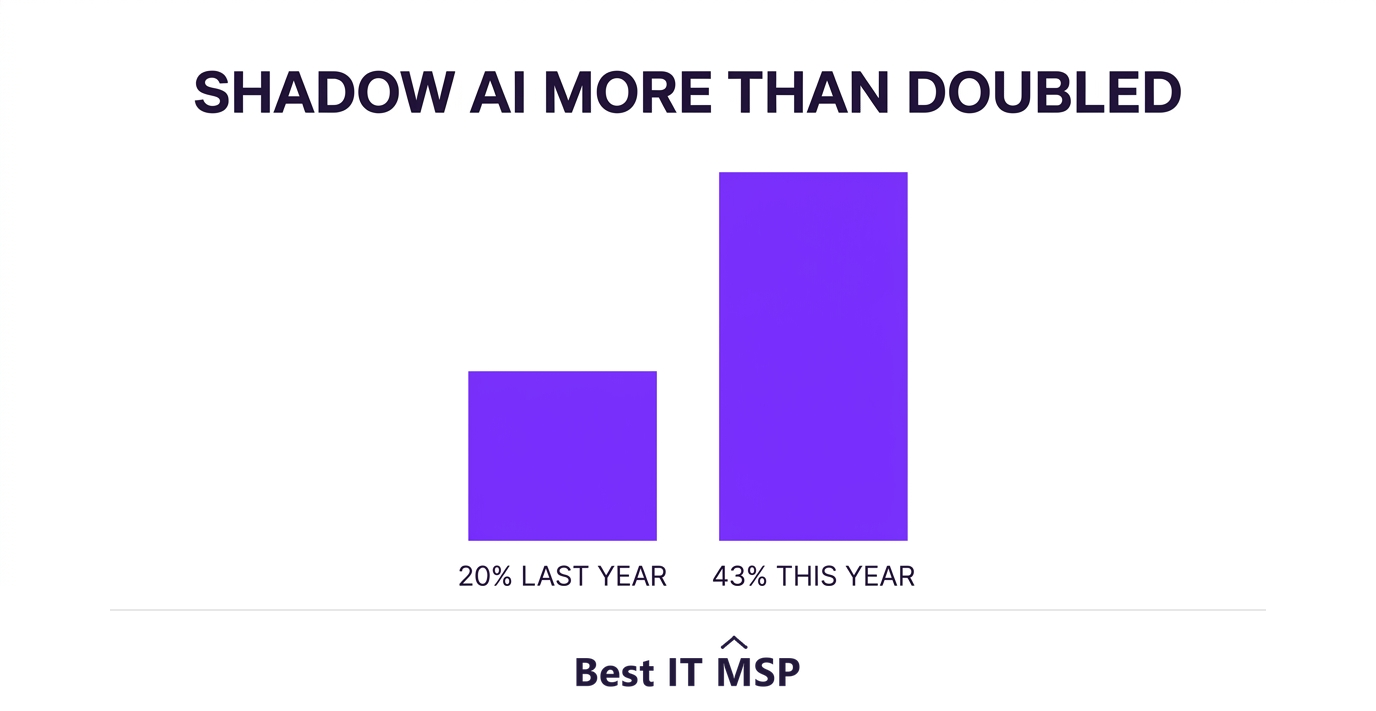
- Shadow AI incidents more than doubled in a year, to 43% of breached organisations from 20%.
- Breaches involving shadow AI averaged USD 5.39 million, above the USD 4.99 million global average.
- 68% of breached organisations had no governance to manage AI or detect shadow AI at all.
- Banning AI outright pushes usage onto personal devices where you cannot see it. Approve a tool instead.
- A usable policy fits on one page and answers three questions: which tools, which data, and who to ask.
What shadow AI is, and why it appeared so fast
Shadow AI is your staff using AI tools you did not approve, with data you did not intend to share. Someone pastes a customer list into a free chatbot to tidy the formatting. Someone uploads a contract to summarise it. Someone runs payroll figures through a spreadsheet assistant. None of them are acting maliciously, and most would be surprised to hear it was a problem.
It appeared quickly because adoption did. Almost 60% of small businesses now use artificial intelligence for business operations, up from 40% in 2024 and 23% in 2023, and 58% self-identified as using generative AI specifically. Roughly tripling in two years leaves no time for policy to catch up.
The result shows in breach data. Security incidents involving shadow AI more than doubled to 43% of breached organisations from 20% the previous year. That is not a fringe risk any more, it is close to half.
What it costs when it goes wrong
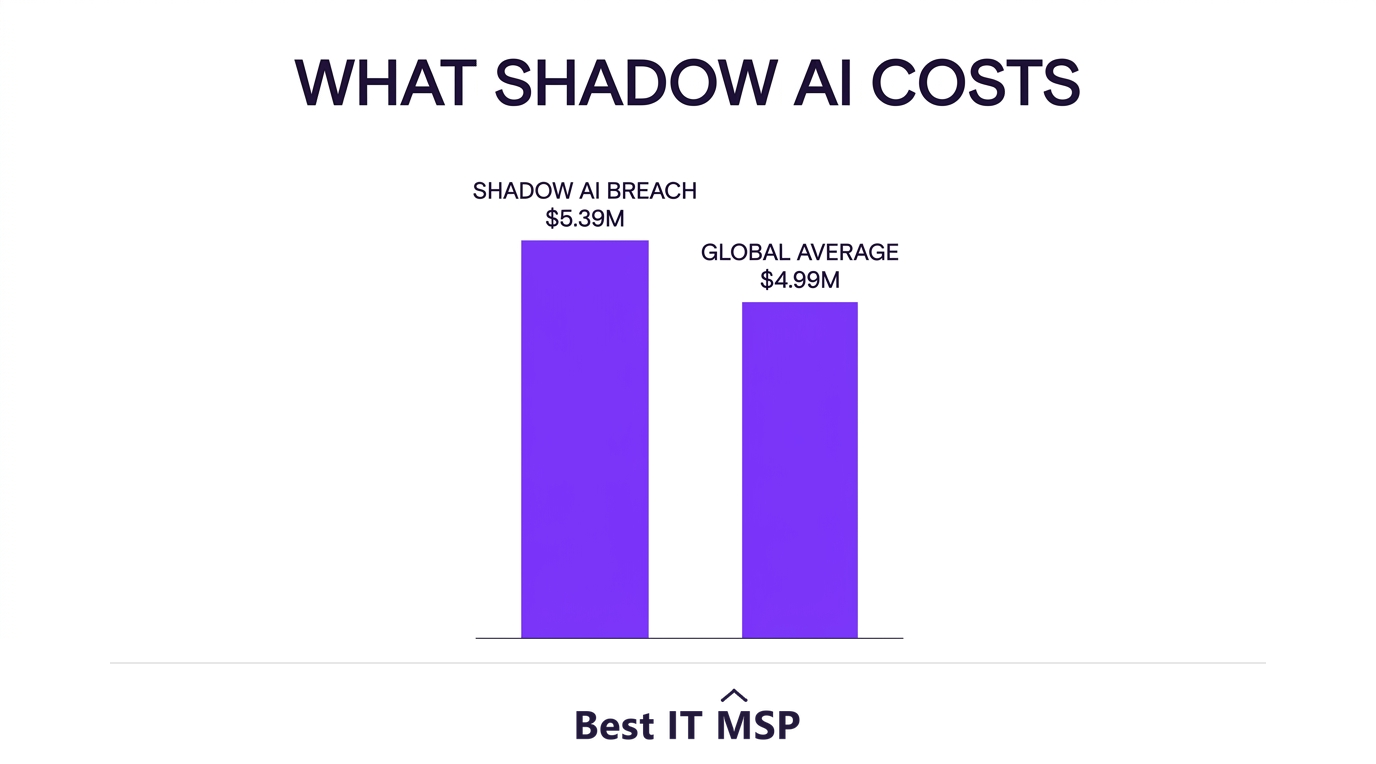
Shadow AI does not just add incidents, it adds expensive ones. Breaches involving shadow AI cost an average of USD 5.39 million, up from USD 4.63 million the previous year, against a global average that reached a record USD 4.99 million in 2026.
The reason is the kind of data involved. People reach for an AI tool when a task is fiddly and text-heavy, which describes customer records, contracts and internal reports. Customer personal information was the most commonly stolen data type, appearing in 52% of breaches at an average of USD 192 per record.
There is also a disclosure problem. Once company data has been pasted into a third-party service, working out exactly what left, and whether it triggers a notification obligation, is materially harder than tracing a conventional intrusion.
Almost nobody can see it happening
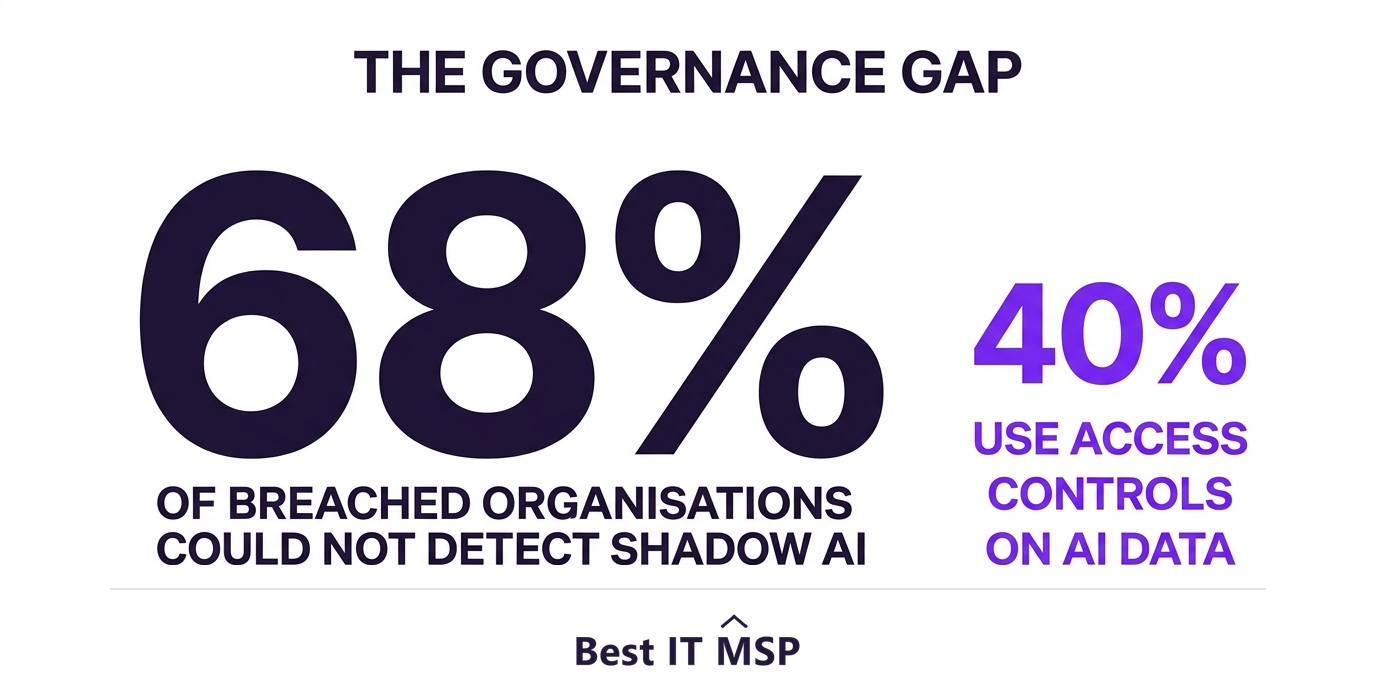
The uncomfortable finding is not that shadow AI exists. It is that most organisations have no way of knowing. 68% of breached organisations lacked governance to manage AI or detect shadow AI, and that figure moved the wrong way, worse than the 63% reported the previous year.
Controls are just as thin. Only 40% of organisations reported using access controls on AI models and data at all, and among organisations that suffered an AI-related breach, 92% lacked proper AI access controls.
There is a genuine positive signal though. A third of organisations (33%) said they were developing AI governance policies, up from 22% the previous year. The gap is closing, slowly, and being in that third costs very little.
Why banning AI does not work
The instinctive response is to block the tools at the firewall and put a line in the handbook. It fails for a predictable reason: the work still has to get done, and the phone in someone's pocket is not on your network.
A ban converts visible usage into invisible usage. Staff move to personal devices and personal accounts, where you have no logging, no data controls and no ability to investigate afterwards. You have not reduced the risk, you have blinded yourself to it.
There is a commercial cost too. Staff using these tools are generally trying to be faster, and the businesses adopting AI are not shrinking: the U.S. Chamber found 82% of small businesses using AI increased their workforce over the past year. A blanket ban asks people to work slower than their competitors.
The workable position is approval, not prohibition. Give people one sanctioned tool that meets your data requirements, and the incentive to go around you largely disappears.
The one-page AI use policy
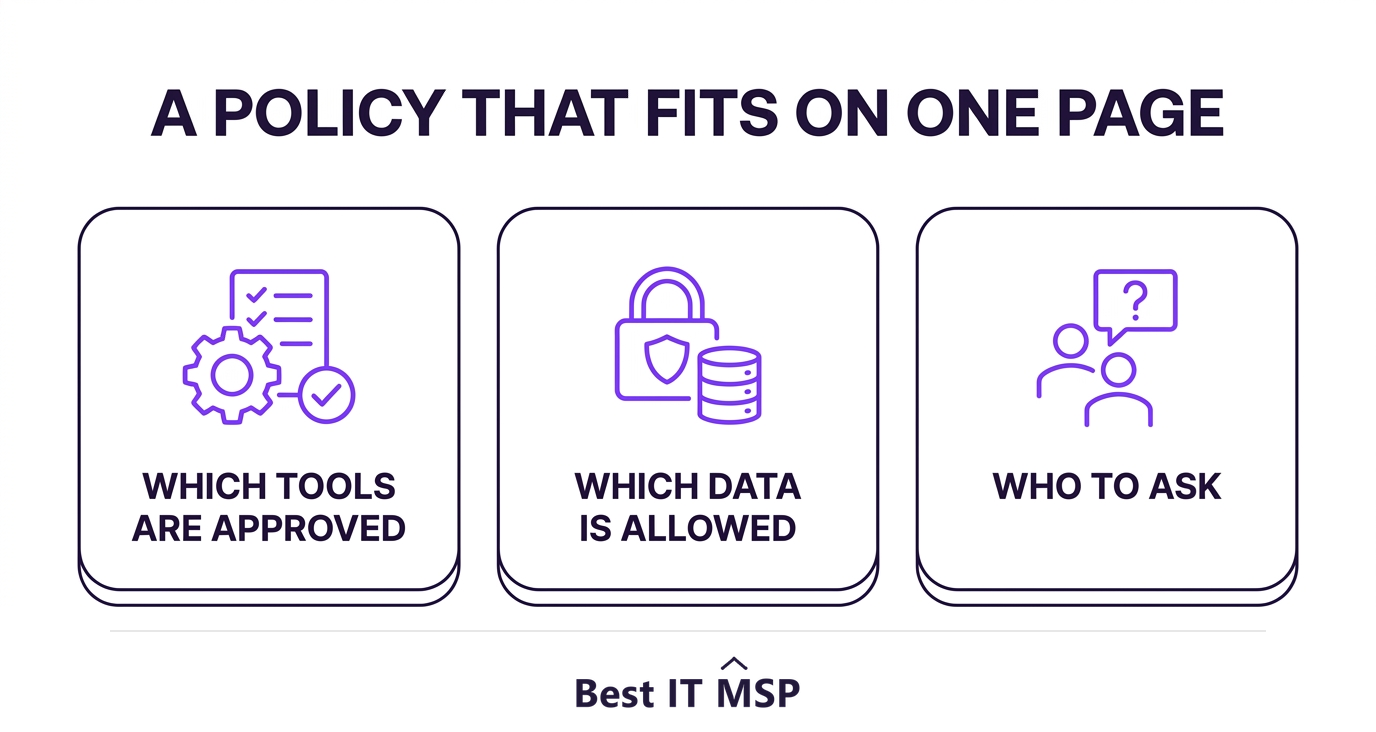
A policy nobody reads protects nobody. Keep it to one page and answer three questions in plain language.
- Which tools are approved. Name them. One approved assistant with a business agreement beats a general principle about 'reputable vendors'.
- Which data is allowed. Use three tiers people can actually apply: fine to use, ask first, never. Put customer personal data, payroll, credentials and anything under a client confidentiality clause in the never column.
- Who to ask. One named person or inbox for 'can I use this for that?' Requests you can answer are requests that do not become shadow AI.
Add two short clauses while you are there. First, that AI output is checked by a human before it goes to a customer or into a decision. Second, that AI use is disclosed where a client contract or regulator requires it.
If you want a recognised structure behind it, the NIST AI Risk Management Framework is the reference most auditors and vendors already map to, and CISA's AI guidance covers the security side.
The technical controls that make the policy real
Policy without enforcement is a document. Four controls do most of the work, and a competent managed IT provider can implement all four.
- Visibility. Find out which AI services are actually being reached from your network and accounts. You cannot govern what you have not measured.
- An approved tool with a business agreement. Consumer tiers often reserve the right to use your inputs differently from business tiers. Read which one you are on.
- Access controls on AI tools and the data they touch, which is precisely the control 92% of organisations with an AI-related breach were missing.
- Data loss prevention on the obvious paths, so a paste of a thousand customer records into a browser form gets flagged.
None of this is exotic, and it overlaps with controls you may already own through your Microsoft or Google licensing. The reason it does not get done is ownership, not cost.
Where your IT provider fits
This is a reasonable thing to expect help with, but do not assume it is included. 48% of managed IT providers rank AI and automation as their clients' top need for 2026, while only 13% earn meaningful revenue from AI services, which tells you demand is universal and delivery is not.
Buyers have noticed. AI expertise is now the third most important attribute small businesses look for in a provider, behind threat prevention and 24/7 support.
Ask three questions of your current provider. Can you tell me which AI services my staff are using? Can you apply access controls to AI tools and the data they reach? Will you help me write and enforce a one-page policy? A provider that answers yes to all three is doing the work; one that offers to resell you an AI product is answering a different question.
Do not let this crowd out the basics either. 31% of breaches now start with the exploitation of software vulnerabilities, overtaking stolen credentials as the leading initial access vector, so AI governance sits alongside patching rather than ahead of it.
FAQ
What is shadow AI?
Shadow AI is employees using AI tools that the business has not approved, usually with company data. It is the AI equivalent of shadow IT. Security incidents involving it more than doubled to 43% of breached organisations from 20% the previous year.
How much does shadow AI actually cost?
Breaches involving shadow AI averaged USD 5.39 million, up from USD 4.63 million the previous year, and above the USD 4.99 million global average for all breaches. The data involved tends to be text-heavy records such as customer information and contracts.
Should we just ban AI tools at work?
Banning tends to move usage onto personal devices and accounts where you have no visibility, logging or data controls. Approving one tool that meets your data requirements removes most of the incentive to go around you, and keeps the usage somewhere you can see it.
What should an AI use policy contain?
Three answers in plain language: which tools are approved by name, which data may be used with them in three tiers of fine, ask first and never, and who to ask when someone is unsure. Add that AI output is human-checked before it reaches a customer.
How do I find out if staff are already using AI tools?
Ask your IT provider to report which AI services are being reached from your network and accounts. Most organisations cannot answer this: 68% of breached organisations had no governance to manage AI or detect shadow AI at all.
Is our data safe in a paid AI tool?
It depends which tier you are on. Consumer tiers often handle inputs differently from business agreements, so read what the specific plan commits to regarding training on your data and retention, rather than relying on the vendor's general reputation.
Best IT MSP is the independent, researched ranking of managed IT providers in every city. Ask a shortlist whether they can show you which AI tools your staff already use.