Healthcare IT Providers in Philadelphia: 10 Best, Ranked for 2026
PCS ranks first among Philadelphia healthcare IT providers, holding 5.0 from 249 verified reviews. This list ranks 10 firms by confidence-weighted rating, so review volume counts, and every one is tagged to healthcare on its own listing.
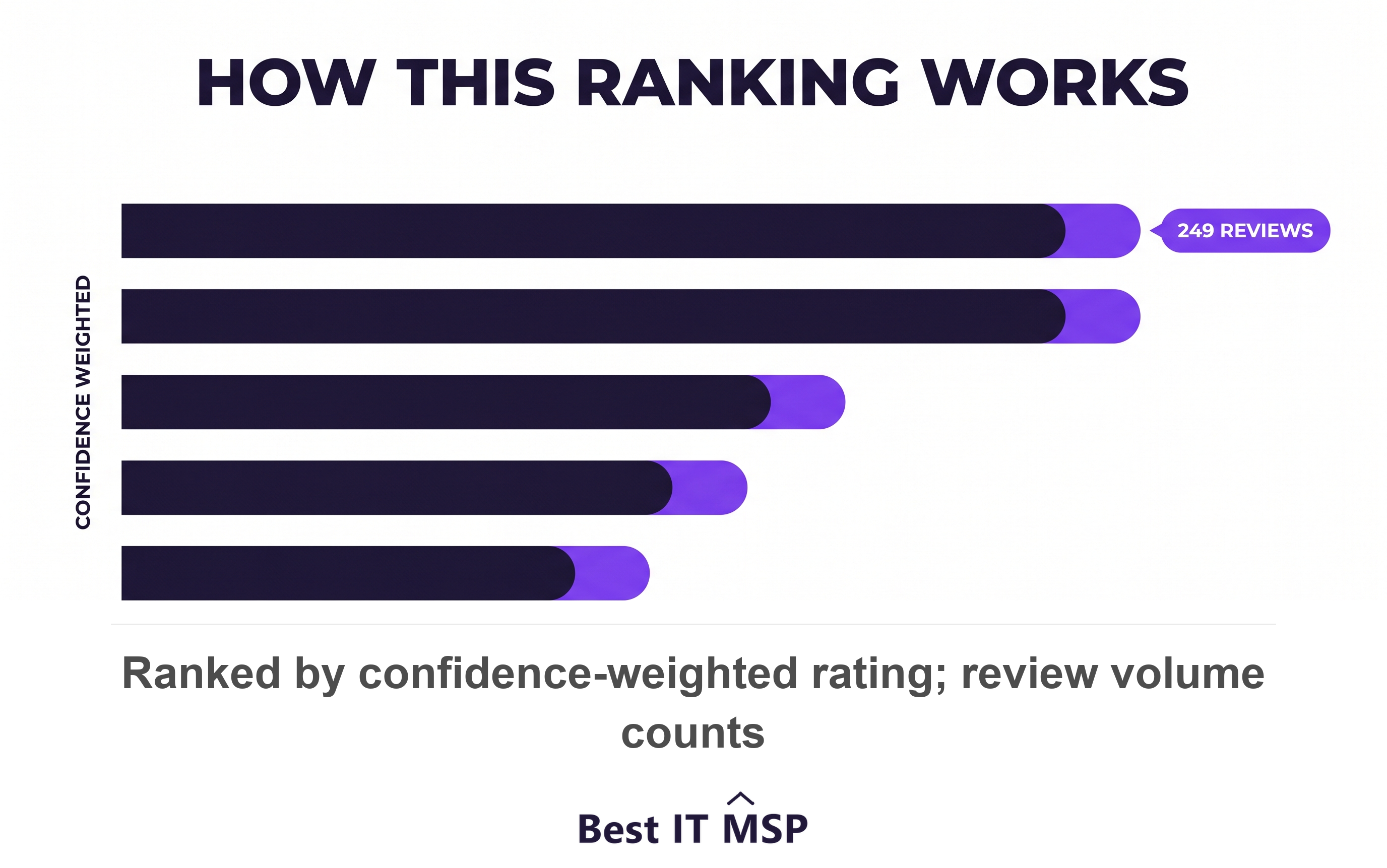
- Ranking is by confidence-weighted rating, so a 5.0 from 249 reviews outranks a 5.0 from 16.
- All 10 firms are tagged to healthcare on their own directory listing.
- 26 Philadelphia providers qualified; the 10 here are the top of that field.
- The top two carry more reviews than any other pairing in this series.
- In this city a practice may also be a research site, and that changes the data.
How we ranked these providers
Every position on this page comes from one rule, applied the same way to every firm, and it is published here before the list so you can judge it.
- Eligibility. A provider had to be tagged to healthcare on its own Best IT MSP listing. General managed IT firms that never mention the sector were excluded. That left 26 qualifying providers in Philadelphia.
- Order. Providers are ranked by confidence-weighted rating rather than raw average. A firm's score is pulled toward the local average in proportion to how few reviews it carries, and the Philadelphia average is 4.79. That is why review volume changes the order.
- Unrated firms. A provider with no published rating is listed but never placed above a rated one. Absence of evidence is not evidence.
- Paid placement. Excluded entirely. This is a merit list. Where Best IT MSP sells a Featured Partner spot it is labelled as one and kept out of the ranked order.
- Independence. Best IT MSP does not sell IT services and does not appear in its own rankings.
The figures behind the order are the verified rating and review count on each provider's profile. Nothing here is editorial preference.
Why does Philadelphia healthcare IT involve research?
Because the city's health economy is unusually weighted toward discovery rather than only delivery. Greater Philadelphia is the nation's second-largest cell and gene therapy hub, trailing only Boston and ahead of New York and San Francisco, and it is where the field started two decades ago.
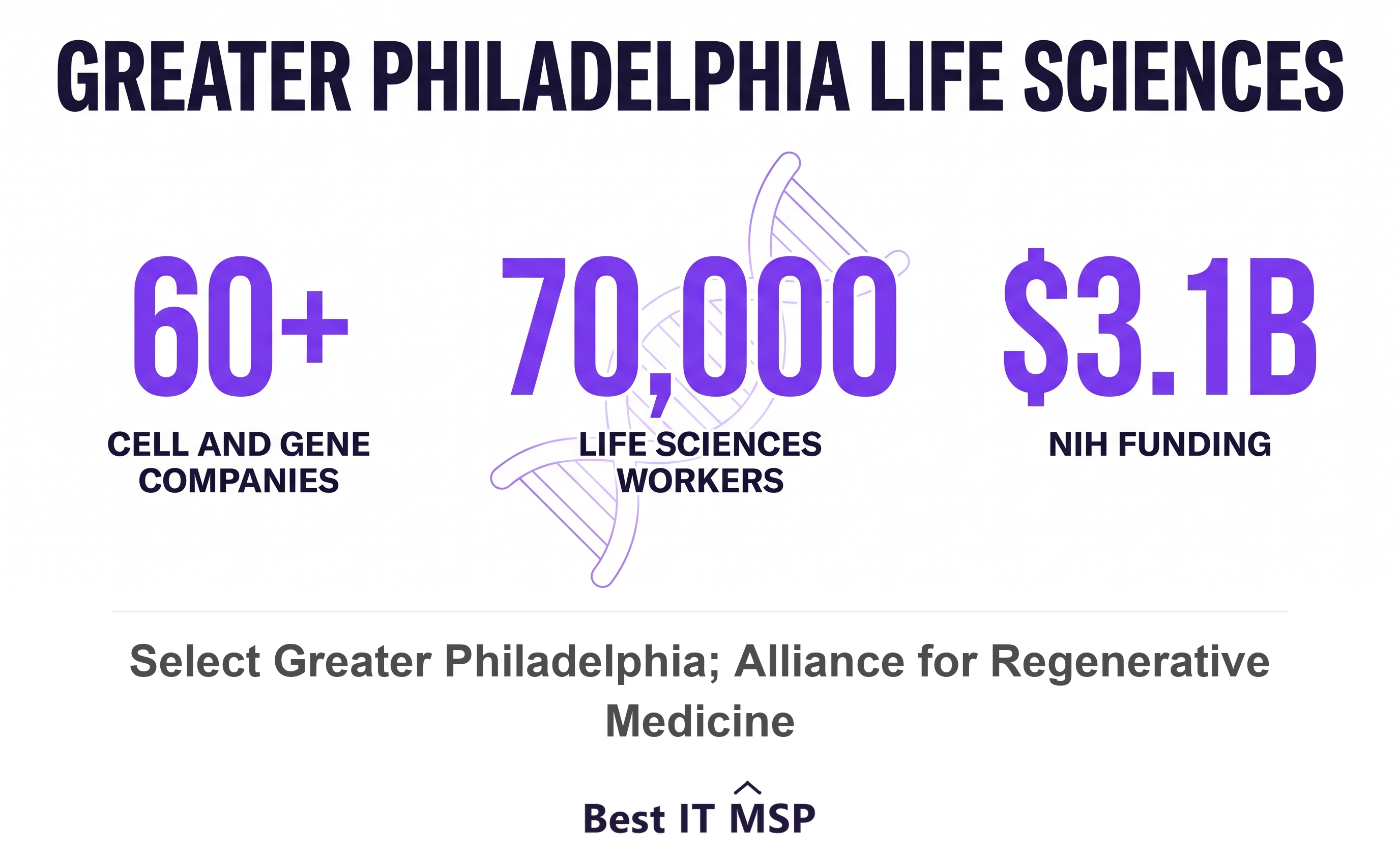
The scale is easy to understate. The region hosts more than 60 cell and gene therapy research and development companies, 70,000 people employed across its life sciences industry, and nearly 10,000 workers holding specific cell and gene therapy expertise. Penn Medicine describes the city as the academic hub for cell and gene therapy.
The institutional base behind that is dense: seven medical schools, ten medical centres, fifteen major health systems, and 3,000 biomedical and biological sciences degrees conferred each year. Funding follows, with more than $3.1 billion in National Institutes of Health funding and over $1 billion in investment capital raised for life sciences.
What that means for the data on your network
A practice in this city is more likely than most to be a trial site as well as a clinic. When it is, the data on the network stops being only patient records. It becomes study data with a sponsor attached, a retention schedule set by somebody else, and monitors who will eventually ask to see how it was handled.
That changes the IT question from confidentiality alone to confidentiality plus provenance. Who touched this record, when, and can you show it two years later when the study closes? A provider who has only ever supported clinical operations will not have been asked that before.
Which healthcare IT providers rank highest in Philadelphia?
These are the top 10 of 26 qualifying providers, in the order the methodology above produces.
| Provider | Based in | Rating | Reviews | Team size |
|---|---|---|---|---|
| PCS (Pro Computer Service) | Delaware Valley, Moorestown, NJ | 5.0 | 249 | 50-249 |
| InOs Computers | Tacony, PA | 5.0 | 209 | 10-49 |
| Total Technology Resources | Northeast Philadelphia, PA | 5.0 | 88 | 10-49 |
| Proper Sky | Philadelphia, PA | 5.0 | 85 | 10-49 |
| ITAdOn IT Solutions | Rittenhouse Square, PA | 5.0 | 56 | 10-49 |
| Cityscape Technologies | Center City, PA | 5.0 | 51 | 10-49 |
| radius180 | Philadelphia, PA | 5.0 | 26 | 10-49 |
| KPInterface | Center City, PA | 5.0 | 16 | 10-49 |
| Kontech IT Services | Center City, PA | 5.0 | 16 | 10-49 |
| Pop Quiz Computers | Northeast Philadelphia, PA | 4.9 | 37 | 10-49 |
1. PCS (Pro Computer Service) holds 5.0 from 249 reviews, works from Delaware Valley, Moorestown, NJ, trading since 1999, a 50-249 person team. The deepest review record anywhere in this series, and it works from Moorestown across the river in New Jersey while serving the Delaware Valley. Worth knowing if you want an engineer on site in Philadelphia itself.
2. InOs Computers holds 5.0 from 209 reviews, works from Tacony, PA, a 10-49 person team. Also past two hundred reviews. The top two here have more evidence behind them than any other pairing in this series, which makes the top of this table unusually solid.
3. Total Technology Resources holds 5.0 from 88 reviews, works from Northeast Philadelphia, PA, a 10-49 person team. Northeast Philadelphia, comfortably past eighty reviews.
4. Proper Sky holds 5.0 from 85 reviews, works from Philadelphia, PA, trading since 2006, a 10-49 person team. Close behind on volume, so third and fourth are separated by a small margin.
5. ITAdOn IT Solutions holds 5.0 from 56 reviews, works from Rittenhouse Square, PA, a 10-49 person team. Rittenhouse Square, in the centre of the city, with a solid record.
6. Cityscape Technologies holds 5.0 from 51 reviews, works from Center City, PA, a 10-49 person team. Center City, on a review base in the same band as the firm above it.
7. radius180 holds 5.0 from 26 reviews, works from Philadelphia, PA, a 10-49 person team. The evidence steps down here. From this position, ask for references from medical practices rather than from clients generally.
8. KPInterface holds 5.0 from 16 reviews, works from Center City, PA, a 10-49 person team. Center City with a modest sample; the average is unbroken but the base is thin.
9. Kontech IT Services holds 5.0 from 16 reviews, works from Center City, PA, a 10-49 person team. Also Center City and on a comparable sample to the firm above it, so treat eight and nine as close.
10. Pop Quiz Computers holds 4.9 from 37 reviews, works from Northeast Philadelphia, PA, a 10-49 person team. The only firm on this table not holding a perfect average, at 4.9, and it carries more reviews than the three firms above it. Tenth on the rating, better evidenced than its position suggests.
What should a Philadelphia practice ask before signing?
Three questions belong on every healthcare IT shortlist, and a city built on clinical research raises the stakes on each one.
- Will you sign a Business Associate Agreement, and what does it commit you to?
- How do you evidence who accessed patient data, and how far back does that log go?
- What is your documented recovery time if the practice loses its server on a Monday morning?
In this city, add a fourth: ask whether the provider has supported a site running clinical research, and what it had to produce for a sponsor or monitor.
The answer separates two kinds of experience quickly. Clinical IT is judged on uptime and confidentiality. Research IT is judged on those plus an audit trail somebody outside your organisation will inspect on their own schedule, years after the work was done.
Why is research data harder to hold than patient data?
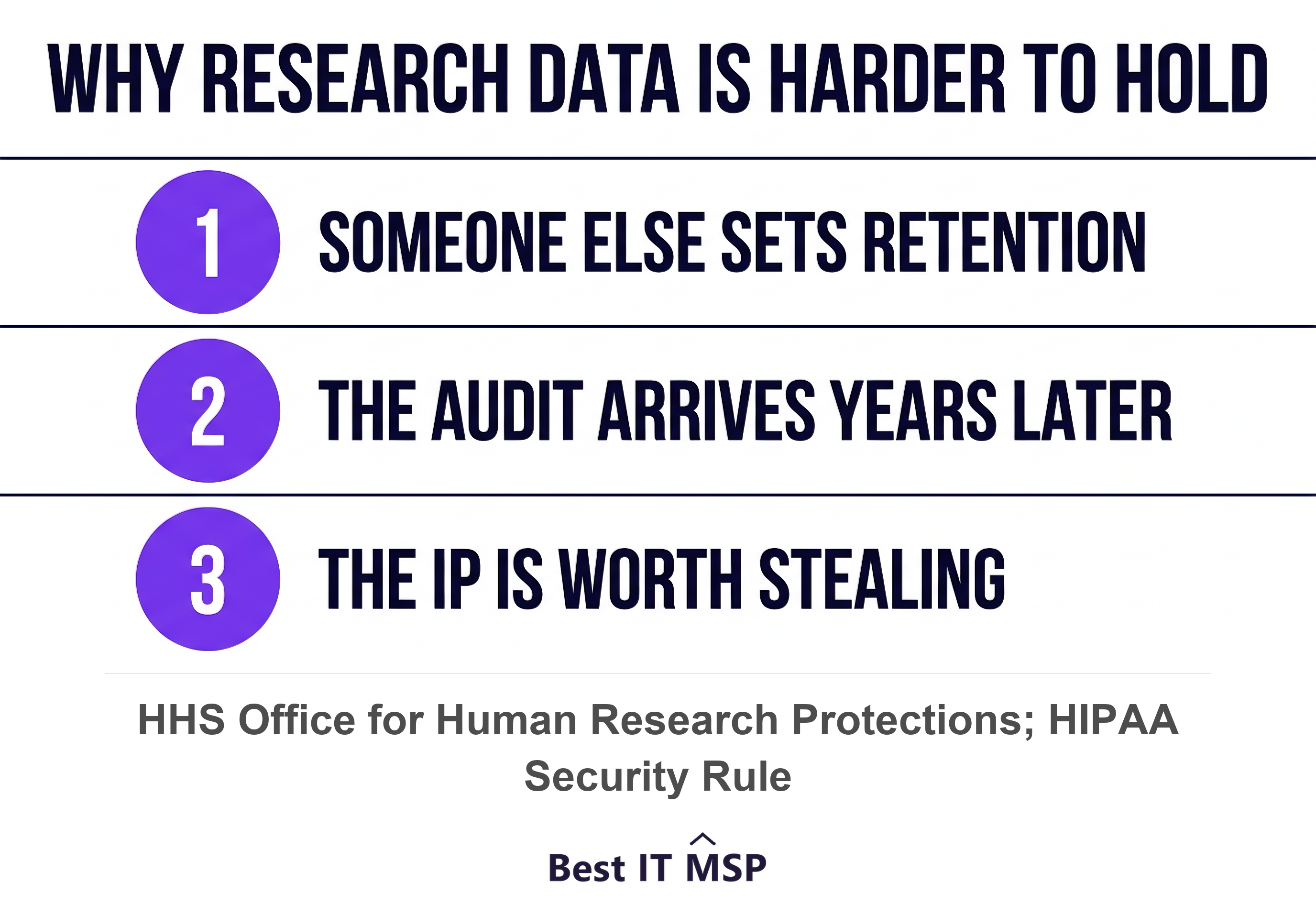
Three reasons, and none of them is about volume.
- The retention clock belongs to someone else. A sponsor or protocol sets how long study records must survive, and it is usually far longer than a practice's own policy. A backup rotation tuned to clinical needs will quietly expire material somebody is contractually entitled to see.
- The audit is external and delayed. Monitors arrive after the fact and ask what happened, so the useful artefact is the log rather than the reassurance. Logging that rolls over is the same as no logging when the question comes two years late.
- The intellectual property is worth stealing. Around a cluster with this much investment behind it, research data has a market value that a patient roster does not. That changes the threat model from opportunistic to targeted.
A provider does not need to be a clinical research organisation to handle this well. It needs to have met the requirement before, and to be able to say what it produced when somebody asked.
How do you check a provider fits this city?
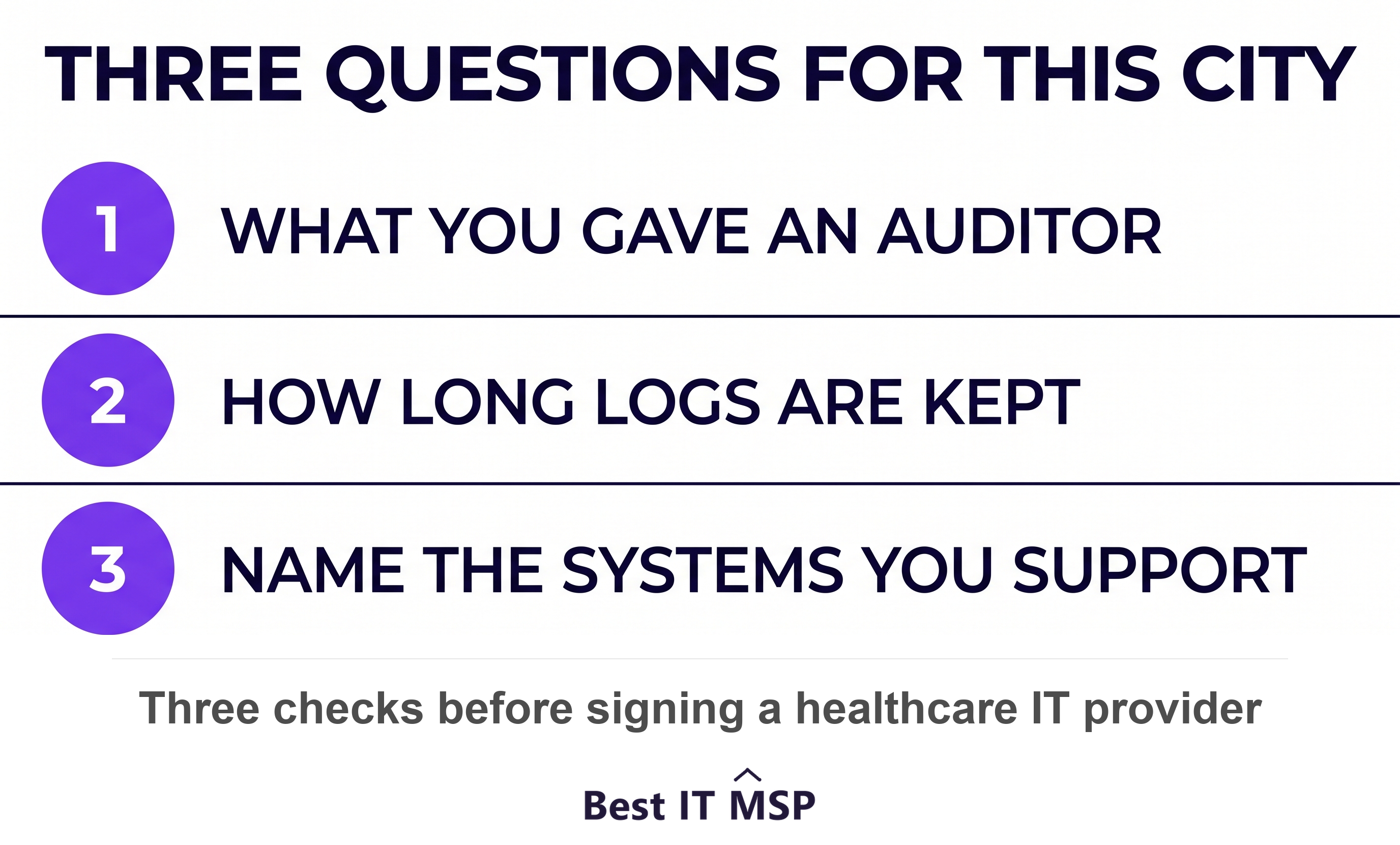
Three questions, all answerable on a first call, and none of them technical.
- Ask what they have produced for an external auditor, whether a sponsor, a monitor or a partner institution. A real answer names the artefact. A weak one describes willingness.
- Ask how long they retain access logs, and expect a period given without prompting. This is the single question that separates providers used to research from providers used to clinics.
- Ask which records or study systems they support in production, by name. This city runs on a specific set of platforms and a provider learning yours is learning it on your study.
A practice that never touches research loses nothing by asking these. A practice that does, or that expects to, finds out in one conversation whether the provider in front of it has done this work before.
FAQ
How were these Philadelphia healthcare IT providers ranked?
By confidence-weighted rating. Each provider's verified rating is pulled toward the Philadelphia average in proportion to how few reviews it has, so a 5.0 from 249 reviews outranks a 5.0 from 16. Only providers tagged to healthcare on their own listing were eligible, and paid placement was excluded.
Why does research matter for a Philadelphia medical practice?
Greater Philadelphia is the second-largest cell and gene therapy hub in the country, with more than 60 research and development companies and 70,000 people employed in life sciences. A practice here is more likely than most to also be a clinical trial site, which puts study data with external retention and audit duties on the same network as patient records.
What is different about clinical research data?
The retention clock is set by a sponsor or protocol rather than by the practice, the audit is external and often years delayed, and the intellectual property has a market value that a patient roster does not. Logging that rolls over monthly is no use when a monitor asks two years later.
Do these providers work with the major health systems?
Generally no. The region's fifteen major health systems and ten medical centres run substantial internal IT departments. These firms serve the layer around them: private practices, specialist clinics, imaging centres and smaller research operations.
Does it matter that the top-ranked firm is based in New Jersey?
It matters if you want an engineer on site quickly. The firm works from Moorestown and serves the Delaware Valley, so weigh travel time against the fact that it carries the deepest review record in this series.
How often is this ranking updated?
It is regenerated from the directory's provider data, so it moves when ratings and review counts move. The date at the top of this article is the last time the underlying figures were rebuilt.
Best IT MSP is an independent directory of managed IT providers across the US and Canada. We rank on verified rating and firmographic data, we label paid placement, and we do not sell IT services. Browse the full Philadelphia shortlist and filter by team size, service, and industry.