Common Business IT Problems (and How to Fix Them)
The most common business IT problems are downtime, security threats, outdated hardware and software, slow performance, data loss, poor connectivity, lack of IT strategy, and no in-house expertise. Almost all share one root cause: reactive, break-fix IT instead of proactive management.
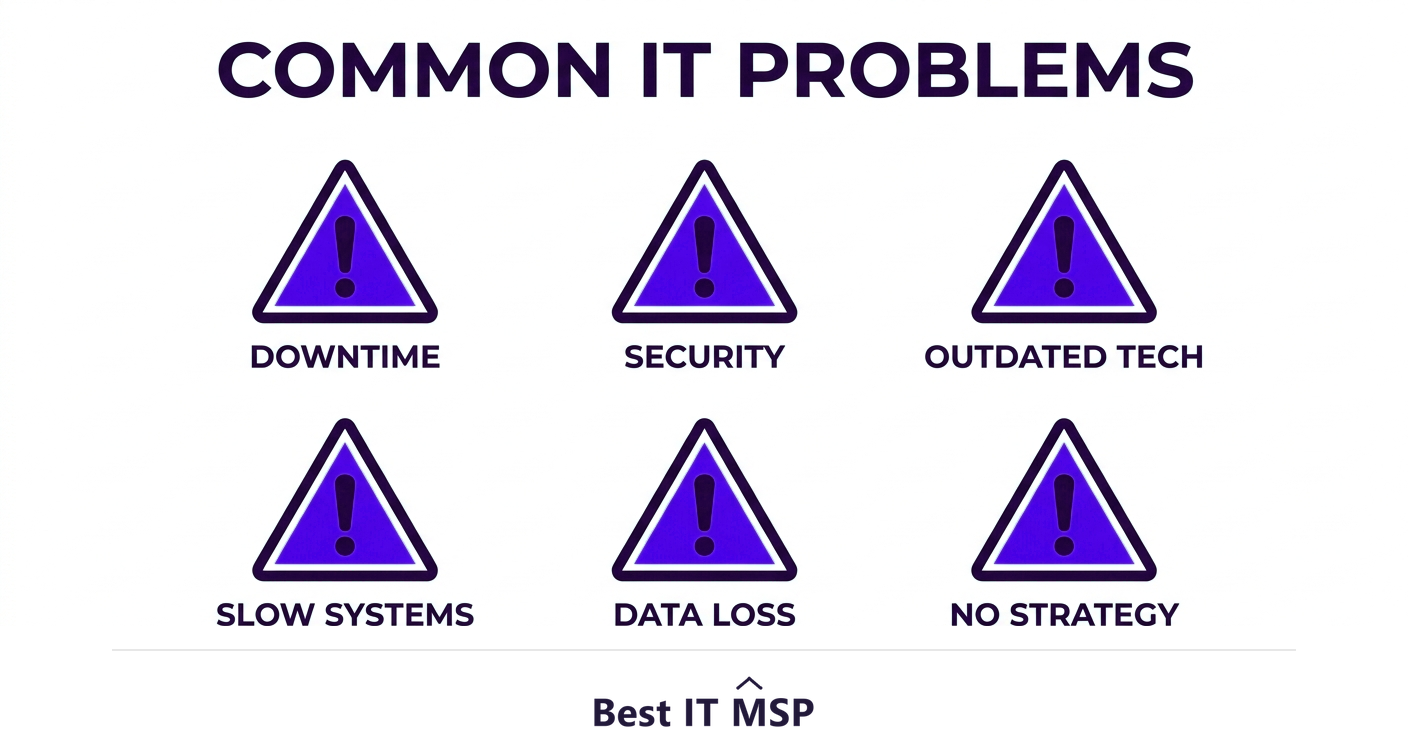
- Most business IT problems are recurring and preventable, not random bad luck.
- Downtime, security threats, and outdated technology are the most damaging and most common.
- The shared root cause is reactive break-fix IT instead of proactive monitoring and maintenance.
- Data loss and weak strategy quietly cause as much harm as visible outages.
- Proactive managed IT fixes the pattern by preventing problems rather than reacting to them.
Why business IT problems keep recurring
Every business hits technology problems, but the same handful show up again and again, and most are preventable. The reason they recur is rarely bad luck. It is almost always a reactive approach: waiting for something to break, fixing it, and moving on, without ever addressing the underlying cause. That break-fix pattern guarantees the problem returns. Understanding the most common IT problems, and their shared root, is the first step to escaping the cycle.
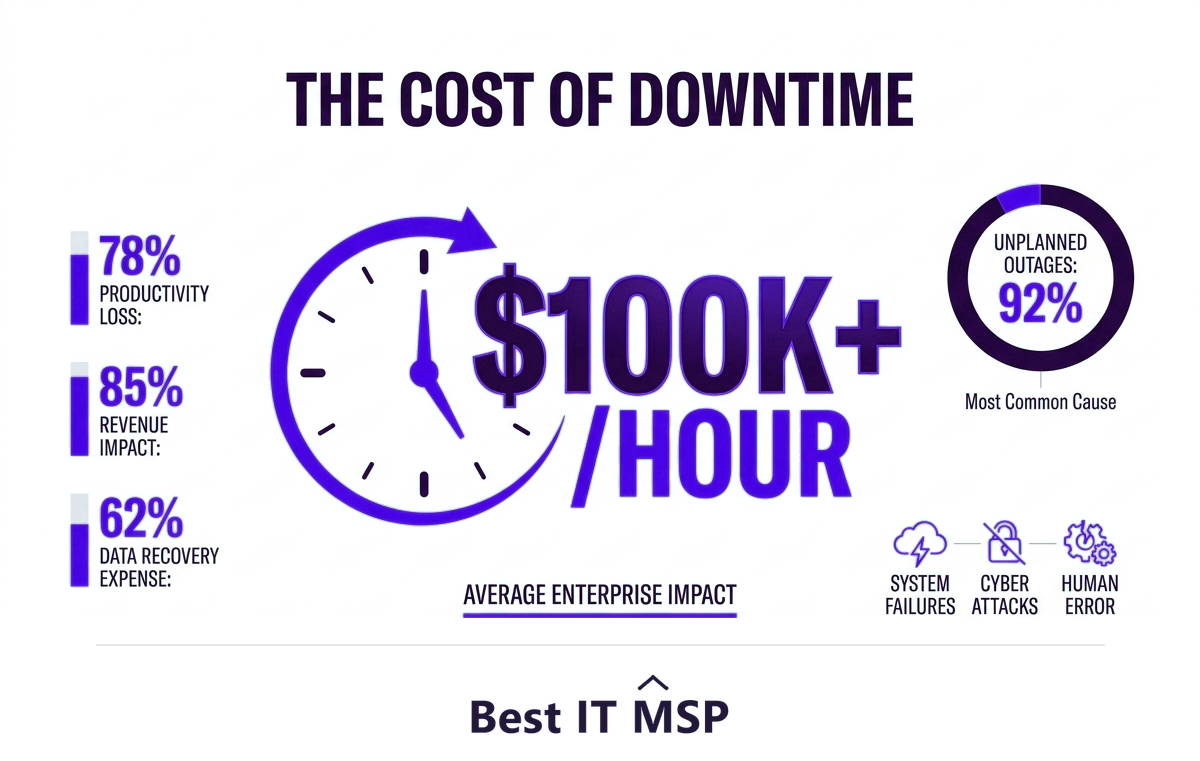
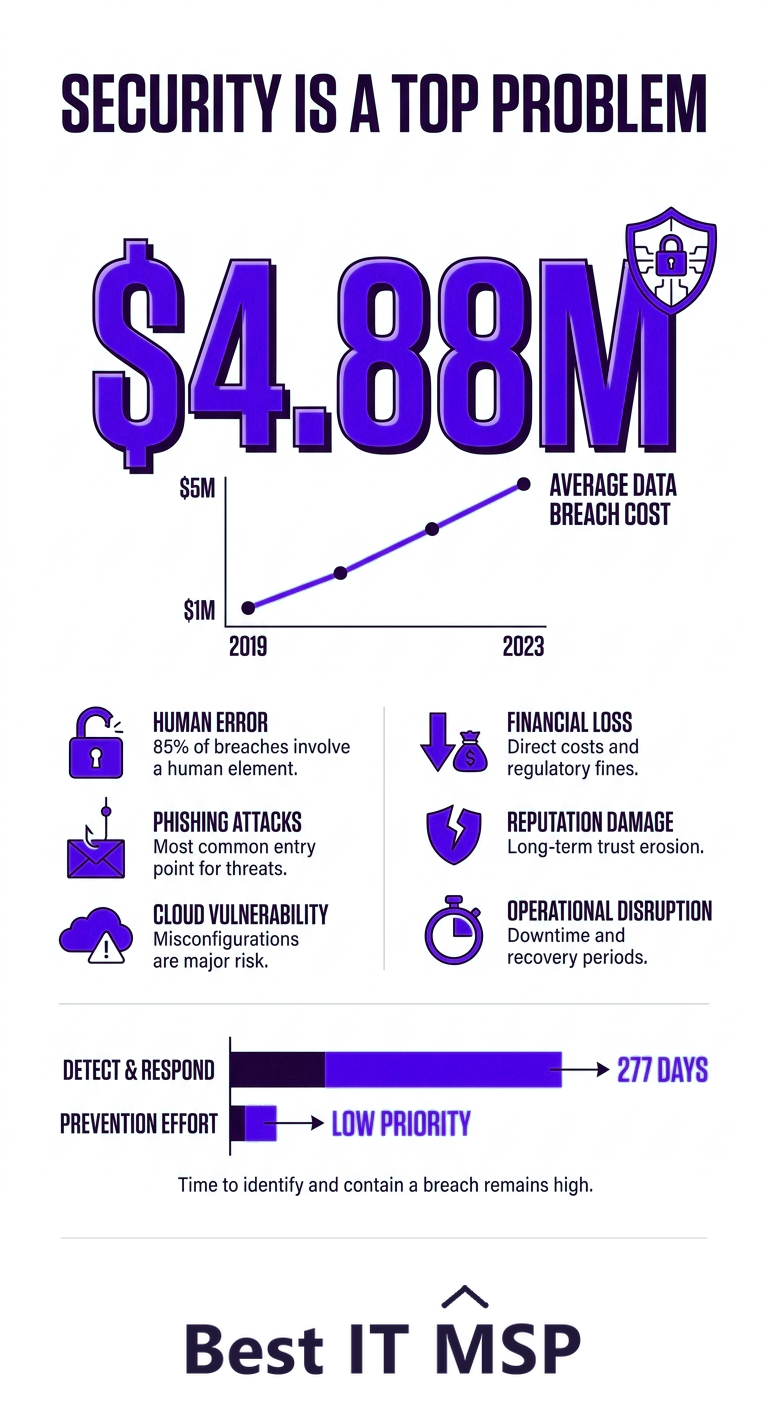
These problems are expensive when left unmanaged. An hour of downtime costs most organizations more than $100,000, the average data breach reached $4.88 million in 2024, and reported cybercrime losses topped $12.5 billion in a single year. Below are the most common business IT problems and how to fix each. This guide pairs with our IT support services overview.
1. Unplanned downtime
The most visible and costly IT problem is downtime: systems, networks, or applications going offline and stopping work. Whether caused by hardware failure, a network fault, or an attack, every minute of downtime is lost productivity and revenue. The fix is proactive monitoring and maintenance that catches issues before they cause an outage, paired with reliable backups so recovery is fast when something does fail.
2. Security threats
Cyberattacks, ransomware, phishing, and data breaches are now a daily risk for businesses of every size, and the cost of an incident can be existential. Many small businesses assume they are too small to target, which is exactly why attackers find them easy. Worse, intrusions go undetected for a long time: the average breach takes about 258 days to identify and contain, giving attackers months inside the network before anyone notices. The fix is layered security, endpoint and email protection, multi-factor authentication, monitoring, and staff training, maintained continuously rather than bolted on after an incident, plus an incident response plan so a breach is contained fast instead of spreading.
3. Outdated hardware and software
Aging computers, servers, and unsupported software slow staff down and open security holes, because old systems stop receiving the patches that fix known flaws. The problem compounds quietly until something fails or is exploited. The fix is lifecycle management: track what you own, keep everything supported and patched, and replace equipment on a planned schedule rather than waiting for it to die at the worst possible moment.
4. Slow systems and performance
Slow computers, laggy applications, and sluggish networks are a constant drain on productivity that rarely gets diagnosed properly because no single failure forces the issue. The causes range from underpowered hardware and full disks to network bottlenecks and misconfiguration. The fix is regular maintenance and monitoring that spots the bottleneck and resolves it, plus right-sizing hardware and connectivity to what the business actually needs. Slow systems are easy to tolerate and easy to underestimate, but a few minutes lost per employee per day, multiplied across a team and a year, is a serious hidden cost that proactive maintenance quietly recovers.
5. Data loss and weak backups
Data loss from hardware failure, accidental deletion, or ransomware can be catastrophic, and many businesses discover their backups were incomplete or untested only when they desperately need them. The fix is a proper backup and disaster recovery plan: automated backups, copies kept off-site or in the cloud, and, crucially, regular tests to confirm the data can actually be restored. A backup you have never tested is a hope, not a plan.
6. Poor connectivity and no IT strategy
Two quieter problems round out the list. Unreliable internet and WiFi disrupt work and frustrate staff, and usually point to aging equipment or an under-provisioned connection that monitoring and proper network design would fix. The deeper problem is the absence of an IT strategy: technology bought reactively, with no roadmap, no budget plan, and no alignment to business goals. Without strategy, every other problem is more likely, because nothing is being anticipated. The fix is a roadmap, often guided by a virtual CIO, that plans technology around where the business is going, so purchases are deliberate and budgets are predictable rather than driven by the latest emergency.
The root cause: reactive instead of proactive IT
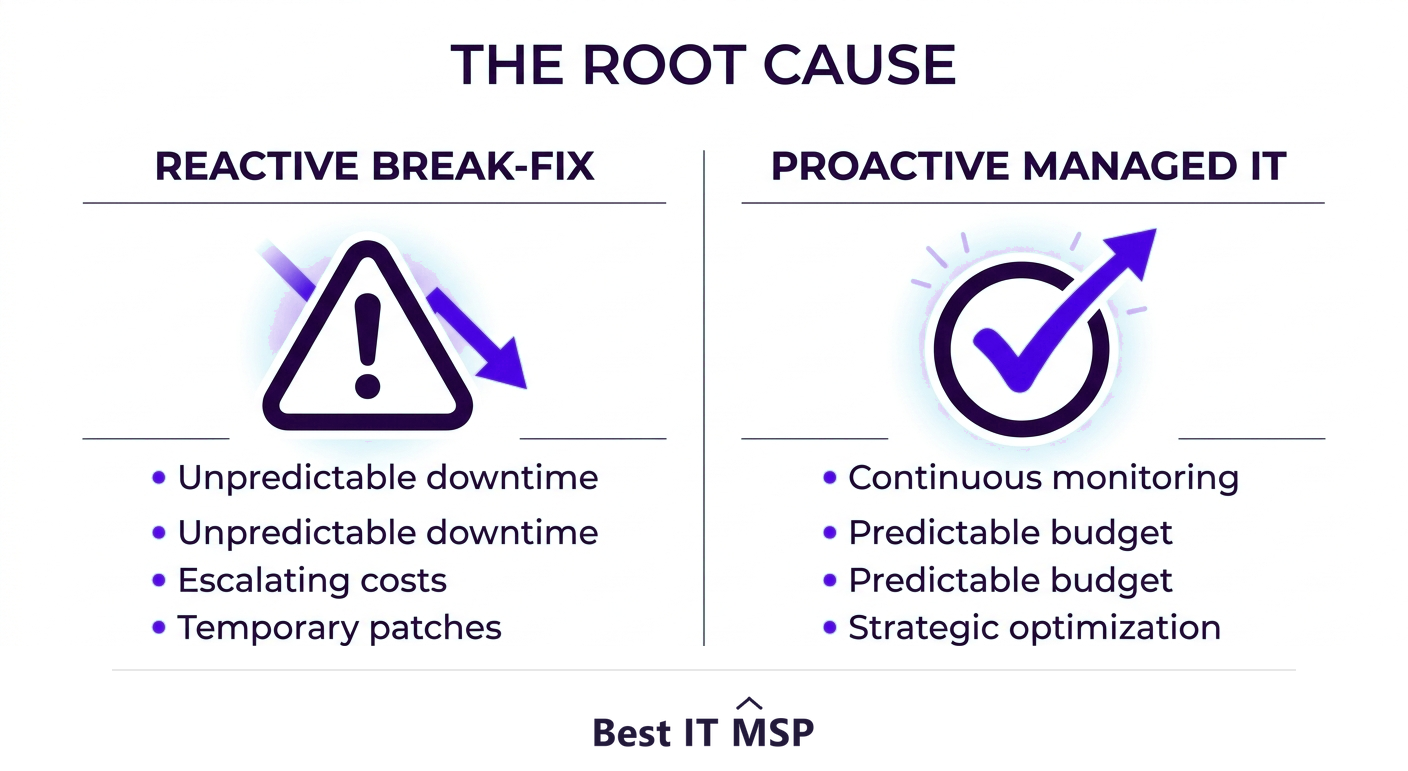
Look closely and almost every problem above shares one root cause: reactive, break-fix IT. When technology is only addressed after it breaks, problems are guaranteed to recur, downtime is common, security is an afterthought, and nothing is planned. Proactive management flips this. By monitoring systems around the clock, patching and maintaining them, securing them by default, backing them up, and planning ahead, a business prevents most problems instead of fighting them.
This is also why hiring alone rarely solves it. A single overworked technician, or no IT staff at all, cannot monitor everything around the clock, and skilled help is scarce amid a global shortfall of about 4.8 million cybersecurity and IT professionals. As more systems move to the cloud, in a market where public cloud spending is forecast to top $723 billion in 2025, the gap between reactive and proactive IT only widens.
How to break the cycle
The practical fix for most small and midsize businesses is managed IT: a provider that takes responsibility for monitoring, maintaining, securing, and planning your technology for a predictable monthly fee. Instead of paying by the emergency, you get proactive prevention, and the recurring problems above gradually disappear. The shift in the market reflects how well this works, with the managed services market projected to grow from about $330 billion in 2024 to about $879 billion over the next decade. The change in experience is what businesses notice most: instead of lurching from one crisis to the next, technology becomes quiet, predictable, and dependable, and the team stops thinking about IT at all, which is exactly how it should be.
If the same IT problems keep interrupting your business, the answer is usually a better model, not another quick fix. To find a provider that prevents problems rather than just reacting to them, browse vetted, merit-ranked firms by city in the Best IT MSP directory, where ranking is earned on rating and verified data.
FAQ
What are the most common business IT problems?
The most common are unplanned downtime, security threats such as ransomware and phishing, outdated hardware and software, slow systems and performance, data loss from weak backups, poor connectivity, and the lack of an IT strategy. Most are recurring and preventable rather than random, and they share a single root cause.
Why do the same IT problems keep happening?
Because most businesses take a reactive, break-fix approach: they fix what breaks and move on without addressing the underlying cause, so the problem returns. Proactive management, monitoring, patching, securing, backing up, and planning ahead, prevents problems instead of repeatedly reacting to them, which is what breaks the cycle.
How much do IT problems cost a business?
More than most expect. An hour of downtime costs most organizations more than $100,000, the average data breach reached $4.88 million in 2024, and reported cybercrime losses topped $12.5 billion in a single year. Slow systems and data loss add hidden costs in lost productivity and recovery that rarely get measured.
How do you fix recurring IT problems?
Address the root cause by switching from reactive break-fix to proactive management: monitor systems around the clock, patch and maintain hardware and software, secure everything by default, run tested backups and disaster recovery, and follow an IT strategy aligned to business goals. For most businesses, managed IT delivers this as one service.
Why is data loss such a common IT problem?
Because many businesses have backups that are incomplete or never tested, and only discover the gap when hardware fails, someone deletes a file, or ransomware strikes. The fix is automated backups, off-site or cloud copies, and regular restore tests. A backup you have never tested is a hope, not a plan.
Should I hire IT staff or use a managed provider to fix these problems?
A single technician or no IT staff cannot monitor everything around the clock, and skilled help is scarce. For most small and midsize businesses, a managed IT provider is the practical fix: it delivers proactive monitoring, maintenance, security, and strategy for a predictable fee, preventing the recurring problems rather than reacting to them.
Best IT MSP is the independent directory of vetted managed IT providers across North America. Compare merit-ranked firms in your city that prevent problems with proactive monitoring and support. No pay-to-play.