The Business Benefits of IT Outsourcing
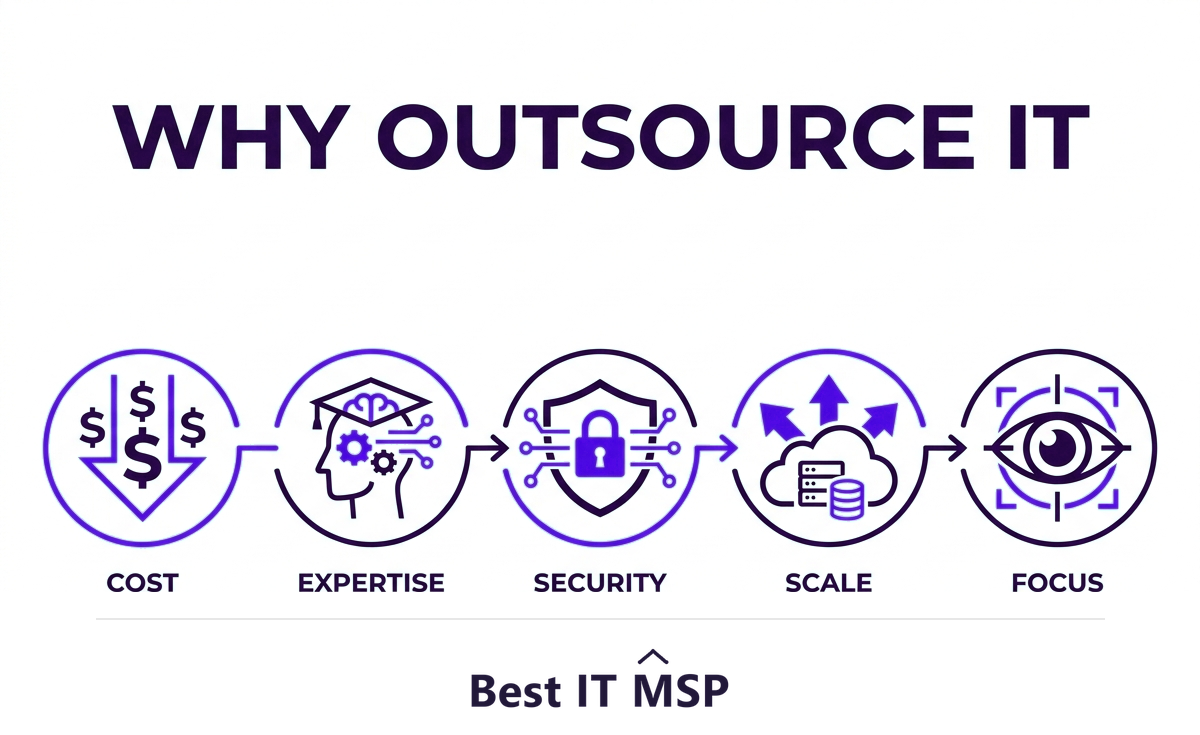
The main benefits of IT outsourcing are lower and more predictable costs, instant access to specialized expertise, stronger cybersecurity, the ability to scale up or down quickly, and more time to focus on your core business.
- IT outsourcing means delegating some or all of your technology to a specialized external provider.
- The biggest benefits are predictable cost, expert talent, stronger security, scalability, and focus on the core business.
- It is usually cheaper and more capable than building an equivalent in-house team, especially for SMBs.
- Outsourcing also reduces risk: a provider brings enterprise-grade security and around-the-clock coverage.
- The key is choosing the right provider and a model (full or co-managed) that fits how your business works.
What is IT outsourcing?
IT outsourcing is the practice of delegating some or all of your technology functions to a specialized external provider, instead of handling everything with in-house staff. That can mean outsourcing your entire IT operation to a managed service provider, or bringing in outside help for specific areas like cybersecurity, cloud, or help desk support. The common thread is the same: you get expert capability and capacity from a partner whose whole business is technology, usually for a predictable fee.
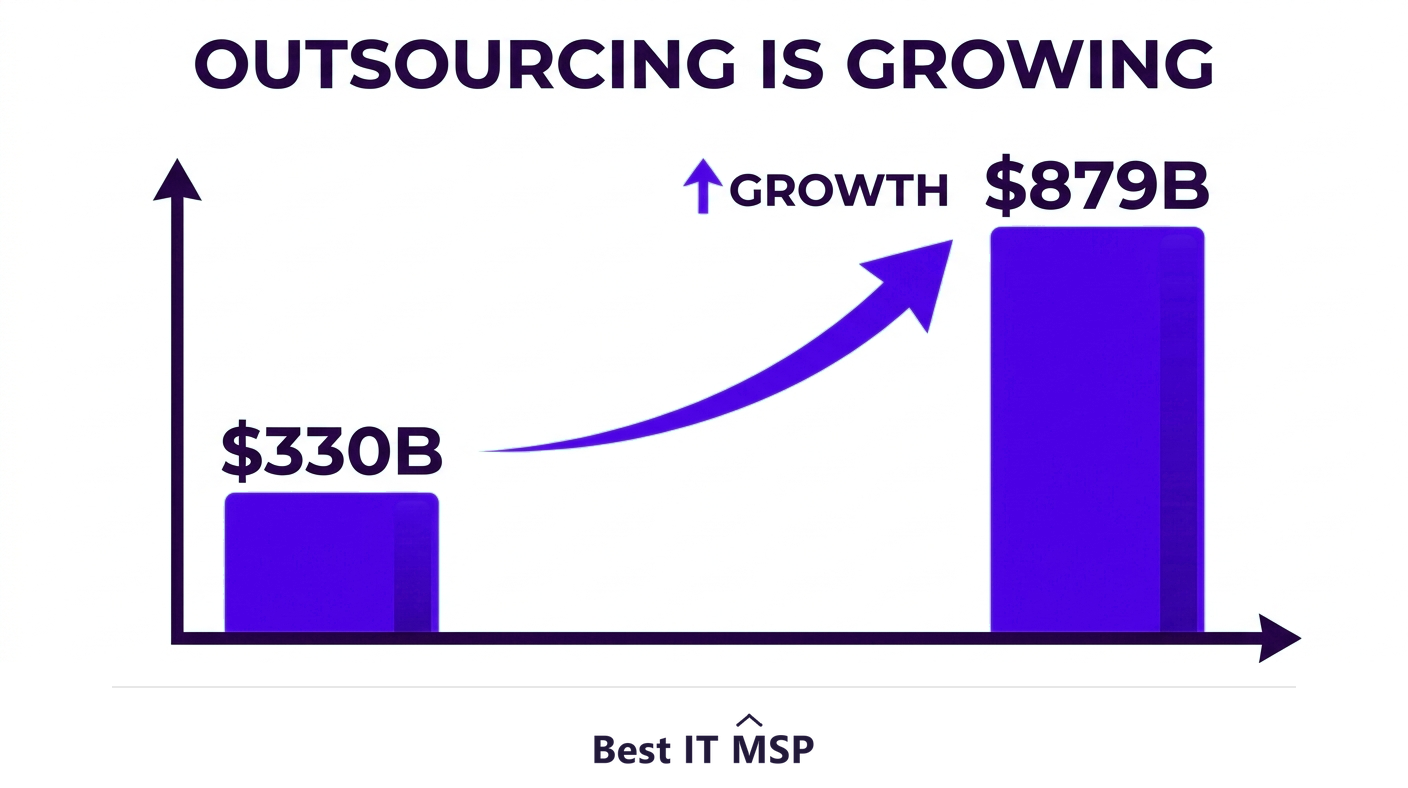
It has become a mainstream strategy rather than a last resort. The global managed services market was valued at roughly $330 billion in 2024, is projected to reach about $879 billion over the next decade, and is growing at roughly a 13 to 15 percent annual rate. Businesses outsource because technology is more central, more complex, and more targeted than ever, and building all of that expertise in-house is expensive and slow. This guide covers the real benefits, and the trade-offs. It pairs with our IT outsourcing services overview.
Benefit 1: Lower and more predictable costs
Cost is the most immediate benefit. Building an in-house IT team means salaries, benefits, training, tools, and management overhead, all fixed costs you carry whether or not you need them every day. Outsourcing converts most of that into a predictable monthly fee, usually priced per user or per device, so your technology spend becomes a single budgetable line item instead of a series of surprise expenses. You also avoid the large upfront cost of hiring, and you stop paying for idle capacity between projects and emergencies.
Benefit 2: Instant access to specialized expertise
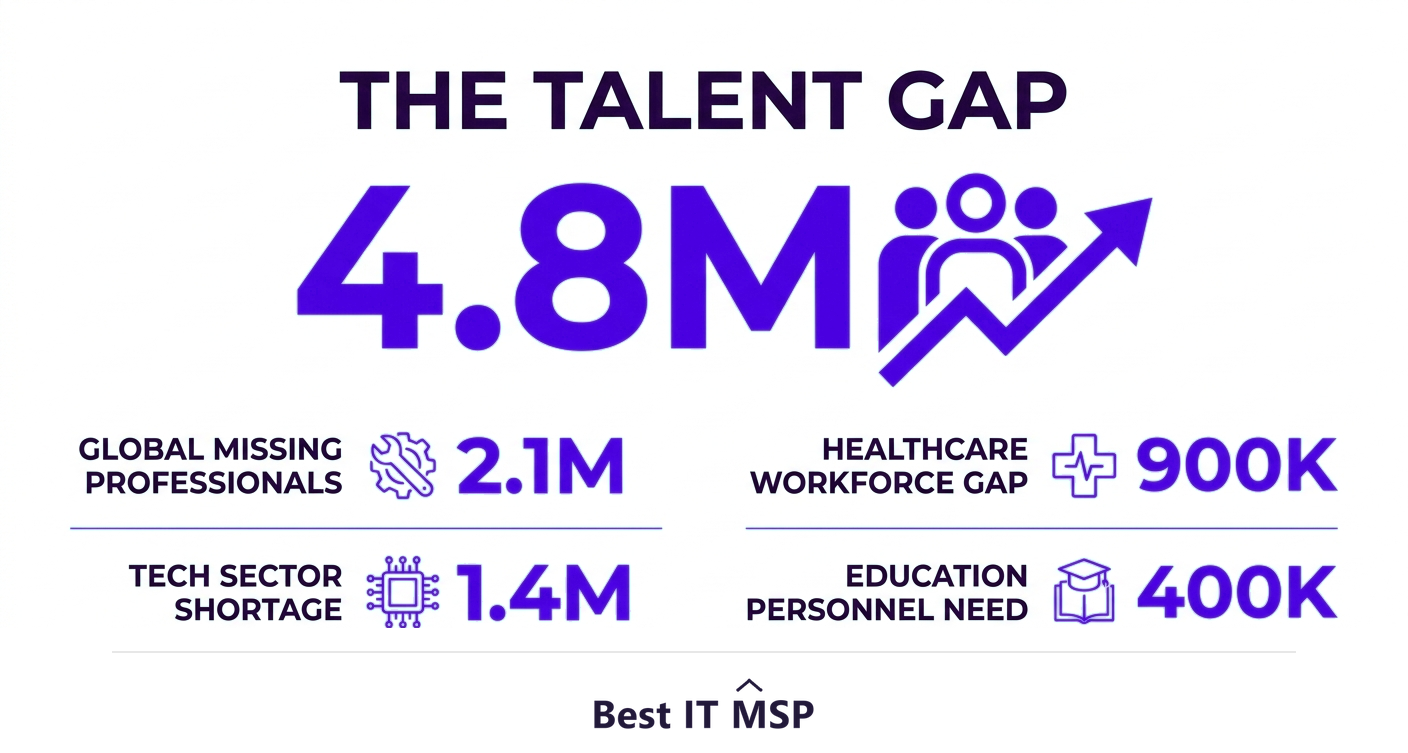
No single hire can be an expert in security, cloud, networking, compliance, and help desk support all at once, yet a modern business needs all of them. A provider spreads a deep team of specialists across many clients, so you get access to that full range of expertise for far less than the cost of employing it. This matters more every year, because skilled talent is genuinely scarce: there is a global shortfall of about 4.8 million cybersecurity professionals, which makes hiring slow, expensive, and competitive. Outsourcing solves the talent problem instantly.
Benefit 3: Stronger cybersecurity
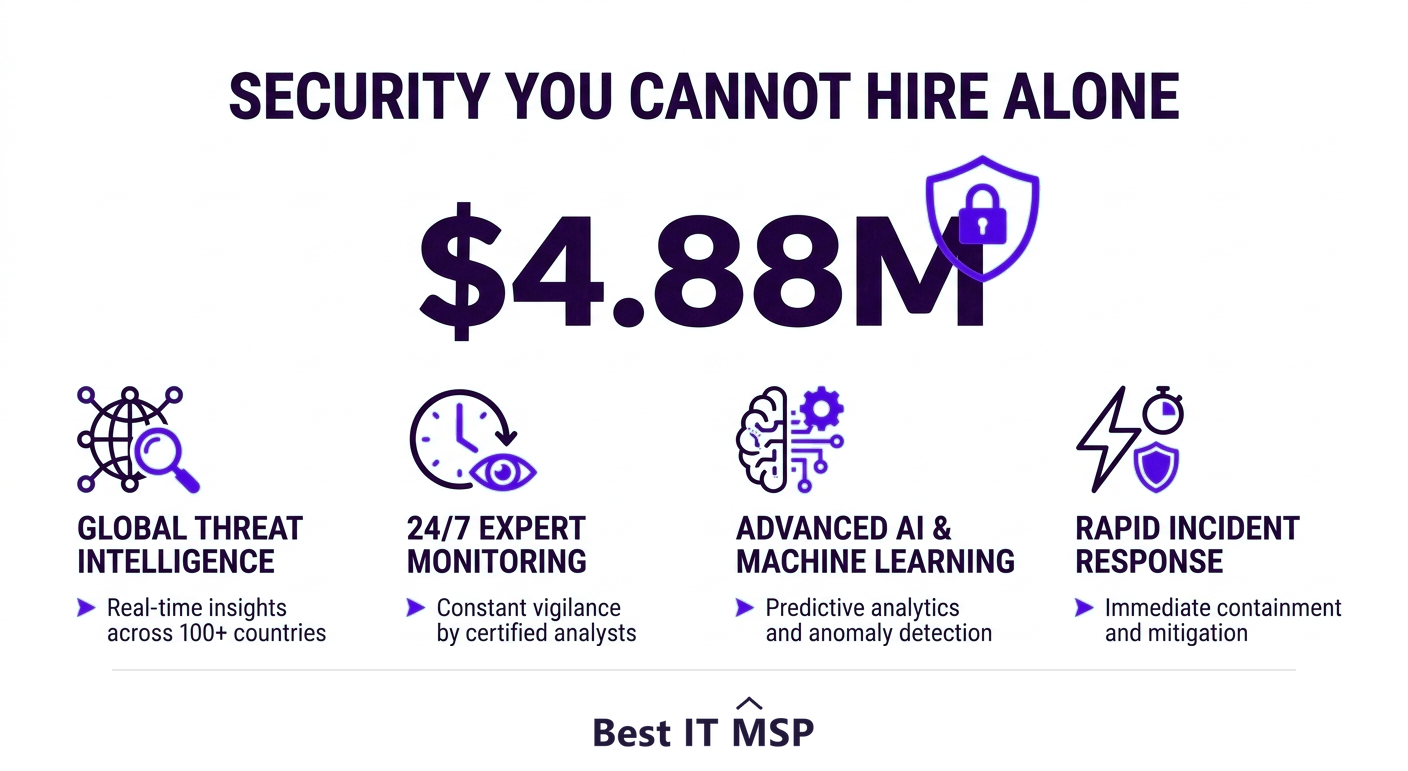
Security is where outsourcing often pays for itself. A good provider bundles enterprise-grade defenses, endpoint protection, email security, multi-factor authentication, monitoring, and tested backups, that most businesses cannot assemble or staff alone. The stakes are high: the average data breach now costs $4.88 million, reported cybercrime losses top $12.5 billion in a single year, and the typical breach takes about 258 days to identify and contain. A provider gives you around-the-clock protection and faster detection than a small internal team can usually match.
Benefit 4: Scalability and flexibility
Outsourced IT flexes with your business. Because services are typically priced per user or per device, your IT capacity and cost rise and fall with your headcount, so the same partner supports you through growth, seasonal swings, or a downturn without forcing you to hire or lay off staff. Spinning up a new office, onboarding a wave of employees, or launching a project becomes a matter of scaling the service rather than rebuilding your team. This agility is hard to achieve with a fixed in-house department, where adding capacity means a months-long hiring cycle and shedding it means layoffs. In short, outsourced IT is inherently scalable: capacity becomes something you turn up or down on demand, not something you recruit and train for. For a fast-growing business, that elasticity can be the difference between technology accelerating growth and technology becoming the bottleneck that holds it back.
Benefit 5: More focus on your core business
Perhaps the most underrated benefit is focus. When technology is handled by a partner, the owner and team stop firefighting IT and get back to the work that actually grows the company. Downtime is a direct drain on that focus and on revenue, with an hour of downtime costing most organizations more than $100,000, and a provider that prevents outages protects both your time and your income. Outsourcing lets a business behave like a much larger one technologically, while keeping its energy on its real mission.
The trade-offs to weigh
Outsourcing is not free of trade-offs, and naming them is part of doing it well. You give up some direct control, so a clear service level agreement and good communication matter. You depend on the provider, which makes choosing a reliable one and understanding the exit terms important. And a poor provider can deliver slow response or thin security, erasing the benefits. The answer is not to avoid outsourcing but to choose carefully and, where you want to keep an internal team, to consider a co-managed IT model that blends in-house staff with outside support. Set clear expectations up front, agree on response times and reporting in writing, and treat the provider as a long-term partner rather than a disposable vendor. The businesses that get the most from outsourcing are the ones that manage the relationship actively instead of signing a contract and walking away.
Is IT outsourcing right for your business?
IT outsourcing fits most small and midsize businesses that depend on technology but do not want to build and run a full internal department, as well as larger organizations that want to offload routine work or fill specialist gaps. It is especially valuable if you lack in-house IT, face security or compliance requirements, or are growing and need capacity that scales. Because the public cloud is now central to most IT, in a market where public cloud spending is forecast to top $723 billion in 2025, a provider also keeps you current with technology that changes faster than most teams can track.
As with any partnership, the benefits depend on the provider you choose. Shortlist a few, compare them on response times, included security, and references, and pick the best fit. To start from a vetted, merit-ranked list, browse providers by city in the Best IT MSP directory, where ranking is earned on rating and verified data.
FAQ
What are the benefits of IT outsourcing?
The main benefits are lower and more predictable costs, instant access to specialized expertise, stronger cybersecurity, the ability to scale up or down quickly, and more time to focus on your core business. Outsourcing converts unpredictable IT costs into a flat fee and gives you a full team for less than the cost of hiring one.
Does outsourcing IT save money?
Usually yes. Outsourcing replaces the salaries, benefits, tools, and overhead of an in-house team with a predictable monthly fee, and it avoids paying for idle capacity. Preventing downtime and breaches saves more still, since an hour of downtime costs most organizations more than $100,000 and the average breach costs $4.88 million.
Is outsourced IT more secure than in-house IT?
Often, for small and midsize businesses. A provider bundles enterprise-grade defenses such as endpoint protection, email security, MFA, monitoring, and backups, with around-the-clock coverage that a small internal team rarely matches. Given a global shortfall of about 4.8 million cybersecurity professionals, this expertise is hard and expensive to hire directly.
What are the risks of IT outsourcing?
The main trade-offs are giving up some direct control, depending on the provider, and the risk that a poor provider delivers slow response or thin security. These are managed with a clear service level agreement, good communication, careful provider selection, understood exit terms, and, if you want to keep internal staff, a co-managed model.
Can IT outsourcing scale with my business?
Yes. Because outsourced IT is usually priced per user or per device, your capacity and cost rise and fall with your headcount. The same provider can support growth, seasonal swings, new offices, or downsizing without forcing you to hire or lay off staff, which is far more flexible than a fixed in-house department.
Should I fully outsource IT or use a co-managed model?
It depends on whether you have or want internal IT staff. Full outsourcing suits businesses with no in-house team, while a co-managed model blends your internal staff with a provider to cover gaps, projects, security, and after-hours support. Both deliver the core benefits; the right choice fits how your business already works.
Best IT MSP is the independent directory of vetted managed IT providers across North America. Compare merit-ranked firms in your city on real ratings and verified data, not on who pays the most. No pay-to-play.