Vulnerability Assessment vs Penetration Testing
A vulnerability assessment is a broad, mostly automated scan that finds and lists known weaknesses across your systems. A penetration test is a deeper, human-led exercise where ethical hackers actively try to exploit weaknesses to prove what an attacker could really do.
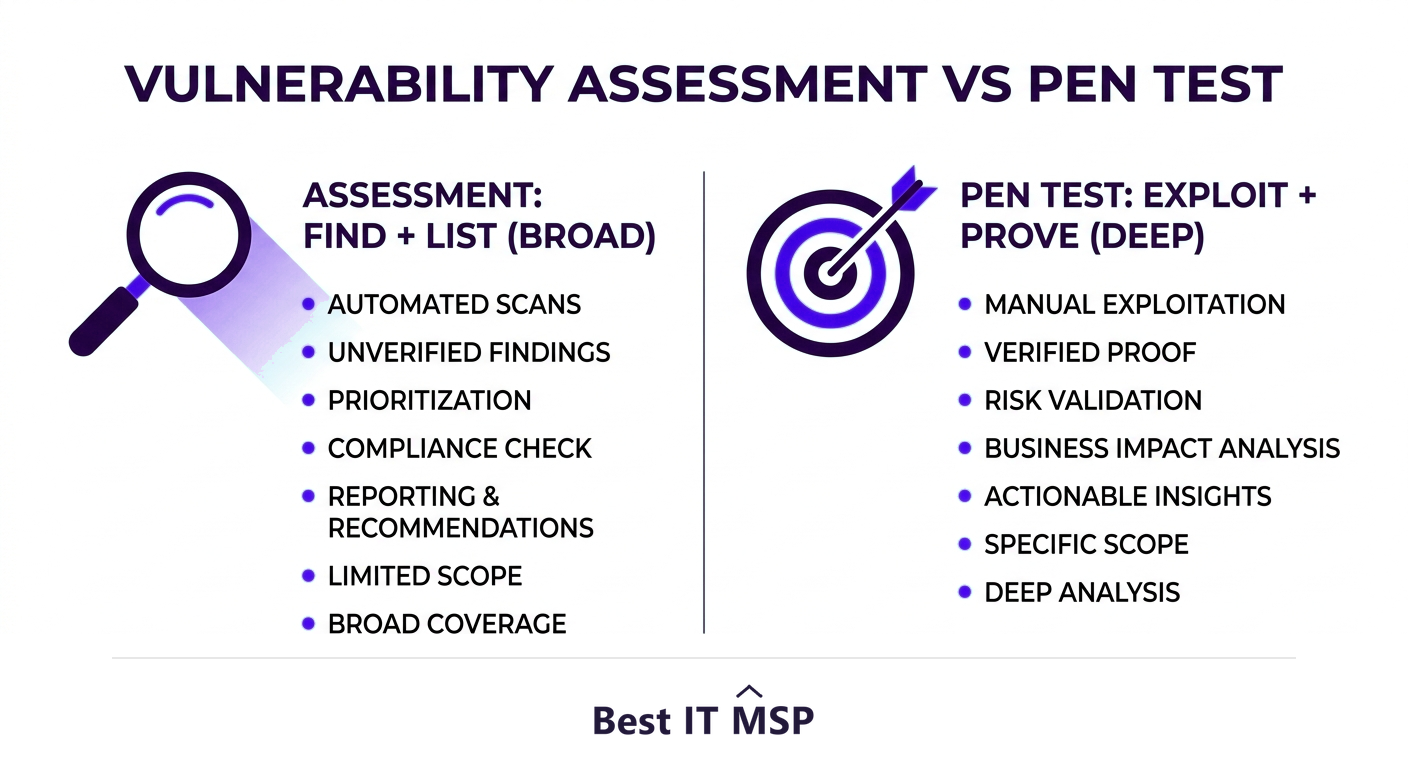
- A vulnerability assessment scans broadly to find and list known weaknesses; it is mostly automated.
- A penetration test is human-led and actively exploits weaknesses to prove real-world impact.
- Assessments cover breadth and run often; pen tests provide depth and run periodically.
- Pen testing costs more and goes deeper; vulnerability scanning is cheaper and continuous.
- They are complementary, and most businesses need both for a complete picture of their risk.
How did we compare vulnerability assessments and penetration tests?
By what each one produces, because the deliverable is the difference. One hands you a list to work through; the other hands you a story about what an attacker did with it.
- The dimensions. Approach, goal, breadth against depth, how often each runs, what it costs, and the form the output takes.
- The evidence. Exploitation trends come from Verizon, breach cost from IBM, reported losses from the FBI's IC3, and the hiring gap from ISC2.
- No vendor ranking. This compares approaches, not products. It names no vendors and recommends no supplier.
- Independence. Best IT MSP does not sell IT services or security services, and does not appear in its own rankings.
The output row is the one buyers most often get wrong, because a list and a narrative are not substitutes for one another.
What is the difference between a vulnerability assessment and a penetration test?
These two security tests are often confused or used interchangeably, but they answer different questions. A vulnerability assessment asks where might we be weak? It scans your systems broadly and produces a list of known vulnerabilities, missing patches, misconfigurations, weak settings, ranked by severity. A penetration test asks how bad could it really get? Skilled ethical hackers actively try to exploit weaknesses, chaining them together the way a real attacker would, to prove what damage is actually possible. In short, an assessment finds and lists potential weaknesses across many systems; a pen test takes a smaller set and proves, by exploiting them, what an attacker could do with them.
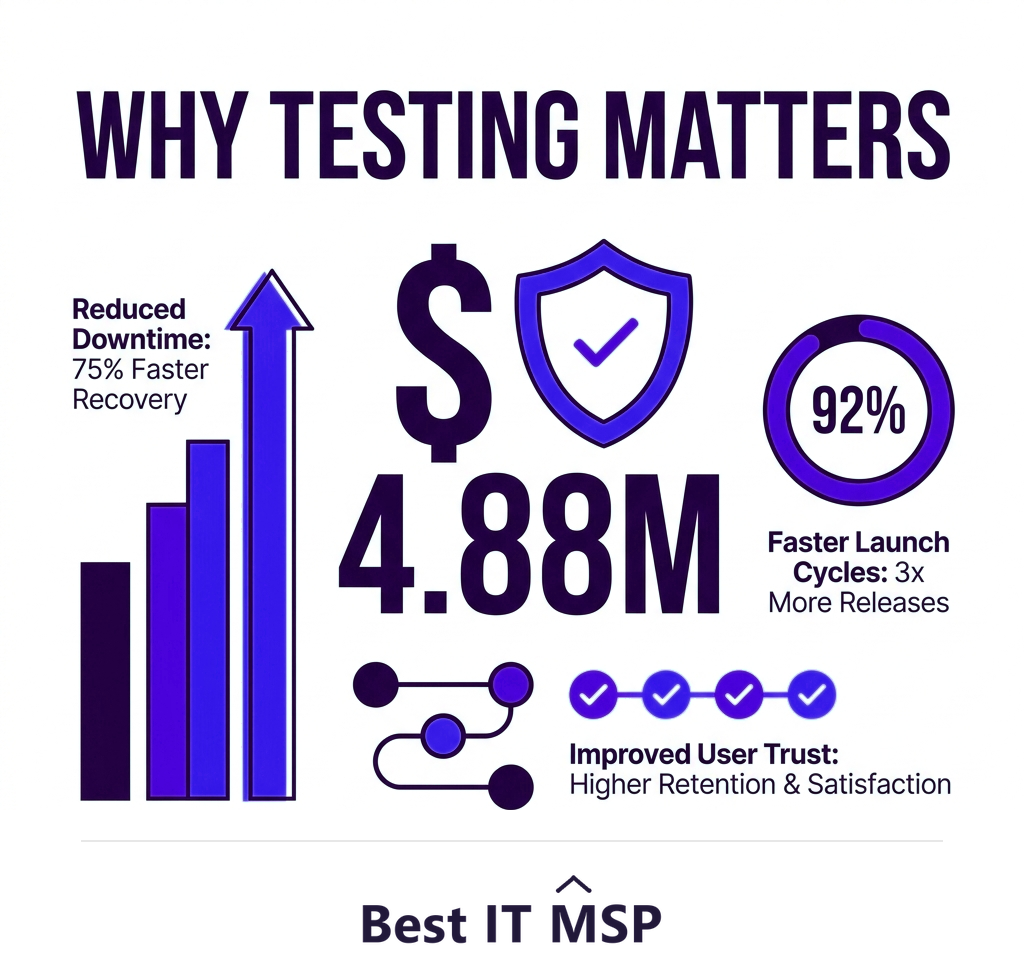
Both matter because unfound and unproven weaknesses are exactly what attackers exploit, and the cost is high, with the average data breach reaching $4.88 million, the human element involved in 68 percent of breaches, an outage from a successful attack costing more than $100,000 an hour, and reported cybercrime losses topping $12.5 billion in a single year. Knowing which test you need, and when, saves money and closes the right gaps. This guide explains the differences and how they work together. It pairs with our penetration testing services and cybersecurity services overviews.
What is a vulnerability assessment?
A vulnerability assessment is a broad, systematic review, largely automated, that scans your systems, networks, and applications to identify known weaknesses. Specialized scanning tools check your environment against huge databases of known vulnerabilities and misconfigurations, then produce a report listing what they found, usually rated by severity. The strength of a vulnerability assessment is coverage and speed: it can examine your entire environment quickly and repeatedly, giving you a comprehensive, up-to-date list of where you might be exposed. Because it is mostly automated, it is affordable enough to run frequently, which is exactly how it should be used, since new vulnerabilities appear constantly. Its limitation is that it identifies potential weaknesses without confirming whether they are truly exploitable or how damaging they would be.
What is penetration testing?
A penetration test (pen test) is a deeper, human-led exercise in which skilled ethical hackers actively attempt to break into your systems, with permission, using the same tools and techniques as real attackers. Rather than just listing weaknesses, they exploit them: chaining vulnerabilities together, escalating access, and seeing how far they can get, then documenting exactly what they achieved and how. A pen test answers the question a scan cannot: if an attacker targeted us, what could they actually reach and do? Because it relies on human expertise and creativity, a pen test goes far deeper than automated scanning and uncovers complex, logic-based, and chained weaknesses that tools miss, but it is more time-consuming and expensive, so it is run periodically rather than continuously.
How do the two differ, dimension by dimension?
Put side by side, the contrast is clear:
| Dimension | Vulnerability assessment | Penetration test |
|---|---|---|
| Approach | Mostly automated scanning | Human-led, hands-on |
| Goal | Find and list weaknesses | Exploit them to prove real-world impact |
| Breadth against depth | Broad and shallow, covering everything | Narrow and deep, going hard at a target |
| Frequency | Often, monthly or continuously | Periodically, often annually or after a major change |
| Cost | Relatively inexpensive | Higher, because of the expert time |
| What you get | A prioritised list of vulnerabilities | A narrative of what was breached, with proof |
- <strong>Approach.</strong> A vulnerability assessment is mostly automated scanning; a pen test is human-led, hands-on hacking.
- <strong>Goal.</strong> An assessment finds and lists weaknesses; a pen test exploits them to prove real-world impact.
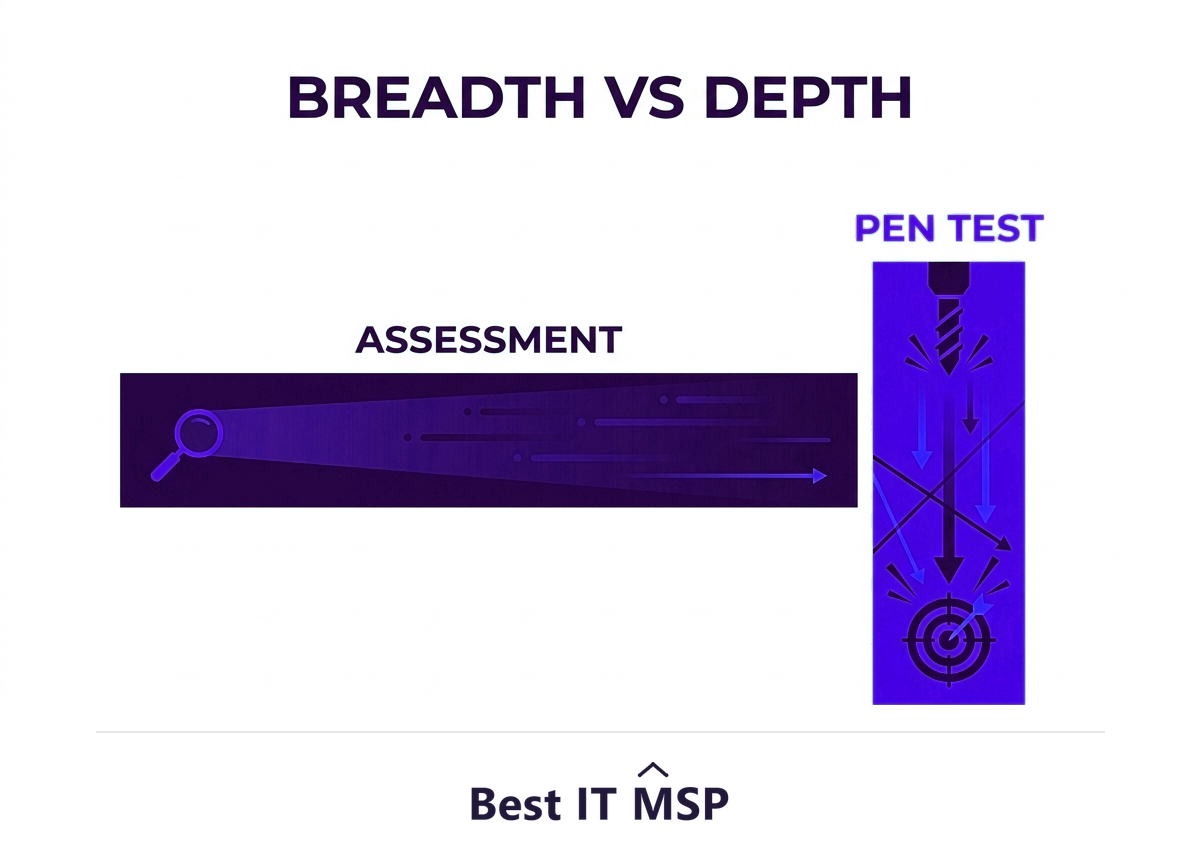
- <strong>Breadth vs depth.</strong> Assessments are broad and shallow, covering everything; pen tests are narrow and deep, going hard at a target.
- <strong>Frequency.</strong> Assessments run often (monthly or continuously); pen tests run periodically (often annually or after major changes).
- <strong>Cost.</strong> Assessments are relatively inexpensive; pen tests cost more because of the expert time involved.
- <strong>Output.</strong> An assessment gives a prioritized list of vulnerabilities; a pen test gives a narrative of what was breached and proof of impact.
When should you use each one?
Because they do different jobs, the question is usually not which one but when to use each. Run vulnerability assessments frequently, monthly, or continuously, as ongoing hygiene to catch new and known weaknesses as they appear, especially after patches, new deployments, or configuration changes. Run penetration tests periodically, commonly once a year and after significant changes such as a major new application or infrastructure overhaul, and when a compliance framework or a customer requires one. Many standards (like PCI DSS) mandate regular pen testing, and customers increasingly ask for a recent pen test as proof of security. Use assessments to stay continuously aware of your exposure, and pen tests to periodically prove your defenses against a determined adversary.
Why do you need both?
Vulnerability assessment and penetration testing are not competitors; they are complementary parts of a complete security testing program. Relying only on assessments leaves you with a long list of potential weaknesses but no real understanding of which ones a skilled attacker could chain into a serious breach, so you may waste effort on low-risk items while missing the dangerous combination. Relying only on pen tests gives deep insight a few times a year but leaves you blind to the new vulnerabilities that appear in between. Together they cover both breadth and depth, and both frequency and rigor.
The reason this is not an academic distinction is that the entry route has shifted. Verizon reported that the exploitation of vulnerabilities as an initial point of entry almost tripled year on year, accounting for 14% of all breaches. Finding the weakness and proving what can be done with it are now two halves of the same job.
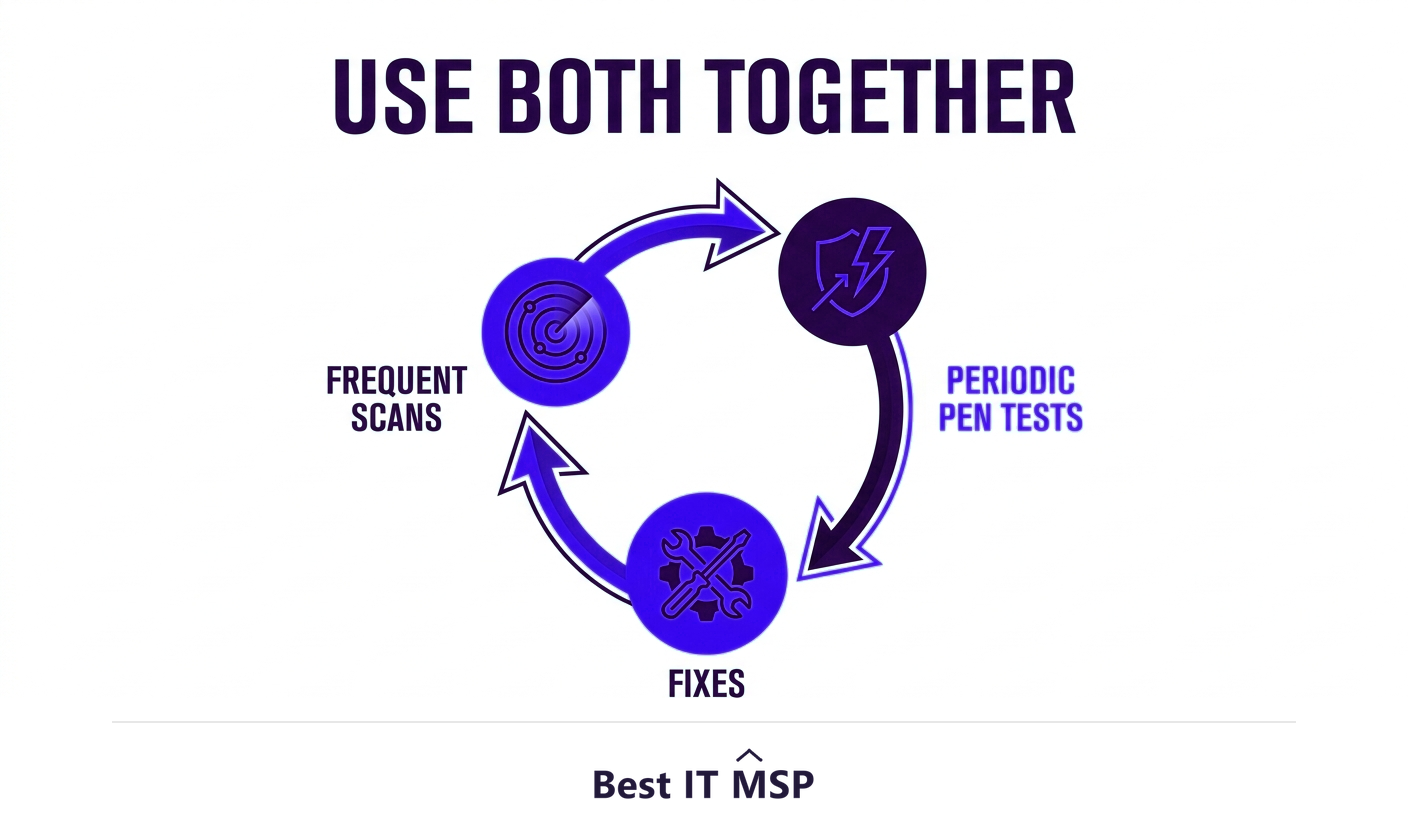
The practical model is: scan frequently to stay aware and fix the obvious issues, and pen test periodically to find what the scans cannot and to prove your real-world resilience. Both feed your remediation, and both matter when the average breach takes about 258 days to identify and contain without strong proactive testing.
How do you get security testing right?
Both tests require expertise to do well, vulnerability assessments need someone to configure the scans, interpret the results, and separate real risks from noise, while penetration testing requires genuinely skilled ethical hackers. That expertise is scarce amid a global shortfall of about 4.8 million cybersecurity professionals, and quality varies widely between providers. Many businesses get both through a managed IT or security provider that runs continuous vulnerability scanning as part of their service and arranges periodic professional pen tests, part of why the managed services market is projected to grow from about $330 billion in 2024 to about $879 billion over the next decade. The point of either test is the same: find the gaps before attackers do, and fix them.
If you need vulnerability assessment, penetration testing, or both, a qualified provider can scope and run them and help you remediate. To find one, browse vetted, merit-ranked firms by city in the Best IT MSP directory, where ranking is earned on rating and verified data.
FAQ
What is the difference between a vulnerability assessment and a penetration test?
A vulnerability assessment is a broad, mostly automated scan that finds and lists known weaknesses across your systems, ranked by severity. A penetration test is a deeper, human-led exercise where ethical hackers actively exploit weaknesses to prove what a real attacker could do. An assessment finds potential weaknesses; a pen test proves their real-world impact.
What is a vulnerability assessment?
A vulnerability assessment is a systematic, largely automated review that scans your systems, networks, and applications against databases of known vulnerabilities and misconfigurations, then reports what it finds, rated by severity. Its strengths are broad coverage and speed, so it can be run frequently, but it identifies potential weaknesses without confirming whether they are truly exploitable.
What is penetration testing?
A penetration test is a human-led exercise where skilled ethical hackers, with permission, actively try to break into your systems using real attacker techniques. They exploit and chain weaknesses, escalate access, and document exactly what they could reach and do. It goes far deeper than scanning and finds complex weaknesses tools miss, but it is more time-consuming and costly.
Which is better, a vulnerability assessment or a pen test?
Neither is better; they do different jobs and are complementary. Vulnerability assessments give breadth and frequency to catch weaknesses as they appear, while penetration tests give depth and proof of what an attacker could actually achieve. Relying on only one leaves a gap, so most businesses need both for a complete picture of their risk.
How often should you do each?
Run vulnerability assessments frequently, monthly or continuously, as ongoing hygiene, especially after patches, deployments, or configuration changes. Run penetration tests periodically, commonly once a year and after significant changes, and when a compliance framework like PCI DSS or a customer requires one. Assessments keep you continuously aware; pen tests periodically prove your defenses.
Do I need both a vulnerability assessment and a pen test?
For most businesses, yes. Assessments alone give a long list of potential weaknesses without showing which a skilled attacker could chain into a breach. Pen tests alone give deep insight only a few times a year, leaving you blind to new vulnerabilities in between. Together they cover breadth and depth, frequency and rigor, for complete security testing.
Best IT MSP is the independent directory of vetted managed IT and security providers across North America. Compare merit-ranked firms in your city that run vulnerability assessments and penetration testing. No pay-to-play.