Public Cloud vs Private Cloud Explained
A private cloud is cloud infrastructure dedicated to a single organization, offering maximum control and isolation. A public cloud is shared infrastructure run by a provider like Microsoft Azure or AWS, offering lower cost and effortless scaling.
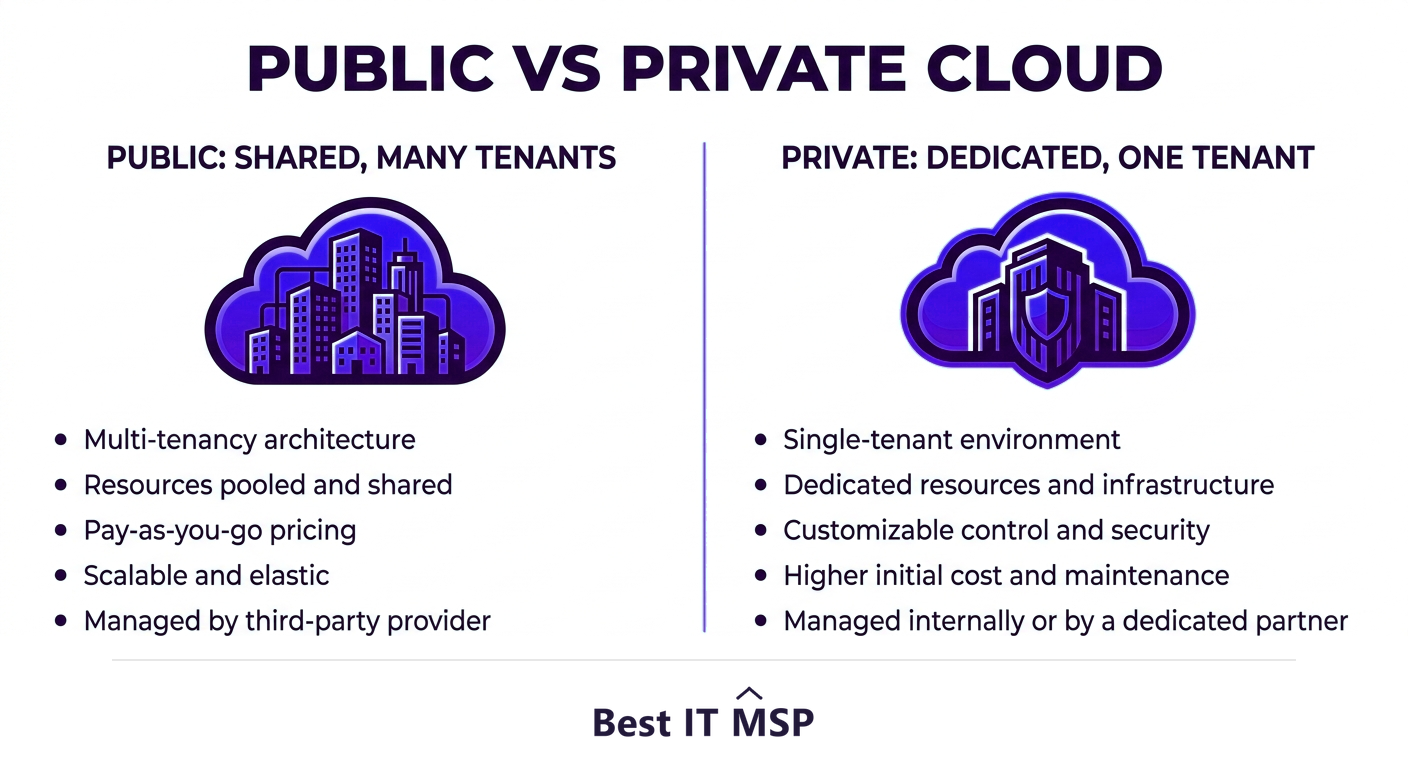
- A private cloud is dedicated to one organization; a public cloud is shared infrastructure run by a provider.
- Public cloud offers lower cost, effortless scaling, and no hardware to manage.
- Private cloud offers maximum control, isolation, and easier compliance for sensitive workloads.
- Hybrid cloud combines both, keeping sensitive systems private while using public cloud for the rest.
- The right choice depends on cost, control, compliance, and how variable your workloads are.
How did we compare public and private cloud?
On the five things that change once you are running rather than buying, because the deployment model is easy to choose and expensive to reverse.
- The dimensions. Cost, control, how far each scales, what compliance each makes easier, and who maintains the infrastructure underneath.
- The evidence. Cloud spending comes from Gartner, breach cost and location from IBM, and the security hiring gap from ISC2.
- No vendor ranking. This compares approaches, not products. It names no vendors and recommends no supplier.
- Independence. Best IT MSP does not sell IT services or security services, and does not appear in its own rankings.
One thing the table cannot show is that most firms end up running both, which changes the question from which to choose to how to hold two at once.
What is a private cloud, and what is a public cloud?
When people talk about the cloud, they usually mean one of two deployment models, and the difference comes down to who shares the underlying infrastructure. A private cloud is cloud infrastructure dedicated entirely to a single organization. The servers and resources are used by you alone, whether they sit in your own data center or are hosted by a provider just for you. A public cloud, by contrast, is shared infrastructure owned and run by a third-party provider such as Microsoft Azure, AWS, or Google Cloud, where many organizations draw computing power from the same massive pool, each isolated from the others.
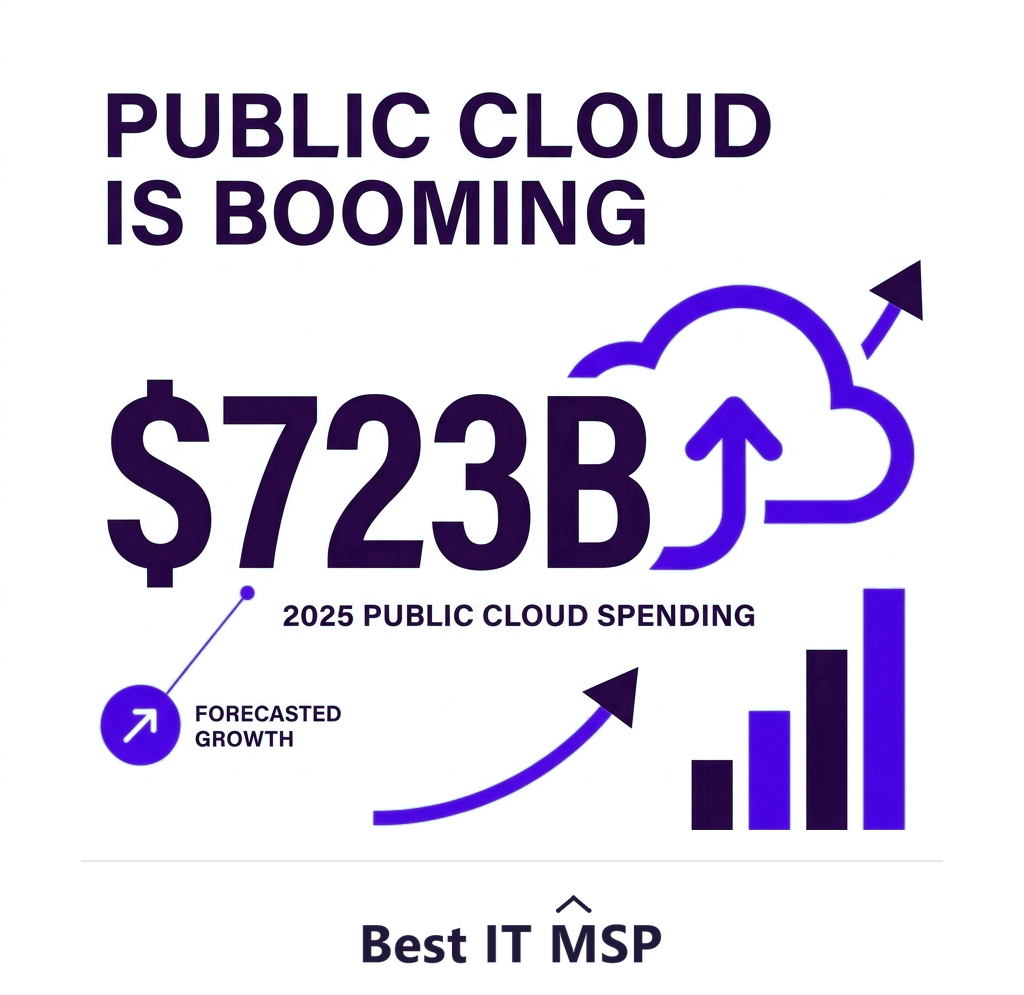
Both deliver computing resources on demand over a network; the question is whether you want a dedicated environment or a shared one. That single distinction drives everything else: cost, control, scalability, security, and maintenance. The public cloud has become the default for most workloads, with worldwide public cloud spending forecast to top $723 billion in 2025, up from about $595.7 billion in 2024, but private cloud remains the right answer for specific needs. This guide explains the trade-offs and pairs with our cloud services overview.
How do public and private cloud actually differ?
Public and private cloud trade the same handful of factors against each other. Understanding them is how you choose:
| Dimension | Public cloud | Private cloud |
|---|---|---|
| Entry cost | Pay-as-you-go, no hardware to buy | Higher up-front and ongoing, funding dedicated infrastructure |
| Control | Some traded for the provider's scale | Full control of hardware, configuration and data location |
| Scaling | Almost instant, and near limitless | Only as far as the capacity you provisioned |
| Compliance and residency | Secure, but shared and configured by you | Single-tenant isolation can simplify strict requirements |
| Who maintains it | The provider | You, or a provider you appoint |
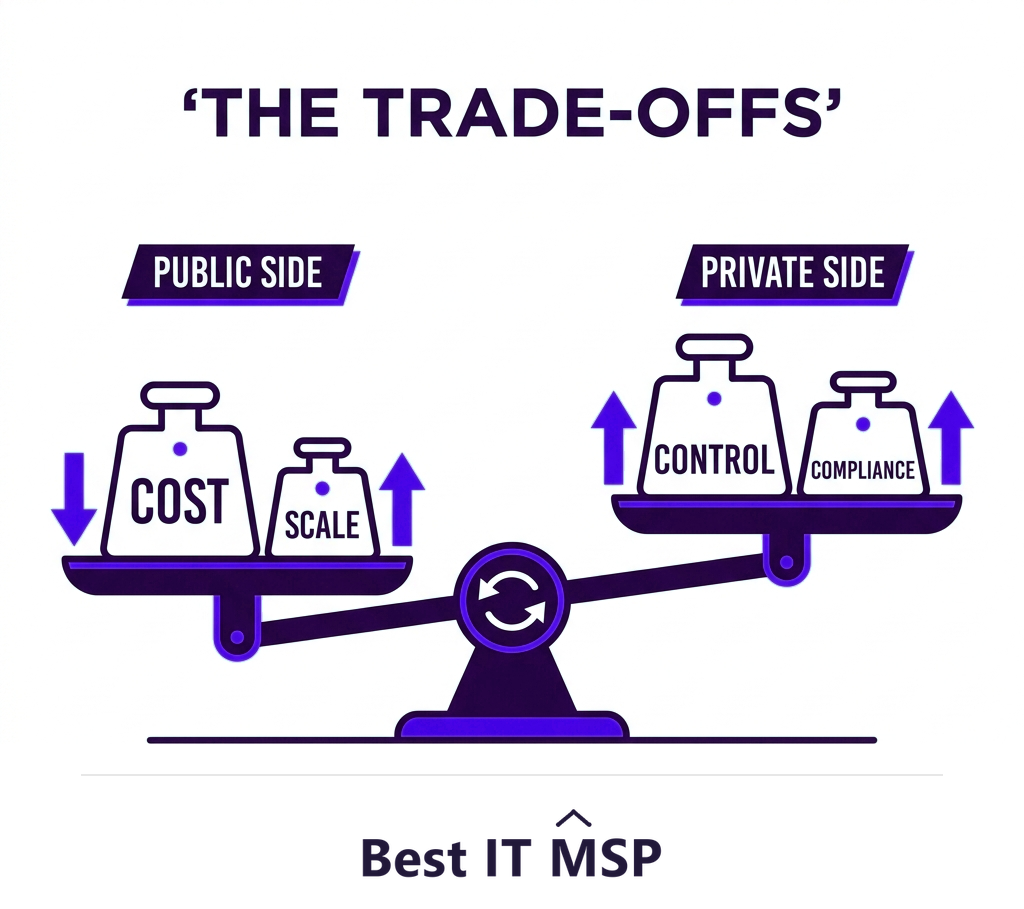
- <strong>Cost.</strong> Public cloud is pay-as-you-go with no hardware to buy, so it has a low entry cost. Private cloud carries higher upfront and ongoing cost because you fund dedicated infrastructure.
- <strong>Control.</strong> Private cloud gives you full control over hardware, configuration, and data location. Public cloud trades some control for the provider's convenience and scale.
- <strong>Scalability.</strong> Public cloud scales almost instantly and nearly without limit. Private cloud scales only as far as the capacity you have provisioned.
- <strong>Security and compliance.</strong> Private cloud's single-tenant isolation can simplify strict compliance and data-residency requirements. Public cloud is highly secure too, but you share the platform and must master the shared responsibility model.
- <strong>Maintenance.</strong> In a public cloud the provider maintains the infrastructure. In a private cloud, you (or your provider) are responsible for it.
When does public cloud make sense?
For most businesses, the public cloud is the natural starting point, and for good reason. There is no hardware to buy or data center to run, so you avoid large upfront costs and start quickly. It is endlessly scalable, handling a sudden spike in demand or a wave of new users without you provisioning anything. The provider handles maintenance, patching, and uptime, and you get access to advanced services, analytics, AI, global networks, that would be impossible to build yourself. For variable workloads, growing businesses, and anything where speed and flexibility matter most, public cloud is usually the right call. It is no accident that the public cloud has become the default for the majority of new workloads across nearly every industry.
When does private cloud make sense?
Private cloud earns its higher cost when control and isolation genuinely matter. Because the environment is dedicated to you alone, it offers maximum control over configuration, performance, and exactly where data lives, which can be decisive for organizations under strict regulation or data-residency rules. Industries like healthcare, finance, and government, or any business with highly sensitive data, often choose private cloud for that isolation and governance. It can also be more predictable for stable, heavy workloads that run constantly, where pay-as-you-go public pricing would actually cost more over time. The trade-off is real: you give up some of the effortless scale and low entry cost of public cloud in exchange for control.
What about hybrid cloud?
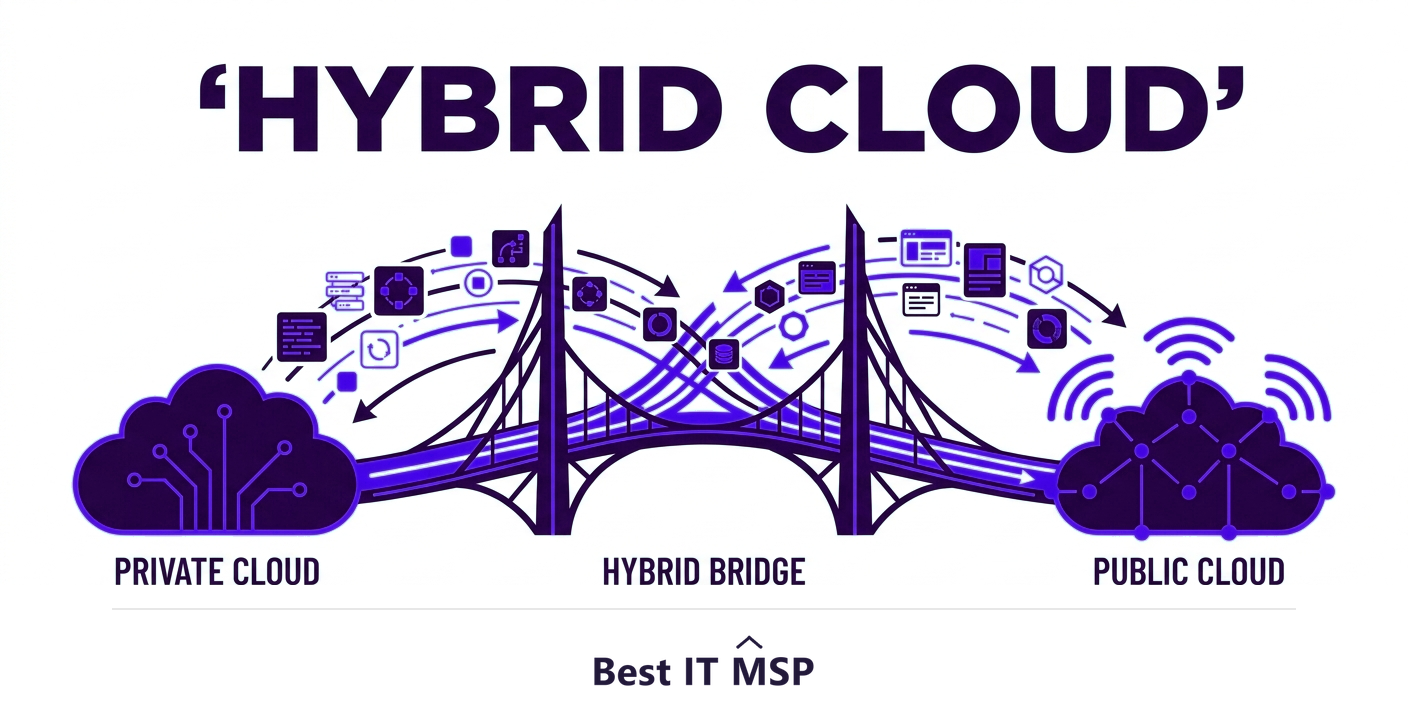
The choice is rarely all-or-nothing. A hybrid cloud combines public and private, connecting them so workloads and data can move between the two, and it is how many businesses get the best of both worlds. A common pattern is to keep sensitive, regulated, or steady workloads in a private cloud while running everything else, and absorbing demand spikes, in the public cloud. Hybrid lets you put each workload where it fits best rather than forcing a single model onto the whole business. The trade-off is added complexity: connecting and securing two environments takes expertise, which is one reason hybrid setups are often run with a provider's help.
The split estate is where the real cost hides. IBM found that 40% of breaches involved data spread across several environments at once, public cloud, private cloud and on-premise together, and that those breaches cost more than USD 5 million on average and took 283 days to identify and contain, longer than any other kind. Choosing both models is reasonable. Losing track of what sits where is what gets expensive.
How do you choose the right model?
The right model follows from your priorities. Choose public cloud if cost, speed, and effortless scaling matter most and you have no unusual control or compliance demands. Choose private cloud if you need maximum control, isolation, or must meet strict data-residency or regulatory rules, and your workloads are stable enough to justify the cost. Choose hybrid if different parts of your business genuinely need different models. Whatever you pick, remember that security in the cloud is shared and never automatic, with the average data breach costing $4.88 million and reported cybercrime losses topping $12.5 billion a year, so configuration and governance matter regardless of model. The average breach also takes about 258 days to identify and contain, a reminder that whichever model you choose, monitoring and good practices decide your real security far more than the public-versus-private label does.
How do you get cloud strategy right?
Choosing and running the right cloud model is a strategic decision with real cost and security consequences, and the details are easy to get wrong. Specialist cloud skills are scarce amid a global shortfall of about 4.8 million cybersecurity and IT professionals, which is part of why so many businesses lean on partners, with the managed services market projected to grow from about $330 billion in 2024 to about $879 billion over the next decade. A provider can assess your workloads, recommend public, private, or hybrid for each, and run the environment securely.
If you are weighing public versus private cloud, an experienced partner will save you from expensive missteps. To start from a vetted, merit-ranked list, browse providers by city in the Best IT MSP directory, where ranking is earned on rating and verified data.
FAQ
What is a private cloud?
A private cloud is cloud infrastructure dedicated entirely to a single organization. The servers and resources are used by you alone, whether hosted in your own data center or by a provider just for you. It offers maximum control, isolation, and easier compliance, in exchange for higher cost and responsibility for maintenance compared with public cloud.
What is the difference between public cloud and private cloud?
The core difference is who shares the infrastructure. A public cloud is shared infrastructure run by a provider like Azure or AWS, offering low entry cost and effortless scaling. A private cloud is dedicated to one organization, offering greater control and isolation at higher cost. Public favors cost and flexibility; private favors control and compliance.
Is private cloud more secure than public cloud?
Not automatically. Private cloud's single-tenant isolation can simplify strict compliance and data-residency requirements, but major public clouds are also highly secure. In both models, security is shared and depends on correct configuration and governance. With the average breach costing $4.88 million, getting the configuration right matters more than the model you choose.
What is hybrid cloud?
A hybrid cloud combines public and private cloud, connecting them so workloads and data can move between the two. A common pattern keeps sensitive or steady workloads private while running everything else and demand spikes in the public cloud. Hybrid lets each workload sit where it fits best, at the cost of the added complexity of connecting and securing two environments.
Which is cheaper, public or private cloud?
Public cloud is usually cheaper to start with, because it is pay-as-you-go with no hardware to buy and it scales on demand. Private cloud carries higher upfront and ongoing costs for dedicated infrastructure, but for stable, heavy workloads that run constantly it can be more predictable and even cheaper over time than pay-as-you-go public pricing.
How do I choose between public, private, and hybrid cloud?
Choose public cloud if cost, speed, and effortless scaling matter most and you have no unusual control or compliance needs. Choose private cloud if you need maximum control, isolation, or strict compliance and your workloads are stable. Choose hybrid if different parts of the business need different models. A provider can assess each workload and recommend the right fit.
Best IT MSP is the independent directory of vetted managed IT providers across North America. Compare merit-ranked firms in your city that design public, private, and hybrid cloud. No pay-to-play.