AWS Security vs Azure Security: Compared
Neither is meaningfully safer. Independent comparisons give Azure the edge on identity and threat detection, AWS the edge on network controls, and call logging, compliance and encryption a tie. What actually decides your risk is how you configure and operate the platform, not which one you pick.
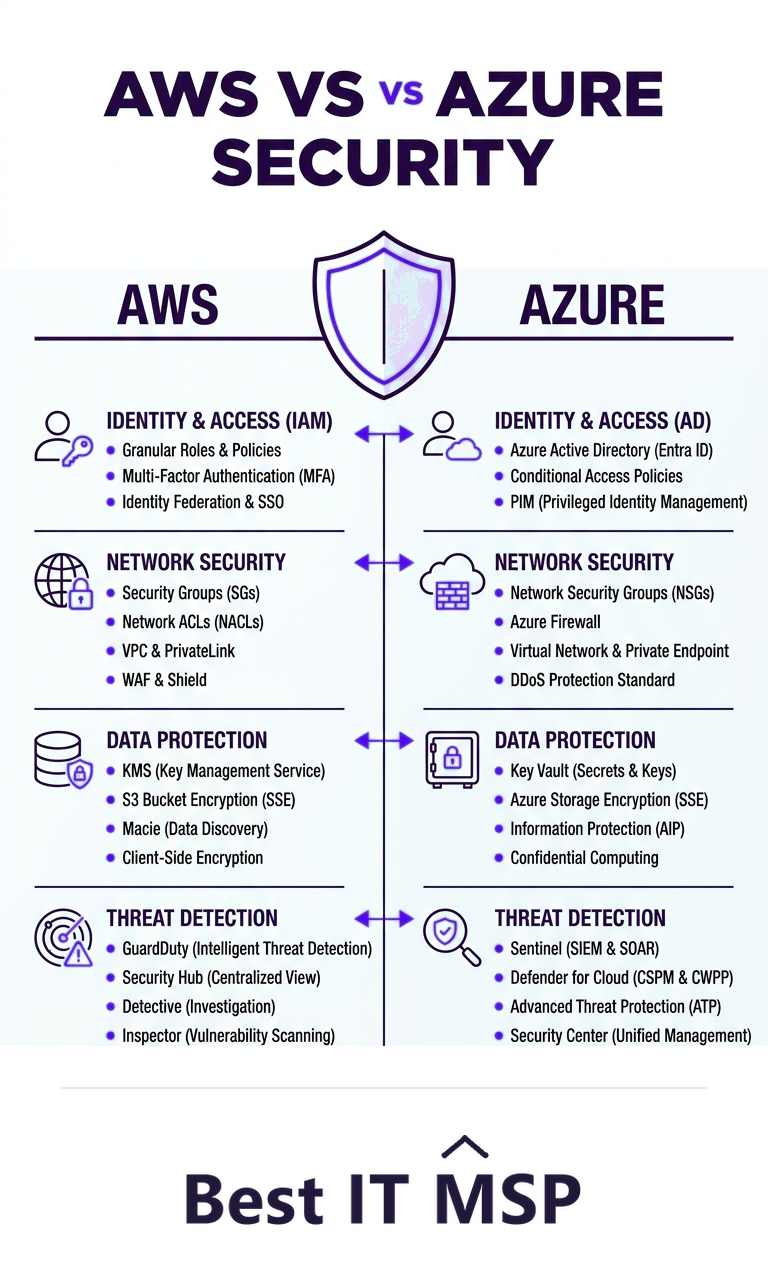
- At the infrastructure level AWS and Azure are close to even; both run heavily certified data centers and pass the same major compliance audits.
- Azure tends to win on identity (Microsoft Entra ID) and threat detection (Microsoft Defender for Cloud and Sentinel).
- AWS tends to win on network security thanks to granular VPC controls, Shield, and WAF.
- Logging, compliance, and key management are effectively a tie between the two clouds.
- Under the shared responsibility model, most cloud breaches trace to customer misconfiguration, not the provider, so operation matters more than the brand.
How did we compare AWS and Azure security?
Category by category, and with the conclusion stated before the evidence: at the infrastructure level these two are close enough that the platform is not what decides your exposure.
- The dimensions. Identity, threat detection, posture management, network controls, logging, compliance certification, and key management. Seven categories, each called for one platform or scored a tie.
- The evidence. Both vendors' own shared-responsibility documentation, an independent platform comparison from Wiz, breach cost and data from IBM, breach causes from Verizon, and cloud spending and misconfiguration analysis from Gartner.
- What we are not claiming. No benchmark was run and no penetration testing was performed. This synthesises published documentation and independent comparison, which is what a buyer can verify for themselves.
- No vendor ranking. This compares approaches, not products. It names no vendors and recommends no supplier.
- Independence. Best IT MSP does not sell IT services or security services, and does not appear in its own rankings.
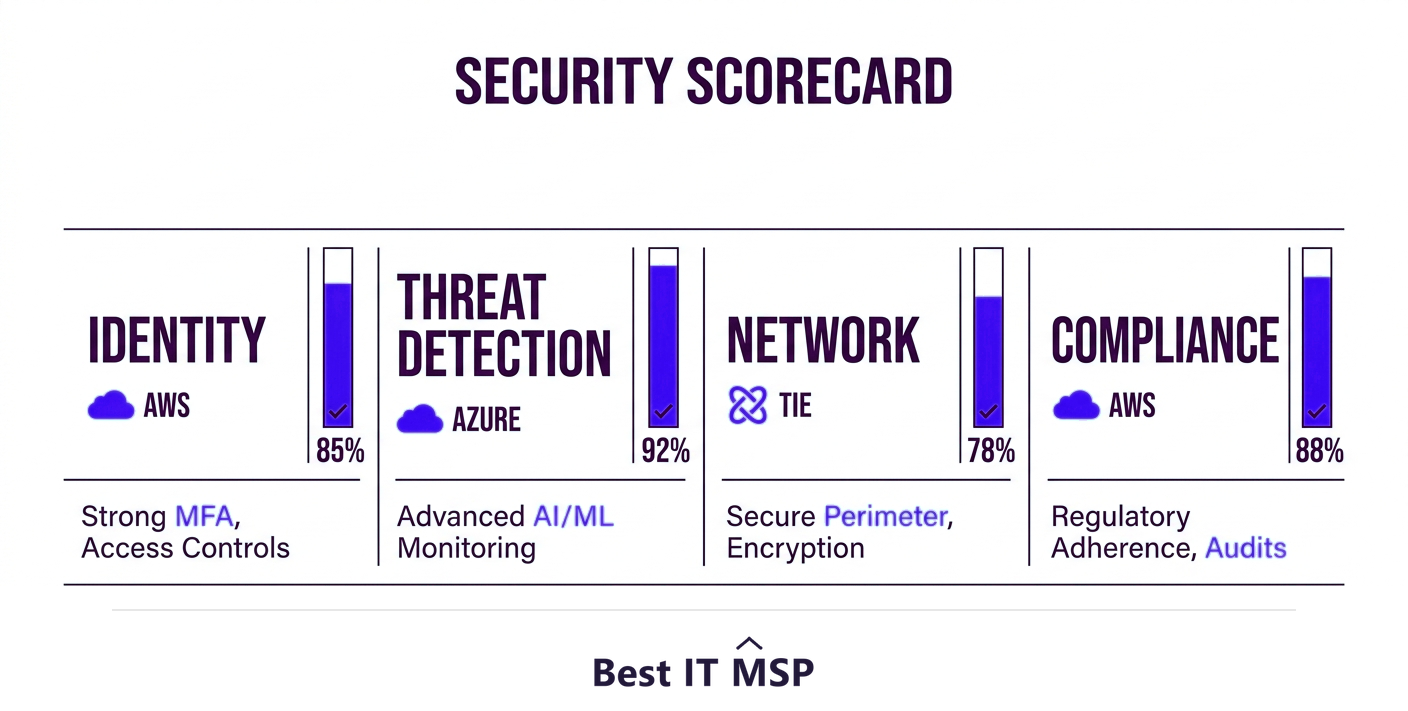
The scorecard below is the whole comparison in one place. Note how much of it is a tie.
Is AWS or Azure more secure?
AWS and Azure are the two largest public cloud platforms, and for most businesses the security question is not which one is safer in the abstract, but which one fits how you already work. Both Amazon Web Services and Microsoft Azure run enormous, heavily certified data centers and pass the same major compliance audits. The honest answer to whether AWS or Azure is more secure is that the platforms are close to even at the infrastructure level, and the real difference in your risk comes from how you configure and operate them. That distinction matters because cloud spending keeps climbing, with worldwide public cloud end-user spending forecast to reach $723.4 billion in 2025, and every new workload is one more thing to secure.
This guide compares aws security vs azure security across the categories that decide real-world risk: the shared responsibility model, identity and access management, threat detection, network security, logging, compliance, and encryption. It pairs with our broader cloud security overview and the managed IT services hub. The stakes are concrete: the average data breach now costs $4.88 million, and a single cloud misconfiguration can expose data to the entire internet.
What does the shared responsibility model put on you?
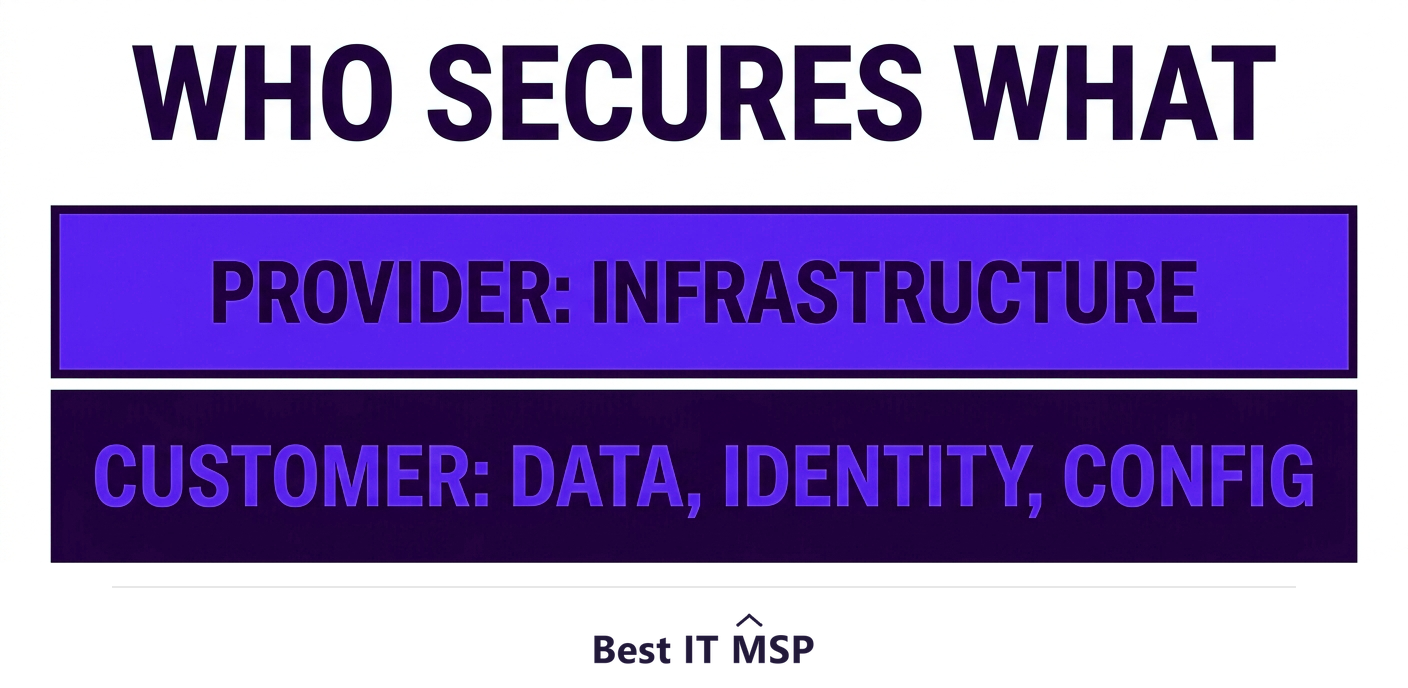
Before comparing tools, understand the rule that governs both platforms: the shared responsibility model. Under it, the cloud provider secures the infrastructure, the physical data centers, hardware, and the virtualization layer, while you, the customer, secure what you put in the cloud, your data, identities, configurations, and access. AWS documents this split and Azure documents an almost identical one. The practical takeaway is sobering: most cloud breaches are not the provider's failure. Gartner has long projected that through 2025, 99% of cloud security failures will be the customer's fault, almost always a misconfiguration or an over-permissive identity. Whichever platform you pick, the majority of the work to secure it is yours to own.
Which is stronger on identity and access management?
Identity is the new perimeter, so identity and access management is the first place to compare. AWS uses AWS IAM, which lets you write fine-grained, JSON-based policies that define exactly which actions a user, group, or role can perform on which resources. It is powerful and flexible, with attribute-based access control for dynamic, context-aware rules, and it shines in complex multi-cloud and multi-account environments where you need to configure access precisely. Azure uses Microsoft Entra ID (formerly Azure Active Directory) with role-based access control, predefined and custom roles, conditional access, and privileged identity management. For organizations already running Microsoft Active Directory and Microsoft 365, Entra ID integrates so seamlessly it is hard to beat.
Independent comparisons generally give the edge to Azure here, largely because of that first-party identity ecosystem, while AWS keeps an advantage for granular control in sprawling multi-cloud setups. Either way, the human element is involved in 68% of breaches, so tight identity hygiene, least-privilege roles, and multi-factor authentication matter far more than which logo is on the console.
Which is stronger on threat detection?
Both clouds offer native, machine-learning-driven threat detection. On AWS, Amazon GuardDuty continuously analyzes signals like VPC Flow Logs, DNS logs, and CloudTrail events to detect anomalies and potential threats, and AWS Security Hub aggregates findings against benchmarks like CIS and PCI. On Azure, Microsoft Defender for Cloud combines security posture management with threat protection, and pairs with Microsoft Sentinel, a cloud-native SIEM, to hunt threats across your environment. The category usually tilts toward Azure because Defender for Cloud is genuinely multi-cloud (it can even protect AWS and Google Cloud workloads) and integrates tightly with the wider Microsoft security stack. GuardDuty remains excellent and trivially simple to switch on. Detection speed is what counts: breaches still take an average of 258 days to identify and contain, and faster detection is the single biggest lever on that number.
Which is stronger on network security?
Network security is the category where AWS tends to win. AWS builds isolation around the Virtual Private Cloud (VPC), with subnets, route tables, security groups, and network ACLs giving granular control over how traffic flows between components, backed by AWS Shield for DDoS protection and AWS WAF for application-layer defense. Azure provides the equivalent with Virtual Networks (VNets), network security groups, and Azure Firewall, plus Azure DDoS Protection. Both are strong, but AWS's network controls are widely regarded as more granular and customizable, which is why network-heavy architectures often lean AWS. As always, the tools only help if they are configured correctly, because an open security group is just as dangerous on either platform.
How do logging, compliance and encryption compare?
In several core categories the two platforms are effectively even. For logging and monitoring, AWS CloudWatch and CloudTrail match up against Azure Monitor and its powerful Kusto Query Language, and security teams split on which is easier to operate. For compliance, both maintain deep certification portfolios, AWS through AWS Artifact and Azure through the Azure Trust Center, and both cover the major frameworks like HIPAA, PCI DSS, SOC 2, and GDPR. For key management and encryption, AWS KMS and Azure Key Vault both create, store, rotate, and audit cryptographic keys with native service integration. If logging, compliance, or encryption is your deciding factor, you will be well served by either cloud.
How do AWS and Azure score, category by category?
Pulling the comparison together, here is how independent analysis scores the seven categories:
| Category | Stronger | Why |
|---|---|---|
| Identity and access management | Azure | Microsoft Entra ID and tight Active Directory integration |
| Threat detection | Azure | Defender for Cloud and Sentinel lead, though GuardDuty is strong |
| Security posture management | Azure | Defender for Cloud offers genuine multi-cloud coverage |
| Network security | AWS | Granular VPC controls and DDoS protection |
| Logging and monitoring | Tie | CloudWatch and Azure Monitor are evenly matched |
| Compliance certification | Tie | Both carry deep, audited certification portfolios |
| Key management and encryption | Tie | KMS and Key Vault offer the same core capabilities |
- <strong>Identity and access management: Azure.</strong> Microsoft Entra ID and tight Active Directory integration give it the edge.
- <strong>Threat detection: Azure.</strong> Microsoft Defender for Cloud and Sentinel lead, though GuardDuty is strong.
- <strong>Security posture management: Azure.</strong> Defender for Cloud offers genuine multi-cloud coverage.
- <strong>Network security: AWS.</strong> Granular VPC controls and DDoS protection win the category.
- <strong>Logging and monitoring: tie.</strong> CloudWatch and Azure Monitor are evenly matched.
- <strong>Compliance: tie.</strong> Both carry deep, audited certification portfolios.
- <strong>Key management and encryption: tie.</strong> KMS and Key Vault offer the same core capabilities.
So which should you choose?
The scorecard leans slightly toward Azure, but the right pick is rarely about winning categories. Choose Azure if you already run Microsoft 365, Active Directory, and Windows-heavy infrastructure, because Entra ID and Defender for Cloud will feel native and reduce friction. Choose AWS if you want maximum flexibility, the deepest catalog of services, and the most granular network controls, or if your team's expertise already sits there. Many organizations end up multi-cloud and need to secure both, which is exactly why platform-native tools are only the starting point. What actually moves your risk is operational discipline: least-privilege identities, encrypted data, monitored logs, and fast response. Extensive use of security automation, for example, saved breached organizations an average of $2.22 million.
What risk do both clouds share?
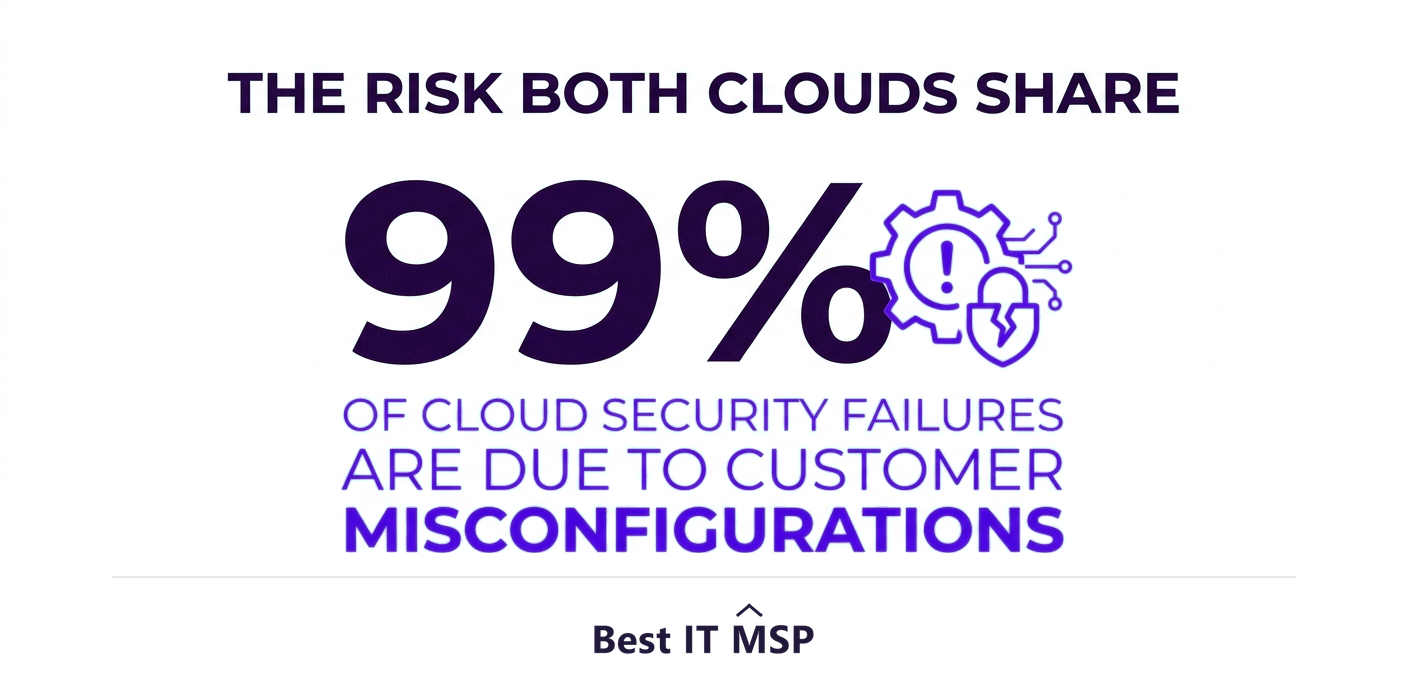
If there is one lesson that outranks the AWS-versus-Azure debate, it is this: the platform rarely fails, the configuration does. Gartner's projection that 99% of cloud security failures are the customer's fault plays out as exposed storage buckets, over-permissive roles, unpatched workloads, and forgotten public endpoints, on both clouds equally. The sprawl makes it harder: 40% of breaches involved data spread across multiple environments such as public cloud, private cloud, and on-premises, and those breaches cost the most to resolve. This is why so many businesses bring in a managed provider to secure and monitor their cloud rather than relying on default settings. Downtime alone from an incident can exceed $100,000 an hour, and the managed services market is growing from about $330 billion in 2024 toward $879 billion over the next decade as more companies decide cloud security is not a do-it-yourself job.
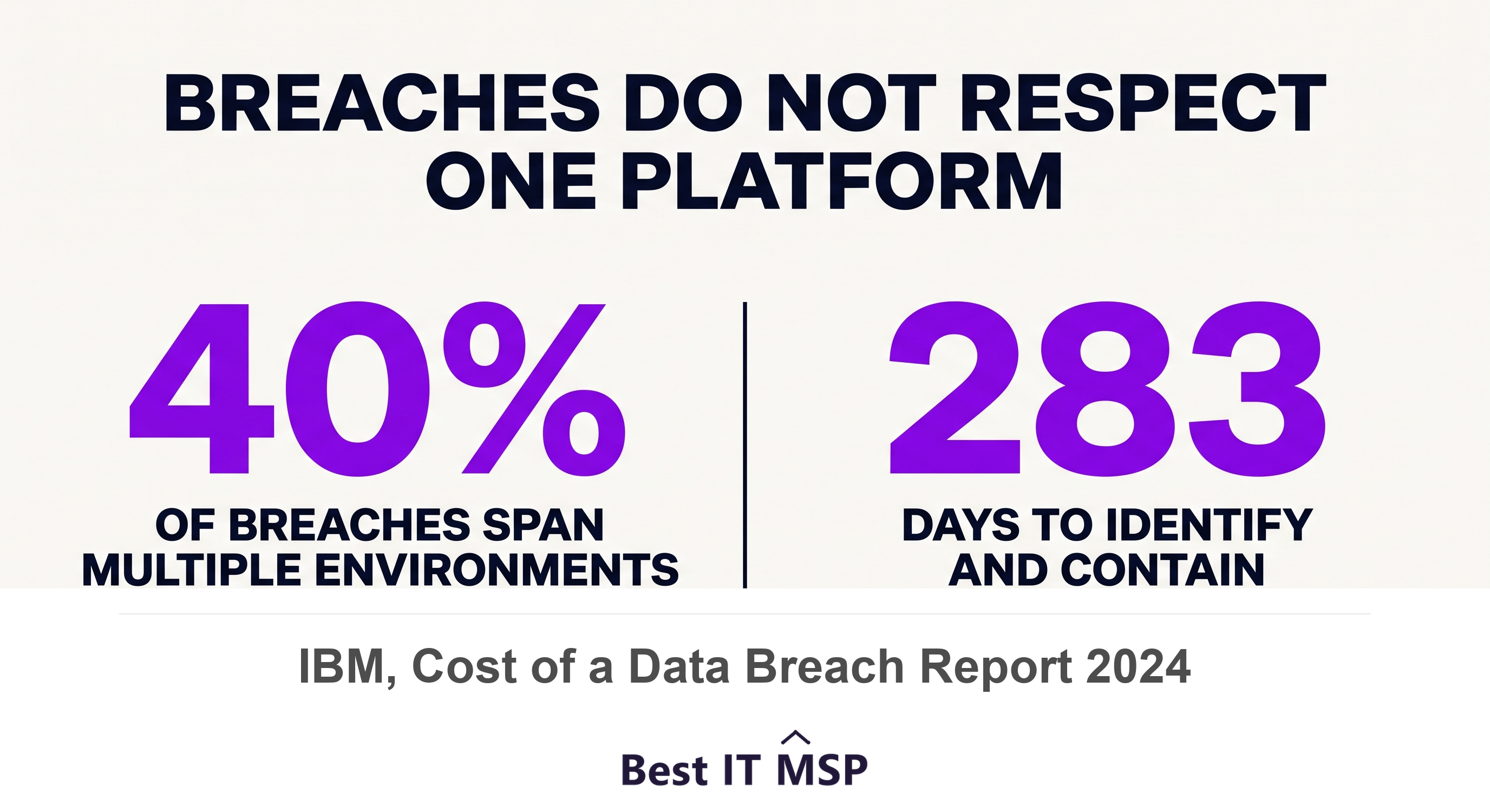
The platform question also matters less than the estate question. IBM found that 40% of breaches involved data spread across several environments at once, and that customer personal information featured in more breaches than any other record type, at 46%. Most organisations are not securing AWS or Azure. They are securing both, plus whatever remains on-premise, and the seams between them are where the exposure sits.
How do you secure your cloud, whichever you choose?
AWS and Azure both give you the raw materials for strong security, and at the infrastructure level there is no wrong choice. The difference that determines whether you actually stay secure is how the platform is configured, monitored, and maintained day to day, which is the part the shared responsibility model puts squarely on you. For most businesses, the smartest move is to pair a well-chosen cloud with a provider that secures and operates it properly. Learn more in our cloud security guide.
If you want help securing AWS, Azure, or a multi-cloud environment, comparing vetted providers on merit is the place to start. Browse merit-ranked managed IT and security firms by city in the Best IT MSP directory, where ranking is earned on rating and verified data, not on who pays the most.
FAQ
Is AWS more secure than Azure?
Neither is meaningfully more secure than the other at the infrastructure level. Both run heavily certified data centers and pass the same major compliance audits. Independent comparisons give Azure the edge in identity and threat detection and give AWS the edge in network security, but the real driver of your risk is how you configure and operate the platform, not which provider you pick.
What is the difference between AWS and Azure security?
The core security capabilities map closely: AWS IAM versus Microsoft Entra ID for identity, Amazon GuardDuty versus Microsoft Defender for Cloud for threat detection, and AWS VPC versus Azure VNet for network security. Azure tends to lead on identity and threat detection thanks to its Microsoft ecosystem integration, while AWS tends to lead on granular network controls. Logging, compliance, and encryption are largely a tie.
Which is better for identity and access management, AWS or Azure?
Azure usually wins on identity. Microsoft Entra ID (formerly Azure Active Directory) integrates seamlessly with Active Directory and Microsoft 365, offers role-based access control, conditional access, and privileged identity management. AWS IAM is highly flexible with fine-grained, attribute-based policies and is excellent for complex multi-cloud setups, but Entra ID's first-party ecosystem gives Azure the edge for most Microsoft-centric organizations.
Do AWS and Azure use the shared responsibility model?
Yes. Both AWS and Azure operate under a shared responsibility model in which the provider secures the underlying infrastructure and the customer secures their data, identities, configurations, and access. This is why most cloud breaches trace to customer misconfiguration rather than provider failure, and why Gartner has projected that through 2025, 99% of cloud security failures will be the customer's fault.
Which cloud is better for network security?
AWS generally wins the network security category. Its Virtual Private Cloud (VPC) offers granular control through subnets, route tables, security groups, and network ACLs, backed by AWS Shield for DDoS protection and AWS WAF. Azure's Virtual Networks, network security groups, and Azure Firewall are strong as well, but AWS's controls are widely regarded as more granular and customizable.
Should I use AWS or Azure for my business?
Choose Azure if you already run Microsoft 365, Active Directory, and Windows-heavy infrastructure, because Entra ID and Defender for Cloud will feel native. Choose AWS if you want maximum flexibility, the broadest service catalog, and the most granular network controls. Many businesses run both. Whichever you choose, the security outcome depends on disciplined configuration, monitoring, and response, often best handled with a managed provider.
Best IT MSP is the independent directory of vetted managed IT and security providers across North America. Compare merit-ranked firms in your city that secure AWS, Azure, and multi-cloud environments. No pay-to-play.